

Published by

Accounting practices across the UK are at an inflection point. According to Xero and Cebr's 2025 research, 98 per cent of UK accounting and bookkeeping practices now use AI to support day-to-day tasks. Yet the depth and strategic focus of that adoption varies dramatically. The same research puts the average time saving at 18 hours and 53 minutes per week per practice, but only 46 per cent of accountants and bookkeepers report productivity gains so far. This guide clarifies what AI can actually deliver for accountants, which tools matter most, how to navigate the practical and regulatory challenges, and how to build the skills your team needs to remain competitive as the profession transforms. For a comprehensive overview of AI adoption across finance teams, see the parent pillar article on AI for Finance & Accounting.
What Is AI for Accounting and How Is It Changing UK Practices?
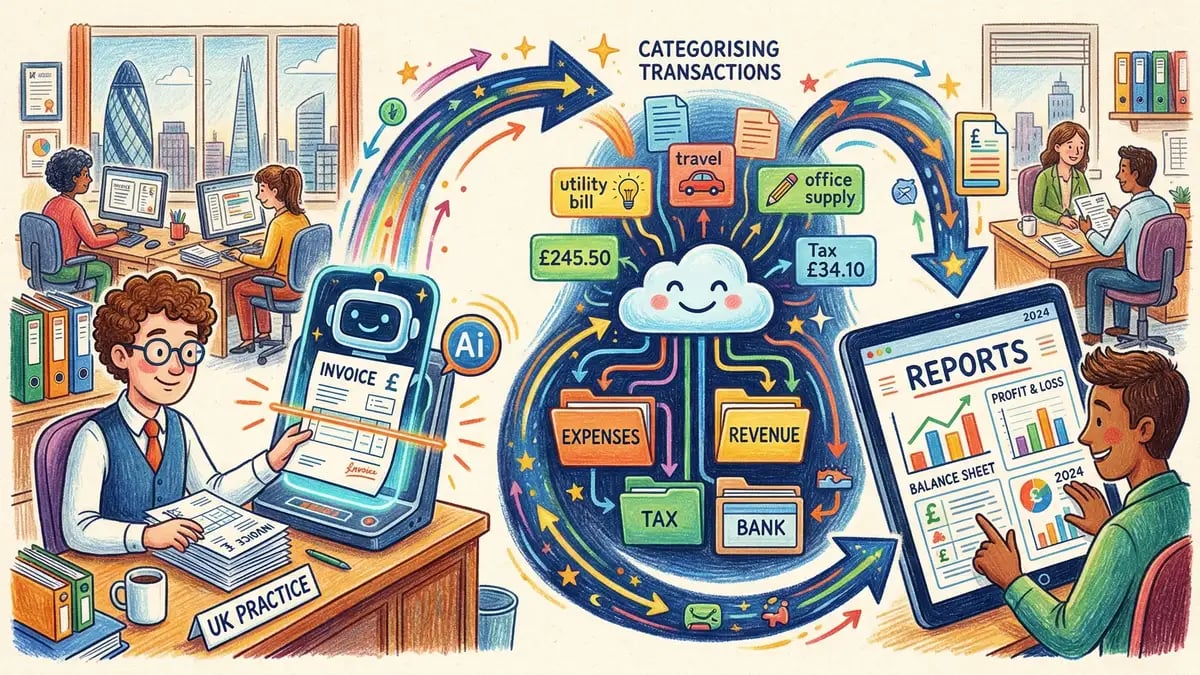
AI in accounting refers to the use of machine learning, optical character recognition (OCR), and large language models to automate or augment manual accounting tasks. Unlike general-purpose AI tools, accounting-focused AI targets high-volume, data-heavy work: invoice processing, expense coding, bank reconciliation, deduction matching, and month-end close activities. The distinction between augmentation and replacement is critical. In practice, AI augments accountants—it handles the data entry, categorisation, and exception flagging. The accountant handles judgment, client relationships, and strategic advice.
The adoption landscape has three overlapping layers. First, platform-embedded AI: Xero, QuickBooks, Sage, and other accounting software now include built-in AI features (invoice data capture, automatic coding, reconciliation assistance). Second, specialist accounting automation tools: Trullion, BlackLine, and HighRadius provide deeper functionality for invoice matching, accounts receivable optimisation, and close automation. Third, general-purpose large language models (ChatGPT, Claude, Gemini) used supplementarily for analysis, reporting narratives, and research. Most UK practices experience AI through the first channel—embedded features in their existing accounting software—rather than purchasing separate best-of-breed tools. For detailed implementation strategies, refer to the AI Implementation Guide.
Key Takeaway
AI in accounting is not monolithic. It exists as embedded features within platforms you already use, specialist tools for specific pain points, and general LLMs for cognitive work. The trend across UK practices is towards platform-embedded AI rather than specialist point solutions.
Which Accounting Tasks Can AI Automate Most Effectively?
AI delivers measurable productivity gains in high-volume, repeatable tasks—the work that occupies significant staff time and is prone to manual error. Research from Xero and Cebr found that 47 per cent of UK accounting practices use AI at least once per week, and that practices complete these AI-supported tasks in 31 per cent less time on average (Xero, Cebr and Censuswide, 2025). The specific use cases driving these gains are well-documented.

Invoice and Receipt Processing: Manual invoice data entry (vendor name, amount, GL code, approval routing) is perhaps the highest-impact use case. OCR technology extracts data from invoices in any format—email attachments, scanned documents, PDFs—and automated coding assigns general ledger codes based on historical patterns. The impact can be substantial: automated capture and coding remove most manual keying, so the remaining time is spent on exceptions and approvals rather than data entry. The size of the saving depends on invoice volume, data quality and how much of the approval workflow is also automated.
Expense Categorisation and GL Coding: Coding expenses to the correct general ledger account is time-consuming and error-prone. Machine learning models trained on historical coding patterns can automatically assign GL codes to new expenses with high accuracy. This reduces both staff time and coding errors, improving financial reporting consistency and audit efficiency.
Bank and Credit Card Reconciliation: Matching transactions to bank statements is labour-intensive and repetitive. AI automates three-way matching (invoice-to-payment-to-bank), flags unmatched items and anomalies, and prioritises exceptions for accountant review.
Month-End Close and Variance Analysis: Close processes are time-pressured, error-prone, and repetitive: account reconciliations, journal entry templates, variance analysis narratives. AI accelerates close cycles by automating routine reconciliations and generating variance analysis comments.
Deduction and Allowance Processing: For practices managing accounts receivable on behalf of clients, AI identifies and categorises customer deductions (early payment discounts, freight allowances, promotional disputes), prioritises high-value exceptions, and suggests resolution strategies. This accelerates cash application and reduces aged deduction backlogs.
98%
UK Practices Use AI
Xero and Cebr 2025
31%
Less Time on AI Tasks
Average with AI
18h 53m
Weekly Time Saved
Per practice average
56%
Report Fewer Errors
In client work
Source: Xero, Cebr and Censuswide survey of 515 UK accountants and bookkeepers, published November 2025
What Are the Best AI Tools for UK Accountants?
The accounting software market has fragmented into three overlapping categories. Platform-embedded AI (Xero, QuickBooks, Sage) is most widely used. Specialist accounting automation tools address specific pain points. General-purpose LLMs provide supplementary cognitive support. Understanding the distinctions matters because each serves different problems and maturity levels.
| Tool Category | Examples | Primary Use | Best For |
|---|---|---|---|
| Platform-Embedded AI | Xero JAX, QuickBooks AI agents, Sage Copilot | Invoice OCR, auto-coding, reconciliation assistance | Practices using standard cloud accounting software (most common) |
| Specialist Finance AI | Trullion, BlackLine, Concur, Ramp | Advanced matching, transaction validation, close automation | Larger practices or those with complex reconciliation needs |
| General-Purpose LLMs | ChatGPT, Claude, Gemini, Copilot | Analysis, research, narrative generation, training | All practices; supplementary use only |
Platform-Embedded AI: Most UK accounting practices experience AI through their existing accounting software. Xero JAX, for example, is an AI financial superagent embedded in Xero that uses large language models to understand natural language requests ("show me expenses over £500 in November") and retrieve data. QuickBooks has introduced a team of AI agents for UK customers, including an Accounting Agent for bookkeeping and categorisation, and Sage offers Sage Copilot. The advantage is simplicity: no new tool to learn or integrate, and much of the functionality is included in your existing subscription, although features vary by plan. The limitation is that features are constrained by what the platform vendor prioritises and may not address your specific pain points.
Specialist Accounting Automation Tools: Trullion applies AI to lease accounting, audit preparation, document matching and financial statement validation. BlackLine offers comprehensive close management, including intercompany accounting automation and consolidation support. Ramp focuses on accounts payable efficiency with intelligent invoice capture and approval routing. These tools are purpose-built for accounting and deliver deeper functionality but require integration with your existing systems and involve implementation costs. Production-scale implementation work typically falls within a market range of about £8,000 to £250,000+, depending on scope, according to our UK AI Consultancy Price Index; licence pricing for these tools is generally available on request.
General-Purpose Large Language Models: ChatGPT, Claude, Gemini, and Copilot are increasingly used by accountants for supplementary tasks: drafting audit responses, generating explanatory narratives, researching tax treatment questions, and training staff on accounting principles. The advantage is ubiquitous access and low cost. The limitation is that LLMs do not have real-time access to your data and cannot execute transactions. They require manual inputs and human validation.
Critical Consideration: Data Privacy and LLM Training
The risk: Using general-purpose LLMs with client financial data (entering transaction details, account balances, or sensitive client information into ChatGPT) can expose confidential information and potentially violate client confidentiality obligations and GDPR requirements.
The safeguard: Use platform-embedded AI or specialist accounting tools that operate within your secure environment. For general-purpose LLMs, anonymise or abstract data (e.g., "a client with £2M revenue and a 60-day DSO" instead of specific client names and amounts). For deeper governance guidance, see the AI Governance Framework article.
How Does AI Accounting Comply with UK Regulations?
Regulatory uncertainty is often cited as a barrier to AI adoption in accounting. Yet UK regulation is actually clearer than many practitioners assume. The frameworks are principles-based, not prescriptive, which creates flexibility but also responsibility.

ICAEW and Professional Body Guidance: The Institute of Chartered Accountants in England and Wales (ICAEW), ACCA, and CIMA have all published guidance on AI use by accountants. The consensus is straightforward: AI tools are permissible if they are used competently and documented appropriately. Accountants remain responsible for the outputs; if you use AI to prepare accounts and the AI makes an error, the accountant (not the AI vendor) is liable under professional standards. This creates an obligation to validate AI outputs, understand the tool's limitations, and maintain appropriate audit trails.
Data Protection and GDPR: The UK Information Commissioner's Office (ICO) has published guidance on AI and GDPR. If you use AI to process personal data (employee expense claims, vendor contact information, client personal financial details), GDPR applies. This does not prohibit AI use; it requires clear documentation of how data is processed, a lawful basis for processing, transparency with data subjects, and appropriate safeguards. For most accounting practices, GDPR compliance means having a clear data retention policy, ensuring vendor contracts include Data Processing Agreements, and being cautious about sharing client data with third-party LLMs.
Making Tax Digital (MTD): HMRC's Making Tax Digital programme requires tax software to be compatible with HMRC systems. Most modern accounting platforms with AI features are MTD-compatible; however, compatibility must be verified. Using non-compliant software can result in penalties. Since 6 April 2026, sole traders and landlords with qualifying income over £50,000 have been required to use Making Tax Digital for Income Tax; the threshold falls to £30,000 from 6 April 2027 and £20,000 from 6 April 2028 (HMRC).
FCA and Bank of England: If you serve clients regulated by the Financial Conduct Authority or provide advice to financial institutions, the FCA's AI governance guidance applies. The FCA does not ban AI; it requires firms to manage AI risk using existing regulatory frameworks. Key principles are transparency and explainability (you should understand why the AI made a decision), fairness (the model should not discriminate against protected groups), robustness (the system should fail gracefully), and accountability (someone in your organisation should own AI governance).
In practice, compliance for accounting practices means: document which AI tools you use and for what purpose; understand the tool's capabilities and limitations; maintain audit trails of AI-assisted work; validate AI outputs before they are finalised; ensure client data is handled securely; and stay informed of professional body guidance. This is not onerous—it is good practice applied to AI. For more on regulatory compliance in regulated industries, refer to the AI Compliance in Regulated Industries article.
What ROI Can UK Accounting Practices Expect from AI?
The ROI question is nuanced. Accounting practices do not typically invest in AI to increase revenue; they invest to reduce cost and compress cycle time, freeing staff to do higher-value advisory work. The return comes in two forms: direct time savings and indirect client value.
Direct Time Savings: The Xero research quantified the aggregate productivity impact: UK accounting practices save an average of 18 hours and 53 minutes per week through AI adoption, which Xero describes as half the typical working week of one employee. Against this, practices reported an average annual spend of just £1,746 on AI tools and employee training. Your own return depends on how that time is reinvested, so measure it against a baseline rather than assuming a payback period.
Redeployment and Advisory Services: Many practices are using freed-up capacity not to reduce headcount but to grow advisory services: tax planning, bookkeeping consulting, financial strategy. This drives higher-margin work and improves client satisfaction. Xero's research found that 76 per cent of UK accounting practices say AI has influenced their hiring strategy, and 62 per cent of those are hiring more non-accounting professionals, with technical and advisory specialists among the main focus areas.
Client Profitability Impact: At the macro level, AI adoption across UK accounting practices has increased industry profitability by £338 million, with practices contributing an additional £1 billion to UK GDP and £1.6 billion in gross value added to the wider economy as their clients also benefit from efficiencies.
Error Reduction and Quality: Beyond time, AI reduces errors. In the same Xero research, 56 per cent of practices said AI has reduced the number of errors in client work (Xero, Cebr and Censuswide, 2025). This improves audit efficiency, reduces restatement risk, and enhances client confidence in reporting accuracy.
Start with Your Biggest Time-Drain Task
If invoice processing occupies 15 hours per week, start there. If month-end close is painful, focus on close automation. AI delivers measurable ROI fastest on high-volume, repetitive work.
Audit Data Quality First
Inconsistent GL codes, missing vendor master data, or poorly structured expenses will make AI less effective. Clean data first or expect modest improvements.
Measure Before and After
Establish a baseline: How many hours per week does this task take? How many errors occur? Once AI is active, measure the same metrics monthly for at least three months.
Train Your Team Thoroughly
The biggest barrier to realising ROI is staff who do not understand the tool or trust its outputs. Invest time in training, create simple runbooks, assign a power user, and review outputs for quality regularly.
What Skills Do Accountants Need to Work with AI?
AI is reshaping the skill profile of accounting. According to Harvey Nash's 2025 Digital Leadership Report, AI rose from the seventh to the most scarce technology skill in UK financial services within 18 months, a 260 per cent increase in reported shortages. The same research found that only 9 per cent of UK financial services executives believe their firm is prepared for incoming AI regulation. This skills gap is a competitive advantage for practices that close it early. Explore training options with our AI Training programme.
Accounting teams need three layers of capability: foundational AI literacy, tool expertise, and (rarely) advanced data science. Most practices should prioritise the first two.
Foundational AI Literacy (Essential for All Staff): This is not technical. It means understanding what AI can and cannot do, recognising when an AI output is plausible or suspicious, understanding data quality constraints, and being aware of bias and fairness risks. Staff should know the difference between machine learning (systems that learn from data) and rule-based automation (systems that follow explicit logic). This foundation enables all staff to contribute ideas for AI application, identify when an AI tool is struggling, and use LLMs (like ChatGPT) safely for research and drafting.
Tool Expertise (Essential for Power Users and Tool Owners): If your practice deploys Xero JAX or Trullion, someone needs to understand that specific tool deeply: how to configure it, how to interpret its outputs, when to override it, how to troubleshoot, and how to retrain the model when accounting rules change (new GL codes, new vendors, new client types). In a small practice, this is usually a named responsibility for one or two people. Vendors provide training, and online communities and certifications are emerging (e.g., Xero certification programmes). This expertise is where ROI comes from; without it, tools underperform.
Advanced AI Engineering (Rarely Needed): Building custom AI models, training data science pipelines, and optimising machine learning algorithms is beyond the scope of most accounting practices. If you need custom models, hire specialist consultants or work with your vendor's professional services team. Focus your team on using and governing the tools you choose, not building new ones from scratch.
Key Takeaway
AI adoption success in accounting depends far more on change management and capability building than on technology. Invest in training, assign clear ownership of AI governance, and create a culture where staff feel confident using and validating AI outputs. The tool is secondary to the team.
Frequently Asked Questions
Is using AI in accounting ethical and fair?
Ethical use of AI in accounting hinges on transparency and validation. If an AI tool flags a suspicious transaction or suggests a GL code, an accountant reviews it and decides whether to accept or override. The accountant remains responsible for the final decision. Concerns arise if AI is used to automate decisions without oversight (e.g., automatically approving all flagged invoices without human review). Professional standards require you to understand the logic behind AI recommendations and validate outputs. This is not different from the professional responsibility you have when a junior staff member prepares a reconciliation—you review it.
How do I know if my practice's data is ready for AI?
Data readiness assessment is straightforward: randomly sample 100 invoices, expense claims, or transactions; manually verify them against source documents; and calculate accuracy. If the sample shows frequent errors, your data is not ready. Common problems are inconsistent GL coding, missing vendor data, or poorly formatted transaction descriptions. If you find issues, clean the data first before implementing AI. This takes time but is essential. Tools like Xero and QuickBooks have data cleanup utilities; consider using them or hiring a data consultant for a one-time cleanup project.
How much does AI for accounting cost?
Most UK accounting practices experience AI as embedded features in their existing accounting software (Xero, QuickBooks, Sage) often at no additional cost—much of it is included in the subscription, although features vary by plan. Specialist tools like Trullion or advanced AP automation platforms generally quote pricing on request, based on transaction volume and feature complexity. Individual paid plans for general-purpose assistants, such as ChatGPT Plus and Claude Pro, are listed at about US$20 per user per month before tax. Xero, Cebr and Censuswide found that UK practices spend an average of £1,746 per year on AI tools and employee training. Measure time saved against a baseline to judge your own payback.
Will AI replace accounting jobs?
The evidence suggests augmentation, not replacement. AI automates routine data entry, coding, and reconciliation—the repetitive work that occupies significant accounting staff time. Demand is shifting away from purely transactional work towards analytical and advisory roles (tax strategy, financial planning, audit, business partnering). Most successful accounting practices are using AI to free staff from administrative work and redeploy them to higher-value client relationships and advisory services. The Xero research found that 76 per cent of practices say AI has influenced their hiring strategy, and 62 per cent of those are hiring more non-accounting professionals, with technical and advisory specialists among the main focus areas. The risk is not job loss but skill obsolescence: if you do not adapt to AI tools, you may struggle to compete.
How do I ensure client confidentiality when using AI tools?
Use tools that operate within your secure environment: platform-embedded AI (Xero JAX, QuickBooks AI) or specialist accounting software (Trullion, BlackLine). These tools are designed to handle confidential data securely and are often SOC 2 or ISO 27001 certified. For general-purpose LLMs (ChatGPT), avoid entering specific client names, amounts, or sensitive details. Instead, use abstract examples: "a client with £2M revenue and a 60-day DSO" rather than "Acme Ltd with £2.3M revenue and a 73-day DSO". If you use cloud-based tools, verify that the vendor has appropriate Data Processing Agreements in place and operates under GDPR principles. Most modern SaaS providers meet these standards; verify before signing up.
How often do AI tools need to be updated or retrained?
Platform-embedded AI (Xero, QuickBooks) is updated automatically by the vendor; you do not need to retrain it. Specialist accounting tools require occasional recalibration, typically when significant changes occur: new GL codes, new client types, new accounting rules (e.g., a new lease accounting standard). Check whether your vendor's annual fees include retraining support. The key is assigning someone in your practice to monitor tool performance (accuracy, false positive rates) and flag when retraining is needed. A quarterly review is a sensible cadence. Most practices find that AI tools require minimal ongoing maintenance once properly configured.
Ready to Transform Your Accounting Practice with AI?
Helium42 helps UK accounting practices move from AI curiosity to measurable results. Our education-first approach is designed to help your team build lasting capability and confidence, not just tool dependency. Learn how to identify the highest-impact use cases in your practice, navigate the regulatory landscape with confidence, and build the skills your team needs to compete in an AI-native accounting profession. Explore more in the complete guide to AI for business, or contact us for AI consultancy tailored to your practice.
Peter Vogel
Co-founder and AI Strategy Lead, Helium42
Peter leads Helium42's AI adoption strategy and education programmes. He has more than 15 years of experience in digital transformation and has led digital marketing transformation programmes for over 500 organisations. At Helium42 he focuses on translating AI capability into measurable business outcomes through education-led implementation and governance frameworks that embed accountant expertise at every stage.
Sources: Xero, Cebr and Censuswide research on AI in UK accounting practices (November 2025); Harvey Nash Digital Leadership Report 2025; HMRC guidance on Making Tax Digital for Income Tax