

Published by

Only 23% of boards surveyed by the US National Association of Corporate Directors have assessed how AI disruption might affect their strategy (NACD), yet almost 90% of UK AI businesses surveyed by the government expect revenues to grow within the next 12 months (DSIT AI Sector Study 2024). This gap between ambition and accountability defines the central challenge of AI governance in 2026: organisations are deploying AI systems at pace whilst lacking the governance structures required to manage the risks those systems create.
AI governance is the system of policies, processes, roles, and oversight mechanisms that ensure artificial intelligence is developed and deployed responsibly — aligned to organisational values, regulatory expectations, and the rights of affected individuals. For UK organisations, establishing effective AI governance is not optional. It is a board-level responsibility with regulatory, financial, and reputational consequences that intensify with every quarter of inaction.
Key Takeaway
Effective AI governance requires board-level accountability, cross-functional governance structures, and risk-based frameworks proportioned to the consequences of each AI system. Integrating AI governance into existing enterprise risk management avoids parallel structures and gives the board a single view of AI risk. With EU AI Act obligations for Annex III high-risk systems applying from 2 December 2027 (European Commission), preparation should start now for any organisation serving European markets.
What Is AI Governance and Why Does It Matter for UK Organisations?
AI governance encompasses the formal structures, policies, and processes through which organisations oversee the development, deployment, and monitoring of AI systems. It translates abstract principles — fairness, transparency, accountability — into operational practices embedded within day-to-day decision-making. For UK organisations, AI governance matters because regulatory enforcement is accelerating, the Data (Use and Access) Act 2025 has restructured automated decision-making protections, and the EU AI Act creates binding obligations for any organisation whose AI systems affect EU citizens.
The UK government employs a principles-based regulatory approach centred on five cross-sector principles: safety, security and robustness; appropriate transparency and explainability; fairness; accountability and governance; and contestability and redress. These principles are applied through existing sector regulators — the ICO, FCA, MHRA, and SRA — rather than a single unified AI regulator. This distributed model provides flexibility but demands that organisations understand regulator-specific expectations and maintain governance frameworks that satisfy multiple oversight bodies simultaneously.
The governance maturity gap is substantial. UK-specific board data are limited, but NACD survey data indicate that only 23% of boards have assessed how AI disruption might impact their long-term strategy, despite 62% dedicating board agenda time to AI discussions. Only 21% of boards have audited current AI use within their organisations, creating visibility gaps that prevent effective risk oversight. These statistics reveal a systemic disconnect: boards discuss AI regularly but lack the governance infrastructure to translate discussion into accountability.
For organisations already pursuing AI implementation, governance is not a separate initiative — it is the framework within which implementation decisions are made, monitored, and corrected. Organisations that treat governance as a post-deployment concern consistently experience higher rates of compliance failure, reputational damage, and abandoned initiatives.
23%
Boards Assessed AI Impact
Despite 62% discussing AI regularly
21%
Boards Audited AI Use
NACD board survey, 2025
€35m
Maximum EU AI Act Fine
Or 7% of global turnover
42%
Abandoned Most AI Initiatives
North America and Europe, 2025
Sources: NACD Director Essentials: Implementing AI Governance, EU AI Act Article 99, S&P Global Market Intelligence 2025

How Should Boards Structure AI Governance and Accountability?
Boards should structure AI governance around four pillars: strategic oversight, capital allocation discipline, risk integration, and technology competence. These four pillars distinguish effective board-level AI governance from aspirational awareness. Without all four, governance remains performative rather than functional.
Strategic oversight requires boards to develop shared perspectives on AI's relevance to corporate strategy and establish regular cadences for AI discussion beyond isolated agenda items. Effective boards connect AI investments to measurable strategic outcomes rather than treating AI as an isolated technology initiative. Capital allocation ensures boards scrutinise proposed AI budgets with the same rigour applied to traditional capital expenditure, requiring regular reviews of pilot project viability before committing to scaling investments.
Risk integration demands that boards incorporate AI into enterprise risk management frameworks rather than treating AI risk as a specialist domain. This means requesting management to provide AI risk categories within ERM reporting, designating audit or risk committees as primary oversight bodies, and ensuring the full board receives updates on material AI risks at least annually. Technology competence extends beyond the technology director to encompass audit, compliance, and executive committees, as AI impacts create cross-functional governance implications that no single board member can oversee alone.
The organisational structure supporting board governance varies by company size. Larger enterprises increasingly establish Chief AI Officer or Chief Responsible AI Officer positions with direct board reporting. For mid-sized organisations, designating a senior executive with an explicit AI governance mandate achieves similar clarity. The critical requirement is sufficient authority to influence AI development proactively and direct reporting relationships enabling board-level escalation.
Cross-Functional Governance Committee
Includes representatives from legal, compliance, risk management, data science, and business units. Uses RACI matrices to clarify who is Responsible, Accountable, Consulted, and Informed for each governance activity. Prevents the common dysfunction where everyone is consulted but nobody is accountable.
Designated Senior Executive
Reports to the Chief Risk Officer, Chief Compliance Officer, or CIO depending on organisational structure. Has explicit authority to review high-risk AI systems before deployment, direct board escalation paths, and protected time to fulfil governance responsibilities without subordination to operational pressures.
Helium42 works with organisations to establish these governance structures as part of AI transformation programmes that embed accountability from the outset. IBM's model — a central Responsible Technology Board, co-chaired by Betsy Greytok and Francesca Rossi, that sets governance standards for how the company develops and deploys AI — provides a reference architecture that mid-sized organisations can adapt proportionately.
What Does the EU AI Act Require from UK Organisations?
The EU AI Act creates binding obligations for UK organisations regardless of domicile if their AI systems impact EU residents or are supplied into European markets. The Act's extraterritorial reach applies based on territorial impact rather than provider location, making compliance assessment essential for any UK organisation with European customer bases, partnerships, or operations.
The Act employs a risk-tiered classification system fundamentally different from the UK's principles-based approach. Four risk levels — unacceptable, high, limited, and minimal — establish increasingly prescriptive compliance obligations based on potential impact. The phased implementation schedule established progressive deadlines: prohibited AI practices became enforceable in February 2025, general-purpose AI model requirements commenced in August 2025, most remaining rules, including transparency obligations, applied from 2 August 2026, and high-risk obligations for Annex III use cases now apply from 2 December 2027 (2 August 2028 for AI embedded in products covered by Annex I), following the political agreement to simplify the Act (European Commission).
| Risk Tier | Examples | Obligations | Timeline |
|---|---|---|---|
| Unacceptable | Social scoring, manipulative AI, emotion recognition in workplaces and education | Prohibited outright | Enforced Feb 2025 |
| High | Recruitment, credit scoring, employee evaluation, critical infrastructure | Conformity assessment (internal control for most Annex III systems), risk management, human oversight, post-market monitoring, EU registration | 2 Dec 2027 (Annex III); 2 Aug 2028 (Annex I) |
| Limited | Chatbots, deepfake generation, emotion recognition | Transparency obligations — users must know they interact with AI | August 2026 |
| Minimal | Spam filters, AI-enabled games, inventory management | No specific requirements under EU AI Act | N/A |
Sources: EU AI Act Official Text, Bird & Bird UK AI Regulation Analysis 2026
The practical compliance challenge involves assessing which AI systems fall within high-risk categories. Annex III lists eight areas of high-risk use, from biometrics and critical infrastructure to employment, education and access to essential services, meaning many organisations using AI in conventional business applications — employee performance evaluation, customer credit scoring, or applicant screening — unexpectedly encounter high-risk obligations. UK providers of high-risk systems without an EU establishment must appoint an authorised representative (Article 22) responsible for compliance and regulatory communication.
Treating EU AI Act compliance as foundational to product development, rather than as a bolt-on regulatory obligation, reduces the risk of costly redesign late in delivery. For organisations already managing AI compliance in regulated industries, integrating EU AI Act requirements into existing governance frameworks avoids duplication and strengthens overall governance maturity.
The Cost of Delayed Compliance
Common mistake: Treating the EU AI Act as irrelevant because the organisation is UK-based. If any AI system impacts EU citizens — through recruitment, credit decisions, or customer-facing services — the Act applies regardless of corporate domicile.
The reality: Fines reach up to €35 million or 7% of global turnover. More practically, conformity assessment requires documentation, testing and quality-management evidence that takes time to assemble. With Annex III obligations applying from 2 December 2027, organisations starting now have adequate preparation time; those that delay face a compressed timetable.
How Do You Build a Practical AI Governance Framework?
Building a practical AI governance framework requires five sequential steps that translate principles into operational practices. The framework must be proportionate — governance intensity should match the risk level of each AI system — and embedded within existing organisational processes rather than layered as a separate oversight function.
Establish Leadership and Accountability
Designate a senior executive with explicit AI governance mandate. Form a cross-functional governance committee with representatives from legal, compliance, risk, data science, and business units. Define RACI accountability for every governance activity. The single most common governance failure is unclear ownership — address this first.
Inventory and Classify AI Systems
Map every AI system in use — including "shadow AI" deployed by business units without formal oversight. Classify each system by risk level: minimal (content generation, process automation), limited (customer interaction), high (hiring, credit decisions, healthcare), and prohibited. Many organisations discover substantial shadow AI during this exercise.
Conduct AI Impact Assessments
Perform AI Impact Assessments (AIIAs) for every high-risk system. Document the system purpose, affected stakeholders, potential harms and benefits, risk categories (technical, operational, ethical, regulatory, reputational), mitigation strategies, and residual risk tolerance. ISO 42001 mandates AIIAs for systems posing high potential impact to individuals or society.
Implement Bias Auditing and Monitoring
Audit trained models for fairness before deployment, then conduct annual re-audits on production systems to detect performance drift. Examine multiple fairness metrics — equal opportunity, predictive parity, and intersectional bias — because optimising for a single definition of fairness often creates trade-offs with others. Define acceptable thresholds aligned to organisational values.
Establish Continuous Governance and Documentation
Embed governance into standard organisational calendars alongside enterprise risk management, audit, and compliance reviews. Maintain comprehensive documentation: system purpose, data sources, model development decisions, validation testing results, deployment conditions, and incident logs. This documentation serves internal understanding, regulatory audits, and evidence of reasonable care.
Organisations following an AI implementation roadmap should integrate governance milestones at each phase rather than bolting governance on after deployment. Helium42's AI governance consulting embeds governance checkpoints within the implementation lifecycle, so that risk assessment, bias auditing, and documentation occur as standard workflow steps rather than afterthoughts.
Building AI governance into your organisation? Explore Helium42's AI consultancy services for structured governance frameworks.
Explore AI ConsultancyWhat Risk Assessment Methods Should Organisations Use for AI?
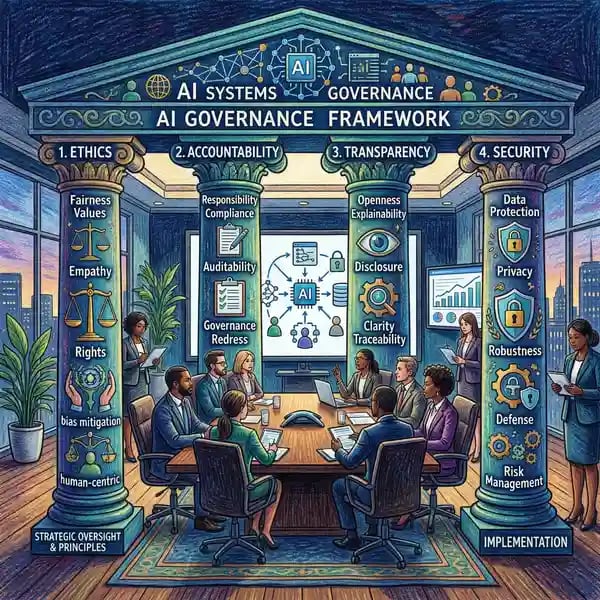
Organisations should use a combination of complementary risk assessment frameworks rather than relying on a single methodology. The NIST AI Risk Management Framework, ISO 42001's AI Impact Assessment requirements, and the ICO's data protection impact assessment methodology each address different dimensions of AI risk.
The NIST AI RMF structures risk management around four functions. Govern establishes leadership and accountability structures. Map identifies and categorises AI systems, documenting their contexts and potential impacts — this is where organisations discover "shadow AI" deployed without formal oversight. Measure implements pre-deployment fairness testing, security evaluations, transparency assessments, and impact assessments. Manage establishes continuous monitoring and predefined remediation pathways for when monitoring identifies concerning patterns.
| Framework | Type | Primary Focus | Best For |
|---|---|---|---|
| NIST AI RMF | Voluntary | Comprehensive risk lifecycle: Govern, Map, Measure, Manage | Overall governance architecture and risk integration |
| ISO 42001 | Certifiable | AI management system with controls, annual audits, impact assessments | Organisations seeking certification and external assurance |
| ICO DPIA | Mandatory | Data protection: lawful basis, data subject rights, automated decisions | Any AI processing personal data under UK GDPR |
| IEEE CertifAIEd | Certification | Transparency, accountability, and bias reduction evaluation | Product certification and competitive differentiation |
| EU AI Act | Mandatory | Risk-tiered conformity assessment for high-risk systems | Organisations with EU market exposure |
Sources: NIST AI Risk Management Framework, ISO/IEC 42001:2023, IEEE CertifAIEd Programme
Bias auditing has matured from aspirational principle to operational discipline. Audit-style frameworks now use controlled demographic pairings to detect bias attributable to demographic characteristics rather than legitimate performance differences. Critically, intersectional bias testing addresses a limitation of demographic-group auditing: discrimination often emerges only when attributes intersect — a hiring algorithm might show no overall gender bias but systematically disadvantage older women. Auditing must vary protected attributes simultaneously rather than examining demographics independently.
For organisations building AI training programmes, risk assessment capability should be a core competency developed alongside technical skills. The persistent shortage of responsible AI practitioners makes internal capability development essential rather than relying solely on external consultants.

How Do ISO 42001 and Other Standards Support AI Governance?
ISO/IEC 42001:2023 has established itself as the primary certifiable AI management system standard, providing a comprehensive framework for AI governance throughout the system lifecycle. The standard mandates formal leadership structures and accountability for AI risk management, systematic risk identification and evaluation, controls aligned to identified risks, and ongoing monitoring to ensure those controls remain effective. Annual reviews of governance policies and controls ensure governance evolution keeps pace with technological change.
The practical value of ISO 42001 certification extends beyond compliance demonstration. Darktrace announced ISO/IEC 42001 certification from BSI in July 2025, demonstrating how technology firms can achieve internationally recognised governance maturity. Many organisations recognise that certification differentiates in competitive contexts where customers value ethical AI, provides frameworks supporting continuous governance improvement, and creates documented evidence of governance commitment that supports regulatory engagement.
ISO/IEC 42001 sits alongside ISO/IEC 23894, the AI risk management guidance that adapts ISO 31000 (enterprise risk management) to AI, and it can be used together with the NIST AI RMF. This alignment means organisations already operating ISO 31000-based risk management can extend existing processes to encompass AI governance rather than building parallel structures. The standard's compatibility with enterprise risk frameworks is particularly valuable for mid-sized organisations that cannot sustain separate governance architectures for different risk domains.
The Bottom Line
Organisations do not need to adopt every standard simultaneously. The practical pathway is to use NIST AI RMF as the overarching governance architecture, implement ISO 42001 controls for high-risk AI systems, conduct ICO DPIAs for any system processing personal data, and prepare for EU AI Act conformity assessments if serving European markets. This layered approach provides comprehensive coverage without requiring every system to undergo every assessment.
The IEEE CertifAIEd programme offers product-level certification evaluating AI systems for transparency, accountability, and bias reduction. For organisations developing AI products or platforms, IEEE certification provides credible evidence of responsible practices that supports market access and customer trust. Combined with organisational-level ISO 42001 certification, product-level IEEE certification creates a comprehensive governance evidence base.
Organisations considering whether to pursue formal certification should assess the competitive context. In sectors where custom AI solutions are being deployed in high-risk applications, certification increasingly functions as a market access requirement rather than a differentiator. The investment in certification — both financial and operational — typically provides returns through reduced regulatory friction, improved customer confidence, and streamlined due diligence processes during procurement.
What Are the Consequences of Getting AI Governance Wrong?
The consequences of inadequate AI governance span financial penalties, operational disruption, reputational damage, and legal liability. These consequences are no longer theoretical — documented enforcement actions and litigation provide concrete evidence of governance failure costs.
Many AI-related security risks stem from governance gaps as much as from technical vulnerabilities. When governance fails to establish clear ownership, oversight procedures, and continuous monitoring, AI systems become vulnerable to misuse, data exfiltration, and adversarial manipulation.
In the recruitment domain, Mobley v. Workday shows that US courts are prepared to test whether "the AI made the decision" offers any shelter from discrimination law. In May 2025 the federal court in the Northern District of California granted preliminary certification of a nationwide collective action under the Age Discrimination in Employment Act for applicants aged 40 and over who were rejected through Workday's platform. Organisations deploying algorithmic systems should expect to be held accountable for discriminatory outcomes regardless of vendor involvement. The plaintiffs allege that Workday's screening tools disadvantaged applicants on the basis of age and disability; the allegations have not been proven.
The ICO can issue administrative fines up to £17.5 million or 4% of annual worldwide turnover under UK GDPR (Data Protection Act 2018, s.157) for serious data protection breaches involving AI systems. Sector-specific regulators — the FCA for financial services, the MHRA for healthcare — apply existing penalty authorities to irresponsible AI deployment. Beyond financial penalties, enforcement creates reputational damage, operational disruption from forced system modifications, and management distraction from remediation requirements.
| Consequence | Evidence | Mitigation Through Governance |
|---|---|---|
| Financial penalties | ICO fines up to £17.5M / 4% turnover; EU AI Act up to €35M / 7% turnover | Documented governance frameworks demonstrate reasonable care and reduce penalty severity |
| Legal liability | Mobley v. Workday: nationwide age-discrimination collective action certified (May 2025) | Bias auditing, impact assessments, and documented fairness testing provide legal defence |
| Abandoned projects | 42% of companies in North America and Europe abandoned most of their AI initiatives in 2025 (S&P Global) | Data governance foundations ensure AI projects proceed on solid ground |
| Security incidents | AI introduces new attack routes, including prompt injection and data leakage through model outputs | Clear ownership, monitoring protocols, and incident response reduce breach frequency and impact |
Sources: Data Protection Act 2018 s.157, EU AI Act Article 99, Mobley v. Workday Inc. (N.D. Cal., No. 3:23-cv-00770), S&P Global Market Intelligence 2025
The positive case is equally compelling. Integrating AI governance into existing enterprise risk management frameworks gives leadership a single view of AI risk and avoids duplicated controls. Governance is not merely a cost centre or compliance burden — it is a competitive advantage that enables faster, more confident AI adoption. For organisations evaluating the business case for AI investment, governance maturity should be treated as part of the investment case.
Frequently Asked Questions
What is the difference between AI governance and AI compliance?
AI governance is the broader system of policies, processes, roles, and oversight mechanisms that guide responsible AI use across an organisation. AI compliance is the subset of governance focused specifically on meeting regulatory and legal requirements. Effective governance encompasses compliance but also addresses ethical principles, organisational values, stakeholder trust, and strategic alignment that extend beyond minimum legal obligations.
Does AI governance apply to organisations that only use third-party AI tools?
Yes. Organisations deploying third-party AI tools bear governance responsibilities for the outcomes those tools produce. Under UK GDPR the deploying organisation, as controller, remains accountable for how personal data is used in automated decisions, and the EU AI Act places specific obligations on deployers (Article 26), including human oversight and monitoring, alongside the vendor's duties as provider. Deployers are therefore responsible for ensuring automated decisions meet legal requirements, bias testing is conducted in the deployment context, and human oversight is maintained. Governance frameworks must encompass vendor-supplied AI alongside internally developed systems.
How much does implementing an AI governance framework cost?
Costs vary significantly by organisational size, AI portfolio complexity and how much work is done in-house. Initial setup typically covers governance committee establishment, an AI system inventory, impact assessments for high-risk systems and policy development, followed by ongoing monitoring, re-audits and training. Where external support is used, our UK AI Consultancy Price Index records published discovery and readiness engagements at £1,000–£10,000 (median £3,000) and specialist day rates of £900–£1,500. ISO/IEC 42001 certification audit fees are quoted by certification bodies on request and depend on scope. These costs compare favourably to potential penalties: UK GDPR fines can reach £17.5 million or 4% of annual worldwide turnover.
What is ISO 42001 and should every organisation pursue certification?
ISO/IEC 42001:2023 is the international standard for AI management systems, providing a certifiable framework for AI governance. Not every organisation needs formal certification, but every organisation deploying high-risk AI should implement the standard's principles. Certification is particularly valuable for organisations in regulated sectors, those selling AI products, or those competing in markets where governance maturity influences procurement decisions.
How does the UK approach to AI regulation differ from the EU AI Act?
The UK uses a principles-based approach where existing sector regulators (FCA, ICO, MHRA, SRA) apply current frameworks to AI systems, providing flexibility in implementation. The EU AI Act uses a prescriptive, risk-tiered approach with specific obligations for each risk category, mandatory conformity assessments, and registration requirements. UK organisations serving EU markets must comply with both approaches simultaneously.
What role should the board of directors play in AI governance?
The board should provide strategic oversight, capital allocation discipline, risk integration, and technology competence development. This means assessing AI's strategic implications, approving AI investment through rigorous evaluation, incorporating AI into enterprise risk management reporting, and ensuring all directors maintain foundational AI literacy. Boards should designate audit or risk committees as primary AI oversight bodies and receive material AI risk updates at least annually.
Ready to Establish AI Governance That Enables Growth?
Helium42 helps mid-sized UK organisations build governance frameworks that satisfy regulatory expectations whilst accelerating responsible AI adoption. From board-level strategy to operational implementation.
Sources: Data (Use and Access) Act 2025, EU AI Act Official Text, ISO/IEC 42001:2023, NIST AI Risk Management Framework, ICO Guidance, FCA AI Approach, Alan Turing Institute AI Governance, NACD Director Essentials: Implementing AI Governance, DSIT AI Sector Study 2024, S&P Global Market Intelligence 2025, IEEE CertifAIEd Programme
Peter Vogel
AI Strategy Lead, Helium42
Peter Vogel is AI Strategy Lead at Helium42, helping mid-sized UK organisations navigate AI governance, implementation, and transformation. With more than 15 years of experience in digital transformation, Peter specialises in building governance frameworks that enable responsible AI adoption whilst maintaining competitive momentum.
understanding what AI governance is
creating an AI policy template
EU AI Act extraterritorial scope affecting UK companies
governance best practices for mid-market implementation
risk management and compliance requirements
data governance within AI governance frameworks
AI governance in legal practice AI governance consultancy services
We help mid-market organisations design and embed AI governance frameworks that regulators accept.
Explore AI Governance Consultancy