AI Software Development Agency: How to Choose the Right Partner
The AI Software Development Market in 2026 £337.75bn UK AI market size by 2032 (26.4% CAGR) £800–£1,500+ Daily rates for mid-market...
15 min read
Peter Vogel
:
Updated on March 29, 2026
UK contact centres achieved 67 per cent adoption of conversational AI tools by Q4 2023, with generative AI implementation accelerating rapidly through 2024. Organisations across financial services, retail, telecommunications, and energy sectors are reporting 30-45 per cent reductions in average handling time (AHT) and 25-35 per cent cost savings through conversational AI deployment. For customer service operations, this technology shift is no longer optional—it represents the primary lever for managing rising customer expectations, controlling costs, and competing effectively in crowded markets.
Conversational AI enables customer service teams to handle routine enquiries, complex troubleshooting, and sensitive interactions with consistency, speed, and accuracy that human-only operations cannot match at scale. The integration of generative AI has further transformed the landscape, shifting focus from rule-based chatbots to systems that understand context, manage multi-turn conversations, analyse emotional tone, and generate natural responses that feel human-like.
This article explores how conversational AI delivers measurable outcomes for UK customer service operations, what platforms lead the market, how to implement responsibly under UK regulations, and where this technology is heading next.
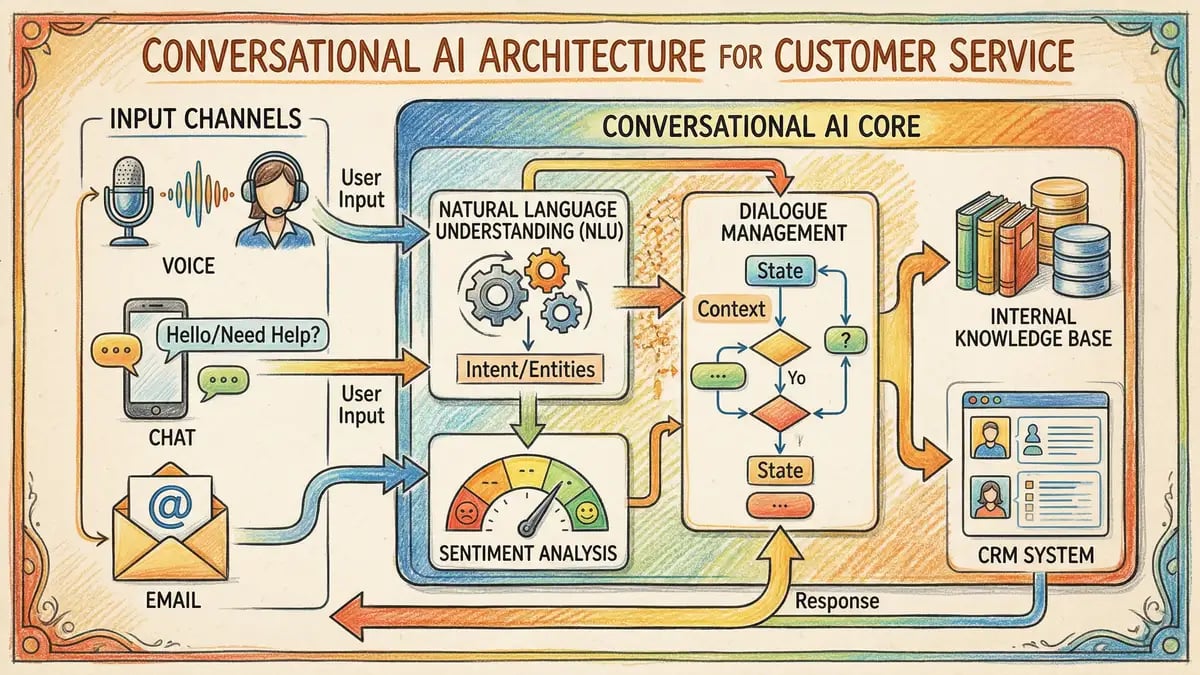
Conversational AI is fundamentally about machines understanding human intent and responding with appropriate actions or information. The technology stack comprises three interconnected layers: natural language understanding (NLU), dialogue management, and response generation.

Modern NLU systems achieve 92-96 per cent accuracy in intent recognition for customer service interactions. Rather than matching exact keywords, these systems use transformer-based models (BERT variants) that understand meaning in context. When a customer says "I want to upgrade my plan" or "Can I move to a faster service?", the system maps both to a single "upgrade_request" intent, regardless of the specific wording. This contextual understanding eliminates the frustration customers experience with traditional rule-based systems that require exact phrase matching.
Dialogue management maintains context across multiple conversation turns, enabling coherent multi-step interactions. For example, when a customer reports an issue, the system might ask clarifying questions, retrieve relevant account information, offer a solution, and confirm the customer is satisfied—all within a single conversation thread. The system tracks what has been discussed and what still needs resolution, eliminating the need for customers to repeat themselves if transferred to a human agent.
Sentiment analysis operates at multiple levels simultaneously. Basic lexicon-based detection identifies emotional keywords. Contextual embeddings understand sentiment in context (distinguishing between "incredible" as positive praise versus "incredibly frustrating" as negative complaint). Advanced systems detect aspect-based sentiment, enabling the distinction: "The agent was helpful but your product quality is poor" maps to positive agent sentiment and negative product sentiment—critical for targeted agent coaching.
Conversational AI operates across both voice and text channels, with each presenting distinct technical and user experience challenges. Voice-based conversational AI represents the evolution of traditional Interactive Voice Response (IVR) systems, but with radically enhanced capabilities. Instead of "Press 1 for billing, Press 2 for technical support," customers simply speak naturally: "I need to report a payment issue." The system understands the intent within milliseconds and either resolves the issue directly or transfers the customer to the appropriate specialist with full context.
Speech analytics technology processes voice interactions in real-time, providing agents with immediate insights. Call Centre technology leaders report 87 per cent accuracy in identifying customer frustration during the call, enabling supervisors to send coaching cues ("Show empathy") or route to senior staff before the interaction escalates. Post-call, systems automatically generate summaries in 40-60 seconds—a capability eliminating manual note-taking that previously consumed 12-15 per cent of agent time.
Text-based conversational AI operates through chat interfaces, with different user experience patterns. Chat bots excel for asynchronous customer interactions—customers can initiate a chat, receive an immediate response to their initial query, then step away and return to the conversation later. This differs from voice interactions, which typically require synchronous back-and-forth. UK customer research indicates 62 per cent of online adults accept AI for simple, quick enquiries via chat, whereas voice interaction acceptance trails at 41 per cent.
Omnichannel deployment—where conversational AI operates across voice, chat, email, and social media simultaneously—is becoming standard practice. Fifty-eight per cent of UK enterprises had deployed multi-channel conversational experiences by 2024, up from 41 per cent in 2023. The advantage of omnichannel is consistency: the same NLU models, dialogue logic, and knowledge base serve all channels, ensuring customers receive identical service quality whether they contact via phone, web chat, social media, or email.
The emergence of large language models (LLMs) like GPT-4 and Gemini has fundamentally altered conversational AI. Traditional systems required extensive training data and manual intent cataloguing. Generative AI systems require fewer training examples (two-to-three examples suffice for few-shot learning), are more flexible with customer phrasing variations, and generate responses that feel more natural and contextually aware. By Q2 2024, 71 per cent of UK contact centres had either deployed or were piloting generative AI capabilities.
Agent co-pilots powered by generative AI represent the most immediate application. As customers speak or type, the system generates real-time suggestions for agent responses, pulls relevant knowledge articles, and alerts the agent to compliance risks or customer sentiment escalation. Major UK insurance and financial services organisations report agent handle time reduced by 18-22 per cent with co-pilot assistance, whilst first contact resolution improved by 12-16 per cent because agents have better information at their fingertips.
Automated response generation creates a second critical use case. For email support, generative AI drafts replies to routine enquiries with human review before sending. For social media monitoring, systems identify customer mentions, assess sentiment, and generate appropriate responses. For proactive outreach, organisations use generative AI to create personalised customer messages—renewal reminders, service recovery after outages, cross-sell opportunities—at scale. Organisations report cross-sell conversion uplift of 8-15 per cent through generative AI-driven campaigns.
A critical responsibility: all customer-facing generative AI applications must include mandatory human review before sending. Leading platforms (Amazon Connect, Nuance, Google CCAI) provide governance workflows ensuring humans approve AI-generated responses. The risk is real—language models occasionally hallucinate (generate false information with confidence). Responsible implementation requires treating AI as a tool that accelerates human decision-making rather than replacing it.
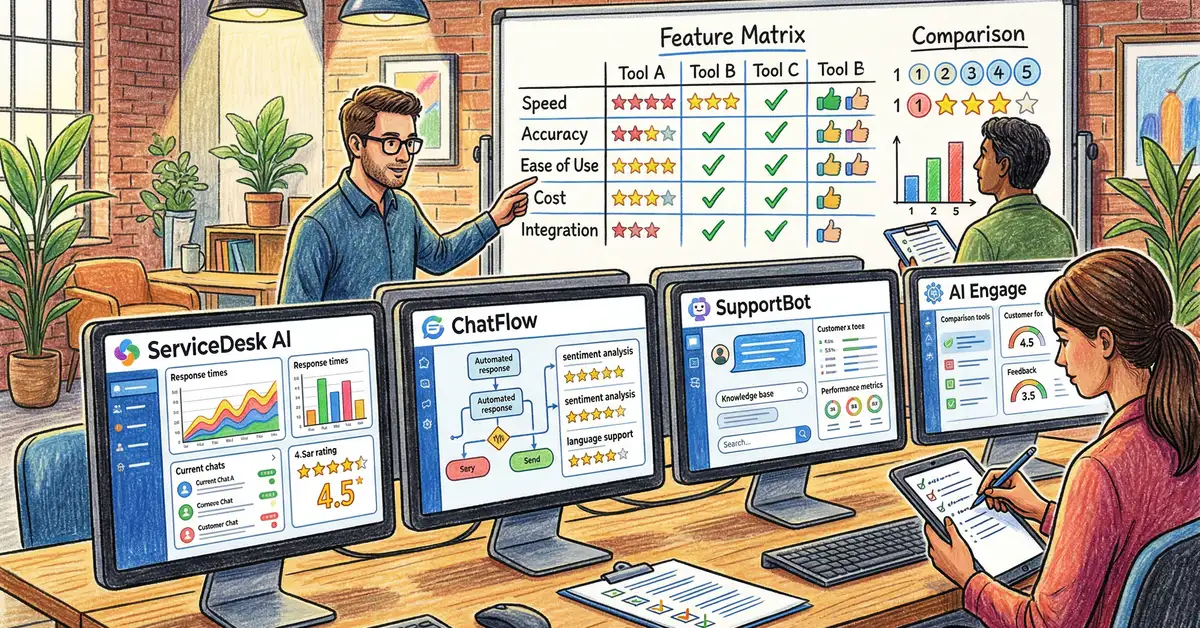
The UK conversational AI platform market is dominated by four vendors with distinct strengths. Amazon Connect commands 28 per cent market share, leveraging Amazon Lex for intent recognition and Contact Lens for real-time speech analytics. The platform excels in rapid deployment, native integration with AWS infrastructure, and recent generative AI co-pilot capabilities. Its strength lies in cost-efficiency and scalability for high-volume contact centres.
Google Cloud Contact AI (CCAI) leverages Dialogflow and large language models to provide sophisticated natural language understanding and conversation intelligence. The platform achieves 91 per cent sentiment analysis accuracy and integrates tightly with Google Workspace. Leading telecommunications and energy companies (Vodafone, EDF Energy) have reported 34 per cent CSAT improvement post-CCAI deployment.
Nuance (Microsoft-owned) holds 18 per cent market share with specialisation in speech analytics and compliance tooling. The Nina conversational AI platform and Nuance Call Analytics provide sophisticated speech-to-text accuracy, compliance keyword detection, and UK GDPR-aware data handling. Integration with Microsoft Copilot framework is positioning Nuance for deeper enterprise AI integration. The platform has been particularly successful in regulated industries where compliance documentation and audit trails are critical operational requirements.
Five9 provides a cloud-native platform particularly strong in outbound and inbound omnichannel orchestration. Its AI-driven quality management enables real-time agent coaching and predictive routing. The platform grew UK customer base by 18 per cent during 2024, particularly among lending and insurance sectors.
Mature conversational AI deployments operate across all customer touch points simultaneously. When a customer initiates a chat enquiry on Monday morning, receives an AI-generated response, closes the chat, then calls on Wednesday with a follow-up question, the system has memory of the earlier interaction. The phone agent sees the chat history and continues the conversation contextually, rather than requiring the customer to re-explain their situation.

Social media monitoring integration is increasingly critical. Organisations deploy conversational AI to monitor brand mentions across Twitter/X, Facebook, Instagram, and LinkedIn, automatically flagging negative sentiment, identifying service recovery opportunities, and drafting responses. This capability is particularly valuable for retail and travel/hospitality sectors where public complaints demand rapid response to prevent reputation damage.
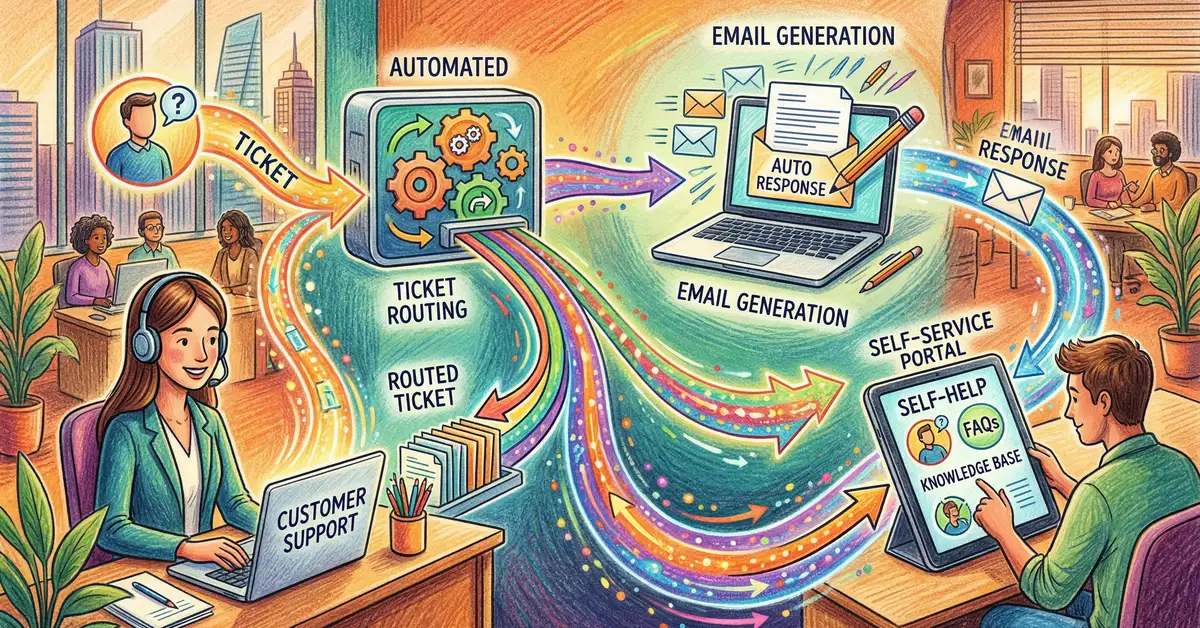
Email integration enables asynchronous support at scale. Rather than agents manually typing replies to email enquiries, conversational AI drafts responses which pass through a human approval queue before sending. This maintains quality and brand voice whilst dramatically improving response time. One major UK retailer reduced average email response time from 24-48 hours to 2-4 hours using this pattern, improving customer satisfaction whilst reducing agent manual typing by 68 per cent.
The UK contact centre industry employs 1.28 million people as of 2024, down 3.1 per cent year-on-year, primarily due to automation investments. The average contact centre operates with 82 agents, though size distribution shows 34 per cent of operations employ fewer than 20 agents, whilst 25 per cent employ over 100 agents. The mid-market segment (20-100 agents) is most common and shows fastest growth trajectory in conversational AI adoption.
Sectoral adoption varies significantly. Financial services (81 per cent adoption) and telecommunications (76 per cent adoption) lead the market, driven by high-volume routine enquiries suitable for automation. Retail and e-commerce follow at 68 per cent adoption. Government and public sector lag at 42 per cent adoption, reflecting budget constraints and regulatory complexity. Healthcare adoption stands at 31 per cent, with NHS 111 trialling conversational AI for symptom triage.
Investment trends reinforce this adoption momentum. UK contact centre technology spending reached £1.635 billion in 2024, with conversational AI commanding 18 per cent of budgets (£310 million), growing at 34 per cent year-on-year—the fastest growth category. Cloud contact centre platforms (CCaaS) account for 31 per cent of spending (£520 million), with 18 per cent annual growth. These trends indicate conversational AI is transitioning from experimental pilot phase to mainstream operational requirement.
Successful conversational AI deployments integrate tightly with existing customer relationship management (CRM) and ticketing systems. The integration pattern typically follows this workflow: customer initiates contact → conversational AI processes intent, extracts entities (account number, product codes, issue description) → system pulls customer context from CRM (account history, previous interactions, preferences) → dialogue management determines routing (resolve automatically, assist human agent, escalate). Upon completion, the system automatically updates the CRM with structured data (ticket created, issue resolved, follow-up actions required).
Salesforce Service Cloud leads CRM integration readiness (95 per cent API integration), followed by Microsoft Dynamics 365 (93 per cent) and Zendesk (85 per cent). Data handling follows strict GDPR protocols: customer personal data is tokenised (masked) before transmission to large language models, conversation transcripts are retained in UK-based data centres per Information Commissioner's Office guidance, and audit trails document all AI system interactions for regulatory compliance.
Ticket routing automation delivers significant operational value. When a customer initiates an enquiry, conversational AI automatically determines priority level (high-priority: angry customer with critical product issue and churn risk; medium-priority: routine technical issue; low-priority: FAQ-type enquiry), assigns category and specialist queue, and populates required fields. This automation reduces triage time from 5-8 minutes to <30 seconds, enabling agents to focus immediately on problem-solving rather than administrative data entry.
Conversational AI deployment in UK customer service operates within a complex regulatory environment distinct from other markets. The Information Commissioner's Office (ICO) has issued guidance on AI and data protection that organisations must respect. GDPR transparency requirements mandate disclosing to customers that their interactions may be processed by AI: "Your conversation may be recorded and analysed using artificial intelligence for quality and service improvement purposes." Annual privacy notices must explicitly mention conversational AI usage.
Data minimisation principles require collecting only strictly necessary information. Personal identifiable information (account numbers, names, addresses, phone numbers, email addresses) should not be exposed unnecessarily to AI systems. Best practice involves anonymising PII before large language model processing, creating a tokenised reference that preserves meaning for the AI without exposing sensitive data to unwarranted access.
The Financial Conduct Authority (FCA) requires that customer-facing conversational AI communications be "fair, clear, and not misleading." This applies equally to AI-generated responses as to human-generated content. For financial services organisations, conversational AI cannot be used to make final lending decisions without human underwriter review. Customers must be able to escalate complaints without barrier. The Conduct of Business rules (COBS 2.1R) require that recommendations be in the best interest of the customer—a principle that applies to AI recommendations equally.
Consumer Rights Act 2015 and Competition and Markets Authority guidance increasingly scrutinise unfair contractual terms. Organisations cannot exclude liability for AI errors causing financial loss, nor can they require unreasonable dispute resolution mechanisms. As conversational AI becomes more prevalent in offering advice (mortgage eligibility assessments, insurance quotes, investment recommendations), organisations should assess liability exposure and consider specialist AI insurance policies. The Information Commissioner's Office continues to provide updated guidance on responsible AI use, particularly regarding bias, transparency, and data handling.
Conversational AI delivers quantifiable business impact across efficiency, quality, and revenue metrics. Average handling time (AHT) reduction of 20-25 per cent is standard: organisations report AHT declining from 7 minutes to 5-6 minutes through AI automation and agent co-pilot assistance. First contact resolution (FCR) typically improves by 8-12 per cent as conversational systems reduce customer frustration with inadequate first interactions. These metrics compound: shorter calls plus resolved issues on first contact equals 25-35 per cent cost savings per customer interaction.
Quality improvements are equally significant. Customer satisfaction (CSAT) typically increases from 4.0-4.2/5.0 baseline to 4.4-4.6/5.0 post-deployment, driven by faster response times and fewer repeat calls. Net Promoter Score (NPS) improvements of 15-20 points are reported by early adopters, indicating conversational AI provides customers with genuinely improved experiences rather than merely efficient experiences. Complaint rates typically decline by 40-50 per cent, as consistent automated responses reduce service variability that historically drove complaints.
Revenue impacts from proactive customer engagement are substantial. Conversational AI identifies cross-sell and upsell opportunities by analysing customer account history, interaction patterns, and purchase trends. Organisations report incremental revenue uplift of 8-15 per cent through AI-driven campaigns. Churn reduction of 6-12 per cent is typical, achieved through proactive retention outreach identifying at-risk customers and triggering service recovery. Over a three-year period, cumulative customer lifetime value uplift of 15-25 per cent is achievable.
Return on investment typically achieves payback within 10-18 months for mid-market deployments. A 240-agent financial services organisation investing £680,000 in conversational AI platform and implementation typically realises £2.7 million annual cost savings (AHT reduction, escalation reduction, improved FCR) plus £340,000-£500,000 revenue uplift (upsell, churn reduction) by year two, generating three-year cumulative net benefit exceeding £7 million.
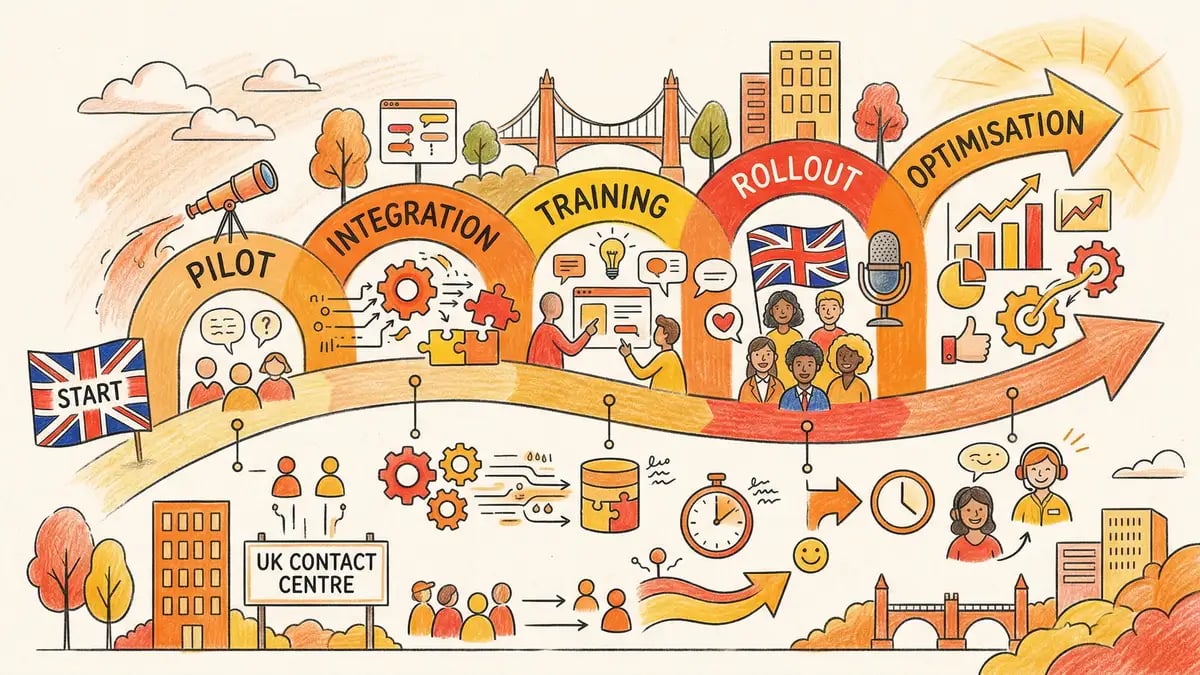
Successful conversational AI implementation follows a structured phased approach rather than big-bang deployment. Phase 1 (Assessment and Planning, months 1-2) establishes baseline metrics, prioritises highest-impact use cases, evaluates technology vendors, and gains executive sponsorship. Phase 2 (Design and Configuration, months 3-5) develops intent catalogues (targeting minimum 50 sample utterances per intent), designs dialogue flows, integrates with CRM/ticketing systems, and trains initial NLU models. This phase is effort-intensive, typically requiring 8-12 weeks despite common initial estimates of 2-3 weeks.
Phase 3 (Pilot and Testing, months 6-8) deploys to a small segment (20-30 per cent of contact centre) to validate assumptions and identify issues in controlled environment. Success criteria include intent recognition accuracy ≥92 per cent, sentiment analysis accuracy ≥87 per cent, automated resolution rate ≥25 per cent without human escalation, and agent satisfaction ≥4.0/5.0 on co-pilot usability. Phase 4 (Full-Scale Deployment, months 9-12) expands from pilot to 100 per cent of contact centre with continuous model retraining on production data. Phase 5 (Continuous Improvement, months 13+) focuses on ongoing optimisation, expanded use cases, capability upgrades, and ROI tracking.
Critical best practices include: (1) Intent catalogue development from historical customer interaction data rather than speculation; (2) Iterative model refinement—launch with 20 high-confidence intents, expand to 50+ over six months based on production data; (3) Human review workflows for all customer-facing AI-generated content; (4) Regular bias audits ensuring systems treat all customers fairly regardless of accent, dialect, or protected characteristics; (5) Change management addressing agent concerns about job displacement (conversational AI eliminates repetitive work, enabling agents to focus on complex problem-solving). Organisations should also establish clear governance frameworks before deployment. UK government guidance on AI emphasises responsible innovation, transparency, and accountability. This means documenting how conversational AI makes decisions, who is accountable if errors occur, and how customer appeals or complaints are handled. Establish cross-functional steering committees (operations, legal, compliance, customer experience) that meet monthly during implementation and quarterly thereafter. Ensure executive sponsorship and budget commitment—conversational AI fails when treated as a tactical quick-fix rather than a strategic operational transformation.
UK customer attitudes toward conversational AI vary significantly by use case. Acceptance is highest for low-risk, routine transactions: account balance enquiries (97 per cent acceptance), recent transaction lookups (96 per cent), password resets (93 per cent), and product information requests (89 per cent). Acceptance declines sharply for sensitive interactions: complaints/escalations (18 per cent AI-only acceptance; customers overwhelmingly prefer human), sensitive account changes without human verification (12 per cent acceptance), and refusal to provide service (8 per cent acceptance).
Forrester survey data indicates 76 per cent of UK adults prefer speaking with humans for complex issues, yet 62 per cent accept AI for simple, quick enquiries. Primary concern is data privacy (54 per cent of respondents), reflecting UK GDPR awareness. Secondary concern is poor quality experience: 71 per cent report frustration when AI systems cannot resolve issues and escalation to humans is delayed or difficult. Best practice is transparent communication: clearly identify AI interactions, set expectations about capabilities, and ensure effortless escalation to human agents without requiring customers to repeat information.
Agent sentiment toward conversational AI is nuanced. Gartner survey of 1,200 UK contact centre agents indicates 68 per cent view AI co-pilot as improving efficiency, with 64 per cent reporting reduced frustration with repetitive work. However, 47 per cent express concern about job displacement, and 31 per cent find AI recommendations intrusive or distracting. The critical success factor is positioning: AI systems should be presented as augmenting agent capability (freeing time for complex problem-solving), not replacing agents.
Agent skills evolve rather than diminish. Organisations with conversational AI co-pilot experience faster new agent ramp time (5.5 weeks versus 8 weeks baseline), reduced attrition (6-12 per cent lower), and improved job satisfaction (59 per cent of agents report improved satisfaction post-deployment). Agent training requirements increase slightly (45 hours/year baseline to 62 hours/year with AI systems), focusing on AI literacy, complex problem-solving, and emotional intelligence to handle escalations where automation cannot help.
Conversational AI deployment presents genuine risks requiring proactive management. Hallucination (AI generating confident but false information) is a medium-probability risk with high impact potential. Mitigation requires grounding AI responses in verified knowledge bases rather than allowing free-form generation. Bias in automated decision-making (systems treating certain customer segments unfavourably) requires diverse training data and regular fairness audits. Data privacy violations are lower-probability but critical-impact risks, mitigated through UK data residency, encryption, and vendor due diligence.
Customer backlash against over-automation is medium-probability and medium-impact. Organisations that deploy conversational AI without clear human escalation pathways, or that hide AI involvement from customers, risk reputational damage and competitive switching. Mitigation requires transparent disclosure, ease of escalation, and continuous monitoring of customer satisfaction metrics. Economic downturn risks (reducing investment budgets) are mitigated by focusing on cost-optimisation use cases (AHT reduction, FCR improvement) rather than revenue-only initiatives.
Implementation timeframes of 9-12 months are realistic for mid-market organisations. Common pitfall: underestimating effort required for intent catalogue development, which typically requires 8-12 weeks rather than 2-3 weeks. Total budget for mid-market (100-300 agents) typically ranges £430,000-£1,010,000 in Year 1 (software licensing £180,000-£400,000, implementation £120,000-£280,000, training £40,000-£80,000, data preparation £60,000-£150,000, infrastructure £30,000-£100,000), with ongoing annual costs of £140,000-£350,000. Return on investment typically achieves payback within 10-18 months.
Start with high-volume, routine transactions: account balance enquiries, recent transaction lookups, password resets, product information requests, and return/refund initiation. These use cases have high customer acceptance (82-97 per cent), clear resolution criteria (either resolved automatically or escalated), and minimal regulatory complexity. Avoid complex, sensitive, or complaint-related enquiries in initial deployment—these require human agents. Early wins build organisational confidence and agent acceptance before expanding to more complex use cases.
Seamless escalation is critical to customer experience. When conversational AI cannot resolve an enquiry, the full conversation transcript, sentiment analysis, extracted customer data, and AI-generated summary should transfer to the human agent. The agent should NOT require the customer to repeat information. Best practice is agent acknowledgment: "I see from our conversation history that you are frustrated about X—I understand, and let me help you resolve this." Organisations should measure escalation rate (target: <40 per cent) and escalation time-to-agent (target: <30 seconds). If escalation rates exceed 50 per cent, it indicates intent catalogue inadequacy requiring retraining.
UK organisations must comply with GDPR transparency requirements (disclosing AI use to customers), ICO guidance on AI and data protection (data minimisation, UK data residency, anonymisation before LLM processing), FCA requirements for fair communication (if financial services regulated), and emerging Online Safety Act provisions. All customer-facing AI-generated content requires human review before deployment. Conversational AI cannot be used to make final decisions affecting customer rights (lending, insurance underwriting) without human review. Document AI system involvement in decisions for regulatory audit trails. Engage legal counsel specialising in AI regulation to assess sector-specific requirements.
Core metrics include: Average Handling Time (target 20-25 per cent reduction), First Contact Resolution (target 8-12 per cent improvement), Cost Per Interaction (target 25-35 per cent reduction), Customer Satisfaction/CSAT (target 0.4-0.6 point improvement), Intent Recognition Accuracy (target 96 per cent), Automation Rate (target 40-50 per cent resolved without agent). Secondary metrics include Net Promoter Score (target 15-20 point improvement), Quality Assurance scores, and Complaint Rate reduction. Revenue metrics (upsell lift, churn reduction) should be tracked quarterly. Establish baseline metrics pre-deployment and track weekly or monthly depending on organisation size. Present KPI trends to leadership quarterly to maintain investment support.
For deeper exploration of conversational AI for customer service, consider reading our comprehensive guide to implementing this technology across your operations. Explore the core foundations with AI for customer service support, which establishes foundational principles. Understand the chatbot-specific implementation in AI chatbot for customer service, which covers conversational design patterns. Learn how AI agents work in the customer service context with AI agents for customer service. Evaluate specific tools with best AI tools for customer service, which compares leading platforms. Finally, understand broader operational transformation through AI for customer service automation.
The conversational AI landscape continues to evolve rapidly. By end-2026, estimated 85 per cent of UK contact centres will have generative AI pilots or deployments (extrapolating from 71 per cent reported in Q2 2024). Fine-tuned models trained on company-specific data are expected to improve accuracy from 89-91 per cent to 94-96 per cent. Multimodal AI—combining text, voice, and video—will enable richer contextual understanding and more natural customer interactions. Organisations should anticipate that current "state-of-the-art" systems will become commoditised; competitive advantage will shift from basic AI deployment to sophisticated integration with business processes and customer experience optimisation.
Regulatory evolution will require attention. The proposed UK AI Bill (expected Parliament consideration Q2-Q3 2026) will likely require conformity assessments for "high-risk" AI systems—conversational AI determining credit decisions, handling sensitive customer information, or making escalation/routing decisions would likely qualify. The Online Safety Bill, now partly in force, will create liability for harmful content generated by conversational systems. Right to explanation principles (currently GDPR-based) are expected to strengthen through case law, meaning customers may increasingly demand transparency about why AI made specific recommendations.
Organisations should begin preparing now by building governance frameworks, documenting AI decision-making processes, implementing explainability features, and ensuring human oversight mechanisms are embedded throughout conversational systems. Early movers who establish responsible AI practices will have significant competitive advantage when regulations tighten—they will have proven compliance infrastructure whilst competitors scramble to retrofit governance.
Helium42 works with UK customer service organisations at every stage of the conversational AI journey. We begin with assessment and strategy—evaluating current operations, identifying highest-impact use cases, and building business cases for investment. We then guide design and configuration—developing intent catalogues, designing dialogue flows, ensuring CRM and ticketing system integration, and conducting GDPR and FCA compliance reviews. Throughout implementation, we provide agent training, customer communication templates, and risk mitigation planning.
Critically, we support the transition from implementation to operational maturity. After your conversational AI system goes live, continuous improvement is essential: model retraining on production data, bias audits, expanded use cases, and capability upgrades. Our approach positions conversational AI as a sustained competitive advantage rather than a one-time technology project. We help organisations navigate the evolving regulatory landscape, ensuring compliance with ICO guidance, FCA requirements, and emerging AI legislation. Whether you are exploring conversational AI for the first time or optimising an existing deployment, Helium42 brings proven methodology and sector expertise to accelerate your journey and deliver measurable business outcomes.
Contact Helium42 today to explore how conversational AI can transform your customer service operations, reduce costs by 25-35 per cent, and improve customer satisfaction measurably. Our consultants have deep experience across UK financial services, retail, telecommunications, energy, and healthcare sectors—we understand the specific challenges and regulatory requirements of your industry.
The AI Software Development Market in 2026 £337.75bn UK AI market size by 2032 (26.4% CAGR) £800–£1,500+ Daily rates for mid-market...
Artificial intelligence is fundamentally transforming how UK businesses deliver customer service. Yet most organisations still perceive AI automation...
UK businesses are investing decisively in artificial intelligence for customer service. Organisations report that automated customer service...