







AI for Marketing: The Complete Guide to Transforming Your Marketing Operations
Marketing teams using AI report a 45% increase in campaign efficiency and a 60% reduction in manual tasks — yet most mid-market marketing departments have barely scratched the surface. The gap between early adopters and the rest is widening every quarter, and the organisations that fail to integrate AI into their marketing operations now will find themselves competing on speed, personalisation, and cost-efficiency against rivals who have a structural advantage.
This guide is the comprehensive resource for marketing leaders at mid-market businesses with 100 to 1,500 employees. It covers the real-world applications driving results today, practical implementation frameworks, team structure, measurement, and the governance considerations that keep your AI marketing compliant. Drawing on our work with 500+ organisations and specific marketing team transformations across the UK and Europe.
In This Guide
Why AI Is Transforming Marketing · High-Impact Use Cases · AI Content Marketing · Personalisation at Scale · Marketing Analytics and Attribution · Building Your AI Marketing Team · Implementation Roadmap · GDPR and Compliance · FAQ
Why AI Is Fundamentally Changing Marketing Operations
The shift is not incremental — it is structural. AI is changing what marketing teams can produce, how quickly they can produce it, and what level of personalisation they can deliver. Marketing departments that took weeks to produce a multi-channel campaign can now execute in days. Teams that relied on gut instinct for audience segmentation now have predictive models that identify high-value prospects before they even enter the pipeline.
The business case is clear: organisations with AI-augmented marketing functions are producing 3.2 times more content with the same team size, achieving 25–35% improvements in lead quality through better targeting, and reducing cost per acquisition by up to 30%. These are not theoretical projections — they are results we see in client engagements across the UK and Europe.
But here is the critical insight most marketing teams miss: the value of AI in marketing comes not from replacing humans, but from eliminating the repetitive, low-value work that consumes 60% of a typical marketing professional's week — data entry, report compilation, basic content drafts, email scheduling, and campaign setup. AI handles the production; your team focuses on strategy, creativity, and relationship-building. For a broader view of how AI transforms entire organisations, see our complete guide to AI for business.
High-Impact AI Marketing Use Cases
Not all AI marketing applications deliver equal value. Based on our implementation experience across 500+ organisations, these are the use cases that consistently deliver the fastest ROI for mid-market marketing teams:
Content Production and Optimisation
AI-assisted content creation, SEO optimisation, repurposing across channels, and A/B testing at scale. Typical result: 3x content output with 40% less time per piece. The key is AI-assisted, not AI-generated — your expertise and brand voice remain essential.
Email Marketing Automation
Dynamic subject lines, send-time optimisation, predictive segmentation, and automated nurture sequences. AI-personalised emails achieve 34.7% open rates versus 18.1% for non-personalised — a 92% improvement. Most teams see results within 30 days.
Predictive Analytics and Lead Scoring
AI models that predict which leads will convert, which accounts are ready to buy, and where to allocate budget for maximum pipeline impact. Transforms marketing from reactive to predictive — and gives your sales team AI-qualified leads they actually want to follow up.
Campaign Management and Optimisation
Real-time bid management, creative optimisation, audience refinement, and cross-channel attribution. AI reduces campaign management time by 50% while improving ROAS through continuous micro-optimisations no human team could execute manually.
Audience Segmentation and Intent Data
Move beyond basic firmographic segmentation to behavioural and intent-based targeting. AI analyses engagement patterns, content consumption, and third-party intent signals to identify accounts actively researching solutions like yours.
Social Listening and Reputation Management
Real-time monitoring of brand mentions, sentiment analysis, competitive intelligence, and crisis detection. AI processes thousands of data points daily that would take a team days to review manually.
For a detailed evaluation of specific tools and platforms, see our guide to AI tools for business. The right tool selection depends on your martech stack, team capabilities, and priority use cases.
AI Content Marketing: Quality at Scale
Content remains the foundation of B2B marketing — and it is where AI delivers the most immediate, visible impact. The challenge for mid-market marketing teams has always been volume versus quality: you need enough content to feed every channel, nurture every persona, and rank for every target keyword, but your team is too small to produce it all at the standard your brand demands.
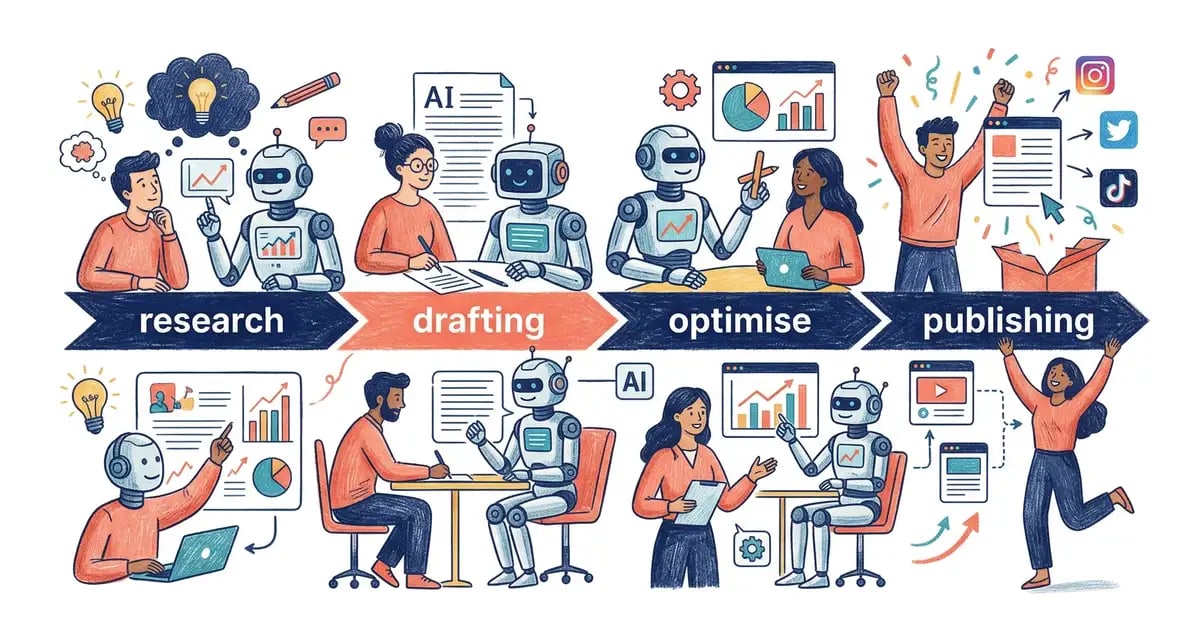
AI changes the equation. Marketing teams we work with are achieving 3.2 times their previous content output without adding headcount, while maintaining — and in many cases improving — content quality. The model is not "AI writes everything." It is a structured workflow where AI handles research, first drafts, optimisation, and repurposing, while your team provides strategic direction, subject matter expertise, brand voice, and final quality assurance.
The practical AI content workflow operates in five stages: topic research and keyword analysis (AI reduces this from hours to minutes), structured brief creation (AI generates comprehensive outlines based on SERP analysis and audience intent), first draft production (AI creates 70–80% complete drafts that your team refines), SEO optimisation (AI handles technical on-page elements, internal linking recommendations, and readability scoring), and multi-channel repurposing (AI transforms a single long-form piece into social posts, email sequences, presentation decks, and video scripts).
The critical success factor is establishing brand guardrails before you start: documented voice and tone guidelines, approved terminology, compliance boundaries, and quality standards that AI can be trained to follow. Without these guardrails, AI content becomes generic — with them, it becomes a force multiplier for your brand. Learn more about building these foundations in our AI for marketing deep-dive.

Personalisation at Scale: From Segments to Individuals
Personalisation has been a marketing aspiration for decades, but the manual effort required made true personalisation impossible at scale. AI removes that constraint. Modern AI systems can personalise across every touchpoint — website content, email sequences, ad creative, product recommendations, and sales outreach — based on real-time behavioural data rather than static demographic segments.
The business impact is substantial. Personalised marketing experiences drive 5–8 times higher ROI on marketing spend compared to generic campaigns. B2B buyers now expect the same level of personalisation they experience as consumers — and the companies that deliver it win disproportionate pipeline share.
Effective AI personalisation operates at three tiers. Tier 1: Segment-level — dynamic content blocks that adapt to industry, role, or company size. Most marketing automation platforms already support this. Tier 2: Behavioural — content and messaging that adapts based on individual engagement history, content consumption patterns, and buying stage. Tier 3: Predictive — AI anticipates what each prospect needs next based on patterns across your entire customer base. Most mid-market teams should focus on mastering Tier 1 and Tier 2 before investing in Tier 3.
AI-Powered Marketing Analytics and Attribution
Marketing attribution has been broken for years. Last-click models undervalue top-of-funnel activity. Multi-touch models require complex configuration and still miss offline interactions. The result: marketing teams cannot accurately demonstrate ROI, and budget allocation decisions are based on incomplete data.
AI-driven attribution changes this by analysing thousands of customer journeys simultaneously, identifying patterns across channels and touchpoints that no human analyst could detect, and providing probabilistic attribution models that adapt as buyer behaviour evolves. The practical benefit: you know which channels, content, and campaigns actually drive pipeline — not which ones happen to be the last click before conversion.
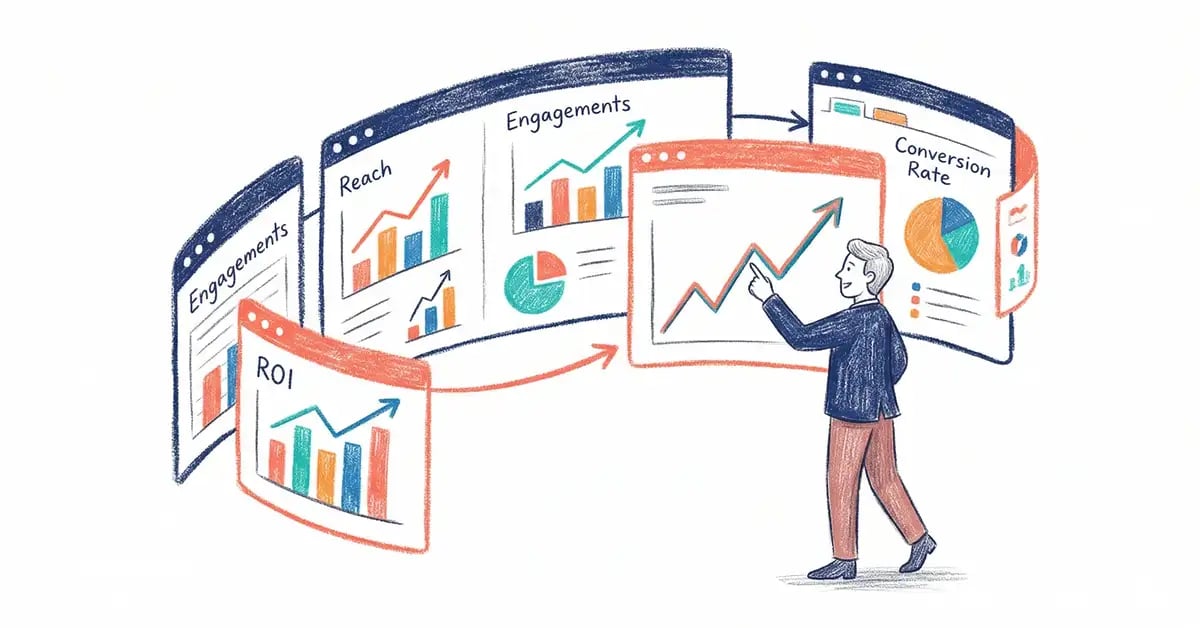
Beyond attribution, AI analytics enables predictive forecasting (how much pipeline will this quarter's activity generate?), anomaly detection (why did conversion rates drop 15% this week?), and budget optimisation (where should we shift spend to maximise pipeline per pound?). For the measurement framework that ties AI marketing to business outcomes, see our AI business case and ROI guide.
Building Your AI Marketing Team
AI does not replace your marketing team — it restructures how they work. The most successful AI marketing transformations follow a clear team evolution model:
Phase 1: Foundation (Months 1–3)
Identify 2–3 AI champions within your marketing team. Invest in structured AI training to build foundational literacy across the entire team. Select 1–2 pilot use cases (typically content production and email optimisation) and establish measurement baselines.
Phase 2: Integration (Months 3–6)
Embed AI tools into daily workflows. Shift team roles from execution to oversight: content managers become content strategists who direct AI output; campaign managers become campaign optimisers who interpret AI recommendations. Establish brand guardrails and quality assurance processes.
Phase 3: Transformation (Months 6–12)
Your team now operates as an AI-augmented unit. Content output has tripled. Campaign optimisation is continuous and automated. Your team's time is focused on strategy, creative direction, and the human relationships that AI cannot replicate. New hire profiles shift from "someone who can write 4 blog posts a week" to "someone who can direct AI to produce 12 while maintaining brand quality."
The critical investment is education. Teams that receive structured AI training adopt new tools 2.8 times faster than those left to figure it out themselves. Our AI for Marketing programme is designed specifically for this transformation — building capability within your team so they become the experts, not us.
The 90-Day AI Marketing Implementation Roadmap
A practical, week-by-week framework for integrating AI into your marketing operations. This roadmap is based on our proven implementation methodology adapted specifically for marketing teams.
Audit current marketing workflows and identify time sinks. Map your martech stack and identify integration points. Select 2 pilot use cases based on highest time savings and clearest measurement. Establish baselines for content output, campaign performance, and team capacity. Begin AI literacy training.
Deploy AI tools for selected use cases. Run A/B tests comparing AI-assisted versus traditional workflows. Document time savings, quality metrics, and team adoption rates. Iterate on prompts, brand guardrails, and quality assurance processes. Report early wins to leadership.
Expand AI integration to additional use cases based on pilot results. Formalise workflows and documentation. Train the full team on proven processes. Build the business case for Phase 2 investment using pilot data. Present ROI to the board with specific metrics.
AI is embedded in every marketing workflow. Your team operates as an AI-augmented unit. Focus shifts to advanced applications: predictive analytics, hyper-personalisation, and automated campaign optimisation. Review strategy quarterly using our AI strategy framework.
GDPR, Data Privacy, and AI Marketing Compliance
AI marketing does not exist outside regulatory boundaries — and for mid-market businesses operating in the UK and EU, those boundaries are substantial. GDPR, the UK Data Protection Act 2018, the EU AI Act, and sector-specific regulations all impose requirements on how you collect, process, and use personal data for marketing purposes.
The good news: compliance and effective AI marketing are not in conflict. The businesses that handle data responsibly build the trust that drives better engagement, higher conversion rates, and stronger customer relationships. The bad news: getting it wrong exposes you to fines of up to 4% of global turnover, reputational damage, and the loss of the customer trust you depend on.
Key compliance requirements for AI marketing include: lawful basis for processing (legitimate interest or consent for marketing communications), transparency about AI use in decision-making, data minimisation (collect only what you need), automated decision-making safeguards (the right to human review), and robust data processing agreements with AI tool vendors.
We cover the full compliance framework in our AI governance guide and our detailed guide to AI compliance for regulated industries. For marketing teams specifically, the priority is establishing clear data governance practices before scaling AI-powered personalisation and targeting.
Ready to Transform Your Marketing with AI?
Our AI for Marketing programme delivers measurable results in 90 days. Your team builds the skills, your campaigns get the efficiency, and your pipeline sees the difference. Start with a discovery call to identify your highest-impact opportunities.
Explore AI for MarketingFrequently Asked Questions
Will AI replace my marketing team?
No. AI augments your team by eliminating repetitive tasks, enabling them to focus on strategy, creativity, and relationship-building. Teams using AI produce more and better work — they do not become redundant. The roles evolve from execution to direction and oversight.
How long before we see results from AI marketing?
Content production improvements are visible within 2–4 weeks. Email optimisation results emerge within 30 days. Full campaign optimisation and pipeline impact typically become measurable by week 8–12. The 90-day roadmap above is designed for demonstrable ROI within one quarter.
What tools do we need to get started?
Start with what you have. Most marketing automation platforms (HubSpot, Marketo, ActiveCampaign) already include AI features. Add a general-purpose AI assistant (Claude, ChatGPT) for content workflows. Specialist tools come later based on specific use case needs. See our AI tools guide for detailed recommendations.
Is AI-generated content bad for SEO?
Not when done correctly. Google's position is clear: quality content is rewarded regardless of how it is produced. The key is AI-assisted content that demonstrates expertise, authority, and trustworthiness — not mass-produced filler. Human oversight, original insights, and brand expertise are what differentiate high-performing AI-assisted content.
How do we maintain brand voice with AI?
Document your brand voice guidelines in a format AI can follow: tone, vocabulary, prohibited terms, sentence structure preferences, and examples of approved content. Feed these into your AI workflows as system prompts or brand guardrails. Review and refine regularly based on output quality.
What about GDPR and AI marketing?
GDPR applies to all personal data processing, including AI-driven marketing. You need a lawful basis for data use, transparency about AI involvement, and robust vendor agreements. It is manageable with the right framework — our compliance guide covers the specifics.
Continue Your AI Journey
Getting Started: AI for Business — The Complete Guide
Strategy: AI Strategy — The Complete Framework
Implementation: The Complete AI Implementation Guide
Marketing Programme: AI for Marketing — Helium42