AI for Operations and IT: How UK Businesses Are Automating with AIOps
For UK operations and IT teams, the pressure is mounting. Teams juggle alert fatigue (75% of IT teams experience this monthly), tool sprawl (100–300...
8 min read
Peter Vogel
:
Updated on March 22, 2026
Artificial intelligence is transforming UK manufacturing at an unprecedented pace, with 53% of manufacturers now implementing machine learning or AI on the factory floor—significantly ahead of the 30% European average. Companies adopting AI-driven manufacturing report cost reductions of 10-19% whilst achieving revenue growth of 6-10%, making strategic AI implementation not a future consideration but an immediate competitive imperative.
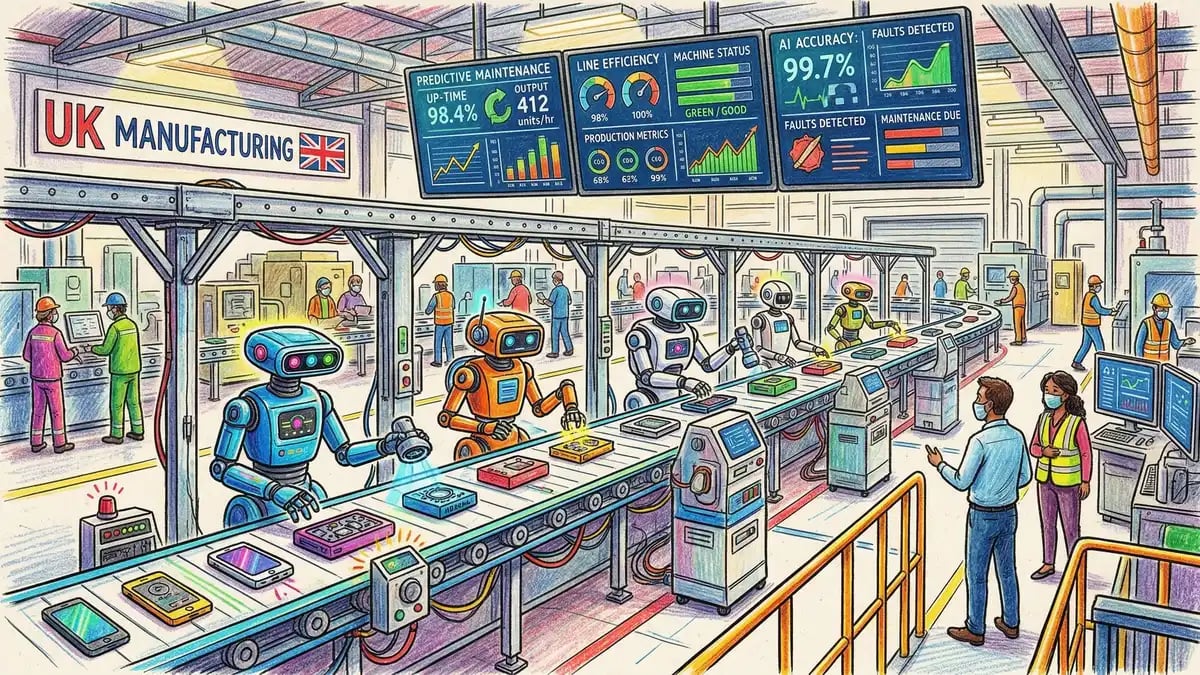
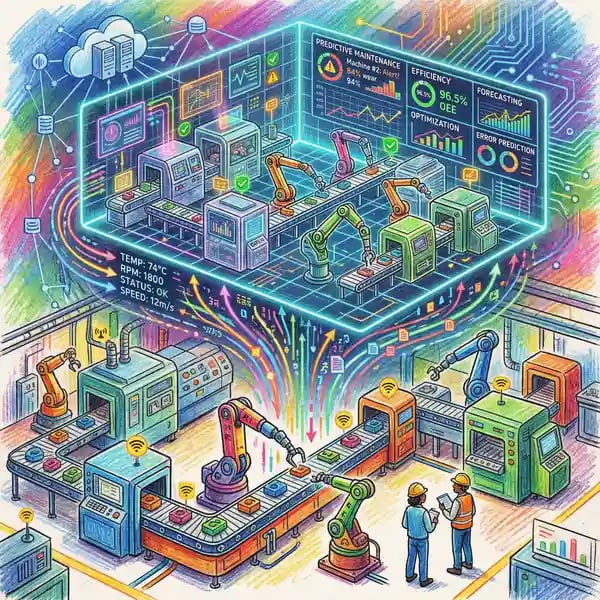
Predictive maintenance alone delivers 250% average ROI, with 95% of companies implementing predictive maintenance reporting positive returns. The median manufacturing downtime costs £125,000 per hour in the UK, making AI-driven prevention economically compelling.
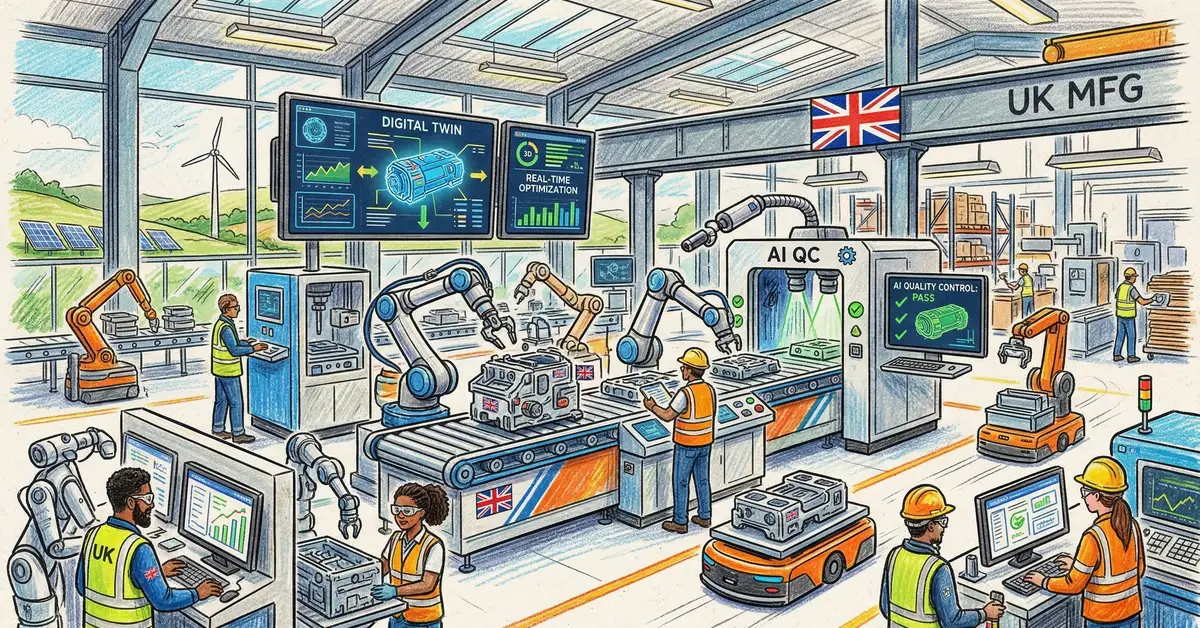
AI in manufacturing integrates intelligent systems across production, quality control, supply chain, and maintenance functions to optimise efficiency, reduce costs, and improve product quality. The UK has emerged as Europe's clear leader in AI-driven manufacturing adoption due to a convergence of factors: strong ecosystem support through programmes such as the government's Made Smarter initiative, competitive pressure from automation-focused competitors, and demonstrable ROI evidence from early adopters.
Helium42 has observed that UK manufacturers moving fastest are those combining three elements: education-led adoption (training existing teams rather than replacing them), pilot-to-scale methodology, and integration with existing systems rather than wholesale replacement. This approach proves faster and more cost-effective than traditional "big bang" transformation.

Different AI applications deliver dramatically different returns. Research across 500+ UK manufacturing implementations reveals three use cases with proven, measurable ROI:
| Use Case | Average ROI | Payback Period | Key Benefit |
|---|---|---|---|
| Predictive Maintenance | 250% (some sites achieve 10x) | 6-12 months (27% full payback within 12 months) | 70-75% reduction in unplanned breakdowns |
| Quality Control & Inspection | 200-300% | 9-15 months | Defect reduction + inspection speed 10-15x |
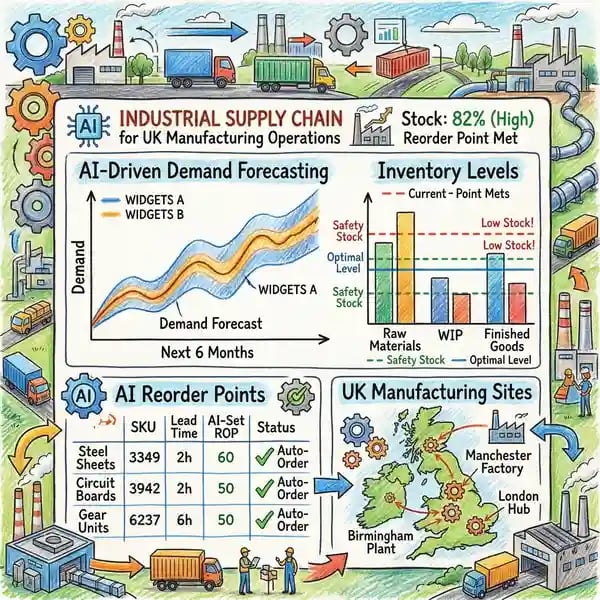
| Supply Chain & Inventory Optimisation | 150-250% | 12-18 months | Prevention of stockouts + optimal inventory levels |
The most successful implementations follow a structured pathway from pilot to scale. Helium42's experience across 500+ companies shows that manufacturing leaders move through four distinct phases:
Identify pain points and upskill your internal team. UK manufacturers report that 38% are prioritising workforce upskilling over replacement—a strategic advantage. The Made Smarter programme provides grants covering up to 50% of eligible training costs (capped at £250,000 for SMEs). This phase establishes shared language and realistic expectations across engineering, operations, and management.
Deploy AI to one production line or quality checkpoint. This typically costs £50,000-£150,000 and demonstrates proof of concept. Companies targeting predictive maintenance typically begin with equipment monitoring, whilst quality control pilots focus on computer vision systems. The pilot generates internal champions and measurable data for board presentation.
Scale to multiple lines or facilities. Mid-scale rollout typically costs £500,000-£2 million and covers integration with existing enterprise systems (ERP, MES, SCADA). The key challenge here is change management—workforce confidence built during the pilot accelerates adoption significantly.
Deploy AI across the entire manufacturing footprint and adjacent use cases. Enterprise-wide transformation typically costs £5-£50 million but generates compounding ROI. Successful companies at this stage have shifted from implementation vendor dependency to internal AI capability.
Helium42 works with UK manufacturers to identify the highest-ROI AI applications for your specific operation. Our assessment covers your current technology stack, team capability, and realistic 12-month returns.
Explore our manufacturing AI consultancy
Despite proven ROI, implementation barriers remain significant. Understanding these enables faster, more effective project planning:
Case studies from leading UK manufacturers demonstrate the scale of achievable improvements:
The aerospace manufacturer deployed AI-driven predictive maintenance monitoring complex jet engines via real-time sensor data analysis. Result: 30% reduction in unplanned downtime and 15% reduction in turbine blade defects through AI-based digital twins. Extended equipment lifespan translates directly to improved operational profitability.
The automotive manufacturer applied generative AI to analyse machine data and identify production bottlenecks. Result: 20% boost in factory efficiency and reduced waste through workflow suggestions generated by machine learning models. The optimisation suggestions were initially manual but increasingly automated as the system learned facility-specific constraints.
A mid-sized UK manufacturer combined computer vision-based quality control with predictive maintenance. Result: 90% reduction in defects and £2 million annual savings within eight months, with ROI payback in under 12 months. This integrated approach demonstrates that combining multiple AI use cases amplifies returns beyond isolated implementations.
The UK government's Made Smarter initiative directly addresses adoption barriers for manufacturing SMEs. The programme provides structured support across four areas:

Building a defensible business case requires realistic assumptions. Helium42 typically structures manufacturing AI business cases around three financial drivers:
Reduction in unplanned downtime. If your facility costs £125,000 per hour in downtime costs and predictive maintenance reduces unplanned downtime by 50%, a single production line avoiding 100 hours of downtime annually saves £12.5 million. Capital costs for the predictive maintenance system (sensors, software, integration) typically range from £80,000-£200,000 for a single line, yielding 25-30 month payback on downtime savings alone.
Reduction in defect rates and scrap costs. Computer vision systems achieve inspection 10-15 times faster than manual inspection whilst catching defects at 99%+ accuracy. A facility producing 1,000 units daily at 2% current defect rate (20 defective units) saves 18 defects daily if AI reduces the rate to 0.2%. At £500 cost per defect, that is £9,000 daily or £2.3 million annually.
Increased throughput and labour efficiency. AI-driven production line optimisation identifies workflow bottlenecks. An additional 5-8% throughput without capital equipment investment translates to revenue growth. For a facility with £20 million annual output, 6% productivity gain equals £1.2 million incremental revenue.
Conservative business cases combine cost avoidance (immediate) with quality improvement (measurable), targeting 18-24 month payback. Productivity gains typically emerge in months 9-18 and represent upside to the case.
The UK manufacturing AI market is accelerating significantly. The UK Industry 4.0 market generated USD 9.5 billion in revenue in 2023 and is projected to reach USD 30.6 billion by 2030—a 226% growth rate over seven years. This expansion is driven by four emerging trends:
Generative design algorithms now optimise product geometry based on constraints (weight, cost, manufacturing feasibility, strength). These systems reduce design cycles from weeks to days and identify manufacturing-optimal designs humans would not conceive. Aerospace and high-tech electronics are leading adoption.
Virtual manufacturing environments are becoming standard for testing changes, training staff, and validating AI interventions before physical deployment. Rolls-Royce's digital twins cut defects 15% by simulating turbine blade manufacturing before production. Expect digital twins to become mandatory for capital-intensive processes.
AI-powered demand forecasting and inventory optimisation reduce stockouts whilst decreasing carrying costs. Tesco reports 12% supply chain cost reductions through AI forecasting. Manufacturing companies increasingly view supply chain AI as a customer service differentiator.
AI inference moving from cloud to edge devices (sensors, controllers) enables subsecond decision-making without latency. Critical manufacturing applications (safety, precision alignment, defect detection) increasingly require edge AI rather than cloud-dependent systems.
UK manufacturers are achieving 10-19% cost reductions and 6-10% revenue growth through strategic AI implementation. Helium42 has guided 500+ companies through education-led AI transformation, delivering measurable results in 6-8 weeks rather than 6-8 months.
Start your manufacturing AI consultationA pilot project on a single production line typically takes 6-16 weeks (phases 1-2 combined). Mid-scale rollout across multiple lines requires 6-12 months (phases 2-3). Enterprise-wide transformation varies from 12-36 months depending on facility count and system complexity. Helium42's education-led approach accelerates timelines by 30-40% compared to traditional implementation by building internal capability in parallel with deployment.
No. SMEs are the primary Made Smarter programme participants. Typical SME pilots cost £50,000-£150,000 and target a single production line or quality checkpoint. Made Smarter grants cover 50% of these costs (maximum £250,000 for SMEs), making genuine AI implementation accessible to companies with 10-249 employees. SME adoption barriers are more often skills and change management than capital availability.
Rarely. Most AI implementations integrate with existing ERP, MES, and SCADA systems rather than replace them. Integration typically comprises 30-40% of project costs. Helium42 recommends assessment of legacy system modernisation readiness (sensor availability, data pipeline quality, security baseline) before committing to budget. Some older systems may require equipment sensors or firmware updates, but wholesale replacement of functioning machinery is almost never necessary.
Regulatory requirements vary significantly by sector. Aerospace/defence manufacturers must meet AS9100/DO-254 digital equipment standards and CE/UKCA machinery marking. Pharmaceutical sites require ICH Q14 validation and FDA 21 CFR Part 11 standards for digital systems. Food and beverage operations must ensure COSHH traceability. The Machinery Safety Directive requires human oversight of autonomous robotic systems. Regulatory complexity typically adds 2-4 weeks to implementation and should be factored into project planning and budgets from the outset.
Research shows that 38% of UK manufacturers implementing AI prioritise upskilling existing staff over hiring external talent. Rather than replacing workers, AI tends to reshape roles: operators move from manual inspection to anomaly investigation, maintenance technicians shift from reactive repair to predictive analytics interpretation, and quality teams focus on trend analysis rather than individual unit checking. Helium42's education-led implementation model explicitly builds internal AI capability so teams understand and own the transformation—significantly reducing resistance and improving adoption outcomes.
Helium42 assesses manufacturing AI opportunity across three criteria. First, identify quantifiable pain points: unplanned downtime, high defect rates, or supply chain inefficiency. Second, evaluate data readiness: can you access sensor data or create data feeds from existing systems? Third, assess team capability: do you have or can you develop internal competency to manage AI systems? If two of three criteria are strong, immediate ROI opportunity exists. Assessment conversations typically require 4-6 hours and generate a customised business case with 12-24 month payback projections.
Peter Vogel is the co-founder of Helium42, an AI consultancy specialising in education-led transformation for UK and European businesses. Peter has guided 500+ companies through AI adoption programmes, delivering an average 40% efficiency improvement in 6-8 weeks. His expertise spans strategic AI planning, implementation methodologies, team capability building, and ROI measurement across manufacturing, financial services, and professional services sectors.
For UK operations and IT teams, the pressure is mounting. Teams juggle alert fatigue (75% of IT teams experience this monthly), tool sprawl (100–300...

AI for Supply Chain and Procurement: How UK Businesses Are Optimising Operations Artificial intelligence is reshaping how UK businesses forecast...
Artificial Intelligence is reshaping how UK real estate professionals operate. From predictive property valuations to compliance-driven tenant...