
Published by

Seventy-eight per cent of organisations have adopted AI in some form. Only one per cent have reached maturity. The gap between pilot and production is where most implementations die — and it is almost always a failure of process, not technology. 42% of UK AI projects are scrapped entirely, and 46% of proofs of concept never reach production.
This guide is the complete plan: the five phases, the practical checklist, and the decisions to make at each step. If you want the week-by-week sequence instead, follow our AI implementation roadmap; if you are weighing a fast first build, see how we deliver an eight-week AI MVP.
This guide provides a complete, week-by-week implementation roadmap designed for UK businesses moving from pilot to production. It covers the five phases that separate successful AI deployments from the 80% that fail: readiness assessment, pilot design, build and integration, change management, and measurement. Each phase includes specific deliverables, decision gates, and the common failure points we see repeatedly across mid-market implementations.
Definition: AI implementation is the structured process of deploying artificial intelligence solutions within a business — from initial data readiness assessment through pilot, production build, team training, and ongoing optimisation. It is distinct from AI strategy (which defines what to build), AI consultancy (which provides who to build with), and AI training for business teams (which builds internal capability to sustain what you deploy).
Key Takeaway
Successful AI implementation follows a five-phase roadmap over six to eight weeks for initial deployment, with full ROI realisation in twelve to eighteen months. The organisations that succeed invest 40% of their budget how much AI development costs in 2026 in integration and data work, 20% in training and change management, and treat the pilot as a business experiment — not a technology demo. Skip any phase and your probability of failure rises sharply.
78%
Organisations adopting AI
42%
UK projects scrapped
150–250%
Typical 3-year ROI
6–8
Weeks to first deployment
Why Most AI Implementations Fail
Before building a roadmap, it is worth understanding why most fail. The patterns are remarkably consistent across industries and company sizes:
| Failure Point | Frequency | Root Cause | Prevention |
|---|---|---|---|
| Data unreadiness | 61% | Fragmented, low-quality, or inaccessible data; poor data governance AI governance framework AI compliance requirements for regulated industries | Phase 1 readiness assessment with data audit |
| Cultural resistance | 67% | Inadequate training; fear of displacement; no executive sponsorship | Phase 4 change management + executive buy-in from day one |
| No business alignment | 30% | Technology-led projects without clear business objectives or KPIs | Phase 1 business case with measurable outcomes |
| Pilot-to-production gap | 46% | No governance framework; insufficient infrastructure for scaling AI transformation programme | Phase 3 production architecture designed from the start |
| Skills gap | 45% | Only 45% of UK enterprises provide AI training; internal capability not built | Phase 4 structured knowledge transfer programme |
Poor data quality alone costs the UK economy an estimated £244 billion annually. When you layer in failed AI projects — 36% of which fail before they even start due to data unreadiness — the argument for a structured implementation process becomes incontrovertible.
Helium42 applies the Education-to-Implementation Pathway, a three-phase methodology that sequences AI adoption: leadership literacy across the executive team, pilot design grounded in a single measurable outcome, and managed scaling once the pilot proves value. We have applied this Pathway with over 500 leaders and more than 2,000 professionals across UK and DACH organisations. The five-phase roadmap below reflects how we structure the implementation portion of that work for operations leaders who need governance, measurement, and momentum to coexist.
The Five Phases of AI Implementation
This roadmap has been refined across dozens of mid-market implementations. It is designed for a six to eight week initial deployment, with full production scaling over three to six months. Each phase has specific deliverables and a decision gate — you do not proceed until the gate criteria are met.
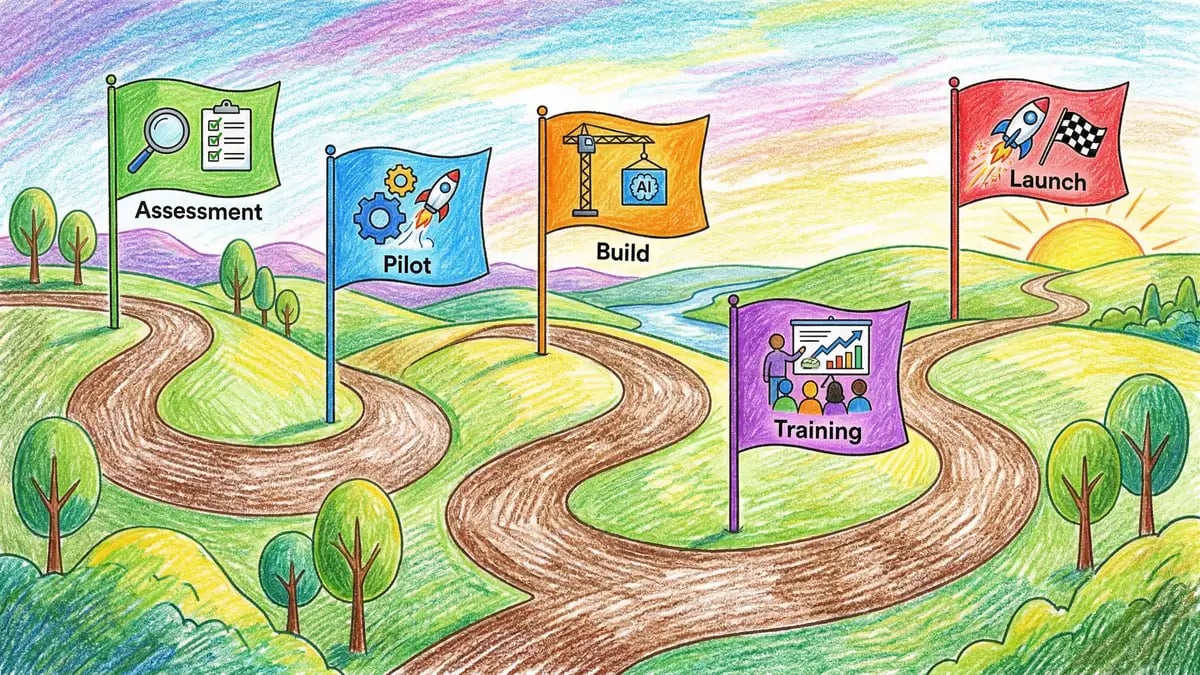
Phase 1: Readiness Assessment (Weeks 1–2)
This is where 36% of UK AI projects fail — before they even begin. The readiness assessment determines whether your organisation has the data, infrastructure, skills, and executive commitment to succeed.
Key activities:
- Data audit: Assess quality, accessibility, governance, and completeness across every data source the AI solution will touch. Score readiness using a maturity template covering data quality, infrastructure, talent, and workflows.
- Business case development: Define two to three use cases with measurable KPIs (revenue impact, cost reduction, efficiency gain). Prioritise by business impact versus implementation complexity.
- Stakeholder mapping: Identify executive sponsor, project owner, technical lead, and change champions. Secure sustained C-suite involvement — organisations with executive buy-in achieve 2.5x higher ROI.
- Compliance review: Map requirements against the UK's five AI principles (safety, security, transparency, fairness, accountability) and sector-specific regulations. The ICO's statutory code of practice on AI and automated decision-making (expected autumn 2025) will create legal AI implementation in legal practicely binding standards.
- Budget allocation: Apply the 40-30-20-10 rule — 40% integration and data work, 30% software and infrastructure, 20% training and change management, 10% ongoing operations.
Phase 1 Decision Gate
Proceed only when: (1) data readiness score exceeds minimum threshold, (2) executive sponsor is named and committed, (3) two to three use cases are prioritised with measurable KPIs, (4) compliance requirements are mapped. If data readiness fails, invest in data quality remediation before proceeding — it will save you multiples of the cost later.
Phase 2: Pilot Design and Execution (Weeks 2–4)
The pilot is a business experiment, not a technology demonstration. Its purpose is to prove business value, identify integration challenges, and build organisational confidence before committing to production investment.
Key activities:
- Use case selection: Choose the highest-impact, lowest-complexity use case from Phase 1. Common first pilots: customer service automation, document processing, sales forecasting, marketing content generation.
- Success criteria: Define specific, time-bound KPIs. Examples: "Reduce average ticket resolution time by 25% within four weeks" or "Generate 40% more qualified marketing content with the same team."
- Technology evaluation: Assess build versus buy. For most mid-market companies, buying proven platforms and customising them delivers faster time-to-value than building from scratch. The exception is when your use case requires proprietary data models or strict data sovereignty.
- Data pipeline construction: Build the minimum viable data pipeline — extract, transform, load (ETL) for the specific use case. This is where 40% of your budget should concentrate.
- Pilot execution: Run for four to six weeks with a dedicated team. Document everything — successes, failures, integration challenges, user feedback. The UK's FCA and other regulators offer sandbox environments for testing in regulated sectors.
Build vs Buy Decision Framework
Buy when: budget is under £80,000, timeline is under eight weeks, use case is common (content, customer service, analytics), team has limited AI experience. Cost: £96–£480 per user per year for SaaS tool custom AI vs pre-built tools comparisons; £30,000–£80,000 for agency-led projects.
Build when: use case requires proprietary data models, data sovereignty is non-negotiable, competitive advantage depends on custom AI, team has in-house AI engineering capability. Cost: £60,000–£300,000+ over six to twelve months.
Phase 2 Decision Gate
Proceed only when: (1) pilot meets or exceeds at least 70% of defined KPIs, (2) integration challenges are documented with solutions, (3) user feedback is positive or constructively actionable, (4) total cost of ownership for production is estimated. If the pilot fails, iterate — do not scale a failing solution.
Phase 3: Production Build and Integration (Weeks 4–6)
This is the phase where most organisations stall. The technical requirements for production AI are fundamentally different from a pilot — monitoring, governance, security, and scalability all become critical.
Key activities:
- Production architecture: Deploy MLOps or LLMOps infrastructure for model monitoring, version control, and drift detection. GPU-accelerated cloud infrastructure typically costs £30,000–£80,000 per year for mid-market deployments.
- API integration: Connect AI outputs to existing business systems (CRM, ERP, marketing automation) via standardised APIs and middleware. Real-time data flows are essential for production accuracy.
- Governance framework: Establish AI governance before deployment — designate an AI officer, define approval workflows for model updates, create audit trails for compliance. This is not optional; it is the difference between scaling and stalling.
- Security and compliance: Implement bias-testing tools, GDPR compliance processes, data anonymisation, and audit logging. Prepare for the UK AI Bill (expected H2 2026) and ICO statutory codes.
- Performance dashboards: Build real-time monitoring dashboards tracking model accuracy, uptime, user engagement, and business KPIs. Continuous monitoring catches drift and degradation before they impact results.
Typical UK Implementation Costs by Company Size
| Company Size | Year 1 Budget | 5-Year Total | Hidden Costs | Typical ROI |
|---|---|---|---|---|
| Micro (1–10 staff) | £2,000–£10,000 | £10,000–£50,000 | Training: £2k–£5k | 100–200% |
| Small (10–50 staff) | £15,000–£75,000 | £75,000–£200,000 | Integration: £20k–£40k | 150–250% |
| Medium (50–250 staff) | £50,000–£250,000 | £200,000–£500,000 | Governance: £15k–£30k | 200–350% |
| Enterprise (250+ staff) | £100,000–£500,000+ | £500,000–£2,000,000+ | Change mgmt: £50k–£150k | 150–500%+ |
Hidden Cost Warning
Hidden costs typically comprise 60% of the five-year total. The biggest surprises: maintenance and model retraining (years 2–3 cost £31,000–£54,000 annually for SMEs), scaling infrastructure (40–80% increase), and security/compliance overhead (15–25% of year 1). Budget for these from the start — not as afterthoughts.
Phase 3 Decision Gate
Proceed only when: (1) production infrastructure passes load testing, (2) governance framework is documented and assigned, (3) security audit is complete, (4) monitoring dashboards are live and tested. Do not go live without real-time monitoring — you will miss drift and degradation.
Phase 4: Change Management and Training (Weeks 5–7)
This is where the human side of AI implementation determines success or failure. 67% of UK leaders cite cultural resistance as a primary barrier. Technology is the easy part; getting people to adopt it is where most organisations underinvest.
Key activities:
- Training programme design: Budget £8,000–£20,000 for year one training (SMEs). Cover tool proficiency, workflow integration, data handling, and governance procedures. Ongoing: £3,000–£8,000 per person per year as models and tools evolve.
- Change champions network: Identify two to three enthusiastic early adopters per department. Give them advanced training, involve them in pilot design, and position them as internal advocates. This is more effective than top-down mandates.
- Communication strategy: Address fears directly. Frame AI as augmentation, not replacement. Share pilot results with specific numbers — "the marketing team now produces 40% more content in the same hours" is more compelling than abstract capability descriptions.
- Workflow redesign: Map how AI changes existing processes. Identify which manual tasks are automated, which are augmented, and which remain unchanged. Document the new workflows before go-live.
- Feedback loops: Establish weekly feedback sessions during the first month of production. Domain-specific labs where teams can experiment safely accelerate adoption and surface integration issues early.
Phase 4 Decision Gate
Proceed only when: (1) all primary users have completed training, (2) change champions are active in each department, (3) new workflows are documented and accessible, (4) feedback mechanism is operational. Launching without training creates resistance that is exponentially harder to reverse later.
Phase 5: Launch, Measurement, and Optimisation (Weeks 6–8+)
The launch is not the end — it is the beginning of the measurement cycle. High-performing organisations achieve ROI in under twelve months by implementing real-time monitoring and continuous optimisation from day one.
Key activities:
- Phased rollout: Start with one department or function. Scale to additional teams only after confirming stability, user adoption, and measurable results. Avoid big-bang launches — they amplify risk.
- Three-tier ROI measurement: Track realised ROI (cost savings, revenue gains — measurable at 18–36 months), trending ROI (efficiency and productivity improvements — visible at 3–12 months), and capability ROI (skills built, infrastructure matured — ongoing).
- KPI dashboard: Monitor financial metrics (cost reduction, revenue impact), efficiency metrics (process time, error rate), quality metrics (accuracy, user satisfaction), and adoption metrics (active users, feature utilisation).
- Model maintenance: Schedule regular model retraining cycles. Monitor for data drift, accuracy degradation, and bias emergence. Budget £31,000–£54,000 annually for ongoing maintenance (mid-market).
- Scaling decisions: Use pilot results to prioritise the next use case. Successful implementations typically expand to two to three additional functions within twelve months.
ROI Measurement Framework
| ROI Tier | Timeframe | What to Measure | Benchmark |
|---|---|---|---|
| Realised | 18–36 months | Direct cost savings, revenue gains, headcount efficiency | 150–250% over 3 years; payback 12–18 months |
| Trending | 3–12 months | Productivity improvements, process speed, error reduction | 40% average efficiency gain (industry benchmark) |
| Capability | Ongoing | Skills development, infrastructure maturity, data quality improvement | Top 20% achieve >500% ROI through governance investment |

Where to Start: High-Impact First Use Cases
Choosing the right first use case is critical. The best best AI tools for business pilots are high-impact, low-complexity implementations that prove value quickly and build organisational confidence for broader adoption.
| Use Case | Department | Expected Impact | Complexity | Timeline |
|---|---|---|---|---|
| Content generation | Marketing | 40% more output, same team | Low | 2–4 weeks |
| Customer service automation | Support | 25–30% ticket reduction | Low | 4–6 weeks |
| Sales forecasting | Sales | 15% faster cycle times | Medium | 4–8 weeks |
| Document processing | Operations / Legal | 60–80% time savings on review | Medium | 6–8 weeks |
| Predictive analytics | Finance AI automation for accounting AI for finance and accounting / Operations | 20–30% forecast accuracy gain | High | 8–12 weeks |
For most mid-market organisations, content generation or customer service automation are the strongest first pilots. They are low-complexity, deliver visible results within weeks, and build the organisational muscle for more ambitious implementations. Avoid starting with predictive analytics or custom model builds — save those for Phase 2 once your team has production AI experience.
UK Regulatory Landscape: What You Must Know
The UK's approach to AI regulation is evolving rapidly. Understanding the current and incoming requirements is essential for any implementation.
- Five core AI principles: Safety, security, transparency, fairness, accountability and contestability. These are applied by existing sector regulators (FCA, ICO, Ofcom, CMA) rather than a single AI regulator.
- ICO statutory code of practice: Expected autumn 2025, this will create legally binding standards for AI and automated decision-making. Prepare now by documenting your AI decision processes and ensuring data subject rights are protected.
- AI Bill: Expected H2 2026, building on the Data Use and Access Act (passed June 2025). Will likely introduce formal obligations for high-risk AI systems.
- Regulatory sandboxes: The FCA's supercharged sandbox (launched 2025) allows businesses to test AI innovations with real consumers under regulatory oversight. Valuable for financial services, insurance, and legal implementations.
- DRCF coordination: The Digital Regulation Cooperation Forum (ICO, Ofcom, CMA, FCA) is developing cross-regulatory guidance for AI. Their 2025/26 work plan focuses on how existing regulatory regimes apply to AI.

Week-by-Week Implementation Checklist
| Week | Phase | Key Deliverables | Decision Gate |
|---|---|---|---|
| 1 | Readiness | Data audit complete, stakeholder map, compliance requirements | Data readiness score |
| 2 | Readiness → Pilot | Business case approved, use cases prioritised, budget allocated | Executive sign-off |
| 3 | Pilot | Technology selected, data pipeline built, pilot launched | Pipeline operational |
| 4 | Pilot → Build | Pilot results analysed, production architecture designed | KPIs met (70%+ target) |
| 5 | Build | Production infrastructure deployed, APIs integrated, governance live | Security audit passed |
| 6 | Training | All users trained, change champions active, workflows documented | Training completion rate |
| 7 | Launch | Phased rollout to first department, monitoring dashboards live | Stability confirmed |
| 8+ | Optimisation | KPI review, model tuning, scaling plan for next use case | ROI tracking initiated |
Download the Implementation Checklist
Use the week-by-week checklist above to track your implementation progress. Each decision gate ensures you are building on a solid foundation before committing further resources.
Talk to our implementation teamFrequently Asked Questions
Q: How long does AI implementation take?
A: Initial deployment takes six to eight weeks using the five-phase roadmap. Full production scaling typically requires three to six months, with realised ROI measurable at twelve to eighteen months. High performers with strong governance can achieve measurable returns in under twelve months. Quick-win pilots in marketing, sales, or customer service can show results in four to six weeks.
Q: How much does AI implementation cost for a UK SME?
A: Year one costs range from £2,000–£10,000 (micro businesses using off-the-shelf tools) to £50,000–£250,000 (medium businesses with multi-function deployment). The critical insight: hidden costs — maintenance, training, scaling — comprise 60% of the five-year total. Apply the 40-30-20-10 budget rule and plan for years two and three from the start.
Q: What is the typical ROI for AI implementation?
A: Typical three-year ROI is 150–250% for mid-market companies, with payback in twelve to eighteen months. Top performers (the top 20%) achieve over 500% ROI by investing an additional 15–20% in governance and change management. The key metric is not just financial return but capability building — organisations that invest in internal skills see compounding returns over time.
Q: Should we build or buy our AI solution?
A: Buy for standard use cases (content generation, analytics, customer service) when budget is under £80,000 and timeline is under eight weeks. Build for proprietary data models, data sovereignty requirements, or competitive advantage use cases. Most mid-market companies should start with buy, then build custom components as internal capability matures.
Q: What are the biggest risks of AI implementation?
A: Data unreadiness (61% of failures), cultural resistance (67%), and the pilot-to-production gap (46% of proofs of concept never reach production). The most overlooked risk is regulatory: the ICO's statutory code of practice (expected autumn 2025) and the AI Bill (H2 2026) will create legally binding obligations. Organisations that build compliance into their implementation from the start will avoid costly retrofitting.
Ready to Implement AI?
The five-phase roadmap above works across industries and company sizes. The difference between the 42% that fail and the organisations that achieve 150–250% ROI comes down to process discipline: readiness assessment, structured pilots, governance, change management, and continuous measurement.
Helium42's approach: We deliver measurable results in six to eight weeks using this exact framework. Education-led implementation, knowledge transfer built into every phase, and outcomes-based pricing so our incentives are aligned with yours.
Conclusion
AI implementation is not a technology problem. It is an organisational challenge that requires structured process, executive commitment, data readiness, and — above all — investment in people. The statistics are clear: 78% of organisations are adopting AI, but only 1% have reached maturity. 42% of UK projects are scrapped. The gap between ambition and execution is a process gap.
The five-phase roadmap closes that gap. It ensures you assess readiness before investing, prove value before scaling, build governance before deploying, train people before launching, and measure continuously from day one. Organisations that follow this approach achieve 150–250% ROI over three years — and the top performers achieve over 500%.
Start with Phase 1. Assess your data readiness, define your business case, secure executive sponsorship, and map your compliance requirements. Then choose the right implementation partner using our twelve-point evaluation checklist, or explore what an AI consultancy can deliver for your organisation.
Sources and Data Points
This article synthesises research from authoritative sources including McKinsey, PwC, Deloitte, Accenture, UK Information Commissioner's Office, Financial Conduct Authority, and industry implementation benchmarks. Data includes UK-specific statistics on project success rates, cost benchmarks, regulatory developments, and ROI frameworks. week-by-week AI implementation roadmap Helium42's education-led AI consultancy agentic AI for business AI training as a foundation for implementation AI for sales teams AI for marketing operations AI for business guide AI strategy framework
AI implementation in HR departments healthcare AI implementation AI implementation in education AI implementation for retailers construction AI implementation customer service AI implementation manufacturing AI implementation supply chain AI implementation AI chatbots for customer service
whether to build or buy AI solutions
generative AI development services
what AI consulting actually costs in the UK
legal AI drafting workflows AI for legal drafting AI readiness for marketing leaders