

Published by

Agentic AI has moved from laboratory concept to boardroom reality. This year, 35% of organisations are already deploying autonomous AI agents, while 44% are actively planning implementation. The global agentic AI market is forecast to grow from £5.5 billion in 2025 to £37.6 billion by 2032 at a compound annual growth rate of 41.8%. For business leaders, the question is no longer whether agentic AI will impact your organisation, but when and how you should adopt it.
What Exactly Is Agentic AI?
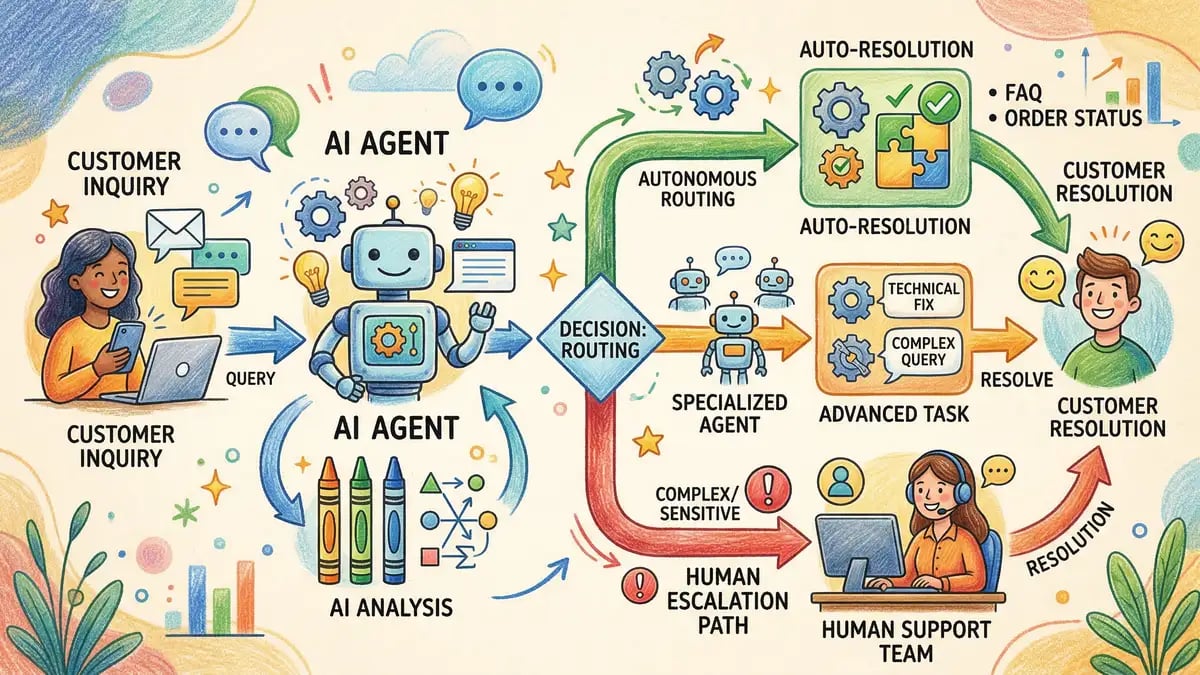
Agentic AI differs fundamentally from the chatbots and assistants most organisations have tested. Where conventional language models respond to individual queries, agentic AI systems are goal-directed. They receive an objective, then independently plan, execute, and refine sequences of actions until they resolve the problem.
Core characteristics define agentic AI systems. They exhibit autonomous reasoning, meaning they can decompose complex problems without human intervention. They possess tool integration, accessing APIs, databases, and workflows to take real-world actions. They maintain memory across interactions, building context for improved decisions. They demonstrate multi-step planning, executing workflows that might span dozens of actions. And critically, they operate within guardrails, respecting constraints and human oversight boundaries.
This is distinct from retrieval-augmented generation (RAG) systems or prompt engineering. Agentic AI represents genuine automation of decision-making processes, not document lookup or template completion.
Where Are Organisations Deploying Agentic AI Today?
The earliest and most mature agentic AI applications cluster around customer-facing operations. Gartner forecasts that by 2029, agentic AI will autonomously resolve 80% of routine customer service inquiries without human escalation. Current deployments show productivity gains of 20–30% in support operations, with response times reduced by 50–70% for common scenarios.
Sales qualification represents another high-impact domain. Leading early adopters report 60% reduction in time spent on initial prospect screening, allowing sales teams to focus on relationship-building with qualified leads. These agents conduct initial discovery calls, verify fit, and route prospects to appropriate sales professionals—freeing human experts from administrative triage.
Back-office operations are next. Agentic AI systems now handle invoice processing, expense reconciliation, employee onboarding workflows, and contract analysis. McKinsey research indicates 72% of enterprises have adopted AI in some form, but most remain at earlier maturity levels. Agentic AI deployment is expanding this footprint significantly.
Vendor Landscape Snapshot
Salesforce Agentforce, Microsoft Copilot Studio, and ServiceNow AI Agents are the three dominant enterprise platforms. Each integrates with existing CRM, workflow, and business system investments. Smaller specialised platforms focus on specific use cases (customer service, sales, HR, finance AI in finance operations). Organisations typically adopt agents incrementally—starting with a single department or workflow, then expanding as internal expertise and governance frameworks mature.
What Measurable Returns Should You Expect?
The financial case for agentic AI adoption is compelling for early movers. Industry research indicates that early adopters achieve return on investment exceeding 100% within 12–24 months. This comes from three primary levers: labour cost reduction, increased throughput with existing teams, and quality improvements that reduce rework and escalation.
20–30%
Productivity Gain
Customer service operations
60%
Time Reduction
Sales qualification workflows
100%+
ROI Achieved
12–24 months for early adopters
However, cost structure differs materially from conventional AI. Token consumption—the computational cost of running inference—can be 10–50 times higher for agentic systems than single API calls. This is because agents make multiple reasoning steps, exploring branching decision trees and re-evaluating actions. Budgeting for operational costs requires careful modelling of agent activity patterns.
Understanding Real Costs
Agentic AI deployment requires detailed cost modelling. We help organisations forecast token consumption, optimise agent architecture for cost-efficiency, and identify workflows where the ROI threshold justifies the operational spend.
Read Our ROI Guide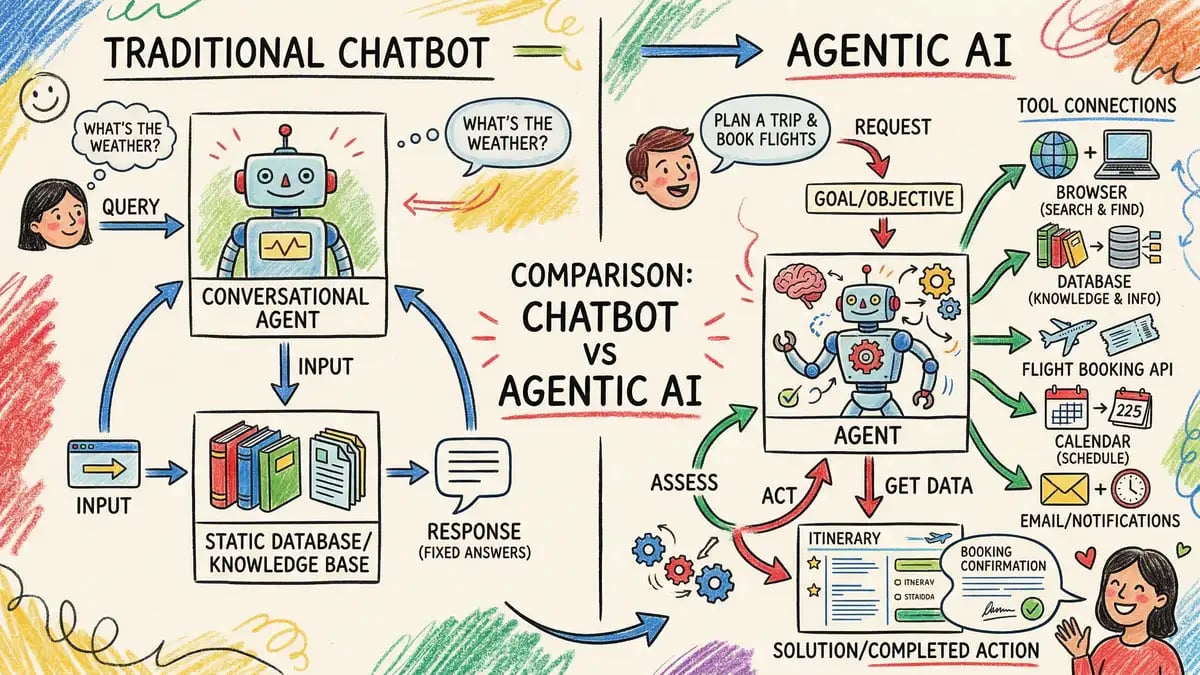
What Guardrails and Governance Must Be in Place?
Autonomy without guardrails is risk without control. Successful agentic AI programmes establish governance frameworks before agents enter production. This includes explicit permission boundaries—defining which data sources an agent can read, which systems it can write to, and which actions require human approval.
Access governance is non-negotiable. An agent handling customer support should never have production database write access. An agent qualifying sales leads should not be able to modify customer credit limits. Role-based access control and principle-of-least-privilege architecture become operationally critical.
Escalation protocols must be defined. Human-in-the-loop approval remains essential for high-stakes decisions: contract modifications, refund approvals exceeding thresholds, or situations where agent confidence falls below defined levels. The governance framework specifies which decision types auto-approve, which require asynchronous approval, and which demand synchronous human review.
Audit trails are mandatory. Every agent action must be logged with reasoning captured. When an agent makes a consequential decision, your organisation must be able to explain why. This is both a compliance requirement and an operational necessity for continuous improvement.
Security Considerations
Agentic systems amplify security surfaces. A poorly constrained agent with API access can execute actions at machine speed. Organisations must conduct threat modelling specific to agentic AI—mapping potential failure modes, permission misuse scenarios, and adversarial inputs. Security reviews must occur before deployment and continue through operational monitoring.

How Should You Approach Adoption?
Agentic AI adoption follows a maturity progression. Stage 1 focuses on single-domain pilots—typically customer service or sales qualification—with high ROI, contained risk, and clear success metrics. Stage 2 scales proven agents to related domains with similar characteristics. Stage 3 builds cross-functional workflows where multiple agents collaborate.
Successful programmes share common patterns. They begin with a clear business objective, not technology enthusiasm. They establish governance and cost monitoring frameworks before building. They involve process owners and domain experts in agent design, not just technologists. They invest in change management and team upskilling, since agentic AI fundamentally alters how work gets done.
The adoption timeline typically spans 6–12 months from initial planning to productive deployment. This includes discovery and assessment, technical architecture design, agent development and testing, governance framework implementation, team training, and careful production rollout with human oversight.
We recommend reading our AI implementation roadmap and transformation playbook for detailed guidance on structuring a programme that fits your operational context.
Frequently Asked Questions
How does agentic AI differ from a chatbot?
Chatbots are reactive. You ask a question; the chatbot searches a knowledge base and responds. Agentic AI is proactive and autonomous. You give it a goal; the agent plans actions, executes them, observes outcomes, and refines its approach until the objective is met. An agent can access live data systems, modify records, call external APIs, and make multi-step decisions without human prompting between steps.
Can agentic AI work in regulated industries like financial services?
Yes, with appropriate controls. Regulated industries require additional governance: human sign-off on certain decisions, enhanced audit trails, and integration with compliance monitoring systems. Major financial institutions and healthcare organisations are piloting agentic AI in controlled environments. The regulatory framework is evolving; we recommend consulting legal expertise for your specific industry and jurisdiction.
What happens when an agent makes a mistake?
Agent failures are monitored, logged, and used to improve agent behaviour. Escalation guardrails catch decisions below confidence thresholds. Human-in-the-loop approval catches high-risk actions. When failures do occur, detailed audit trails allow root-cause analysis. Early adopters treat agent mistakes as learning signals, not failures—incorporating feedback into agent retraining and workflow refinement.
How much does agentic AI cost compared to traditional automation?
Initial implementation costs are comparable to legacy RPA (robotic process automation): typically £50,000–500,000 depending on complexity and scope. Operational costs depend on token consumption—higher than chatbots but lower than human labour for equivalent throughput. Break-even analysis usually favours agentic AI when replacing knowledge-worker time or when scaling customer-facing operations. We model costs specific to your use case during discovery.
Is my organisation too small for agentic AI?
Scale requirements depend on the use case. A small B2B SaaS company might deploy a sales qualification agent handling 50 leads per week. A mid-market retailer might use agents for customer service. Smaller organisations often see outsized returns because agent efficiency amplifies limited team capacity. The question is not organisation size, but whether you have a workflow with sufficient volume and marginal economics that justify implementation.
How do I build the internal skills to support agentic AI?
Agentic AI requires blended expertise: business process owners, data engineers, AI engineers, and governance specialists. Most organisations hire or upskill selectively—retaining external partners for platform architecture and complex workflow design, while building internal capacity for ongoing management and optimisation. We offer executive and technical training programmes tailored to your team structure and use cases.
The Competitive Urgency
Gartner forecasts that by 2028, 33% of enterprise software will include agentic AI capabilities—up from less than 1% in 2024. This represents a five-year window where early adopters gain competitive advantage through process efficiency and customer experience. The second wave of adoption (2028 onwards) will face commodity agentic AI in standard platforms, reducing differentiation.
For UK organisations, this timeline is compressed. US adoption is already mature; European and UK markets are 12–18 months behind. Starting agentic AI exploration now positions your organisation to implement during the window where agents deliver outsized value.
The question is not whether agentic AI is relevant to your business. Across customer service, sales, back-office operations, and specialised domains, autonomous AI is reshaping competitive advantage. The question is whether your organisation will lead or follow this transition.
Ready to Explore Agentic AI for Your Organisation?
We help mid-market and enterprise organisations design, implement, and govern agentic AI programmes that deliver measurable returns. Our discovery process identifies high-impact use cases, models costs and benefits, and builds a roadmap tailored to your competitive context.
Book a Discovery CallRelated Reading
Sources: McKinsey, The State of AI in 2024; MIT Sloan, AI Adoption Survey 2026; Gartner, Agentic AI Forecast 2028; DataForSEO market analysis agentic AI in sales agentic AI in marketing agentic AI training complete guide to AI for business AI strategy guide