
Published by

Fifty-two per cent of UK tech leaders now cite AI as their most difficult role to fill — a 114% increase in twelve months. Yet 61% of UK businesses have no staff working with AI at all, and only 21% of workers feel confident using it in their role. The gap between AI adoption ambition and workforce readiness is the single largest barrier to implementation success.
This guide provides a structured learning roadmap for business team AI training for HR professionalss — from foundational AI literacy through department-specific applications to advanced prompt engineering and governance regulatory compliance obligations. It is designed for organisations that want to build internal AI capability rather than remain dependent on external AI consultants, and it covers the training investments, formats, and competency frameworks that deliver measurable returns.
Definition: AI training for business is the structured process of developing AI literacy, tool proficiency, and strategic thinking across non-technical teams. It goes beyond tool tutorials to encompass data awareness, ethical use, prompt engineering, workflow redesign, and the organisational change management needed to embed AI into daily operations.
Key Takeaway
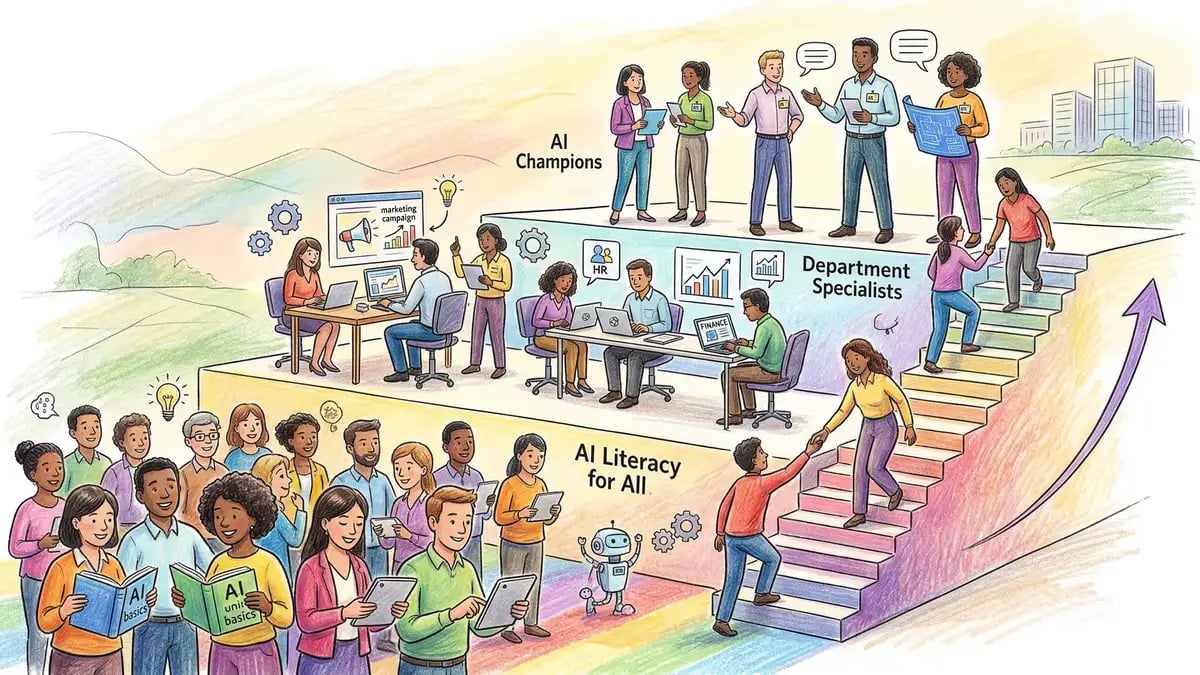
Effective AI training follows a three-tier model: AI literacy for everyone (awareness, ethics, basic use), department-specific applications (marketing, sales AI for sales, finance AI applications in finance, HR), and advanced capabilities (prompt engineering, workflow automation, governance). Organisations that invest in structured training achieve 2.5x higher ROI on their AI implementations and overcome the 67% cultural resistance barrier that derails most projects.
52%
Cannot fill AI roles
61%
No staff using AI
2.5x
Higher ROI with training
3.9m
UK AI jobs by 2035
Why AI Training Is a Business Priority, Not an HR Initiative
The UK Government's "AI Skills for Life and Work" report projects that AI-related jobs could reach 3.9 million (12% of the current workforce) by 2035, with a further 9.7 million people in adjacent roles that require AI literacy. This is not a niche skill set — it is a fundamental workforce capability that will determine competitive positioning for the next decade.
Yet the current state is alarming. 56% of UK employers rate their workforce AI knowledge as "beginner" or "novice". Only 17% of UK adults can explain AI in detail. Skills for AI-exposed jobs are changing 66% faster than for other roles, meaning that training must be continuous — not a one-off workshop. Technical skills now become outdated within three years.
The business case is clear: organisations with sustained executive buy-in for AI training achieve 2.5x higher ROI on their AI investments. Training is not a cost centre — it is the primary driver of implementation success. The 67% of leaders who cite cultural resistance as their biggest barrier are describing a training problem, not a technology problem.
The Cost of Not Training
42% of UK AI projects are scrapped entirely — and the primary reasons are skills gaps and cultural resistance, not technology failures. Every AI implementation that fails due to inadequate training costs the organisation not just the direct investment (typically £50,000–£250,000 for mid-market companies) but also twelve to eighteen months of lost competitive advantage and team morale damage that makes the next attempt harder.
The Three-Tier AI Training Model
Effective AI training is not one-size-fits-all. Different roles require different depths of knowledge. This three-tier model ensures every team member gets the right level of training for their responsibilities.
Tier 1: AI Literacy (All Staff — 4–8 Hours)
Every employee needs foundational AI literacy, regardless of their role. This is not about making everyone a data scientist — it is about ensuring your entire organisation understands what AI can and cannot do, how to use it responsibly, and how it will change their work.
Core curriculum:
- What AI is (and is not): Demystify AI terminology. Explain the difference between generative AI, machine learning, and automation. Address common misconceptions — AI is not sentient, it does not replace all jobs, and it makes mistakes.
- Responsible governance and ethics framework use and ethics: Cover the UK's five AI principles (safety, security, transparency, fairness, accountability). Explain data privacy obligations under GDPR. Define what company data can and cannot be shared with AI tools.
- Basic prompting skills: Teach fundamental prompt engineering — clear instructions, context-setting, output formatting, and iterative refinement. This single skill delivers immediate productivity gains across all departments.
- Critical evaluation: Train staff to verify AI outputs, recognise hallucinations, and understand when human judgement must override AI recommendations. This is essential for maintaining quality and compliance.
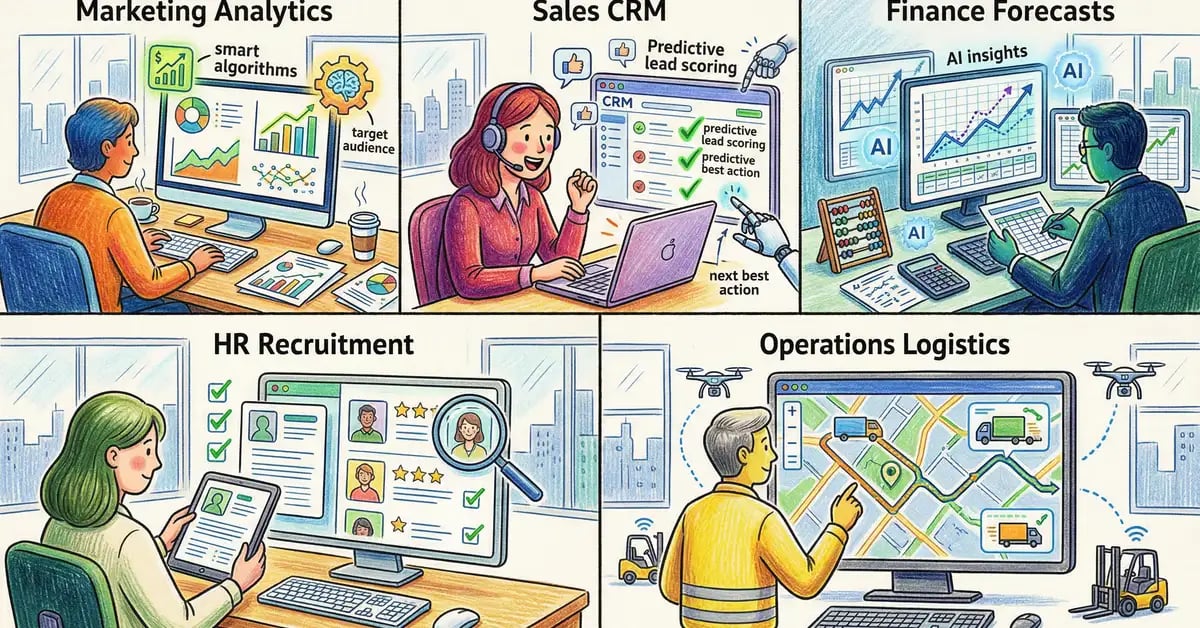
Tier 2: Department-Specific Applications (Role-Based — 16–24 Hours)
Once foundational literacy is established, each department needs targeted training on AI applications specific to their function. This is where the real productivity gains emerge.
| Department | Key AI Applications | Expected Impact | Training Focus |
|---|---|---|---|
| Marketing | Content generation, customer insights, campaign optimisation, SEO automation | 40% more output, same team size | Prompt engineering for content, AI analytics tools, brand voice maintenance |
| Sales | Lead scoring, pipeline forecasting, outreach personalisation, CRM automation | 15% faster cycle times | AI-assisted prospecting, forecast interpretation, data hygiene |
| Finance | Forecasting, anomaly detection, report generation, compliance monitoring | 20–30% faster reporting | AI for financial analysis, data validation, regulatory awareness |
| HR | Recruitment screening, performance analytics, learning path design, policy drafting | 30–40% time savings on admin | Bias awareness in AI hiring, GDPR for employee data, ethical boundaries |
| Operations | Process automation, quality control, supply chain optimisation, document processing | 60–80% time savings on review | Workflow automation, integration with existing systems, exception handling |
Tier 3: Advanced Capabilities (AI Champions — 40–60 Hours)
Every organisation needs a cadre of AI champions — two to three per department — who go beyond using AI tools to designing AI workflows, training colleagues, and driving continuous improvement.
Advanced curriculum:
- Advanced prompt engineering: Chain-of-thought prompting, few-shot learning, system prompt design, structured output formatting, and multi-step workflows. This transforms AI from a simple assistant into an integrated business tool.
- Workflow automation design: Map existing processes, identify automation opportunities, design AI-augmented workflows, and build approval gates for quality control.
- AI governance and compliance: Understand the UK's regulatory landscape, implement bias testing, maintain audit trails, and prepare for the ICO's statutory code and the forthcoming AI Bill.
- Evaluation and measurement: Define KPIs for AI-augmented processes, build monitoring dashboards, and conduct periodic AI impact assessments.
- Training delivery: Equip champions to train their colleagues, run department-specific workshops, and serve as the first point of contact for AI questions within their teams.
What AI Training Costs — and What It Returns
| Investment Area | Year 1 Cost (SME) | Ongoing Annual | Expected Return |
|---|---|---|---|
| Tier 1: All-staff literacy | £3,000–£8,000 | £1,500–£3,000 | Overcomes 67% resistance barrier; enables safe AI use |
| Tier 2: Department-specific | £5,000–£12,000 | £3,000–£8,000/person | 40% productivity gain in trained functions |
| Tier 3: AI champions | £4,000–£10,000 | £2,000–£5,000 | Internal capability; reduced consultant dependency |
| Total (50-person company) | £12,000–£30,000 | £6,500–£16,000 | 2.5x ROI on AI investment; 40% efficiency gains |
Training should constitute approximately 20% of your total AI implementation budget (the "20" in the 40-30-20-10 rule). Organisations that skimp on training consistently underperform on AI ROI — the 59% of UK organisations not currently upskilling in generative AI are leaving measurable value on the table.
Building an AI Learning Culture
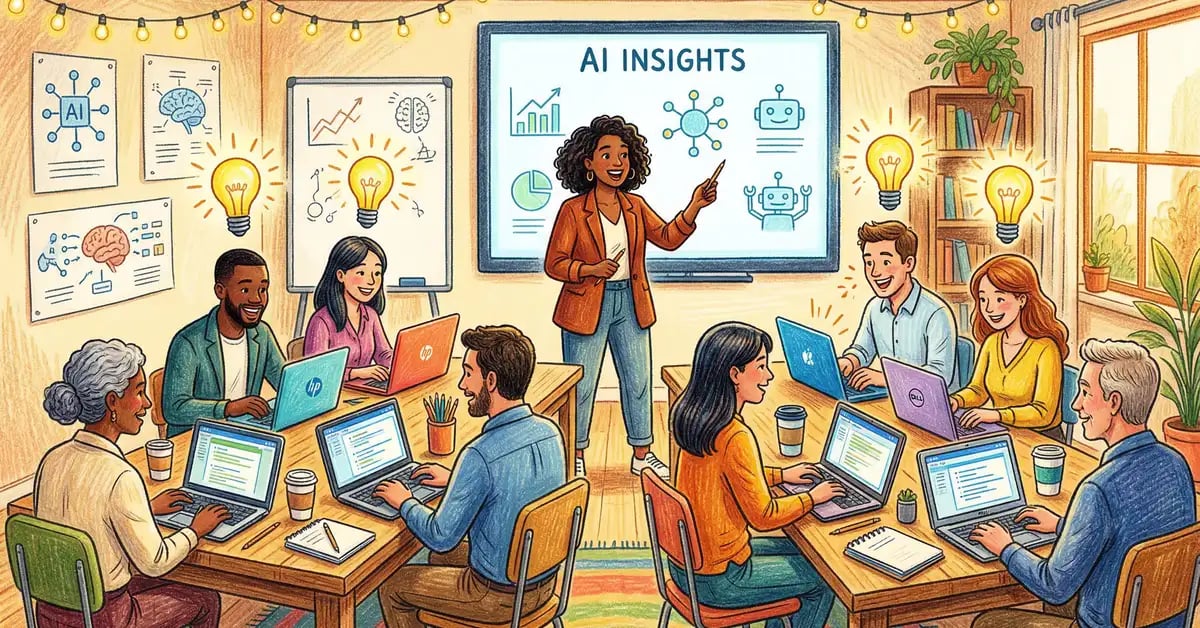
One-off training sessions do not work. AI evolves too quickly — skills become outdated within three years, and new tools and capabilities emerge monthly. The organisations that succeed build continuous learning into their operating rhythm.
Five principles for sustainable AI learning:
- Executive sponsorship is non-negotiable. When leadership actively uses AI and talks about their learning journey, it signals that AI fluency is a career priority. Organisations with sustained C-suite involvement achieve 2.5x higher ROI.
- Embed learning in workflows, not classrooms. The most effective AI training happens in the context of real work — daily stand-ups that share AI tips, Slack channels for prompt sharing, and monthly "AI show-and-tell" sessions where teams demonstrate how they have used AI to solve real problems.
- Create safe experimentation spaces. Set up sandbox environments where teams can experiment with AI tools without risk to production systems or client data. Fear of making mistakes is a primary adoption blocker.
- Measure and recognise progress. Track AI adoption metrics (active users, feature utilisation, productivity improvements) and celebrate wins publicly. What gets measured gets managed.
- Update continuously. Schedule quarterly curriculum reviews to incorporate new tools, updated regulations, and lessons learned. Annual reviews are insufficient given the pace of change.
12-Week Training Implementation Timeline
| Weeks | Activity | Deliverables | Success Metric |
|---|---|---|---|
| 1–2 | Skills audit + programme design | Baseline assessment, learning paths, champion nomination | 100% staff assessed |
| 3–4 | Tier 1: All-staff AI literacy | Foundation modules completed, AI use policy signed | 80%+ completion rate |
| 5–8 | Tier 2: Department workshops | Function-specific sessions, hands-on tool training | Each dept has 2+ active use cases |
| 5–10 | Tier 3: Champion deep-dives | Advanced prompting, workflow design, governance training | Champions running dept sessions |
| 9–12 | Embed + measure | Feedback loops live, KPI dashboards, quarterly review scheduled | 40%+ productivity gain in at least one function |
Start Your AI Training Programme
Helium42's education-led approach means training is built into every engagement. We do not just implement AI — we ensure your team can own and evolve it without us.
Explore AI Education ProgrammesFrequently Asked Questions
Q: How much should we budget for AI training?
A: Allocate 20% of your total AI implementation budget to training. For a 50-person SME, expect £12,000–£30,000 in year one and £6,500–£16,000 annually thereafter. This covers all three tiers: literacy, department-specific, and AI champion development. The investment delivers 2.5x ROI on your broader AI programme.
Q: How long does it take to train a team on AI?
A: Foundational AI literacy takes four to eight hours per person. Department-specific training takes sixteen to twenty-four hours spread over three to four weeks. AI champion development takes forty to sixty hours over six to eight weeks. A complete programme from baseline to embedded capability takes twelve weeks.
Q: Should we train everyone or just the technical team?
A: Everyone needs Tier 1 literacy — without it, cultural resistance (cited by 67% of leaders as the top barrier) will derail your implementation. Department-specific training targets the teams that will actively use AI tools. AI champion training focuses on two to three people per department who will drive adoption and support colleagues.
Q: What is the most important AI skill for non-technical staff?
A: Prompt engineering. The ability to write clear, effective prompts delivers immediate productivity gains across every department. A well-crafted prompt can reduce a marketing team's content production time by 40%, improve sales outreach personalisation, and accelerate financial report generation. It is the highest-ROI skill for non-technical teams.
Q: How do we measure training effectiveness?
A: Track four dimensions: adoption metrics (active AI users, feature utilisation), productivity metrics (output per person, process time reduction), quality metrics (error rates, customer satisfaction), and confidence metrics (self-reported comfort with AI tools). Survey at baseline, four weeks, and twelve weeks to measure improvement.
Build Your Team's AI Capability
The organisations that win with AI are not those with the biggest budgets — they are those with the best-trained teams. Helium42's education-led approach builds lasting internal capability so your team can own, evolve, and scale AI without permanent consultant dependency.
Our training programmes: From half-day AI literacy workshops to twelve-week champion development programmes, structured around your specific industry, tools, and business objectives.
Conclusion
AI training is not an optional add-on to your AI implementation — it is the foundation that determines whether your investment succeeds or joins the 42% that fail. The UK faces a severe AI skills shortage, with 52% of tech leaders unable to fill AI roles and 61% of businesses having no staff working with AI at all. Closing this gap is a competitive imperative.
Start with a skills audit to understand your baseline. Deploy the three-tier model — literacy for all, department-specific applications for active users, and advanced capabilities for your AI champions. Build learning into your operating rhythm, not your training calendar. And measure relentlessly: adoption, productivity, quality, and confidence. For a complete guide to selecting the right AI partner to support your training programme, read our AI consultant evaluation checklist, or explore our complete implementation roadmap to see how training fits into the broader deployment process.
Sources and Data Points
This article synthesises research from UK Government AI Skills Report, People Management / CIPD, PwC Global AI Jobs Barometer, World Economic Forum, and Experis / ManpowerGroup. Statistics include UK-specific workforce data on AI skills gaps, adoption rates, training investment benchmarks, and government policy projections. AI for marketing our AI consultancy services the best AI tools for your team our AI training courses AI-powered sales enablement AI for marketing complete guide to AI for business AI strategy guide AI for marketing guide
AI skills for legal professionals
AI training for accountants AI for education professionals