Published by

UK marketing teams are under unprecedented pressure to prove the value of AI investments, yet most struggle to measure what actually matters. Only 49% of marketing leaders can confidently explain marketing ROI to their boards, and with 80% feeling pressure to adopt AI, the gap between implementation and measurement has never been wider. Without a clear framework for tracking AI marketing ROI, you risk investing in tools that don't deliver business results—or worse, wasting resources on initiatives that can't justify their cost. This guide gives UK CMOs and marketing leaders a proven methodology to measure AI marketing effectiveness, benchmark performance against industry standards, and build the business case for AI adoption that executives demand.
What Is AI Marketing ROI and Why Does It Matter?
AI marketing ROI is the measurable return generated by AI-powered marketing investments relative to their total cost. Unlike traditional marketing ROI, which focuses on channel performance (email, paid ads, SEO), AI marketing ROI captures the incremental value created by AI systems—smarter targeting, better content, faster optimization, and improved customer insights. For UK marketing teams, this distinction is critical: you need to isolate the AI-driven impact from your baseline marketing performance to justify continued investment and identify where AI creates the most value.
The urgency is real. According to Supermetrics' 2026 Marketing Data Report, only 6% of marketers have fully embedded AI into their workflows, while 80% feel pressure to adopt it. This creates a measurement trap: teams adopt AI tools without understanding how to measure their impact, leading to wasted budget and missed opportunities. When you can't measure ROI, you can't optimize spending, prove value to stakeholders, or scale what works.
6%
Fully Embedded AI
Marketers with integrated AI workflows
80%
Feel Pressure
Teams experiencing AI adoption pressure
49%
Can Explain ROI
Leaders confident discussing ROI to boards
35%
Campaign Boost
Potential ROI improvement via AI targeting
Key Takeaway
AI marketing ROI isn't just about comparing costs to revenue. It's about isolating the incremental value AI creates, benchmarking against industry standards, and building a clear narrative for board-level decision makers. UK teams that master this measurement framework gain a 45% ROI boost when combining AI tools with structured marketing training.
The benchmarks and framework below derive from the Education-to-Implementation Pathway — Helium42's framework for taking UK SMEs from AI literacy to measurable production deployments in 6–8 weeks. The Pathway distils our founders' record of digital transformation across 500+ organisations, more than 200 workshops, and over 2,000 trained professionals.
The Five AI Marketing Metrics That Actually Matter
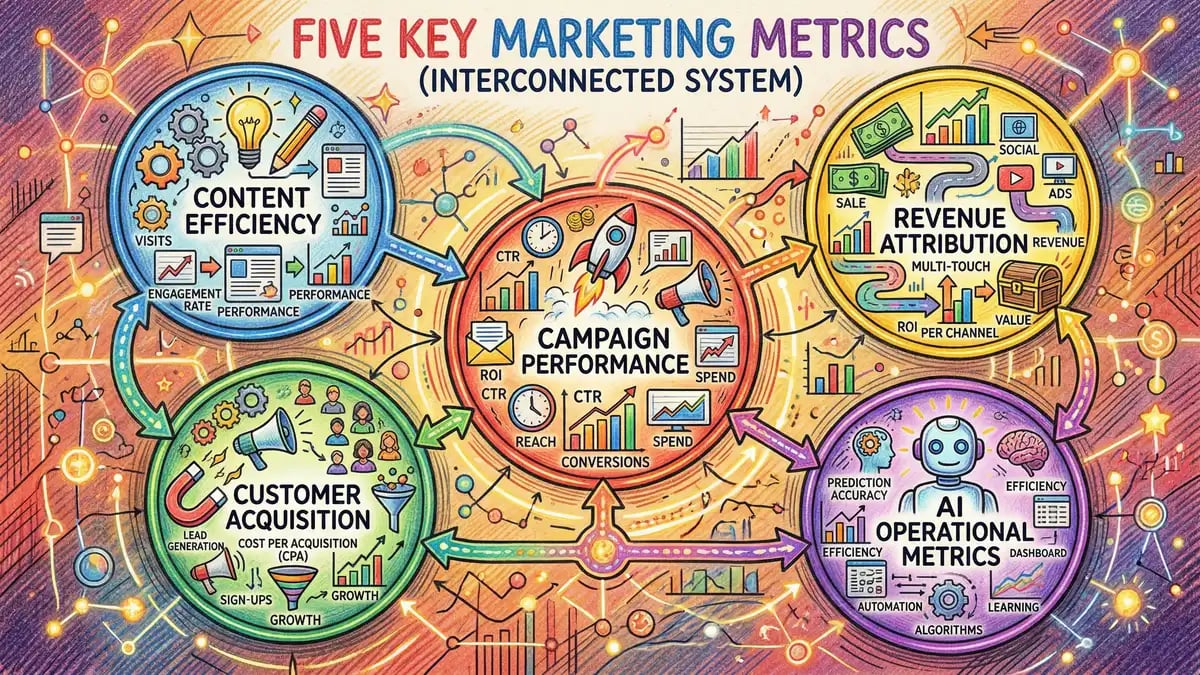
Not all metrics tell the story of AI value. Many marketing teams track vanity metrics—impressions, clicks, engagement—without connecting them to revenue or cost savings. To measure AI marketing ROI correctly, focus on five interconnected metric categories that isolate AI's impact and connect directly to business outcomes.
1. Content Efficiency Metrics
AI excels at scaling content production while reducing cost-per-output. Measure content efficiency by tracking production time, cost per piece, and quality consistency before and after AI implementation.
Key metrics: Hours to produce one blog post, cost per content piece, AI-generated content performance vs. human-written baseline, A/B test win rate for AI-assisted copy. Content that includes AI citations achieves a 1.08% click-through rate versus 0.6% for non-cited sources, demonstrating that transparent AI-generated content resonates with audiences when optimized.
2. Customer Acquisition Metrics
AI-powered targeting and personalization directly impact cost-per-acquisition and conversion rates. Track these metrics to isolate AI's impact on the full funnel.
Key metrics: Cost per acquisition (CPA), customer acquisition cost (CAC), conversion rate improvement, lead quality score, email open rate, and click-to-open rate. AI-powered customer interactions have demonstrated a 40% increase in conversion rates, meaning even modest AI improvements across multiple channels compound quickly.
3. Campaign Performance Metrics
AI optimizes campaigns faster than manual tuning, improving performance metrics before budget is exhausted. These metrics reveal AI's real-time optimization value.
Key metrics: Time to optimization, return on ad spend (ROAS), cost per click (CPC), impressions per budget unit, quality score improvement, and campaign runtime before hitting 2x ROAS. Track these week-over-week during AI implementation to show the acceleration in performance.
4. Revenue Attribution Metrics
This is where most teams fail to measure AI ROI properly. You must track revenue influence—the incremental revenue AI-assisted touchpoints drive—not just traffic attribution.
Key metrics: Revenue per visitor from AI-influenced journeys, customer lifetime value (CLV) for AI-assisted cohorts, pipeline value influenced by AI-optimized campaigns, and win rate for deals touched by AI-generated content. This requires solid attribution modeling (first-touch, multi-touch, or algorithmic) to isolate AI's influence.
5. AI-Specific Operational Metrics
These metrics measure the structural improvements AI brings to your marketing operations—things traditional ROI misses but stakeholders care about.
Key metrics: Time saved on manual tasks, percentage of marketing decisions informed by AI insights, data coverage (% of customer interactions with assigned AI-derived insights), speed of insight generation, and accuracy of AI-assisted forecasting. However, 52% of marketers don't own their data strategy, which directly impacts the reliability of these metrics. Measure your baseline data governance score before and after AI implementation to understand how much of your ROI depends on data quality.
Key Takeaway
Measure AI marketing ROI across five dimensions: content efficiency (cost and time savings), customer acquisition (CPA and conversion improvement), campaign performance (optimization speed), revenue attribution (incremental revenue), and operational impact (data quality and decision speed). This multi-angle approach reveals where AI creates the most value in your specific marketing stack.
AI Marketing ROI Benchmarks for UK Teams (2026)
UK marketing teams need benchmarks to understand whether their AI ROI performance is strong, average, or lagging. The table below shows realistic ROI ranges by channel and use case, based on current market data and adjusted for UK market conditions (lower overall ad spend maturity but higher consulting penetration).
| Use Case / Channel | Traditional ROI | With AI (2026) | Uplift % | Primary Driver |
|---|---|---|---|---|
| Email Marketing | 36:1–42:1 | 48:1–56:1 | +20–25% | Segmentation, send-time optimization |
| SEO / Organic Content | 22:1 | 28:1–32:1 | +18–35% | Volume scaling, keyword clustering |
| Paid Search Ads | 4:1–6:1 | 5.5:1–8:1 | +15–25% | Real-time bidding, audience modeling |
| Paid Social Ads | 3:1–5:1 | 4.5:1–7:1 | +15–40% | Creative automation, targeting precision |
| Lead Nurturing (AI-Assisted) | 5:1–8:1 | 9:1–14:1 | +45–65% | Personalization, predictive lead scoring |
| Content Marketing (AI Scale) | 2:1–4:1 | 5:1–9:1 | +40–80% | Volume, repurposing, distribution speed |
Reading this table: Email marketing, your highest-ROI channel, improves 20–25% with AI due to better segmentation and send-time optimization. Lead nurturing and content marketing (when scaled with AI) show the largest uplift, 45–80%, because AI handles the repetitive personalization and volume scaling that humans can't match at pace. However, these benchmarks assume proper measurement and data governance—which only 48% of marketers have in place. If your current data strategy is weak, invest in data infrastructure before expecting to hit these ROI targets.
How to Calculate Your AI Marketing ROI
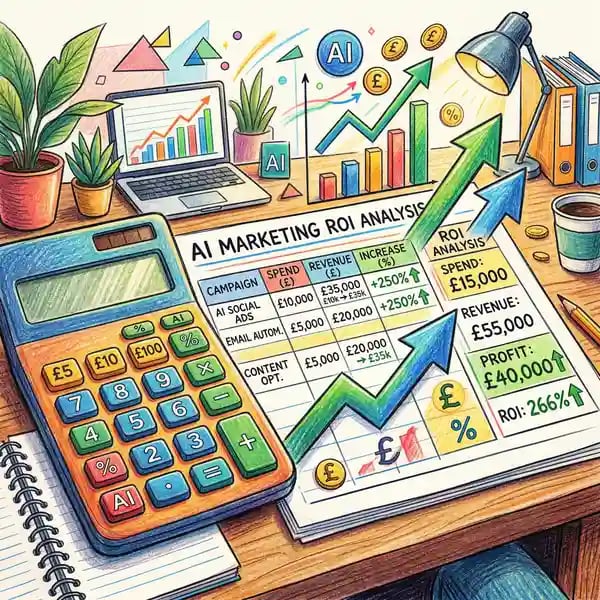
Calculating AI marketing ROI requires isolating the incremental value AI delivers from your baseline marketing performance. Here's the framework most UK marketing teams should follow.
The AI Marketing ROI Formula
AI Marketing ROI = [(Revenue from AI-Assisted Campaigns – Revenue from Control/Baseline Campaigns) – (Total AI Implementation & Operating Costs)] / Total AI Implementation & Operating Costs × 100
Breaking this down:
Revenue from AI-Assisted Campaigns: This is the total revenue influenced by marketing campaigns where you're using AI (personalized email, AI-optimized ads, AI-generated content, predictive lead scoring, etc.). Use your attribution model (first-touch, last-touch, or algorithmic) to assign revenue to AI-touched journeys. If 60% of your campaign touches include AI, you might attribute 60% of that campaign's revenue to AI.
Revenue from Baseline/Control Campaigns: This is the revenue your team generated using traditional methods (manual targeting, human-written content, standard email segmentation) before or without AI. Run parallel campaigns for at least 60–90 days to establish a solid control baseline. If you can't run true control campaigns, use historical month-over-month or year-over-year performance as your baseline, adjusting for known external factors (seasonality, market conditions, campaign changes).
Total AI Implementation & Operating Costs: Sum all costs—software licenses, training, consulting, staff time for setup and optimization, infrastructure, and ongoing maintenance. For many UK teams, this includes everything from platform subscriptions (£500–£5,000/month) to initial strategy consulting (£10,000–£50,000) to internal team time spent implementing and managing the tools.
Step-by-Step Implementation
Month 1–2: Establish Baseline
Document your current performance across key metrics: email open rates, conversion rates, CPA, revenue per visitor. Calculate baseline revenue for your largest channel (usually email or paid search). This becomes your control group.
Month 2–3: Run Parallel Campaigns
Implement AI on one segment (e.g., 50% of your email list gets AI-optimized send times, the other 50% uses your control send time). For paid ads, run one campaign with AI bidding and one with manual bidding. Track performance separately. Ensure both groups have comparable size and quality.
Month 3–4: Calculate Incremental Impact
Calculate the percentage improvement: (AI Group Revenue – Control Group Revenue) / Control Group Revenue. Multiply by total revenue for that channel to get absolute incremental revenue. Example: If email baseline revenue is £50,000/month and AI improves it by 22%, your incremental revenue is £11,000/month.
Month 4+: Calculate ROI and Extrapolate
Use the formula above to calculate ROI for the test period. Annualize if running a 3-month pilot. Separate your findings by channel and use case so you understand where AI delivers the most value.
Worked Example: B2B SaaS Company
Let's say you're a UK B2B SaaS company investing in AI-powered email marketing and predictive lead scoring.
Implementation Costs (Year 1):
- AI Email Platform (Yearly): £3,600
- Predictive Lead Scoring Tool: £6,000
- Implementation Consulting: £15,000
- Internal Team Training (50 hours @ £30/hr): £1,500
- Data Integration & Setup: £2,000
- Total Year 1 Cost: £28,100
Baseline Performance (Pre-AI):
- Email Revenue (Annual): £120,000
- Email Open Rate: 22%
- Conversion Rate: 3.2%
- Cost per Acquisition: £85
Year 1 with AI (Parallel Campaigns):
- AI-Assisted Email Revenue: £145,200 (21% uplift from baseline)
- Predictive Lead Scoring Impact: +35 extra qualified leads @ £3,500 revenue each = +£122,500
- Total Incremental Revenue: £147,700
- Minus Total Costs: £147,700 – £28,100 = £119,600
- AI Marketing ROI = (£119,600 / £28,100) × 100 = 425%
This company's AI marketing investment paid for itself in less than 2 months and delivered a 425% ROI in Year 1—a 4.25:1 return. In Year 2, with no new implementation costs (only £9,600 in platform fees), the ROI would exceed 1,500% if performance stays stable. This is why AI marketing compounds in value over time: the cost structure is mostly fixed, while the revenue impact grows as your data improves and your team optimizes.
Key Takeaway
The formula is simple, but execution requires discipline: establish a clear baseline, run parallel AI and control campaigns for at least 60 days, isolate incremental revenue (not total revenue), and include all implementation costs. Most UK marketing teams see ROI break-even in 3–6 months and significant returns (300%+) by Year 1 end, assuming proper measurement and data hygiene.
Ready to measure your AI marketing impact? Explore our AI for marketing services
Learn About Our ServicesCommon ROI Measurement Mistakes (and How to Avoid Them)
Most UK teams that fail to measure AI marketing ROI correctly make one of these five predictable mistakes. Avoid them and your measurement framework will be bulletproof.
Mistake 1: Attributing All Revenue to AI (Not Just Incremental)
The biggest error: claiming all revenue from AI-touched campaigns as AI ROI. Your team still performed marketing work; AI just improved the result. If you made £50,000 from email before AI and £60,500 after, your AI-generated revenue is £10,500, not £60,500. Use a control group or historical baseline to isolate the incremental impact.
Mistake 2: Ignoring Implementation Time Cost
Many teams calculate software costs but forget the internal labor: your marketing ops manager's 40 hours setting up the platform, your analyst's time building dashboards, your CMO's time in planning meetings. At UK salary levels (£40k–£80k annually), 200 internal hours of setup easily costs £5,000–£10,000. Factor this into Year 1 costs or your ROI will be artificially inflated.
Mistake 3: Not Running Parallel Control Campaigns
If you implement AI across all your campaigns at once, you have no baseline to prove its impact. The market might have improved, seasonality might be favorable, or other campaigns might have grown independently. Always run 50% of your budget (or a separate segment) as a control group using traditional methods for at least 60 days. This is the gold standard for ROI measurement.
Mistake 4: Measuring Output Metrics Instead of Business Metrics
AI improved your click-through rate by 15%—great. But did it improve revenue? Conversion rate? Customer acquisition cost? Output metrics (CTR, impressions, engagement) are easy to measure but disconnected from business value. Always tie measurement back to revenue, CPA, or cost savings. If AI helps you produce content 30% faster but doesn't improve ranking or conversion, that's efficiency ROI, not marketing ROI.
Mistake 5: Using Poor Data Attribution
Only 48% of marketers have a clear, documented data strategy. If your attribution is based on last-click only, multi-touch data is missing, or customer journeys are incomplete, your AI ROI calculation will be unreliable. Spend time on data hygiene before measuring AI ROI. Use first-touch, last-touch, and algorithmic (data-driven) attribution models in parallel to triangulate the truth.
Key Takeaway
Accurate AI marketing ROI measurement requires isolating incremental revenue (not total revenue), including all implementation costs (not just software), running parallel control campaigns, measuring business outcomes (not just output metrics), and ensuring clean data attribution. Teams that avoid these five mistakes typically report ROI confidence within 3 months; teams that don't often fail to justify their AI investment and abandon tools prematurely.

Why AI Marketing Training Multiplies Your ROI
Here's a finding that surprises most teams: AI marketing ROI improves 45% when combined with structured training and consulting. Why? Because tools alone don't deliver results. Your team needs to understand how to set up the AI systems correctly, interpret the results, and optimize continuously. A £5,000 investment in training pays back 9x through better tool adoption and faster optimization.
Most UK marketing teams that implement AI without training make critical mistakes: poor data setup (meaning the AI has bad input), misaligned objectives (the tool optimizes for the wrong metric), or underutilization (the team doesn't use 60% of the tool's features). Training fixes all three.
Helium42 offers AI marketing training and workshops specifically designed for UK CMOs and marketing teams. We work with your team to build measurement frameworks, optimize your AI setup, and create accountability for ROI delivery. Our AI training for business programs combine practical exercises with your actual marketing data, so you leave with a working measurement framework, not just theoretical knowledge.
Consider also our AI marketing workshop, which typically runs 2–3 days and covers AI strategy, tool selection, ROI measurement, team change management, and quick-win identification. Teams that complete structured AI training accelerate ROI realization by 3–6 months on average.
Key Takeaway
AI tools + marketing training = 45% better ROI. Without training, teams under-optimize tools and miss quick wins. With structured training (workshops, ongoing coaching, measurement frameworks), teams compress the learning curve from 6 months to 6 weeks and hit ROI targets consistently.
Frequently Asked Questions
How long does it take to see AI marketing ROI?
Most UK marketing teams see ROI break-even in 3–6 months, depending on campaign volume and baseline performance. If you're running email marketing with reasonable list size (50,000+ contacts), you'll typically prove incremental ROI within 90 days. Slower channels like SEO require 6–12 months because ranking changes take time. Faster channels like paid ads show results in 4–8 weeks. To accelerate ROI realization, focus AI investments on high-volume channels first (email, paid search, social ads).
What if we're not hitting ROI benchmarks? What's going wrong?
Most commonly: poor data quality, misaligned optimization targets, or tools configured for the wrong metrics. If your lead nurturing AI is optimized for engagement (opens and clicks) but your business cares about conversion rate, the AI will push the wrong levers. Second issue is underutilization—teams often use only 30% of their AI tool's features. Third is comparing against a bad baseline. If your baseline is already performing very well (90th percentile), there's less room for AI to improve. Run a 30-day diagnostic audit with an external consultant (like Helium42) to identify gaps. Most teams unlock hidden ROI through configuration fixes, not new tool purchases.
Should we measure ROI by individual AI tool or across all AI investments?
Both. Start with aggregate ROI across all AI investments (to prove overall value to the board). Then break it down by tool and use case (to understand where AI creates the most value and where to invest next). You might find that predictive lead scoring delivers 60% of ROI while email optimization delivers 30%, meaning you should expand lead scoring to other teams. Individual ROI tracking also helps justify budget allocation in future years.
What's the difference between measuring AI ROI and marketing ROI?
Marketing ROI measures the return from all marketing activities (email, ads, content, events, etc.) versus total marketing spend. AI marketing ROI isolates the incremental return from AI-powered activities specifically. You might have 3:1 overall marketing ROI but 8:1 AI marketing ROI, showing that AI is your highest-performing channel. For board presentations, lead with overall marketing ROI (what execs expect) but highlight AI marketing ROI as the fastest-growing value contributor and your roadmap for future growth.
How do we handle AI ROI for awareness campaigns where revenue impact is indirect?
Use incrementality testing or marketing mix modeling. Run AI-assisted awareness content to one audience segment and traditional awareness to another, then track which group converts better down the funnel (over 30–90 days). You can also use brand lift studies or first-touch attribution to measure how awareness influences later conversions. Awareness ROI takes longer to measure (90+ days) but is measurable if you plan from the start. If you launch awareness campaigns without a measurement framework, you won't be able to prove ROI retroactively—so set up the test before launch.
Key Takeaway
Most ROI questions boil down to data quality and measurement framework. If you can't answer these five FAQs with confidence, your first step is a measurement audit. Helium42 helps UK teams design measurement frameworks that work for their specific business model and channel mix.
The Bottom Line: Building Your AI Marketing ROI Story
Only 49% of marketing leaders can confidently explain marketing ROI to their boards—and that's without AI in the picture. Now you're expected to justify new AI investments on top of existing marketing spend. This guide gives you the framework to do it: measure incremental revenue, compare against control campaigns, track five key metric categories, and connect everything back to business outcomes.
The best-performing UK marketing teams don't just buy AI tools; they build measurement discipline. They establish baselines before implementation, run parallel control campaigns, calculate ROI rigorously, and use those numbers to guide their next investment. When you can say "Our AI marketing ROI is 350% and we're seeing the strongest returns in lead nurturing and email," your board listens. When you combine that with a structured training program, your ROI improves another 45%.
If you're building a business case for AI in your organization, start here. If you're already implementing AI but struggling to measure impact, this framework will help you close the gaps. And if you want to accelerate the process with expert guidance, our AI consultancy services and AI training programs are designed exactly for this challenge.
Further reading on building your AI marketing case:
Building the AI Business Case: A Guide to ROI Measurement walks through the strategic side of AI adoption and how to structure your investment pitch.
The UK AI Consultancy Guide: Choosing the Right Partner covers how to evaluate AI consulting support and what to expect from the engagement.
AI Training for Business Teams: Building Capability, Not Just Using Tools details how structured training multiplies your ROI and accelerates team adoption.
Ready to Measure What Matters?
Helium42 works with UK marketing leaders to design measurement frameworks, implement AI tools correctly, and deliver measurable ROI. Whether you're just starting your AI journey or struggling to prove impact from existing investments, we can help.
Sources & Research
Supermetrics 2026 Marketing Data Report – Benchmark data on AI adoption, measurement maturity, and ROI confidence among marketing teams.
Hurree – Measuring AI Marketing ROI Guide – Practical framework for isolating AI impact from baseline marketing performance.
Microsoft Azure AI – Marketing Insights Report – Case studies and data on campaign ROI improvements through AI-driven targeting.
MartechVibe – Marketing ROI Leaders Survey 2026 – Industry benchmarks and best practices from top-performing marketing teams.
Related reading: Building the AI Business Case: A Guide to ROI Measurement • The UK AI Consultancy Guide • AI Training for Business Teams
AI sales pipeline optimisation
2026 AI adoption benchmark report
comprehensive AI for marketing guide board-ready AI business case how ready your marketing function is for AI