
Published by

Approximately forty percent of UK law firms had experimented with generative AI for drafting by late 2025, but most solo practitioners and small firms are still hesitant — not because of cost, but because of regulatory uncertainty. The good news: the Solicitors Regulation Authority issued principles-based guidance in 2025 that explicitly does not prohibit free AI tools for legal drafting, provided you exercise professional judgment over output. The challenge: choosing tools that match your matter type and confidentiality profile.
This guide compares the eight free and freemium AI tools UK solicitors are actually using in 2026, walks through the SRA and ICO compliance requirements that apply to each, and gives concrete workflows for the document categories where free AI tools deliver real time savings — typically 25–50% faster initial drafts on routine matters. We have implemented these workflows with multiple UK firms across conveyancing, employment, and commercial practices, and the patterns below reflect what actually works at the small-firm scale.
Key takeaway
No single free AI tool is "best" for legal drafting. Match the tool to your document type, data sensitivity, and review capacity. ChatGPT and Claude free tiers handle correspondence and basic contracts adequately for non-confidential matters; specialist tools like Spellbook and UK-native Genie AI are stronger for contract drafting and conveyancing. All require human validation per SRA professional responsibility rules.
What free AI tools actually work for UK legal drafting in 2026?
Eight platforms dominate the free and freemium AI legal drafting market for UK solicitors in 2026: three general-purpose large language models (ChatGPT, Claude, Google Gemini), three specialist legal AI tools with free tiers (Spellbook, Cuik, Robin AI), and two UK-native platforms (Genie AI, Definely). Each has distinct strengths and constraints that determine where it fits within a firm's workflow.
The general-purpose models offer the broadest accessibility but the weakest jurisdiction-specific reasoning. Specialist legal platforms offer better template structures and Microsoft Word integration but typically restrict free tiers to demonstration features or low monthly volumes. UK-native tools provide explicit calibration to English, Welsh, Scottish, and Northern Ireland law — the jurisdiction problem that breaks general-purpose models — but with smaller feature sets than enterprise alternatives.
Free Tool Comparison — UK Legal Drafting (2026)
| Tool | Best for | Free tier limit | Trains on data? | UK jurisdiction |
|---|---|---|---|---|
| ChatGPT (GPT-4o) | Correspondence, basic contracts | ~80 messages / 3hr | Yes, opt-out available | Generic; weak on Scots/NI law |
| Claude 3.5 Haiku | Long-form drafting, analysis | ~30 messages / 5hr | No (default), opt-in required | Strong with explicit prompting |
| Google Gemini | Drafts inside Google Workspace | Generous, daily reset | Yes, opt-out available | Generic; needs UK law prompts |
| Spellbook | Word-integrated contract drafting | ~50 ops / month | No | English law strong |
| Cuik | Template-driven routine docs | Free template library | No | UK templates available |
| Robin AI | Contract intelligence | Demo + trial only | No (UK-based vendor) | Built for UK firms |
| Genie AI | UK-specific routine drafts | Limited templates | No | Built for UK only |
| Definely | Wills, employment, services | Guided forms free | No | English & Welsh law |
Sources: vendor terms of service as of Q1 2026; Law Society Technology Report 2025; ICO AI guidance.
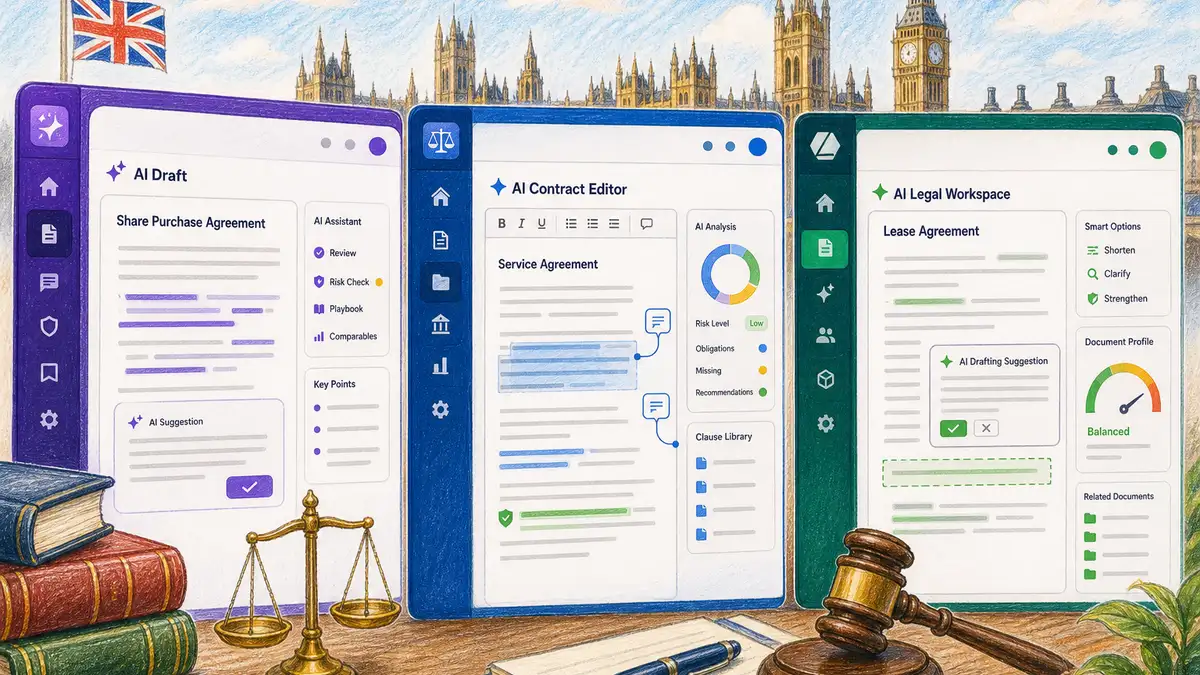
For most small UK firms, the practical starting point is Claude or ChatGPT for general drafting work, Spellbook for Word-integrated contract review, and Genie AI for UK-specific compliance and conveyancing forms. We cover the regulatory framework that determines what you can actually use these for next.
Which free AI tools meet SRA and GDPR requirements?
Compliance is not binary. The same tool can be SRA-compliant or non-compliant depending on how you use it. The SRA's 2025 AI guidance establishes principles-based requirements rather than tool-specific approvals: solicitors retain full professional responsibility for all output, must validate AI-generated content before delivery, and must protect client confidentiality through appropriate technical and contractual safeguards.
The Information Commissioner's Office guidance on AI and GDPR adds three specific requirements when client personal data enters an AI tool: (1) conduct a Data Protection Impact Assessment before deployment, (2) ensure a Data Processing Agreement is in place with the AI vendor, and (3) implement Standard Contractual Clauses if data is transferred to the United States. Free tiers of OpenAI, Anthropic, and Google generally do not include DPAs meeting GDPR requirements — this is the single most important constraint on free tool use for client work.
2026 UK Adoption Data
40%
of UK law firms had experimented with AI for drafting by late 2025; 55% adoption among mid-market practices (20–50 fee earners). Solo practitioners lag at 15–20%.
The practical implication is a two-track approach. Track 1: use free general-purpose tools (ChatGPT, Claude, Gemini) only for matters that do not involve client personal data — internal precedent drafting, public-information research, template development, training exercises. Track 2: use specialist or UK-native tools with DPAs (Spellbook, Genie AI, Robin AI) for client work involving personal data, after completing a DPIA. The boundary between the two is your firm's policy decision and must be documented.
For matters with particularly sensitive client information — family law, immigration, financial restructuring, criminal — most UK firms now restrict cloud-based AI entirely and either use on-premises open-source alternatives like Docassemble or wait until the matter is complete before using AI for any anonymised analysis. The pattern of treating different matter types differently aligns with what we see in our work with conveyancing practices where high-volume routine work has different risk profiles from bespoke commercial transactions.
How do you actually use ChatGPT or Claude for contract drafting safely?
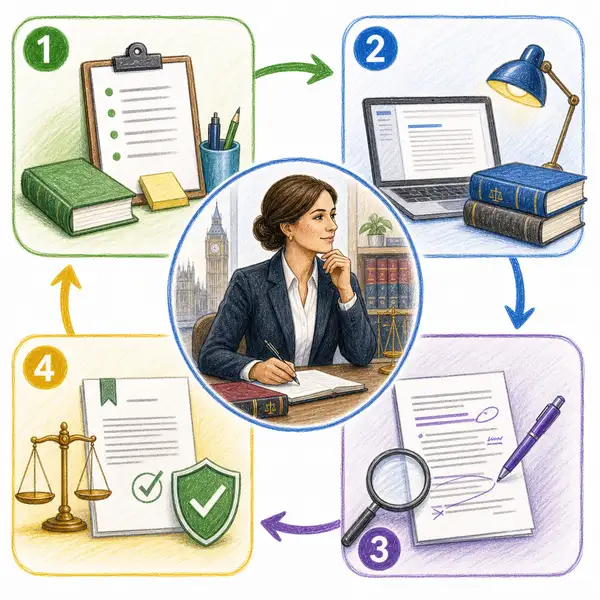
The workflow that produces reliable results from free general-purpose AI tools follows four steps consistently across firms. First, prepare a structured brief offline before opening the AI tool — capturing all parties, scope, key commercial terms, jurisdiction, and any specific protective provisions required. Second, engineer the prompt to specify English law (or the applicable UK jurisdiction explicitly), state the document type and required sections, and include the brief content as a structured input rather than a conversational request.
Third, generate the draft and immediately export it to Word for editing — never edit inside the AI tool, because subsequent prompts can introduce drift in earlier sections. Fourth, validate the draft against three checklists: a commercial-terms checklist (does the draft accurately capture what the parties agreed?), a legal-substance checklist (are the protective provisions appropriate to the specific risks?), and a jurisdiction checklist (does the draft correctly reflect English/Welsh/Scots/NI law for any clauses where these jurisdictions diverge?).
The error patterns to watch for are well-documented. AI-generated contracts typically meet 65–80% of quality benchmarks on first generation; the most common failures are omission of provisions that should have been included based on context (20–25% of drafts), inappropriate standardisation when specific legal issues should have triggered different treatment (15%), and imprecise legal language (20%). Hallucinated case citations or fictional statutes occur in only 5–8% of drafts but are the most professionally damaging when they slip through review.
For the high-volume contract types most amenable to AI assistance — services agreements, NDAs, employment contracts, basic supply agreements — independent studies show 30–50% time reduction on initial drafts compared to working from blank templates, after factoring in increased review time. For more complex or novel matters, the reduction shrinks to 15–20% and is sometimes negative when the AI's drift creates more problems than it solves. The skill is recognising which category your matter falls into before opening the tool.
This pattern matches what we describe in our contract review automation guide and follows the same principles as our broader best-AI-for-legal-drafting evaluation: AI assistance amplifies competent fee earners and is dangerous in the hands of staff who cannot recognise its specific failure modes.
What are the actual time savings versus the professional risks?
Empirical data from the Law Society Technology Report 2024 and Legaltech analyst surveys conducted through 2025 establishes consistent benchmarks for what AI-assisted drafting actually delivers in UK practice. For routine commercial agreements, 42% average time reduction on initial drafts. For conveyancing contracts, 35% time reduction with 15–20% additional review time, netting to approximately 20% overall efficiency improvement. For wills and basic probate documents, 30–40% time reduction. For correspondence including letters before action and demand letters, 40–60% time reduction.
The professional risks fall into four categories worth quantifying separately. Hallucination risk — invented citations or fictional statutes — appears in 5–8% of AI-generated documents and is largely caught by experienced fee earner review. Confidentiality risk — inappropriate disclosure of client information through cloud AI processing — is mitigable through tool selection, DPAs, and matter-type restrictions but requires deliberate policy. Jurisdiction risk — applying English law principles to Scottish or NI matters — is concentrated in succession, property, and certain commercial law areas and is best addressed through explicit prompting plus specialist review for non-English matters. Regulatory currency risk — AI training data lagging current FCA, ICO, or sector-regulator guidance by 6–18 months — requires solicitors to verify any compliance-critical content against the most recent official guidance rather than relying on the AI's characterisation.
The economic case is straightforward for high-volume practices. A conveyancing firm processing 100 residential purchase files annually with 15–20 documents each can free 30–60 fee-earner hours per year through AI-assisted drafting alone. At fee-earner rates of £200–£400 per hour, that represents £6,000–£24,000 in capacity that can be redirected to additional matters or pricing competitiveness. For practices billing at capacity, the value is qualitative — fee-earner stress reduction and improved retention — rather than directly billable. Either way, the threshold for ROI on free tools is essentially zero, and the threshold on £10–30k specialist platform subscriptions is reached within 6–18 months for most mid-market practices.
Practical caution
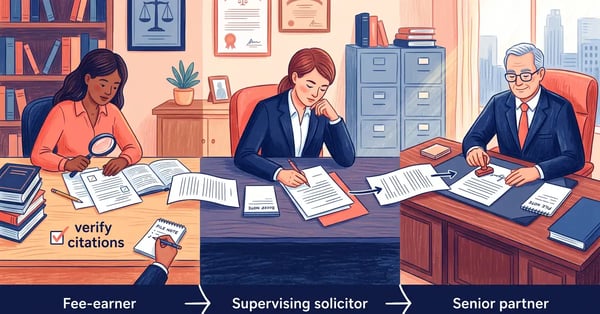
The biggest avoidable risk is delegating AI tool use to staff who cannot recognise its failure modes. We have seen trainees confidently submit AI-generated drafts containing fictional case citations to partner review, and partners catch them only by accident. Treat AI tool use as supervised work in the SRA sense — staff need explicit training in error patterns before independent use.
Which document types are best suited for free AI drafting in UK practice?
The document categories where free AI tools deliver reliable value cluster into five groups based on structural standardisation, regulatory complexity, and confidentiality sensitivity. Routine commercial contracts — services agreements, NDAs, employment contracts, basic supply agreements — are the highest-confidence category, with both general-purpose and specialist tools producing usable initial drafts when given a structured brief. Letters before action and routine legal correspondence are similarly strong, with predictable structure and 40–60% time savings achievable.
Wills and basic probate documents are mid-tier — strong structural standardisation but high error-cost when mistakes are made, requiring rigorous review. Conveyancing documentation works well for routine residential transactions but breaks down quickly for properties with complex ownership, environmental issues, or unusual local authority restrictions. Compliance documentation including DPIAs, GDPR Records of Processing, and similar regulatory documents benefits from AI assistance but must be validated against current ICO, FCA, or sector-regulator guidance rather than the AI's training data.

Three categories where free AI tools generally fail or create unreasonable risk: bespoke high-value commercial transactions where context-specific provisions matter more than template structure, family law matters involving children where confidentiality and emotional sensitivity require human-only handling, and any matter involving recent regulatory changes (in 2026, this particularly applies to UK GDPR developments and AI-specific regulation).
The pattern matches adoption data from the 2024 Law Society survey: 70% adoption in conveyancing practices, 65% in commercial contract practices, but only 20–25% in family law and immigration practices. The variation is explained by document standardisation rather than firm sophistication. For your firm's evaluation, audit your last quarter's matter types and identify the categories that constitute high volume and structural standardisation. That is where free AI assistance pays back fastest.
Helium42's Education-to-Implementation Pathway frames AI adoption for legal practices in three sequenced phases: literacy across partners and senior associates, pilot design against a single drafting workflow with measurable outcomes, and managed scaling once the pilot meets SRA compliance and partner confidence thresholds. We have applied this Pathway with UK law firms and over 500 leaders across UK and DACH organisations. The structure below maps free-tier AI exploration to phase one, with paid specialist platforms entering only at phase three when the workflow and governance are proven.
How should small UK firms structure their AI adoption?
The implementation pattern that works for small UK practices follows a four-phase rollout over 8–12 weeks, designed to validate before scaling rather than committing to a tool before knowing whether it actually works for your specific matter mix. Each phase has explicit success criteria — if a phase fails, you stop rather than push forward.
Audit and select (Week 1–2)
Identify three document categories that constitute >50% of high-volume drafting work. Run a tool comparison on representative samples (10 documents each in 2–3 candidate tools). Pick one tool per category — don't try to standardise on a single tool across all work.
Compliance setup (Week 3–4)
Conduct a DPIA for each tool. Confirm DPA is in place with vendor where matter involves personal data. Document matter-type policy: which categories can use which tools, which cannot. Brief insurers if implementation is material to your professional indemnity profile.
Pilot with two fee earners (Week 5–8)
Two fee earners use selected tools on real client work for one month. Track time-per-document, error rate caught at review, client satisfaction. Validate that real-world time savings match the test results from Week 1–2. If results disappoint, revisit tool selection before scaling.
Scale to firm with training (Week 9–12)
Mandatory training session covering tool capabilities, known failure modes, your firm's matter-type policy, quality assurance procedure. Document use in matter file. Six-month review checkpoint to evaluate continued ROI and tool selection.
The single biggest mistake we see in UK practices is skipping Phase 2 — going straight from "ChatGPT works on test prompts" to fee earner use on client matters without DPIA, DPA, or matter-type policy. This creates compounding risk: data protection exposure, professional discipline exposure, and uncontrolled drift in standards across the firm.
Need help structuring AI adoption at your firm?
Our AI implementation pathway includes legal-sector specifics: SRA-aligned policy templates, DPIA frameworks, and fee-earner training designed for UK practice. We've worked with conveyancing firms, employment specialists, and commercial practices to deploy free and freemium AI tools without regulatory exposure.
Book a Discovery Call →When should you upgrade from free AI tools to paid platforms?
Three signals indicate that free tools have hit their ceiling and a paid specialist platform investment is justified. First, monthly volume exceeds the free tier limits — if Spellbook's 50 operations per month or Claude's 30-message-per-5-hours window is being hit consistently, you are paying in lost productivity what you would pay in subscription. Second, your matter mix shifts toward types that need DPA-backed processing — when client personal data routinely enters drafts, the contractual and technical guarantees that paid tiers provide are not optional. Third, integration friction becomes the bottleneck — if fee earners are copy-pasting between Word, the AI tool, and your DMS for 20+ minutes per document, a tool with native Word integration like Spellbook's paid tier removes that overhead entirely.
The economic threshold for paid specialist platforms (typically £10,000–£30,000 annually for small to mid-market firms) is reached when your matter volume in AI-amenable categories exceeds about 100 documents per month, or when your fee-earner mix is heavy enough that 5–10 hours per fee earner per month of saved time compounds quickly. Below that volume, free tools with disciplined matter-type policies remain the right choice. Our broader best AI for legal research coverage has more on the research-focused tier, and our AI for law firms primer walks through firm-wide implementation patterns.
One specific recommendation for firms considering the upgrade: pilot the paid tool for one quarter while maintaining free tool access for comparison. Measure actual time-per-document and error-catch rates rather than relying on vendor benchmarks. The decision to commit to a £20–30k annual subscription is large enough to deserve real evidence specific to your matter mix.
Frequently asked questions about free AI for UK legal drafting
Can solicitors use ChatGPT for client legal documents under SRA rules?
Yes, with conditions. The SRA's 2025 guidance confirms that no categorical prohibition applies to general-purpose AI tools provided that solicitors exercise professional judgment, validate output before client delivery, and protect client confidentiality. The conditions in practice mean: complete a DPIA before processing personal data, obtain client consent where the client would reasonably expect to be informed, ensure a DPA is in place if using paid tiers, and treat AI output as you would output from a junior fee earner — fully reviewed before delivery.
Does using AI breach legal professional privilege?
Not automatically. Established legal analysis indicates that uploading client information to a cloud AI platform used as a drafting tool maintains privilege provided the upload is made in confidence, for the purpose of obtaining or giving legal advice, with appropriate technical and contractual safeguards. Prudent practice goes further: contractual restrictions with the AI vendor, audit trails of tool use, and explicit client consent for matters where the client has a reasonable expectation of control over information sharing.
Which free AI tool is most accurate for English contract drafting?
For routine commercial contracts in English law, Spellbook (specialist) and Claude (general-purpose) consistently outperform alternatives in independent evaluations, hitting 75–80% of quality benchmarks on first generation versus 65–70% for ChatGPT and 60–65% for Gemini. For UK-specific compliance and conveyancing forms, Genie AI's UK calibration produces fewer jurisdiction errors than any general-purpose tool. None reach the quality of experienced human drafters; all require human review before client delivery.
Are free AI tools GDPR-compliant for client work?
Free tiers of OpenAI, Anthropic, and Google generally do not include Data Processing Agreements meeting GDPR requirements, which restricts their use for matters involving personal data. UK-native and specialist tools (Spellbook, Genie AI, Robin AI) typically offer DPAs in their paid tiers. Free tools can still be used for matters that do not involve client personal data — internal precedent drafting, public-information research, training exercises — provided your firm's policy makes that boundary explicit.
How much time do free AI tools actually save on legal drafting?
Empirical data shows 25–50% time reduction on initial drafts for routine matters, dropping to 15–20% for novel or complex matters. Net efficiency after increased review time is approximately 20% on conveyancing, 30–40% on standard commercial contracts and wills, and 40–60% on routine correspondence. Practices generating >50 high-volume documents monthly typically achieve full ROI on training and implementation effort within 3 months.
What document types should never be drafted by AI?
Three categories where AI assistance is generally inappropriate: bespoke high-value commercial transactions where context-specific provisions matter more than template structure, family law matters involving children where confidentiality and emotional sensitivity require human-only handling, and matters involving recent regulatory changes where AI training data is materially out of date. The Law Society's Technology Report consistently shows lowest adoption (20–25%) in family law and immigration practice areas for these reasons.
Helium42 AI Implementation
Free AI tools, structured for UK legal practice
We help UK law firms deploy free and freemium AI tools without regulatory exposure — SRA-aligned policy frameworks, DPIA templates, and fee-earner training built specifically for legal practice.
Sources: SRA AI and Large Language Models Risk Resource (2025); ICO Artificial Intelligence Guidance; Law Society Technology Research and 2024 Report; Bar Council guidance on generative AI use; UK Government AI Regulation White Paper; Docassemble open-source legal automation framework. Free tier policies and feature limits accurate as of Q1 2026 per vendor terms of service; all vendors update policies frequently and solicitors should verify current state before deployment. compare the best legal AI tools for UK firms keep client data confidential when deploying AI AI legal drafting implementation guide