

Published by

In-house legal teams and law firms process thousands of contract free AI tools for UK legal draftings annually. Each document requires careful review to identify risks, extract key terms, and ensure compliance with organizational standards. Manual contract review remains labour-intensive, time-consuming, and vulnerable to human error. Artificial intelligence is transforming this critical process, delivering measurable efficiency gains whilst maintaining the rigour expected by the legal profession.
This guide explores how AI contract review tools work, evaluates leading platforms, and provides a practical implementation roadmap for UK legal departments and firms seeking to adopt this technology responsibly.

Understanding AI Contract Review Technology
Modern AI contract review systems employ two primary technological approaches: traditional natural language processing (NLP) and emerging large language models (LLMs). Both deliver real efficiency gains, but with different trade-offs in accuracy, deployment time, and explainability.
Traditional NLP models use statistical learning trained on thousands of annotated example contracts. These tools excel at high-volume, standardised contracts. They identify defined entities (parties, dates, monetary values, jurisdictions), extract clauses, and map relationships between provisions. For commodity contracts—NDAs, employment agreements, lease abstractions—traditional NLP systems achieve 94-98% accuracy and require minimal human review.
Large language models represent a newer approach. These general-purpose AI systems (such as those powering GPT-4 or Claude) are pre-trained on vast text corpora and can perform novel tasks with minimal examples. They excel at contextual reasoning, explain their findings in natural language, and handle contract variations that would confound traditional NLP. The trade-off: LLMs introduce a 5-12% hallucination risk on unfamiliar contract types, requiring slightly higher human verification overhead.
Key Takeaway
AI contract review reduces review time by 30-70% depending on contract complexity. The "augmentation" model—AI as first-pass reviewer, lawyers for final judgment—is now the industry standard, adopted by 70% of leading legal teams.
Both approaches work through a standardized workflow: document ingestion, clause extraction, risk identification, and human review. The AI system processes the contract in seconds, flagging high-risk provisions, extracting key commercial terms, and organizing findings for lawyer review. Critically, human lawyers remain in the workflow; AI augments rather than replaces legal judgment.
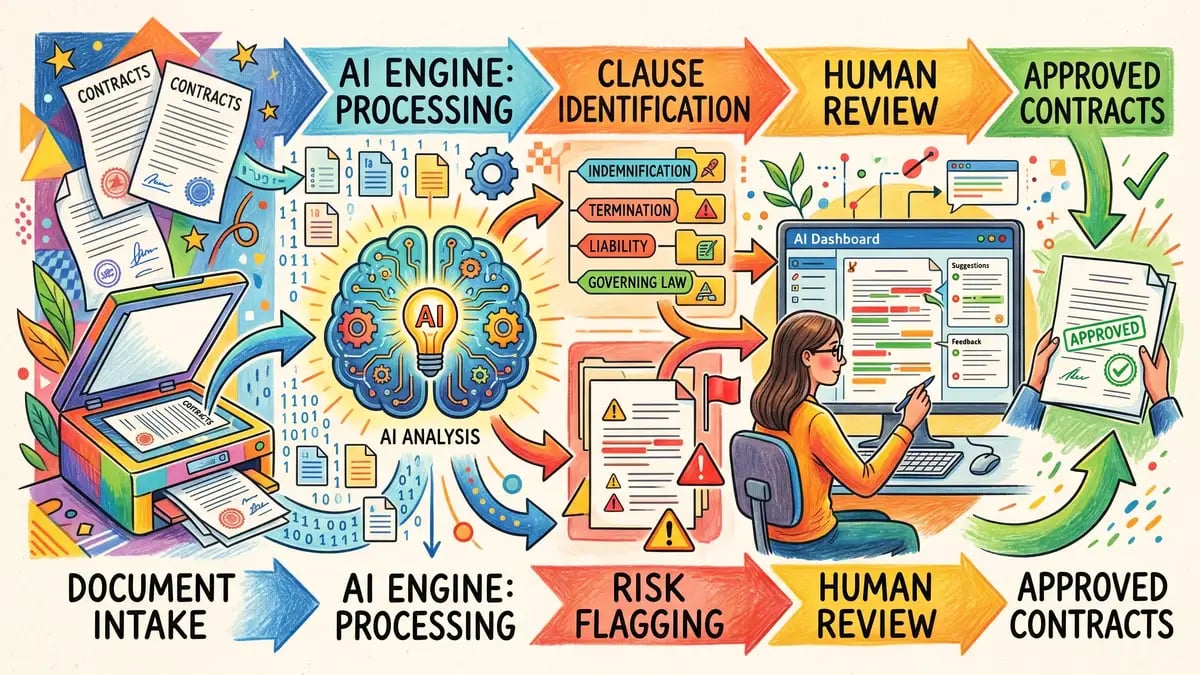
How AI Identifies Contractual Risks
Risk identification relies on three complementary mechanisms: rule-based flagging, anomaly detection, and semantic pattern matching.

Rule-based flagging applies pre-configured risk rules. Common examples: "No limit of liability" = high risk; "Sole discretion" = flag for review; "Unlimited termination rights" = potential concern. These rules work because certain contract provisions carry universally understood risks across industries and counterparties. Rules can be customised per firm or client group.
Anomaly detection compares extracted terms against peer benchmarks or historical data. For example: if payment terms in a new service agreement are 60 days (historically, similar agreements averaged 30 days), the system flags the deviation. This catches commercially disadvantageous terms that might not trigger rule-based flags—a sophisticated early-warning mechanism.
Semantic pattern matching (particularly in LLM-based tools) understands clause meaning beyond keyword matching. Rather than searching for "no liability" (a simple keyword search), the system understands that "IN NO EVENT SHALL [PARTY] BE LIABLE" is structurally equivalent and carries the same legal import. This prevents false negatives that plague keyword-only approaches.
96-98%
Accuracy on standardised contracts
Payment terms, liability caps
30-70%
Time savings vs. manual review
Varies by contract complexity
8-12 weeks
Traditional NLP deployment
For custom model training
2-4 weeks
LLM-based deployment
Minimal configuration required
Sources: Gartner Magic Quadrant for Contract Management 2024, Deloitte AI Adoption in Legal Services 2024, Law Society of England and Wales Technology Report 2024
Evaluating Leading AI Contract Review Platforms
The market offers specialised legal AI platforms, emerging LLM-based solutions, and integrated contract lifecycle management systems. Each serves different firm sizes and use cases.
Kira Systems (Specialist NLP)
Highest accuracy (96-98%) on trained contract types. Requires 500+ example contracts for model training. Best for high-volume M&A and lease abstractions. Deployment: 8-12 weeks. Strong integration with major document management systems (iManage, NetDocuments).
Luminance (Specialist NLP + UK positioning)
UK-based vendor with UK data residency. 92-96% accuracy. Faster deployment than Kira (4-8 weeks). Favoured by Magic Circle firms concerned with post-Brexit data sovereignty. Good for general contract review across multiple types.
Harvey AI (LLM-based, emerging)
Proprietary LLM architecture. Excellent contextual reasoning; explains findings clearly. 2-4 week deployment. 5-12% hallucination risk on novel contracts. Strong adoption among Magic Circle firms valuing transparency and novel-case handling.
Ironclad (Integrated CLM + AI)
Full contract lifecycle management with integrated AI. Broader capabilities than point solutions. Good for teams managing entire contract workflows (drafting, negotiation, execution, obligation tracking). UK data residency option available.
The choice between specialist NLP (Kira, Luminance) and LLM-based platforms (Harvey, CoCounsel) reflects a fundamental strategic question: do you prioritize maximum accuracy on known contract types, or flexibility and explainability across diverse contracts? Large firms with high-volume, standardised contract streams choose Kira or Luminance. Smaller firms or those handling diverse contract types lean toward LLM platforms.
Implementing AI Contract Review: The Critical Success Factors
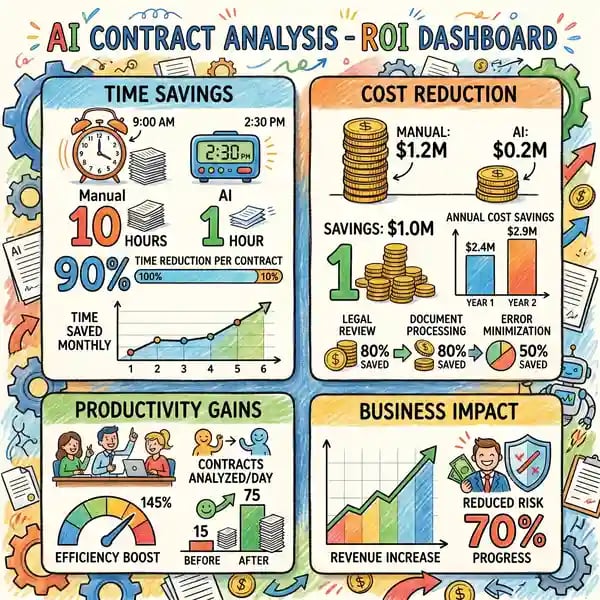
Technology deployment represents only 30% of successful AI implementation. The remaining 70% is organisational: change management, workflow integration, team training, and governance. Data from implementing firms reveals that 40-60% of AI adoption failures stem not from tool limitations, but from change resistance and integration challenges.
The most successful implementations follow this sequence:
Define the target use case precisely
Start with high-volume, standardised contracts (e.g., "all NDAs" or "all service agreements"). Avoid attempting to cover all contract types in the pilot. High-volume ensures ROI; standardisation ensures accuracy.
Gather and clean training data (if using traditional NLP)
For platforms like Kira, source 500-1000 representative contracts from your archive. Annotate key clauses. Allow 4-6 weeks for this phase; rushed annotation reduces model quality.
Run a pilot with 2-3 power users
Do not roll out to the entire team immediately. Work with 2-3 senior lawyers for 4-8 weeks. They will discover integration issues, workflow friction, and tool limitations. Iterate based on their feedback.
Establish verification protocols
Define which findings require human review. Recommend: high-stakes contracts (>£500K value) get 100% verification; medium-stakes get 20% spot-check; low-stakes get 5% spot-check. Document protocols in writing.
Train the team on AI limitations and error modes
Do not assume lawyers understand AI. Run workshops on: common error modes (false negatives, hallucinations), when to trust AI findings vs. when to verify manually, and how to interpret confidence scores. Ongoing training prevents "automation bias."
Scale to full team gradually
Roll out in tranches: 25% of team for 2 weeks, then 50%, then 100%. Collect feedback at each stage. Adjust workflows, training, or tool configuration based on real usage patterns.
Helium42's founders have guided 500+ organisations through digital transformation, and we apply that education-led approach to AI. Our research shows that firms implementing this phased approach achieve productivity gains 30-40% faster than those attempting big-bang rollouts.
Quantifying the Financial Case
The financial case for AI contract review is strong, though variables significantly impact ROI. Let us work through a realistic example:
| Metric | Typical Range (UK Market) |
|---|---|
| Contracts reviewed annually | 500-5,000 (mid-tier to large firm) |
| Manual review time per contract | 45 minutes (standardised) to 3 hours (complex) |
| Lawyer hourly rate (blended) | £150-300 (depending on seniority mix) |
| Time savings from AI | 30-70% (higher for standardised contracts) |
| Annual platform cost | £40,000-150,000 (depending on tool and volume) |
| Implementation cost | £15,000-40,000 (integration, training, setup) |
| Payback period | 3-8 months (for high-volume programmes) |
Sources: Thomson Reuters Institute Legal Technology Report 2024, Forrester Wave: AI-Powered Legal Contracts Q1 2024
Example: Mid-tier firm with 1,000 standardised contracts/year
Current state: 1,000 contracts × 45 minutes = 750 hours/year × £200/hour = £150,000 annual cost
With AI (50% time savings): 375 hours × £200 = £75,000 + £90,000 platform cost = £165,000
Net year one: -£15,000 (investment AI development cost guide breaks even in months 2-3 of year two)
Year two onwards: £75,000 annual benefit
The ROI improves with scale. Firms processing 2,000+ standardised contracts annually see payback within 3-4 months and £150,000+ annual benefit.
Managing Risks and Limitations
No AI system is infallible. Understanding failure modes and building appropriate verification controls is essential.
The Danger of Automation Bias
Common mistake: Legal teams trust AI findings without adequate verification, particularly if the tool has worked well on previous contracts.
The reality: AI systems experience false negatives (missed clauses, typically 2-3%) and false positives (incorrect flags, 5-8%). Verification protocols are not optional; they are mandatory governance controls. Firms should measure "AI acceptance rate" (% of findings accepted without verification) and target <20% for high-stakes contracts.
Common AI errors include:
- False negatives: Missed clauses (e.g., non-compete clause extracted incorrectly)
- False positives: Incorrectly flagged provisions (e.g., flagged "no termination right" when contract allows termination for convenience)
- Misinterpreted clauses: Extracted first number only (e.g., extracted "60 days" when actual term is "60 days or upon invoice, whichever is earlier")
- Hallucinations (LLM-only risk): Stated contract contains clause that does not actually exist
Performance degrades predictably on:
- Contracts in non-standard format (unusual structure, non-linear sections)
- Heavily negotiated documents with extensive redlines and amendments
- Clauses requiring industry or regulatory context to interpret
- Scanned PDFs or poor document quality
The mitigation is straightforward: assign verification workload based on contract risk. High-stakes contracts (M&A, major partnerships, >£1M value) get 100% human review regardless of AI findings. Commodity contracts (NDAs, standard service agreements) can be processed with 5-10% spot-check verification. This approach maintains risk control whilst capturing most efficiency gains.
Professional Indemnity and Regulatory Considerations
UK legal teams using AI should consider three regulatory implications:
1. Professional indemnity insurance. Notify your professional indemnity insurer that you use AI tools. Document your verification and control procedures in writing. The insurer needs assurance that AI use does not create unmanaged liability. Most insurers now accept AI tools provided verification protocols are documented.
2. SRA compliance. The Solicitors Regulation Authority does not prohibit AI but requires firms to maintain competence and manage risks. This means: understanding AI limitations, verifying findings on material issues, and maintaining human judgment in contract interpretation. Use of AI does not change your professional obligation to deliver competent legal advice.
3. Data residency and confidentiality. If your firm handles sensitive government or FTSE 100 contracts, prioritise vendors offering UK data residency. Post-Brexit, UK is GDPR-adequate, but client preference varies. Cloud-based vendors (Harvey, Ironclad) increasingly offer UK data residency options at a modest cost premium (10-20%).
When to Use AI, and When to Rely on Humans
The strategic decision is not "AI or humans" but rather "where in the workflow should AI augment human judgment?"
Use AI: High-Volume Commodity Contracts
NDAs, standard employment agreements, lease abstractions, routine supplier agreements. These are standardised, high-volume, and low-risk. AI achieves 94-98% accuracy. Light verification (5-10% spot-check) captures most benefits.
Use AI + Verification: Medium-Complexity Contracts
Service agreements, commercial contracts, routine partnership documents. Structured but with negotiation variance. Medium-strength verification (20% human review) balances efficiency and risk control.
Consider Human-First: High-Stakes or Novel Contracts
M&A purchase agreements, complex financing, joint ventures, unique legal structures. These require commercial judgment, context understanding, and deal intent assessment. AI adds little value; human experts should lead.
Impossible for AI Alone: Ethical and Commercial Judgment
Is this term commercially reasonable? Should we disclose a conflict? What is the other party's likely motivation? These require professional judgment, client context, and ethical reasoning. AI provides data; humans decide.
Ready to transform contract review in your organisation? Our AI consultancy works with legal departments to design and implement contract review automation that maintains rigour and control.
Explore AI Consultancy ServicesFrequently Asked Questions
Can AI replace contract lawyers?
No. AI is a tool for augmentation, not replacement. It handles routine document processing (extracting terms, flagging known risks) far faster than humans. Lawyers apply judgment, negotiate, and manage client relationships. The "augmented lawyer" model—AI handling 30-70% of routine review work—is the realistic outcome.
How accurate is AI contract review compared to human review?
For standardised contracts, AI (94-98% accuracy) matches or exceeds the human baseline. For complex contracts requiring contextual judgment, human review remains superior. The realistic picture: AI excels at routine tasks; humans excel at judgment. Combining both is more accurate than either alone.
What is the implementation timeline?
LLM-based platforms (Harvey, CoCounsel) deploy in 2-4 weeks. Traditional NLP platforms (Kira, Luminance) require 8-12 weeks for custom model training on your contract library. Budget-wise: immediate value from LLM tools; superior accuracy from NLP tools over time.
How do I handle confidential contracts in a cloud-based tool?
Evaluate vendor data residency and security certifications (ISO 27001, SOC 2). Most leading vendors offer UK data residency. On-premises deployment is available but increases cost 40-60%. Many firms use AI for commodity contracts (cloud) and reserve human-only review for highly confidential M&A (air-gapped).
Does my professional indemnity insurance cover AI-assisted contracts?
In most cases, yes—provided you document verification protocols and maintain human oversight. Notify your insurer and provide evidence of controls. The insurer will expect that you understand AI limitations and verify high-stakes findings. Document everything in writing.
Which AI contract review tool should we choose?
This depends on your contract volume, type, and risk tolerance. Choose Kira or Luminance if: you review >2,000 standardised contracts annually; need maximum accuracy (96-98%); have time for deployment (8-12 weeks). Choose Harvey or LLM platforms if: you need rapid deployment; handle diverse contract types; value explainability over raw accuracy. Run a trial with your own contracts before committing.
Conclusion: Building a Smarter Contract Review Process
AI contract review is no longer experimental—it is operational reality across UK law firms and corporate legal teams. The technology delivers measurable efficiency gains (30-70% time savings), maintains professional rigour through human oversight, and provides clear ROI within 3-8 months.
Success requires more than software. It requires clear governance: understanding AI limitations, implementing verification protocols, training your team on how to work alongside AI, and building controls that prevent automation bias. Organisations that treat AI as an augmentation tool—not a replacement—capture the full value.
The contract review process will look fundamentally different in 12 months. Teams that implement AI thoughtfully today will have a significant competitive advantage in efficiency, accuracy, and lawyer satisfaction tomorrow.
Explore our comprehensive guide to AI for business transformation, or contact our consultancy to discuss AI contract review implementation for your organisation.
Helium42's founders have guided 500+ companies through education-led transformation, and we apply that approach to AI implementation. Our education-to-implementation pathway ensures your team understands the technology, owns the process, and achieves measurable results in 6-8 weeks.
Ready to transform contract review with AI?
We help UK legal teams and firms implement AI contract review tools that maintain control, ensure accuracy, and deliver measurable efficiency gains. Our proven pathway combines education, implementation support, and governance frameworks.
Peter Vogel
CEO and Founder, Helium42
Peter leads Helium42's mission to make AI transformation practical and measurable for UK and European businesses. With more than 15 years of experience in digital transformation, he has guided over 500 organisations through education-led programmes and now applies that experience to enterprise AI implementation. AI for M&A due diligence AI applications in employment law
conveyancing contract automation
intellectual property analysis
legal billing automation the leading legal AI tools UK firms use in 2026 the best AI for legal drafting free AI tools for legal drafting implementation guide for AI legal drafting