

Published by

Key Takeaway
AI-powered billing automation eliminates manual time entry (3-6 hours weekly per fee earner), reduces write-offs, and supports the strategic shift from hourly to fixed-fee and value-based pricing. UK law firms adopting AI billing tools report 15-30% efficiency gains and improved client satisfaction through transparent, outcome-focused pricing models.
Billing accuracy and time tracking remain foundational to law firm profitability, yet they consume disproportionate administrative effort. Manual time entry creates delays, invites omissions, and prevents real-time visibility into matter profitability. Meanwhile, the UK legal market is undergoing fundamental structural change: 54% of law firms anticipate a significant shift away from hourly billing within the next five years, with 68% of clients now prioritising value-based pricing models. This shift fundamentally challenges traditional billing workflows and creates a strategic imperative for firms to adopt technologies that enable transparent, outcome-focused pricing and eliminate billing friction.
Artificial intelligence is transforming legal billing and time tracking by automating routine tasks, improving accuracy, and providing actionable insights into matter profitability and resource utilisation. From automatic time capture and intelligent write-off detection to predictive analytics for fixed-fee modelling, AI-powered billing systems do not merely reduce administrative overhead; they fundamentally change how firms structure their pricing, manage client relationships, and measure profitability. This article explores the mechanisms, platforms, strategic applications, and implementation pathways for AI-driven billing automation in UK law firms.
The Billing Efficiency Crisis in Modern Law Firms
UK law firms operate in an environment of mounting pressure. Fee income per equity partner has increased 25% since 2023-24 to £1.4M average, yet net profit percentages have declined from 32.8% to 27.7% across the market. For smaller firms, interest rate compression has eroded profitability further, reducing net profit from 10-15% to 5-10% of revenue. This margin squeeze occurs precisely as administrative burdens intensify.

Manual time tracking remains endemic in UK legal practice. Fee earners typically spend 3-6 hours weekly on time entry, narrative description, and billing adjustments. This overhead accumulates across a mid-sized firm employing 15-20 fee earners to 60-120 hours monthly—equivalent to 1.5-3 full-time administrative staff. Time omissions are equally problematic: studies consistently show that 5-15% of billable time goes unrecorded due to forgetfulness, system friction, or contextual switching. For a firm billing £3M annually, this represents £150,000-£450,000 in lost recovery.
Beyond revenue loss, manual billing creates operational friction that extends payment cycles, complicates matter profitability analysis, and prevents real-time decision-making. Partners lack visibility into whether matters are running at projected profitability until weeks or months after conclusion. This blindness undermines fixed-fee pricing strategy, where accurate historical data on matter scoping is essential for competitive bidding and margin protection.
Industry Statistics on Billing Transformation
of UK law firms anticipate significant shift from hourly billing within 5 years
of UK clients prioritise value-based billing over hourly models
of mid-sized firms offer fixed fees; 27% offer subscription pricing
efficiency gains from AI billing automation
How AI Automates Time Capture and Eliminates Manual Entry
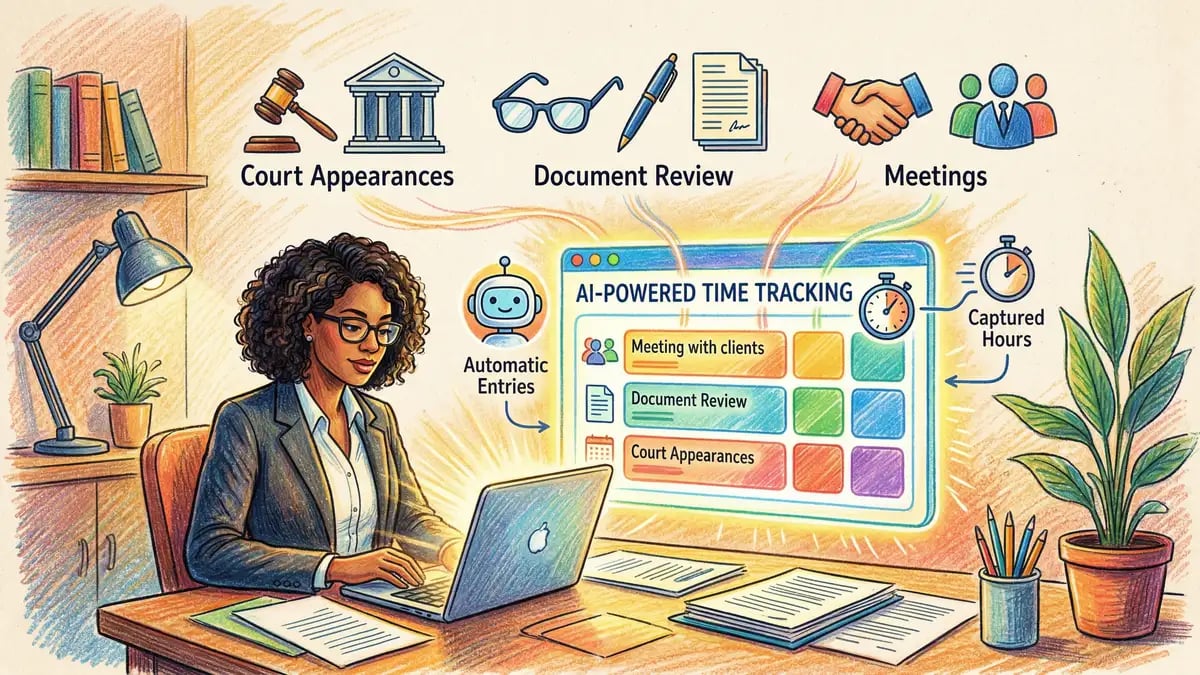
AI-powered time capture operates on three complementary mechanisms: automatic activity logging from email and document systems, intelligent time inference from matter work patterns, and predictive time allocation based on task classification. Together, these eliminate manual entry friction whilst maintaining accuracy and auditability.
Automatic activity logging integrates with email, calendar, and document management systems to record time spent on specific matters without explicit fee earner intervention. When a solicitor receives an email from a client, replies to a matter thread, or opens a contract document tagged to a specific matter, AI systems timestamp the activity and allocate it to the relevant billing code. This happens continuously throughout the working day, with fee earners never opening a time entry form.
Intelligent time inference recognises work patterns and infers reasonable time allocations when direct logging is impractical. If a fee earner attends a three-hour client meeting documented on the calendar for matter X, AI systems automatically allocate three hours to that matter's billing code unless the fee earner manually adjusts it. Similarly, if a solicitor drafts a 40-page contract over a documented 6-hour working session, AI systems can infer that contract drafting consumed the bulk of that time and allocate it accordingly, with the fee earner confirming or refining the allocation in seconds rather than reconstructing time entries from memory.
Predictive time allocation leverages historical data on matter types, task categories, and resource patterns to suggest reasonable time allocations for recurring work. Conveyancing transactions typically follow predictable sequences (enquiries, searches, report, completion). AI systems trained on a firm's historical conveyancing data can predict that a standard residential transaction will require approximately 8 hours of fee earner time across defined phases. When a new transaction begins, the system suggests phased time allocations that the fee earner can accept or adjust, embedding firm-specific knowledge into the billing process.
Billing Analytics and Write-Off Prevention
Beyond time capture, AI billing systems provide real-time analytics that prevent revenue leakage and surface profitability trends. These systems continuously monitor matter performance against budget, flagging anomalies that suggest under-billing, scope creep, or unbilled work.
Write-off detection operates by comparing actual time spent (captured via automatic logging) against client budget and matter estimate. When a matter exceeds its estimated profitability threshold, AI systems alert the engagement partner, enabling proactive decisions about scope adjustment, process optimisation, or budget renegotiation before the matter concludes at a loss. For firms managing hundreds of active matters simultaneously, this real-time visibility eliminates the post-hoc discovery that a matter is unprofitable—a discovery that, in many cases, comes too late to remedy.
Rate-based analytics identify patterns in billing realisations across practice areas, client segments, and fee earner experience levels. Firms can now quantify whether junior solicitors are systematically under-billing due to inefficiency, whether particular client segments demand excessive discounting, or whether specific practice areas are structurally uneconomical at current pricing. These insights feed directly into strategic decisions about pricing adjustment, client onboarding criteria, and resource allocation.
AI-Driven Fixed-Fee and Value-Based Pricing Models
The most transformative application of AI in legal billing is enabling strategic pricing innovation. Traditional hourly billing creates perverse incentives: efficiency reduces revenue, and cost containment requires clients to constrain the very work they need. Fixed-fee and value-based models invert this dynamic by aligning firm and client interests around outcomes.

AI enables this transition by solving the scoping and estimation problem that constrains fixed-fee adoption. Historically, firms quote fixed fees based on rule-of-thumb estimates and prior experience, accepting significant estimation risk. AI systems trained on historical matter data can predict with high accuracy—within 5-10% margin—the actual resource requirements for a given matter category. When a solicitor quotes a fixed fee for a residential conveyancing transaction, an AI system can suggest a rate based on 1,000+ comparable transactions in the firm's historical data, accounting for factors like property complexity, transaction value, and client profile. This enables confident fixed-fee pricing that protects firm margins whilst offering clients transparent, predictable costs.
Value-based pricing extends this logic by linking fees to specific outcomes: successful trial verdicts, regulatory approvals, transaction closures, or dispute resolutions. AI systems quantify the value impact of outcomes and help firms model pricing structures that share value creation with clients. For corporate clients paying multiple firm relationships to support a single transaction, transparent outcome-linked pricing often proves more cost-effective than paying hourly rates across multiple advisors.
Across the UK market, early adoption is accelerating. 82% of mid-sized firms now offer fixed fees for full matters; 27% offer subscription-based pricing for routine advice. These pricing experiments would be economically impossible without AI-driven visibility into matter resource requirements and historical profitability.
Platform Comparison: Leading AI-Enhanced Billing Solutions
The UK legal technology market offers multiple platforms integrating AI billing functionality. Each targets different firm sizes, practice areas, and operational preferences:
| Platform | AI Strengths | Best For | Pricing Model |
|---|---|---|---|
| Clio | Automatic time capture; predictive billing analytics; client portal integration | Small to mid-sized firms; cloud-first operations | SaaS per user, £30-£50/user/month |
| LEAP | Conveyancing workflow optimisation; transaction billing automation | Conveyancing-focused firms | Licence-based, £2,000-£5,000/month |
| Smokeball | Microsoft ecosystem integration; intelligent time allocation; process automation | Microsoft-dependent firms; automation-heavy operations | SaaS per user, £35-£60/user/month |
| BigHand | Voice-to-time conversion; natural language billing; billing analytics | Large firms; high-volume time entry | Enterprise licensing |
| Aderant | Financial accounting integration; enterprise billing analytics; multi-entity support | Large firms; complex multi-office operations | Enterprise licensing, £10,000+/month |
| Thomson Reuters 3E | Legal ERP integration; predictive analytics; advanced reporting | Top-tier and large firms; integrated legal operations | Enterprise licensing, £15,000+/month |
Selection depends on firm size, existing technology stack, practice area specialisation, and digital maturity. Mid-sized general practices often favour Clio or Smokeball for their cloud-first, user-friendly design. Conveyancing-focused firms benefit from LEAP's transaction-optimised workflows. Large firms requiring comprehensive financial integration typically deploy Aderant or Thomson Reuters 3E alongside legacy accounting systems.
Client Relationship and Transparency Benefits
AI-powered billing systems improve client relationships by enabling transparency and predictability. Real-time client portals provide visibility into time spent, work completed, and fees accrued, eliminating the surprise of invoice arrival and reducing disputes. 50%+ of clients now prefer transparent pricing models over traditional hourly billing, with transparency as a primary driver of law firm selection among in-house legal departments.
For matters billed at fixed or value-based rates, transparency takes on additional significance. Clients understand precisely what they are paying and why, shifting the conversation from time negotiation to outcome delivery. This fosters higher retention: firms adopting value-based pricing report 20-30% improvement in client lifetime value compared to hourly-rate peers.
Advanced systems integrate client communication workflows, enabling firms to proactively notify clients when matters approach budget thresholds or when scope changes warrant fee adjustment. This prevents conflict and positions the law firm as a trusted advisor rather than an adversary in cost discussions.
Implementation Roadmap: From Planning to Deployment
Successful AI billing implementation follows a phased approach. Most firms deploy across four stages over 6-12 months:
Phase 1: Assessment and Planning (Weeks 1-4)
Audit existing billing workflows, define key performance indicators (time capture accuracy, write-off rates, billing realisation), and assess integration requirements with existing systems. Identify early-adopter practice areas and pilot users.
Phase 2: Platform Selection and Configuration (Weeks 5-10)
Evaluate shortlisted platforms against firm requirements, negotiate contracts, and begin configuration. Migrate historical matter data to enable AI training on firm-specific patterns. Establish matter codes, practice area classifications, and billing rate structures within the new system.
Phase 3: Pilot Deployment (Weeks 11-16)
Deploy with a pilot group of 8-12 fee earners across 1-2 practice areas. Capture feedback, troubleshoot integration issues, and refine billing rules. Monitor adoption, time entry accuracy, and writing-off patterns. Iterate on configuration and user workflows.
Phase 4: Firm-Wide Rollout (Weeks 17-52)
Expand to all fee earners and practice areas. Complete integration with accounting systems and client portals. Establish ongoing training, governance, and system administration. Monitor system health, user adoption metrics, and billing accuracy KPIs. Plan advanced features (predictive pricing, value-based automation) for deployment in year two.
ROI and Financial Impact
The financial case for AI billing automation is compelling. A mid-sized firm with 20 fee earners, £3M annual billing, and 5% write-off rate experiences:
- Time savings: 60-120 hours monthly (4.5-9 hours per fee earner weekly) redirected to billable work or firm development. At £150/hour blended rate, this represents £9,000-£18,000 monthly incremental revenue recovery.
- Write-off reduction: Decrease write-offs from 5% to 2-3% through real-time monitoring and scope management. At £3M billing, this saves £60,000-£90,000 annually.
- Pricing innovation: Shift 15-25% of revenue to fixed-fee or value-based models, improving margins by 5-15% through outcome-focused pricing and efficiency gains.
- Operational efficiency: Reduce billing administration headcount by 0.5-1.0 FTE, saving £25,000-£50,000 annually.
- Client retention: Improve retention 5-10% through enhanced transparency and outcome alignment, increasing client lifetime value by 15-30%.
Combined annual benefit typically reaches £200,000-£400,000 for a firm of this size. System costs average £3,000-£8,000 monthly (£36,000-£96,000 annually), yielding payback within 3-6 months and ongoing margin benefit thereafter.
Transform Your Billing Operations with AI
Ready to eliminate manual time entry and unlock hidden profitability? Our AI for legal departments guide explores how integrated AI systems drive operational transformation across law firms of all sizes. Learn how leading firms are shifting to value-based pricing and improving client relationships through transparent billing.
Frequently Asked Questions
How accurate is AI time capture compared to manual entry?
AI time capture typically achieves 90-95% accuracy when trained on 6-12 months of firm data. Accuracy improves iteratively as fee earners provide feedback and refine allocations. Studies show AI-captured time is more accurate than manual entry because it eliminates forgetfulness and timestamp inference errors inherent in retrospective time logging.
Does AI billing integration require migration away from legacy systems?
Most AI billing platforms operate alongside legacy systems during transition periods. Modern systems include data migration tools and API integrations that allow gradual transition. However, firms derive maximum benefit from newer cloud-based platforms that integrate billing, time capture, and analytics in a single system rather than point-solution integration across multiple vendors.
Can AI support transition from hourly to fixed-fee billing?
Yes. AI-trained pricing models predict resource requirements based on historical matter data, enabling confident fixed-fee quotation. Firms typically begin with low-risk matters (residential conveyancing, simple contract review) and expand fixed-fee adoption as confidence in estimation models grows. Most firms report 80%+ confidence in AI-suggested fixed fees within 6-9 months of deployment.
What is the typical implementation timeline for AI billing systems?
Implementation typically spans 6-12 months from vendor selection to firm-wide deployment. Assessment and planning (4 weeks), platform selection and configuration (6 weeks), pilot deployment (6 weeks), and full rollout (6-36 weeks depending on firm size). However, firms can realise significant value within the first 3-4 months of pilot deployment.
How do AI systems handle multi-matter time allocation when fee earners work across multiple clients simultaneously?
Advanced systems use contextual inference—email routing, calendar references, document tagging, and browsing history—to infer which matter a fee earner is actively servicing at any moment. When context is ambiguous, the system flags the time entry for manual allocation, ensuring accuracy. Over time, fee earners can train the AI to recognise their typical work patterns, reducing manual adjustments required.
Are there data privacy and security risks when using AI billing systems?
Reputable platforms implement SOC 2 Type II compliance, encrypted data transmission, role-based access controls, and audit trails. AI billing systems should not require direct access to privileged client communications; they operate on metadata and timing information. Choose vendors that offer on-premise or private cloud deployment if regulatory requirements preclude SaaS models. Review data processor agreements carefully and ensure vendor certifications align with your jurisdictional requirements (GDPR, UK legal privilege standards).
Conclusion: Billing as Strategic Competitive Advantage
AI-powered billing systems represent far more than administrative efficiency tools. They are strategic enablers of pricing innovation, profitability improvement, and client relationship transformation. As UK law firms face margin compression, client demand for alternative pricing models, and heightened competition for talent, the firms that invest in intelligent billing automation will separate themselves by combining operational excellence with client-centric commercial innovation.
The market data is clear: 54% of UK firms anticipate shift from hourly billing within five years. 96% of firms are already integrating AI. The window for first-mover advantage—establishing pricing innovation and cost-of-service leadership—remains open but is rapidly narrowing. The firms that deploy AI billing systems now will establish competitive moats based on superior client economics, outcome alignment, and operational transparency. Those that delay risk commoditisation in a market where technology-enabled competitors can undercut on price and outcompete on service quality.
To explore how AI billing systems integrate with broader legal technology transformation, read our guides on AI for law firms, AI for contract review, and AI for M&A due diligence, which cover complementary AI applications across legal service delivery.
Ready to Transform Your Firm's Billing Operations?
Discover how AI billing automation can eliminate manual time entry, reduce write-offs, and enable strategic pricing innovation. Learn from the latest case studies and implementation frameworks across practice areas including conveyancing, IP management, and corporate law.
Author
Peter Vogel
AI Strategy and Legal Technology Consultant
Peter advises law firms and corporate legal departments on AI adoption, legal technology strategy, and digital transformation. Specialising in practice management systems, billing automation, and knowledge management integration.
Sources: Thomson Reuters — State of the UK Legal Market 2025 | Armstrong Watson — Law Firm Benchmarking Review 2024/25 | Clio — 2025 Legal Trends Report | Actionstep — UK Midsize Firms Technology Report 2026 | PwC/Strategy& — UK Legal Services Market Report 2025 | LPM Magazine — Mid-Sized Law Firm Billing Trends