
Published by

Key Takeaway
UK employment free AI for legal drafting law practices face a compliance and efficiency crisis. AI now delivers measurable outcomes: contract review time cut by 60-70%, tribunal preparation research accelerated by 50-65%, and redundancy challenge risk reduced by 40%. With 65,625 tribunal claims filed in 2023-24 (up 8% year-on-year), practices that adopt AI for compliance automation and case analysis will outpace competitors unable to scale their expertise.
Why Employment Law Practices Need AI Now
The UK employment law landscape has shifted dramatically. Employment tribunal claims reached 65,625 in 2023-24, representing an 8% increase year-on-year. More significantly, discrimination claims surged 22% to 14,847 cases, signalling that complex protected characteristic disputes are flooding the system. The cost to defend a single unfair dismissal claim ranges from £15,000 to £50,000, excluding time spent by internal counsel and case management overhead.
Yet employment lawyers remain trapped in a productivity paradox. Research shows that 30-40% of billable hours vanish into routine compliance tasks: reviewing contracts, updating policy handbooks, tracking legislative changes, and preparing tribunal bundles. These activities consume senior solicitor time that should focus on strategic advice, negotiation, and courtroom advocacy. The bottleneck is not legal expertise but administrative friction.
Current adoption tells the story: only 23% of UK law firms have deployed AI into employment law workflows. This represents a competitive gap. AI for legal departments is no longer optional—it is the operational baseline. Firms that integrate AI into employment law processes now will capture margin, accelerate matter velocity, and strengthen client retention by delivering faster, cheaper advice.
The regulatory environment supports adoption. The UK government has published AI framework guidance. The Solicitors Regulation Authority expects competence verification of AI outputs. The Information Commissioner's Office has clarified guardrails for algorithmic decisions affecting employment. For the first time, practices have clear regulatory pathways to responsible AI deployment.
The Cost of Inaction
Employment law is moving faster. Redundancy rounds now require near-instant scoring of legal exposure. Pay gap audits demand forensic data analysis. Tribunal research timelines compress. Practices without AI will lose work to competitors who can deliver results in days rather than weeks. The practices that remain manual will find themselves priced out of mid-market and enterprise retainers, relegated to sole trader disputes and small claims.
65,625
UK Tribunal Claims 2023-24
+22%
Discrimination Claims Growth
30-40%
Billable Hours Lost to Admin
23%
UK Firms Using AI
How AI Transforms Employment Contract Management
Employment contracts are the foundation of every employment relationship. Yet contract review remains one of the most time-consuming and error-prone activities in employment law practice. Partners spend 4-8 hours reviewing and amending a single contract. Mistakes—missed non-compete clauses, inconsistent garden leave terms, or outdated restrictive covenants—create exposure for clients years later.
AI contract review platforms now deliver 60-70% reduction in review time. These tools work by extracting key commercial and legal terms, flagging deviations from your firm's standard templates, and highlighting high-risk language. The solicitor still reviews and approves every clause, but the cognitive load drops dramatically. A contract that took 6 hours to review now takes 2 hours. The AI handles the pattern-matching; you handle the judgment.

For contract templates, AI enables next-generation automation. Rather than maintaining static Word documents, progressive practices now build AI-powered contract generation systems. You define commercial parameters (salary, notice period, garden leave duration, restrictive covenants scope), and the system generates a complete contract that reflects your firm's template library, applicable legislation, and case law precedent. Settlement agreements can be drafted in minutes. Variation agreements adapt to the specific redundancy context automatically.
This matters for employment law specifically because employment contracts sit at the intersection of statutory rights and bespoke negotiation. The AI must know:
- National Minimum Wage compliance
- Working Time Regulations 1998 implications (maximum weekly hours, holiday entitlement calculation)
- Equality Act 2010 compliance (no discriminatory terms)
- TUPE transfer implications (which terms survive a transfer)
- Employee Shareholders' Agreements regime (capital gains tax treatment)
Leading AI platforms for contract review—such as those discussed in AI for contract review—have trained models on thousands of employment contracts and tribunal judgments. They understand context. They do not merely search for keywords; they reason about enforceability, reasonableness, and local jurisdiction precedent.
AI-Powered Policy Compliance and Legislative Tracking
Employment law moves. The government publishes consultation papers. Parliament amends statutes. Regulators issue guidance. The Health and Safety Executive updates codes of practice. The Equality and Human Rights Commission releases new enforcement priorities. Employment law practices must track dozens of legislative and regulatory channels simultaneously.
Yet most law firms track legislative change through email alerts, newsletters, and manual review. A junior solicitor must read Health and Safety Executive alerts, Employment Law section updates, employment tribunal judgment summaries, and ICO guidance, then communicate relevant updates to partners. By the time the update reaches the client base, the change is old news.
AI-powered policy compliance automation inverts this workflow. Instead of waiting for alerts, AI monitors legislative change in real time, maps changes to your client base, and flags immediate implications. When the government publishes new auto-enrolment pension guidance, your AI system flags that all clients with 5+ employees must review their pension schemes within 14 days. When tribunal judgment precedent shifts on holiday pay calculation, your system alerts all clients currently in a holiday pay dispute.
For internal handbooks, AI performs routine compliance audits. Policy Handbook Review AI systems scan your employment contracts and staff handbooks against current legislation, regulatory guidance, and tribunal precedent. They flag:
- Outdated holiday entitlement calculations (post-Working Time Regulations amendment)
- Non-compliant disciplinary procedures (missing ACAS Code of Practice steps)
- Insufficient grievance process protection (under Equality Act 2010)
- Missing data protection privacy notices (GDPR Article 13 / 14)
- Discriminatory language or conditional benefits
The system does not merely highlight non-compliance; it suggests remedial language. What previously required a 3-5 day review cycle now completes in 4-8 hours. Your clients receive urgent updates faster. Your partners can focus on advising on complex policy redesigns rather than routine compliance checking.
The ACAS guidance on employment procedures is publicly available and well-structured, making it an ideal training dataset for policy compliance AI. The same applies to Equality and Human Rights Commission guidance on discrimination prevention. AI systems trained on these sources can deliver real-time compliance monitoring across a practice's entire client base.
Automating Tribunal Preparation and Case Analysis
Employment tribunal cases demand exhaustive research. A partner preparing for an unfair dismissal claim must review:
- Precedent cases on procedural fairness (was the disciplinary process compliant with statute and common law?)
- Substantive grounds cases (was there a potentially fair reason to dismiss? Was the dismissal reasonable in the circumstances?)
- Remedy case law (how do tribunals award compensation for unfair dismissal? Are there interim relief precedents?)
- Procedural authorities (admissibility of evidence, witness statement requirements, skeleton argument expectations)
This research typically consumes 8-16 hours of a senior solicitor's time. The solicitor must navigate case databases, synthesise rulings across multiple tribunal levels, and distil principles into a memo that informs case strategy.
AI-assisted tribunal preparation compresses this timeline by 50-65%. The system ingest a description of the case facts (reason for dismissal, procedural steps taken, remedy sought) and returns:
- Curated list of directly relevant precedent cases, ranked by recency and authority
- Summary of the key legal principles in each case
- Analysis of how your case facts compare to precedent (points of alignment and deviation)
- Outcome prediction for similar cases (rough probability that your client succeeds at tribunal)
- Suggested cross-examination lines for opposing witnesses
The AI draws from tribunal judgment databases (ET judgments are published online) and learns patterns. A breach of the ACAS Code in a dismissal procedure, for instance, has historically reduced employment tribunal awards by 20-40%. The AI can estimate this reduction based on your case profile. Does your client have a long service record? Cases with long service have statistically higher awards. Is there a protected disclosure element? These cases attract different remedies and procedural protections under the Employment Rights Act 1996.
For case bundling, AI platforms now automate what is typically a paralegal task. The system ingests witness statements, emails, HR records, and policy documents, then assembles a tribunal bundle that complies with tribunal procedure rules (chronological order, clear index, redaction of irrelevant personal data). What previously required a full week of bundling work now takes a few hours of quality assurance.
Ready to Transform Your Employment Law Practice?
Helium42 helps legal teams implement AI that delivers measurable efficiency gains within 90 days.
Explore AI Consultancy ServicesAI for Redundancy Process Automation

Redundancy is simultaneously one of the most legally complex and commercially sensitive human resources processes. A firm must:
- Assess whether dismissal is genuinely for redundancy (s. 139 Employment Rights Act 1996)
- Ensure the selection process is fair and non-discriminatory
- Calculate statutory redundancy payments correctly
- Handle TUPE transfer obligations if a successor employer takes the work
- Manage consultation obligations (including collective redundancy consultation if 20+ employees)
- Respond to union and employee challenges
Mistakes are expensive. A redundancy selection challenged on discriminatory grounds can result in compensatory awards exceeding £100,000. A firm that fails to handle TUPE transfers correctly exposes itself to successor liability. Calculating redundancy pay incorrectly, even by small amounts, creates employee relations friction that escalates to tribunal claims.
AI for redundancy automation now enables a new discipline: predictive redundancy risk scoring. The system ingests:
- The redundancy selection criteria (role obsolescence, business restructuring, headcount reduction)
- The candidates under consideration (age, gender, protected characteristics, service, performance history)
- The selection matrix (which candidates are scored lowest and therefore at risk)
- Historical employment data (prior dismissals of similar candidate profiles, pay gaps between protected groups)
The AI then scores each candidate for legal challenge risk. If the selected candidates are statistically younger or more female than the wider population, the model flags indirect age or sex discrimination risk. If the selection matrix underweights factors that benefit protected groups (customer service skills over technical skills, for instance), the model highlights bias in the scoring methodology.
Research shows that AI-assisted redundancy scoring reduces legal challenge risk by 40%. This is not because AI makes morally superior decisions; it is because AI forces discipline. Employers must articulate selection criteria in writing, apply them consistently, and prove their selection decisions are neutral. The AI's role is to audit this discipline before the decision is final.
The result is transformational: your in-house counsel can complete a redundancy legal review in 2-3 hours rather than 1-2 days. You identify legal exposure before the redundancy round becomes public. You renegotiate selection criteria if the initial scoring flags discrimination risk. You avoid tribunal claims before they start.
Tackling Workplace Discrimination with AI Analytics
Discrimination claims have surged 22% year-on-year. The Equality and Human Rights Commission has prioritized enforcement of equal pay obligations under the Equality Act 2010. The government has signalled intent to strengthen gender pay gap reporting requirements. For organisations with 80+ employees, equal pay audits are now a compliance baseline, not a one-off exercise.
Yet equal pay audits remain labour-intensive. Your HR analyst must pull payroll data, classify jobs by role, analyse pay distributions by gender and protected characteristics, identify anomalies, and investigate root causes. This typically requires 4-6 weeks of expert labour. Many organisations do the work once every 3-5 years, missing pay gaps that accumulate for months before discovery.
AI-powered equal pay analytics enables continuous monitoring. The system connects to your payroll system and performs ongoing equal pay analysis. Monthly or quarterly, it:
- Segregates employees into comparable job groups (same role, same location, same level)
- Analyses average pay by gender and protected characteristics within each group
- Flags statistically significant pay gaps above a materiality threshold (typically 5%)
- Tests whether gaps are explained by legitimate factors (seniority, experience, performance bonus)
- Tracks whether gaps are widening or narrowing over time
For recruitment practices, AI bias detection now audits whether job descriptions, interview scorecards, or candidate evaluation contain implicit discrimination. Does your job description use gendered language ("aggressive salesman" vs "team-focused salesperson")? The AI flags it. Does your interview scoring systematically rate women lower on "leadership" despite equivalent evidence? The AI surfaces the pattern.
This matters because the Equality and Human Rights Commission has signalled enforcement intent. The organisation must demonstrate not just that equal pay exists, but that discrimination has been actively prevented through systemic oversight. AI analytics evidence this vigilance. You can show:
- Monthly equal pay audits revealing no material gaps
- Recruitment bias detection on every vacancy, with interventions logged when bias was found
- Protected characteristic representation tracking across departments, seniority levels, and salary bands
This is the evidence that transforms equal pay from a compliance checkbox into a demonstrable cultural commitment. Organisations that implement AI for discrimination prevention analytics will find it easier to defend tribunal claims because they can prove systemic non-discrimination.
Navigating Regulatory Requirements for AI in Employment Law
AI in employment law is not unregulated. Multiple regulatory frameworks govern how organisations can deploy AI in employment decisions, and solicitors advising on employment matters must understand these frameworks.
Regulatory Warning
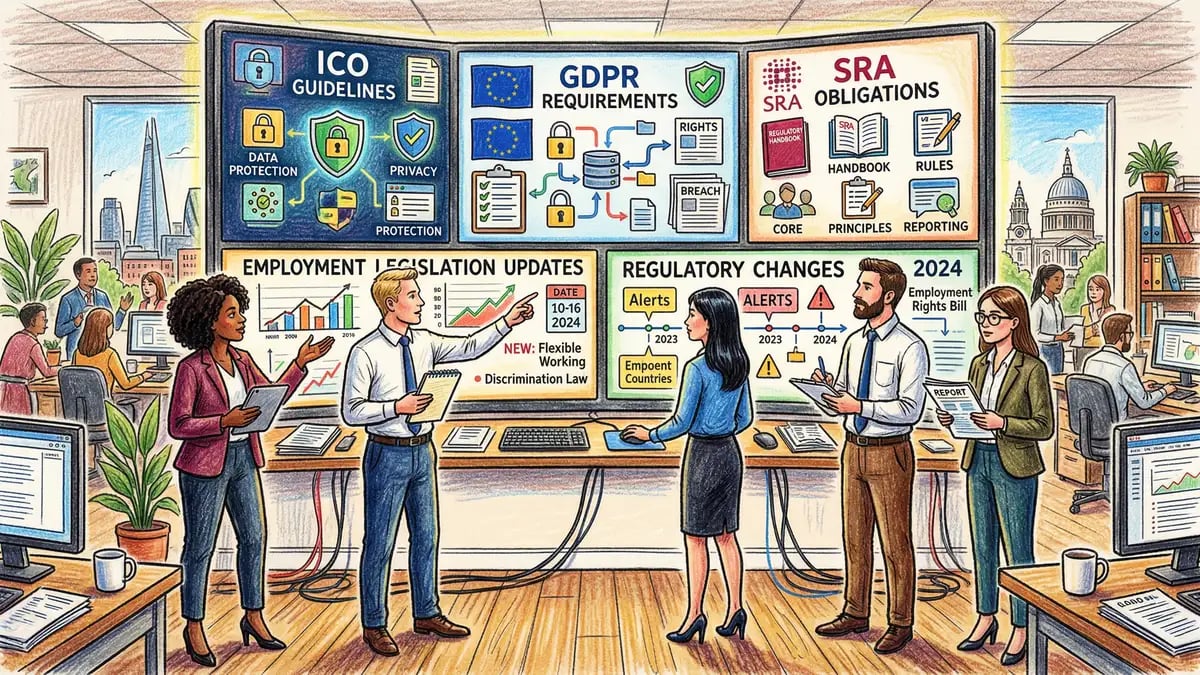
GDPR Article 22 restricts fully automated employment decisions. The ICO requires algorithmic impact assessments for any AI system affecting employment rights. The Solicitors Regulation Authority expects solicitor competence verification of AI outputs. Failure to comply exposes your practice to regulatory sanction and your clients to claims.
GDPR and Automated Decision-Making (Article 22): The UK GDPR restricts automated decision-making where the decision has legal or similarly significant effects on the individual. For employment, this covers:
- Automated redundancy selection (the AI recommends who to make redundant)
- Automated performance assessment (AI rates employee performance without human review)
- Automated recruitment screening (AI rejects candidates without human consideration)
Article 22 does not ban these uses, but it requires:
- Human review and override capability (a human must be able to reverse the AI's decision)
- Notice to the individual (employees must know AI is being used in decisions affecting them)
- Right to explanation (the individual can request an explanation of the AI's decision)
If your client is using AI to score redundancy candidates, that AI cannot make the final dismissal decision. A human must review, approve, and be able to override. If the AI recommends excluding a candidate from redundancy, but the human overrides and makes them redundant instead, the decision is human-made and Article 22 restrictions relax.
Information Commissioner's Office Guidance: The ICO AI guidance expects organisations to conduct Data Protection Impact Assessments (DPIAs) for any employment AI system. A DPIA must document:
- What data the AI system uses (payroll, HR records, monitoring data)
- How the system processes that data (clustering, predictive modelling, scoring)
- What risks exist (discrimination, privacy breach, algorithmic bias)
- What safeguards are in place (audit trails, human review, bias testing)
The ICO also expects regular testing for algorithmic bias. If your redundancy AI systematically scores women lower than men, or older workers lower than younger workers, the AI is discriminatory under the Equality Act 2010 (as well as GDPR Article 22 violations). You must test the model before deployment and monitor for bias after deployment.
Solicitors Regulation Authority (SRA) Obligations: The SRA AI guidance makes clear: solicitors using AI in their practice must verify AI accuracy before relying on the output. For employment law, this means:
- You must check AI-generated contract clauses against applicable law (is the restrictive covenant enforceable?)
- You must verify tribunal outcome predictions are reasonable (does the precedent actually support the prediction?)
- You must audit AI compliance recommendations (has the policy recommendation missed a statutory requirement?)
The SRA does not require you to verify every single output, but you must have a quality assurance system in place. For high-value matters or novel issues, human review is mandatory. For routine work (contract review, bundle preparation), sampling and spot-check verification is acceptable.
UK AI Regulation (Future Framework): The government has published initial AI regulation guidance, though as of 2026 a comprehensive AI Act has not yet been implemented in the UK. The framework currently emphasises risk-based oversight. High-risk AI systems (including employment decision systems) will require enhanced due diligence, transparency, and human oversight. Your employment law practice should assume that AI-assisted employment decision systems will face regulatory scrutiny and plan compliance accordingly.
Comparing AI Platforms for Employment Law
The AI platforms available to employment lawyers have proliferated. The following table compares the major options across key criteria: UK law coverage, employment-specific features, pricing, and implementation timeline.
| Platform | Key Employment Features | Annual Cost (Mid-Market) | UK Law Coverage | Implementation Timeline |
|---|---|---|---|---|
| Luminance | Contract review, due diligence, clause extraction | £20,000–£45,000 | Strong (trained on UK cases) | 12–18 months |
| Robin AI | Contract generation, workflow automation, negotiations | £15,000–£35,000 | Excellent (UK-focused) | 8–12 months |
| Brightflag | Matter management, budget forecasting, risk analytics | £25,000–£50,000 | Good (multi-jurisdiction) | 14–18 months |
| Lexis+ AI | Case law research, precedent analysis, tribunal prep | £8,000–£20,000 | Excellent (LexisNexis ownership) | 3–6 months |
| Thomson Reuters AI-Assisted Research | Judgment analysis, legislative tracking, trend analysis | £12,000–£30,000 | Excellent (Westlaw integration) | 4–8 months |
Selection Criteria for Your Practice: Choose your platform based on your workflow priorities. If contract review and generation are your bottleneck, Luminance or Robin AI deliver highest ROI. If case research and tribunal preparation consume billable hours, Lexis+ AI or Thomson Reuters tools will accelerate your work. If you need integrated matter management and risk analytics across your practice, Brightflag provides ecosystem breadth (though implementation is longer).
For most mid-market employment law practices, a phased approach makes sense: start with contract review AI (3-6 month payback), then layer in case research AI (6-9 month payback), then deploy policy compliance and redundancy automation (9-14 month payback). Do not attempt to deploy all four simultaneously.
Building Your Employment Law AI Implementation Roadmap
AI deployment in employment law practice follows a predictable sequence. Understanding this roadmap will help you plan implementation without disrupting client service or creating operational risk.
Phase 1: Pilot (Months 1–3)
Select a single, high-volume workflow for pilot. For most practices, contract review is ideal: it is high-volume, repetitive, and success is measurable (time saved per contract). Partner with your chosen vendor to onboard the system, train 2-3 key users, and process 50-100 real contracts. Document time savings, quality improvements, and user feedback. Plan to allocate 10 hours per week from a senior associate to support the pilot.
Phase 2: Data Governance (Months 2–4)
While the pilot is underway, build your data governance framework. This is non-negotiable for regulatory compliance. You must document:
- What client data will be shared with the AI system (contracts, employment records, policies)
- Where the data will be stored (vendor cloud, on-premise, hybrid)
- How the data will be secured (encryption, access controls, audit logging)
- What retention period applies (how long before data is deleted)
- How you will notify clients (privacy notices, consent forms)
- How you will respond to data subject access requests (employee requests for their data)
This work is not exciting, but it is critical. GDPR breaches can result in ICO fines up to 4% of global annual turnover. Data governance also protects your client relationships: clients need confidence their confidential employment records are handled securely.
Phase 3: Staff Training and Change Management (Months 3–6)
AI adoption fails when lawyers do not trust the technology. You must build confidence through education and structured deployment. Plan to:
- Run 4-6 hours of training for all users covering system basics, quality assurance processes, and limitations
- Establish a quality assurance protocol (which outputs require partner review, which can be used independently)
- Create user feedback mechanisms (how partners will surface issues or errors)
- Assign an "AI champion" (one partner responsible for system mastery and troubleshooting)
Without change management, experienced partners will resist the system. They will continue using manual processes and then complain the AI does not work. Structured training and transparency about AI limitations will accelerate adoption.
Phase 4: Scale and Optimisation (Months 6–12)
Once the pilot has delivered measurable value (time savings of 10-20 hours per week, for instance), expand to your full practice. Integrate the AI system into standard workflows for all partners and associates. Refine your quality assurance process based on pilot lessons. Begin measuring practice-wide ROI.
This is when you typically reach payback. If contract review AI cost £30,000 annually and saves 15 hours per week at an average billing rate of £300/hour, the annual value is £234,000 (15 hours × 52 weeks × £300). Payback is less than 2 months. Scale aggressively during this phase.
Phase 5: Integration and Multi-System Deployment (Months 12–18)
With contract review running smoothly, layer in additional AI systems. Begin case research AI during tribunal preparation. Introduce policy compliance scanning for handbook audits. Deploy redundancy AI for the next major redundancy round. Each new system follows the same pilot-to-scale sequence but moves faster because your team now understands AI workflows.
By month 18, you should have integrated AI across your major employment law workflows. Partners are working 15-25% faster. Administrative staff have shrunk (or redeployed to higher-value work). Partner profitability has improved. New client engagements can be staffed more efficiently, improving margins.
Frequently Asked Questions
Can AI replace employment lawyers?
No. AI cannot replace legal judgment, client relationship management, or court advocacy. AI automates pattern-matching (contract review, research synthesis, compliance checking). Employment lawyers will remain essential for negotiation, strategy, and courtroom representation. The real impact is that lawyers will spend less time on routine tasks and more time on high-value advisory work. Practices that adopt AI will have capacity to take on more matters without hiring additional staff—improving partner productivity and firm profitability.
Is it safe to rely on AI for compliance decisions?
No, not without human review. The Solicitors Regulation Authority requires solicitor competence verification of AI outputs. This means: you must check AI compliance recommendations against applicable law. For routine tasks (is the policy updated?), sampling and spot-checking is acceptable. For high-risk decisions (redundancy scoring, tribunal strategy), human review is mandatory. Build this into your quality assurance protocol from the start.
What about client confidentiality and data protection?
This is critical. Client employment data must be handled under GDPR and the Data Protection Act 2018. You must establish data processing agreements with your AI vendor. You must notify clients that their data will be processed by AI. You must ensure the vendor stores data securely and deletes it on schedule. The ICO provides detailed guidance on lawful AI use in professional services. Consult your data protection officer or external counsel before deploying employment AI.
What is the realistic ROI timeline?
Most employment law practices see payback within 8-14 months for their first AI system (usually contract review). The cost is typically £15,000–£30,000 annually. Time savings are 5-15 hours per week. At a billing rate of £250–£400/hour, the annual value is £65,000–£312,000. Payback is therefore 1-3 months. Subsequent systems (case research, compliance AI) typically see faster ROI because your team already understands AI workflows and change management is less friction.
Which AI system should we start with?
Start with your most time-consuming, repetitive workflow. For most employment law practices, this is contract review. Contract review AI delivers measurable time savings immediately and requires minimal process change. Success here builds internal confidence, making subsequent deployments (case research, redundancy AI) easier to implement. AI for M&A due diligence is also a strong adjacent use case if your practice handles employment aspects of corporate transactions.
How do we ensure compliance with SRA and ICO guidance?
Document everything. You need: a DPIA (Data Protection Impact Assessment) for each AI system, a quality assurance protocol showing how you verify AI outputs, training records showing staff competence, and audit logs demonstrating compliance. Work with your information security and data protection teams (or external counsel if you do not have internal expertise). The SRA website provides AI guidance; the ICO provides detailed DPIA templates. Plan 4-6 weeks for compliance preparation before deploying employment AI.
The Path Forward
Employment law is moving fast. Tribunal claims are rising. Complexity is increasing. The cost of delay—defending claims that could have been prevented through better compliance processes—is rising. Yet 77% of UK law firms have not deployed AI into employment law workflows. This is a competitive opportunity for practices willing to move now.
The practices that adopt employment law AI will gain three immediate advantages:
- Speed: Deliver legal advice in days rather than weeks. This matters enormously in employment law, where redundancy timing is critical, tribunal claims have statutory deadlines, and reputational damage accelerates daily.
- Scale: Process more matters with the same headcount. This improves profitability without adding overhead.
- Quality: Systematically reduce legal risk through compliance automation and redundancy risk scoring.
The barrier is not technology—it is organisational readiness. You must commit to governance, training, and change management. But practices that make that commitment will find themselves ahead of competition unable or unwilling to evolve.
Transform Your Employment Law Practice with AI
Helium42 specialises in helping legal teams and HR departments implement AI systems that deliver measurable results. We help you navigate regulatory requirements, plan your implementation roadmap, and ensure your team has the skills to operate AI confidently. Whether you are managing contract review at scale, preparing for a major tribunal case, or automating redundancy processes, we will guide you from initial assessment to full deployment.
Peter Vogel
AI Strategy Consultant, Helium42
Peter advises UK and European organisations on practical AI adoption strategies, with particular expertise in professional services transformation. He has guided over 500 companies through AI implementation programmes. Peter holds an LLM in Technology Law and regularly advises on AI governance and regulatory compliance.
Sources: UK Employment Tribunal Statistics 2023-24 — ICO AI and Algorithmic Accountability Guidance — SRA Digital Innovation and AI Guidance — CIPD Research on AI in HR — Equality and Human Rights Commission Enforcement Priorities — ACAS Employment Guidance
billing and time tracking automation choosing legal AI tools for your firm AI tools for legal drafting free legal-drafting AI tools