








AI Strategy for Business: The Complete Framework for Mid-Market Success
60% of mid-market businesses lack a documented AI strategy, despite recognising AI as critical to competitive advantage. The result: scattered pilots, wasted budgets, and organisations that fall further behind competitors who have a plan. The difference between businesses that extract value from AI and those that do not is rarely the technology — it is the strategy behind it.
This guide provides the complete strategic framework for mid-market businesses with 100 to 1,500 employees. It covers maturity assessment, strategic planning, budget allocation, governance, change management, and measurement — drawing on our experience with 500+ organisations across the UK and Europe and research from McKinsey, Gartner, BCG, and Deloitte.

In This Guide
What Is an AI Strategy and Why It Matters · Assessing Your AI Maturity · The Strategic Planning Framework · Budget Allocation for Mid-Market · AI Governance and Ethics · Change Management · Measuring Strategic Success · Strategic Mistakes to Avoid · FAQ
What Is an AI Strategy and Why Every Mid-Market Business Needs One
An AI strategy is a documented, executive-endorsed plan that articulates how your organisation will develop, deploy, and scale artificial intelligence capabilities to achieve specific business outcomes. It is not a list of AI tools to buy. It is not a technology roadmap. It is a business strategy that happens to use AI as its primary lever for transformation.
The distinction matters because organisations with a formal AI strategy achieve measurable ROI 2.1 times faster than those implementing AI tactically. Without a strategy, businesses typically experience what we call "pilot purgatory" — a growing collection of AI experiments that never scale, never connect, and never deliver the efficiency gains the board was promised.
A robust AI strategy comprises five core components: clearly defined business objectives and use cases; a capability assessment covering data, technology, and talent; an organisational readiness plan including governance and change management; a resourcing and investment plan; and a performance measurement framework with AI-specific KPIs.
For a practical introduction to what AI can do for your business before diving into strategy, start with our complete guide to AI for business.
Assessing Your AI Maturity: Where You Stand Today
Before building a strategy, you need to know your starting point. Organisations that begin with a maturity assessment are 3.2 times more likely to achieve ROI from AI initiatives within 18 months. The assessment prevents over-investment in capabilities you are not ready for and under-investment in foundations you cannot skip.
Most mid-market businesses fall into one of five maturity levels:
Level 1: Nascent
Your organisation is exploring AI but has no formal initiatives. Individual employees may use AI tools informally. There is no governance, no budget allocation, and no executive sponsor. Priority: Education and awareness. Start with our AI training programme to build foundational literacy.
Level 2: Developing
You have run one or two AI pilots, typically in a single department. Results are promising but isolated. There is growing executive interest but no cross-functional coordination. Priority: Formalise use cases, build the business case, and secure executive sponsorship. Read our guide to building an AI business case.
Level 3: Defined
AI initiatives are coordinated across multiple departments. You have a documented strategy, dedicated budget, and governance framework. Pilots are scaling into production. Priority: Establish a Centre of Excellence, standardise processes, and build internal capability.
Level 4: Managed
AI is embedded in core business processes with measurable outcomes. You have robust governance, systematic measurement, and a mature Centre of Excellence. Priority: Optimise ROI, expand to adjacent use cases, and invest in advanced capabilities.
Level 5: Optimised
AI drives organisational culture and competitive advantage. Decision-making is data-driven by default. Your teams innovate independently with AI, and you are exploring agentic AI capabilities. Priority: Industry leadership, thought leadership, and ecosystem development.
Most mid-market businesses we work with sit at Level 1 or Level 2. That is not a weakness — it is a starting point. The important thing is knowing where you are so the strategy targets the right next steps.
The Strategic Planning Framework: From Assessment to Execution
Building an AI strategy is not a six-month academic exercise. For mid-market businesses, the goal is a working strategy document within 8–12 weeks that can immediately guide investment decisions and pilot selection. Our framework follows seven phases, designed to run partly in parallel.
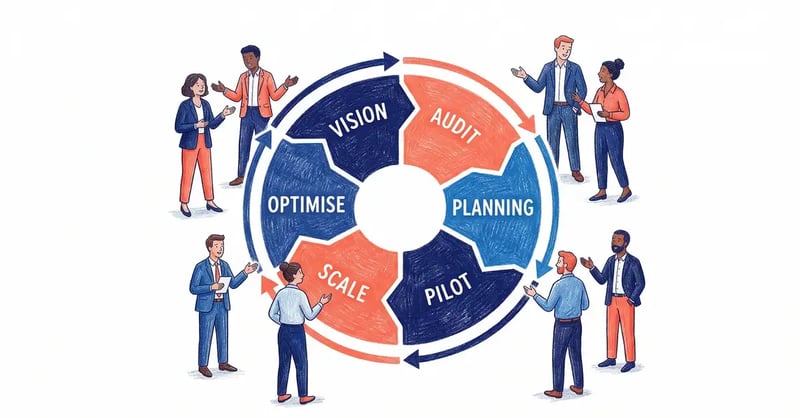
Leadership Alignment
Secure executive sponsorship, define strategic ambition, establish the AI steering committee, and conduct initial education workshops. Without leadership alignment, every subsequent phase stalls.
Opportunity Mapping
Audit current workflows across departments, identify 10–15 candidate use cases, and score them against business impact, feasibility, and data readiness. Narrow to 3–5 priority initiatives.
Capability Assessment
Evaluate your data infrastructure, technology stack, and team skills against what the priority use cases require. Identify gaps and make build-versus-buy-versus-partner decisions for each. See our guide on custom AI versus pre-built solutions.
Strategy Development
Draft the strategy document: vision, prioritised use cases, three-year roadmap, budget allocation, governance framework, and success metrics. This is the deliverable your board needs to approve investment.
Governance and Ethics
Establish the AI governance framework: responsible AI principles, risk assessment processes, compliance requirements, and audit trails. Particularly critical for regulated industries.
Pilot and Validate
Execute the first pilot using the 6–8 week implementation roadmap. Measure outcomes against baseline metrics. Use results to validate assumptions, refine the strategy, and build the case for scaling.
AI Budget Allocation for Mid-Market Businesses
One of the most common questions we hear from mid-market leaders is: "How much should we spend on AI?" The answer depends on your maturity level and ambition, but research provides clear benchmarks for planning.
The average AI budget allocation for mid-market firms breaks down as follows: 40% on technology and tools, 35% on people and skills, 15% on governance and risk, and 10% on measurement. Most mid-market businesses under-invest in the people and governance components — and that is precisely where most AI initiatives fail.

| Company Revenue | Typical AI Investment (Year 1) | Recommended Starting Point |
|---|---|---|
| £10M–£50M | £15,000–£75,000 | Single-department pilot + team education |
| £50M–£150M | £50,000–£200,000 | Multi-department pilots + governance framework |
| £150M–£500M | £150,000–£500,000 | Centre of Excellence + enterprise-wide strategy |
The critical principle is that AI investment should be self-funding within 12 months. Well-scoped pilots at Helium42 typically deliver payback within 6–8 months. If your first AI initiative does not cover its cost within a year, the use case selection — not the technology — is the problem. For a detailed framework on quantifying returns, read our AI business case and ROI guide.
AI Governance and Ethics: Strategic, Not Optional
AI governance is no longer a compliance checkbox — it is a strategic imperative. Board-level reporting on AI has shifted from technology focus to business impact and risk mitigation in 78% of FTSE 250 companies. For mid-market businesses, governance done well accelerates adoption; governance done poorly — or not at all — creates the regulatory exposure and reputational risk that kills AI programmes entirely.
Effective AI governance rests on four pillars: accountability (clear ownership of AI decisions and outcomes), transparency (explainable AI processes and audit trails), fairness (bias testing and ethical deployment), and security (data protection and access controls). The EU AI Act and ICO AI guidance provide the regulatory framework, but good governance goes beyond compliance to build the trust that enables faster adoption.
We cover the practical implementation in detail in our AI governance framework guide and our guide to AI compliance for regulated industries.
Change Management: Where 70% of AI Strategies Fail
Change management failures account for 70% of stalled AI implementations in mid-market organisations. The technology works. The business case is sound. But the organisation resists, and the initiative dies. This is why we place education at the centre of every AI engagement.
Successful AI change management follows a predictable pattern. It begins with executive sponsorship — visible, vocal, and sustained commitment from the CEO or COO. It continues with structured education that builds AI literacy across every level of the organisation, from the board to front-line teams. It requires early wins: small, visible successes that demonstrate value and build momentum. And it demands honest communication about what AI will and will not change about people's roles.
The most effective approach we have seen is what we call the "champion network" model: identify 2–3 AI champions per department, invest heavily in their education, and empower them to drive adoption within their teams. Centres of Excellence built on this model deliver 2.8 times faster time-to-value than decentralised approaches. Our AI training programme is designed specifically to create these internal champions.
For a candid assessment of common resistance patterns, including the "AI will take our jobs" objection, read our AI reality check.
Measuring AI Strategy Success
If you cannot measure it, you cannot manage it — and you certainly cannot justify continued investment. AI strategy measurement operates at three levels:
The most important measurement principle: establish baselines before you start. Every AI initiative should have a "before" number that the "after" is measured against. Without that baseline, you are guessing — and guessing does not survive board scrutiny. For templates and frameworks, see our AI business case and ROI guide.
Eight Strategic Mistakes That Derail AI Initiatives
Drawing on our work with 500+ organisations and research from BCG, McKinsey, and Gartner, these are the most damaging strategic errors we see — and how to avoid them.
1. Buying tools before defining problems
The most expensive mistake. Start with business problems, not technology demos. Map processes, quantify pain points, then evaluate tools against specific requirements.
2. Underinvesting in change management
70% of failures trace back here. Budget at least 35% of your AI investment for people and skills — not just tools and technology.
3. No measurement framework
If you cannot show ROI, the budget disappears next quarter. Define baselines and KPIs before the first pilot begins.
4. Treating AI as a separate function
AI is not an IT project. It must be embedded in business operations with cross-functional ownership. Siloed AI teams produce siloed results.
5. Hiring data scientists before defining use cases
Expensive talent without clear work to do. Define use cases first, then determine whether you need to hire, train existing staff, or partner externally.
6. Insufficient data infrastructure
AI cannot produce reliable outputs from unreliable data. Invest in data quality, integration, and governance as a prerequisite, not an afterthought.
7. Underestimating governance risk
The EU AI Act and ICO guidance are not optional. Build compliance into your strategy from day one, particularly if you operate in regulated sectors.
8. Building capability entirely externally
Outsourcing AI capability creates permanent dependency. Choose partners who build your internal capability, not their recurring revenue.
Ready to Build Your AI Strategy?
Our education-to-implementation approach helps mid-market businesses move from strategic planning to measurable results in 6–8 weeks. Start with a discovery call to assess your AI maturity and identify the highest-impact opportunities.
Book a Discovery CallFrequently Asked Questions
How long does it take to develop an AI strategy?
A working AI strategy for a mid-market business can be developed in 8–12 weeks. This includes maturity assessment, opportunity mapping, capability evaluation, and the strategy document itself. The first pilot typically runs in parallel from week 6–8.
Do we need a dedicated AI team to execute an AI strategy?
Not initially. Most mid-market businesses start with a cross-functional steering committee and 2–3 AI champions per department. A formal Centre of Excellence becomes valuable once you are scaling beyond the first 2–3 pilots.
What percentage of revenue should we allocate to AI?
There is no universal percentage. Start with a specific use case budget (£15,000–£25,000 for a pilot) rather than a top-down allocation. Successful pilots build the case for larger investment. The goal is self-funding within 12 months.
How do we get board buy-in for AI investment?
Boards want three things: quantified business impact, risk mitigation, and competitive context. Present a specific use case with projected ROI, a governance framework that addresses regulatory risk, and evidence of what competitors are doing. Our business case template is designed for exactly this.
Should we build AI capabilities in-house or use an external partner?
The best approach is a hybrid: use an external partner for the initial strategy and first pilots, while simultaneously building internal capability through structured education. The goal is independence — your team should be able to run AI initiatives without external support within 12–18 months.
What if our AI strategy needs to change?
It will. AI moves fast, and your strategy should be reviewed quarterly. The document is a living framework, not a fixed plan. Build in formal review points and be prepared to pivot use case priorities based on pilot results and market developments.
Continue Your AI Journey
Getting Started: AI for Business — The Complete Guide
Marketing: AI for Marketing — The Complete Guide
Implementation: The Complete AI Implementation Guide
Consultancy: AI Consultancy Services — Helium42