
Published by

AI development in the United Kingdom costs between £5,000 and £500,000 depending on project complexity, with the average mid-market implementation falling in the £40,000 to £150,000 range. These figures reflect 2026 market conditions, where costs have declined 15 to 25 percent since 2024 due to open-source model adoption and AI-assisted coding tools. However, hidden costs — data preparation, infrastructure, compliance documentation, and change management — consistently add 35 to 50 percent to initial vendor quotes, making total cost of ownership complete build vs buy decision framework the only reliable planning metric.
This guide provides transparent, evidence-based pricing data for UK businesses evaluating AI development investment. Every figure is sourced from industry research, vendor rate analysis, and project retrospectives.
What Determines the Cost of AI Development?
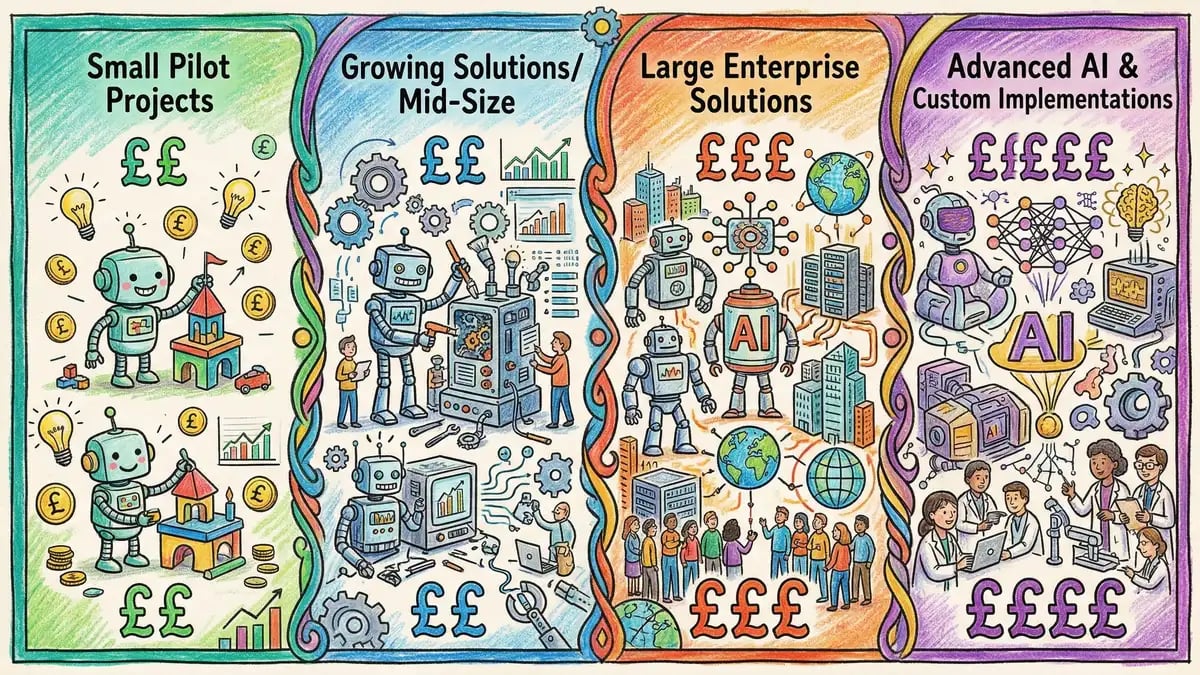
Four primary factors drive AI development costs: project complexity, data readiness, provider type, and regulatory requirements. A basic chatbot integrated with an existing CRM system differs by an order of magnitude from a custom computer vision system processing manufacturing quality data. Understanding these cost drivers before engaging vendors prevents the budget overruns that affect 65 percent of mid-market AI projects, according to McKinsey's Global AI Survey.
Project complexity is the single largest cost determinant. Simple integrations with existing AI platforms cost as little as £5,000, whilst autonomous AI agents with multi-system integration and decision-making capabilities can exceed £200,000. The difference lies in the volume of custom development required — off-the-shelf integrations require configuration, whilst bespoke systems require architecture, training, testing, and deployment from the ground up.
Data readiness is the second most underestimated factor. Organisations with clean, structured, well-documented data spend significantly less than those requiring extensive data preparation. Data cleaning and preparation alone accounts for 15 to 22 percent of total project cost, and 60 to 70 percent of organisations underestimate this line item when budgeting.
Key Takeaway
The vendor quote is never the total cost. Budget for a 1.35x to 1.55x multiplier on any quoted price to account for data preparation, infrastructure, compliance, and change management. A £50,000 quote typically becomes £67,500 to £77,500 in practice.
AI Development Cost by Project Type
The following pricing ranges reflect 2026 UK market conditions across agencies, consultancies, and specialist vendors. Each range includes the hidden cost multiplier that accounts for data preparation, infrastructure, testing, and deployment overhead that vendors frequently exclude from initial quotes.
| Project Type | Basic Cost | Enterprise Cost | Timeline | Hidden Cost Multiplier |
|---|---|---|---|---|
| Chatbot / Conversational AI | £2,500–£8,000 | £40,000–£150,000 | 4–16 weeks | 1.35× |
| RAG System | £15,000–£35,000 | £100,000–£400,000 | 8–20 weeks | 1.50× |
| AI Agent (Autonomous) | £40,000–£100,000 | £200,000–£600,000 | 12–24 weeks | 1.55× |
| Predictive Analytics | £25,000–£60,000 | £100,000–£300,000 | 10–20 weeks | 1.40× |
| Computer Vision | £80,000–£200,000 | £350,000–£800,000 | 14–26 weeks | 1.60× |
| Custom LLM Fine-Tuning | £10,000–£30,000 | £150,000–£500,000+ | 6–24 weeks | 1.45× |
| Generative AI Integration | £5,000–£20,000 | £50,000–£150,000 | 4–12 weeks | 1.30× |
Sources: Forrester AI Services Pricing Study 2024, KPMG AI Pricing Review 2024, QuantumXL UK Market Analysis 2026
Hidden Costs That Blow AI Budgets
Hidden costs account for 35 to 50 percent of total AI project spend. These are the line items that rarely appear in vendor proposals but consistently appear in project retrospectives. McKinsey's 2024 AI implementation report found that 65 percent of mid-market projects exceed initial estimates by an average of 38 percent.

35–50%
Hidden Cost Share
Of total project spend
65%
Projects Over Budget
Average 38% overrun
15–22%
Data Preparation
Most underestimated cost
£180–420k
Failed Project Cost
Average sunk cost mid-market
Sources: McKinsey Global AI Survey 2024, IDC AI Project Cost Analysis 2024
The eight primary hidden cost categories are data preparation and cleaning (15 to 22 percent of total cost), cloud infrastructure and GPU compute (8 to 15 percent), MLOps and deployment infrastructure (10 to 18 percent), compliance and documentation (5 to 12 percent), training data licensing (3 to 8 percent), change management and user training (5 to 12 percent), integration and API development (5 to 10 percent), and testing, quality assurance, and validation (5 to 10 percent).
Data preparation is the most consistently underestimated category. Organisations assume their data is ready for AI consumption, but 60 to 70 percent discover during implementation that data requires substantial cleaning, restructuring, or enrichment. A mid-market financial services firm recently quoted £45,000 for a RAG system saw final costs reach £118,000 — with data vectorisation and cleaning accounting for £22,000 of the overrun alone.
Budget Overrun Warning
Common mistake: Treating the vendor quote as the project budget. Vendor quotes typically cover development and basic testing only.
The reality: A £50,000 vendor quote becomes £67,500 to £77,500 when you add data preparation (£7,500–£11,000), infrastructure (£4,000–£7,500), compliance documentation (£2,500–£6,000), and change management (£2,500–£6,000). Budget for the total cost of ownership from day one.
UK AI Development Provider Comparison: Agencies, Offshore, Big 4, and In-House
Provider selection has a larger impact on total project cost than most organisations realise. The day rate is the most visible cost differentiator, but total cost of ownership — including management overhead, quality assurance, communication costs, and post-launch support — often changes the calculation significantly.
| Provider Type | Day Rate | True Cost (£100k project) | Time to Value | Best For |
|---|---|---|---|---|
| UK AI Agency | £600–£900 | £123k–£145k | 12–16 weeks | £40k–£200k projects needing domain expertise and rapid delivery |
| Offshore (Blended) | £150–£350 | £95k–£130k | 14–20 weeks | Well-defined scope, non-critical internal tools, flexible timeline |
| Big 4 Consulting | £1,200–£2,500 | £170k–£190k | 16–24 weeks | Enterprise programmes £500k+, heavy compliance and change management |
| In-House FTE | £90k–£150k p.a. | £80k–£180k p.a. | 16–32 weeks | Ongoing AI development needs exceeding 1.5 FTE equivalent |
Sources: Forrester TEI AI Services 2024, Gartner AI Vendor Evaluation 2024
The critical insight from this comparison: offshore providers offer 60 to 75 percent lower day rates, but hidden coordination costs — communication overhead, quality reviews, and extended timelines — offset 30 to 40 percent of those savings. UK agencies break even with offshore providers after approximately four to six months of operation due to lower hidden costs and faster time to value.
For mid-market organisations, the blended model produces the strongest cost-to-quality ratio: UK-based senior architects and strategy roles (30 to 40 percent of delivery days) paired with offshore development teams (40 to 50 percent), supplemented by internal governance and light advisory support. This structure typically costs £115,000 to £165,000 for a project equivalent to £100,000 in pure delivery.
Need transparent pricing for your AI project? Explore Helium42's AI development services with clear three-tier pricing.
View AI Development ServicesROI and Payback Periods for AI Development
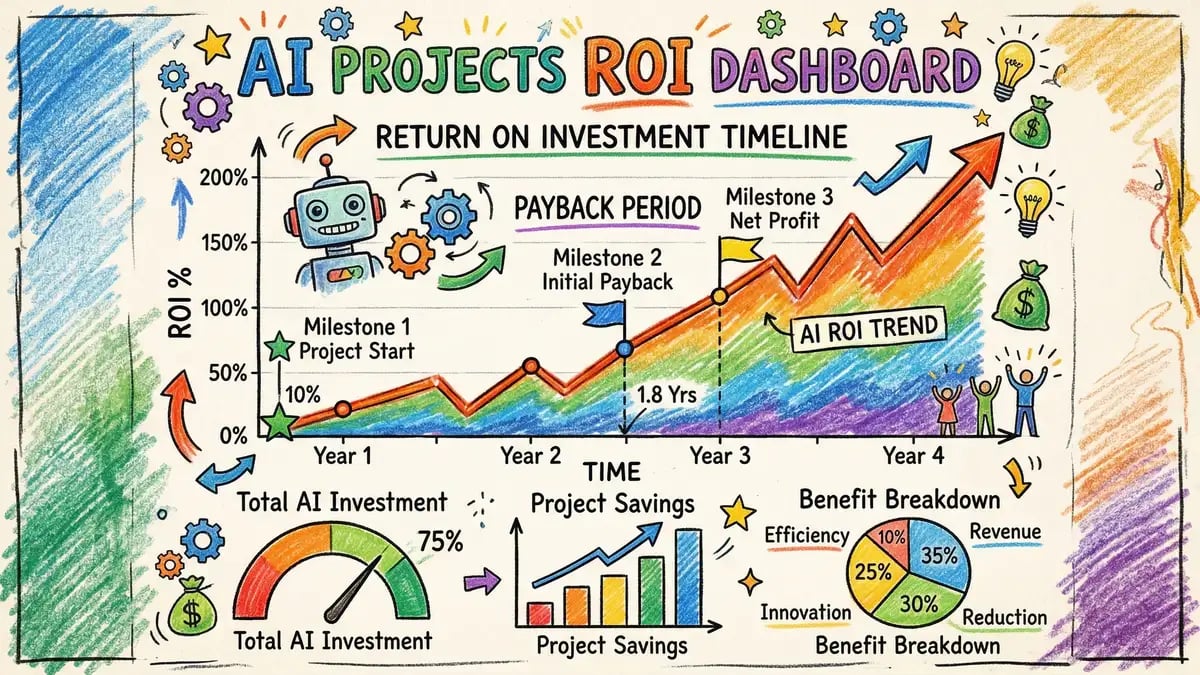
Return on investment depends heavily on project type and implementation quality. Revenue-generating AI projects (sales and marketing automation) deliver the fastest payback at 6 to 12 months, whilst customer-facing chatbots take longer at 12 to 20 months due to adoption curves and integration complexity.
The most critical finding from MIT's 2025 research on AI project outcomes: projects implemented by specialist vendors with pre-built intellectual property achieve a 67 percent success rate, whilst internal builds succeed only 33 percent of the time. The difference is not technical capability — it is domain expertise, change management, and the accumulated learning from previous deployments that specialist firms bring to each engagement.
| Project Type | Payback Period | 2-Year ROI | Critical Success Factors |
|---|---|---|---|
| Process Automation | 8–14 months | 180–280% | Clear process mapping, measurable time savings, team adoption |
| Revenue Generation AI | 6–12 months | 120–240% | Quality training data, sales process alignment, adoption rate |
| Predictive Maintenance | 10–18 months | 150–270% | Reliable historical data, quantifiable maintenance cost baseline |
| Customer-Facing Chatbot | 12–20 months | 90–180% | Deflection rate targets, user adoption, backend integration |
Sources: Forrester 2024, Deloitte AI Implementation Study 2024
How AI Development Costs Have Changed Since 2024
AI development costs have declined 15 to 25 percent since 2024. Three forces are driving this reduction. First, open-source foundation models (Llama, Mistral, and others) have eliminated licensing costs for many applications that previously required expensive proprietary models. Second, AI-assisted coding tools have compressed development timelines by 20 to 40 percent for routine implementation work. Third, commoditised tooling for deployment, monitoring, and orchestration has reduced the infrastructure overhead that previously required specialist DevOps engineering.
However, cost reductions have not occurred uniformly. Projects requiring custom model training, specialised domain expertise, or regulatory compliance have seen minimal cost decreases. The talent premium for senior AI architects and ML engineers continues to inflate at 12 to 18 percent annually in the UK, driven by persistent skills shortages — 73 percent of UK firms still struggle to fill AI-related roles, according to the Department for Science, Innovation and Technology.
Where Costs Have Fallen
Basic chatbot development (down 40 to 50 percent), standard RAG implementations (down 25 to 35 percent), generative AI integrations (down 30 to 40 percent), and MLOps pipeline setup (down 20 to 30 percent). Open-source models and AI-assisted coding are the primary drivers.
Where Costs Have Not Fallen
Custom model training (GPU costs remain high), compliance documentation (regulatory requirements expanding), specialist talent (12 to 18 percent annual salary inflation), and change management (human-dependent, not automatable). These categories resist commoditisation.
UK Government Support: R&D Tax Credits and Grants
UK businesses can offset 19 to 22 percent of eligible AI development costs through R&D tax relief. Small and medium enterprises with annual turnover below £50 million qualify for Enhanced R&D relief at 22 percent, whilst larger organisations claim under the RDEC scheme at approximately 20 percent of qualifying expenditure. AI development work qualifies when it involves creating or improving products, processes, or services through technological uncertainty resolution.
Several grant programmes also provide direct funding. Innovate UK runs regular AI-focused competitions with grants ranging from £25,000 to £500,000 for collaborative R&D projects. The £500 million Sovereign AI Fund announced in March 2026 will provide additional support for British AI companies, though programme details are still being finalised.
However, fewer than 30 percent of eligible businesses claim available R&D tax credits, and grant application complexity deters many mid-market firms. The application process itself can cost £5,000 to £15,000 in professional fees — a cost that should be factored into any grant-funded project budget.
Pricing Models: Fixed Price, Time-and-Materials, or Outcome-Based
The contract structure affects both total cost and risk distribution. Fixed-price contracts show 40 percent project overrun rates because vendors pad quotes by 25 to 40 percent to protect their margins against uncertainty. Time-and-materials contracts are used by 65 percent of UK mid-market firms despite higher cost variance, because they provide transparency and flexibility as project requirements evolve. Outcome-based contracts show the lowest overrun rate at 12 percent but require clearly defined, measurable success criteria.
Start with a Paid Discovery Phase (£5,000–£25,000)
Commission a standalone discovery engagement before committing to full implementation. This produces a validated scope, realistic budget, and go/no-go decision with limited financial exposure.
Use Time-and-Materials with a Capped Budget
Combine the flexibility of time-and-materials with a budget ceiling. This prevents open-ended cost exposure whilst allowing the vendor to adapt to discoveries during implementation.
Negotiate Milestone-Based Payments
Structure payments around deliverable milestones rather than time elapsed. Typical structure: 20 percent on kick-off, 30 percent on proof-of-concept delivery, 30 percent on deployment, 20 percent on acceptance testing completion.
Include IP Ownership and Warranty Clauses
Ensure the contract explicitly assigns intellectual property rights to your organisation and includes a minimum 3 to 6 month warranty period covering defect resolution and performance maintenance.
Total Cost of Ownership: A Real-World Example
Consider a mid-market manufacturing company (£80 million revenue, 300 employees) implementing a predictive maintenance system. The total first-year cost typically breaks down as follows: discovery and proof-of-concept at £20,000 to £50,000 over 8 to 12 weeks, full implementation at £50,000 to £250,000 over 3 to 6 months, optimisation and scaling at £20,000 to £60,000 over 2 to 4 months, and ongoing retainer at £3,000 to £15,000 per month indefinitely. Total first-year investment ranges from £100,000 to £400,000 for a fully-realised custom AI system.
The expected return for this type of project: 25 to 30 percent reduction in maintenance costs, 35 to 45 percent reduction in unplanned downtime, and payback within 10 to 18 months. Subsequent years are driven by retainer costs (£36,000 to £180,000 annually) and any feature expansion, with cumulative two-year ROI typically reaching 150 to 270 percent.
For organisations with tighter budgets, Helium42's phased approach starts with an AI readiness assessment and structured implementation roadmap — typically delivering first measurable value within 6 to 8 weeks at pilot budgets of £15,000 to £25,000, significantly below the industry average time-to-value of 3 to 6 months.
Frequently Asked Questions
How much does a basic AI chatbot cost in the UK?
A basic rule-based chatbot costs £2,500 to £8,000 for simple FAQ handling. Machine learning-based chatbots with sentiment analysis cost £18,000 to £80,000. Enterprise-grade generative AI chatbots with multi-system integration range from £35,000 to £150,000. Apply a 1.35x hidden cost multiplier to any quoted price to estimate true total cost.
What are the biggest hidden costs in AI development?
Data preparation (15 to 22 percent of total cost), cloud infrastructure and GPU compute (8 to 15 percent), MLOps deployment infrastructure (10 to 18 percent), and change management (5 to 12 percent) are consistently underestimated. Together, these hidden costs add 35 to 50 percent to initial vendor quotes.
Is it cheaper to build AI in-house or hire an agency?
In-house teams break even with agencies at approximately 9 months. For projects under 6 months or requiring specialist expertise, agencies deliver better cost-to-quality ratios. For ongoing AI development needs exceeding 1.5 full-time equivalent roles, in-house hiring becomes more cost-effective over a 2 to 3 year horizon. The blended model — UK-based architects with offshore delivery — offers the strongest cost-to-quality balance for most mid-market firms.
Can UK businesses claim R&D tax credits for AI development?
Yes. UK businesses can offset 19 to 22 percent of eligible AI development costs through R&D tax relief. SMEs with turnover below £50 million qualify for Enhanced R&D relief at 22 percent. AI development qualifies when it involves resolving technological uncertainty in products, processes, or services. Fewer than 30 percent of eligible businesses currently claim.
What is the average payback period for AI development investment?
Revenue-generating AI projects deliver the fastest payback at 6 to 12 months. Process automation projects return investment in 8 to 14 months. Predictive maintenance achieves payback in 10 to 18 months. Customer-facing chatbots take longest at 12 to 20 months. Projects implemented by specialist vendors achieve 67 percent success rates versus 33 percent for internal builds.
How much does a failed AI project cost?
Failed AI projects cost mid-market organisations an average of £180,000 to £420,000 in sunk costs. Sixty percent of failures are caused by delivery and change management issues rather than technical problems. The most effective risk mitigation strategy is starting with a paid discovery phase (£5,000 to £25,000) before committing to full implementation budgets.
Ready to Budget Your AI Development Project?
Helium42 delivers AI development with transparent three-tier pricing: workshops from £2,000, pilots from £15,000, and full implementations from £50,000. Proven 40% efficiency gains in 6 to 8 weeks, not 6 to 8 months.
Peter Vogel
Managing Director, Helium42
Peter leads Helium42's AI consultancy practice, helping UK and European mid-market businesses implement AI solutions that deliver measurable efficiency gains. With over 500 companies served and 2,000 professionals trained, he brings practical implementation experience to every engagement.
Sources: McKinsey Global AI Survey 2024, Forrester AI Services TEI 2024, DSIT AI Activity in UK Businesses 2025, IDC AI Project Cost Analysis 2024, Deloitte AI Implementation Study 2024, QuantumXL UK Market Analysis 2026, CleverRoad AI Development Pricing 2026, HM Treasury AI Investment Announcement 2026
AI MVP development methodology
integration services that connect AI to existing systems
custom AI solutions for mid-market businesses
generative AI development services
AI and machine learning development services
AI proof of concept validation
hiring an AI development partner
choosing the right AI software development agency free AI Development Cost Estimator
Estimate the cost of your own AI project in under two minutes.
Open the AI Development Cost Estimator