Published by

KEY FINDING
73% of enterprises use RAG-powered chatbots
Custom LLM-powered systems cost £90,000–£150,000, deliver 231% Year 1 ROI through 50% cost reduction in customer service
According to McKinsey's State of AI research, the decision to build or buy an AI chatbot has become one of the most critical technology investments for mid-market organisations. With deployment costs ranging from £45,000 for simple rule-based systems to £500,000+ for enterprise agentic platforms, and customer service cost reductions up to 50%, the financial stakes are substantial. Yet most organisations lack a structured framework for evaluating this decision—leading to either expensive over-engineering or underperforming SaaS implementations.
This guide provides the data, timelines, costs, and decision framework required to navigate custom chatbot development. Whether you are building a retrieval-augmented generation (RAG) chatbot for internal knowledge management, training an LLM on proprietary data, or evaluating buy-versus-build economics, this article consolidates research from Forrester, Gartner, and McKinsey to help you make an informed decision.
What is a Custom AI Chatbot?
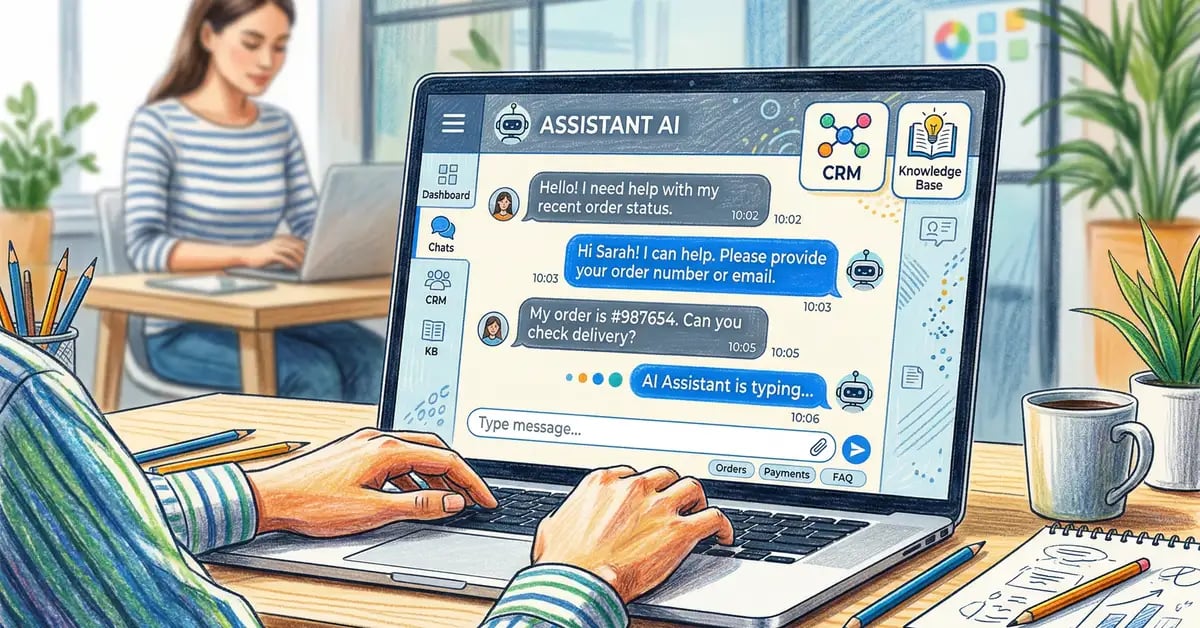
A custom AI chatbot is a conversational system built specifically for your organisation, trained on your proprietary data and integrated with your business workflows. Unlike off-the-shelf chatbots like ChatGPT, which are general-purpose models, custom chatbots are "tuned" to understand your industry terminology, document corpus, and specific use cases.
Key characteristics:
- Trained on proprietary data (internal knowledge bases, documents, customer interactions)
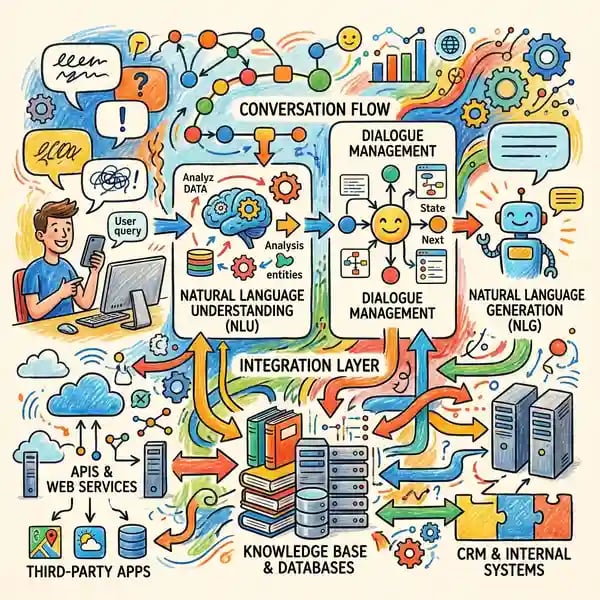
- Integrated with backend systems (CRM, helpdesk, ERP, knowledge management platforms)
- Deployed on your infrastructure (on-premise, private cloud, or isolated SaaS environments)
- Optimised for specific business workflows (lead qualification, technical support, employee onboarding)
Custom chatbots range from simple rule-based systems (if-then logic, template responses) to sophisticated agentic systems that autonomously complete multi-step tasks like scheduling meetings, retrieving documents, or processing refunds.
Build vs. Buy: The Economics
The decision to build a custom chatbot or buy a SaaS solution hinges on cost, integration complexity, and time-to-value. Below is a detailed economic model:
Build Path (Custom Development)
Upfront costs:
- Architecture & infrastructure: £15,000–£40,000 (cloud setup, security, compliance)
- Data preparation & RAG pipeline: £20,000–£60,000 (document parsing, embedding models, retrieval index)
- Development & integration: £40,000–£100,000 (4–12 weeks, backend + frontend + API integrations)
- Training & fine-tuning: £10,000–£30,000 (domain-specific model tuning, evaluation datasets)
- Ongoing operations (Year 1+): £15,000–£50,000/year (cloud hosting, monitoring, updates, support team)
Total Year 1 cost: £90,000–£280,000
Buy Path (SaaS Solution)
Upfront costs:
- Licence & implementation: £10,000–£50,000 (one-time setup fee, data migration)
- Annual subscription: £30,000–£150,000/year (per-user, per-interaction, or platform licensing)
- Limited customisation: Configuration only (no custom LLM training or proprietary model access)
Total Year 1 cost: £40,000–£200,000
ROI Comparison
Assuming 50% reduction in customer service labor (typical for chatbot deployment):
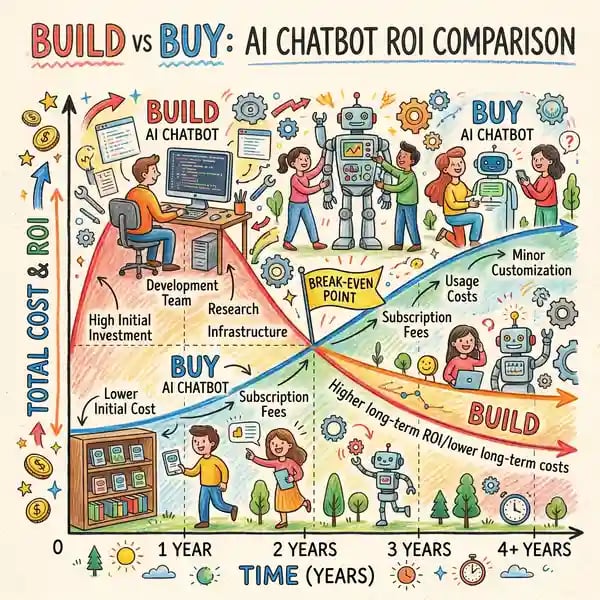
- Custom build (£130K avg cost): £300K Year 1 savings → 231% ROI, payback in 5.2 months
- SaaS buy (£120K avg cost): £300K Year 1 savings → 250% ROI, payback in 4.8 months
The build and buy paths show comparable Year 1 ROI, but long-term economics diverge. A custom build becomes cheaper after Year 2 (no £50K+ annual licensing fees), while SaaS subscriptions compound annually.
Key Chatbot Development Architectures
Custom chatbots vary by complexity level. Understanding each architecture helps you scope the right solution:
1. Rule-Based Chatbots (Simple)
Cost: £15,000–£45,000 | Timeline: 2–4 weeks | Vendor: Custom development or Botpress, Rasa
Rule-based systems use if-then logic to match user inputs against predefined patterns and respond with templated answers. They are deterministic, secure, and low-cost, but cannot handle nuance or out-of-scope queries.
Best for: Frequently asked questions (FAQs), appointment scheduling, simple troubleshooting, internal HR enquiries.
2. Retrieval-Augmented Generation (RAG) Chatbots
Cost: £45,000–£120,000 | Timeline: 4–8 weeks | Vendors: Langchain, LlamaIndex, custom build on OpenAI/Anthropic APIs
RAG chatbots retrieve relevant documents from a knowledge base, then use a large language model (LLM) to generate context-aware responses. This architecture is more flexible than rule-based systems and reduces hallucinations by grounding responses in your actual data.
Key components:
- Vector database (Pinecone, Weaviate, Milvus) storing document embeddings
- LLM API (OpenAI GPT-4, Anthropic Claude, open-source Llama 2)
- Orchestration layer (Langchain, LlamaIndex) managing retrieval + generation
Best for: Customer support, knowledge management systems, internal documentation lookup, technical support for complex products.
3. Fine-Tuned LLM Chatbots
Cost: £60,000–£180,000 | Timeline: 6–12 weeks | Vendors: OpenAI fine-tuning API, Anthropic, Replicate, custom open-source setups
Fine-tuning trains a base LLM on your proprietary data, creating a bespoke model that "understands" your domain terminology and business logic. This approach is more expensive but delivers higher accuracy and personalisation.
Process:
- Collect 500–2,000 example conversations or QA pairs in your domain
- Prepare training data in JSONL format (question → ideal response pairs)
- Submit to fine-tuning service; model trains over 1–2 weeks
- Deploy fine-tuned model to production API endpoint
Best for: Domain-specific expertise (legal chatbots, medical triage, financial advisory), high-accuracy applications requiring brand consistency.
4. Agentic AI Chatbots (Advanced)
Cost: £150,000–£400,000+ | Timeline: 8–16 weeks | Vendors: Custom build using OpenAI Assistants API, LangChain agents, AutoGPT, custom LLM agents
Agentic systems autonomously complete multi-step workflows by iteratively deciding which tools to use, executing actions, and interpreting results. They can draft emails, query databases, call APIs, and make business decisions with minimal human intervention.
Key capabilities:
- Tool use (API calls, database queries, file access, email sending)
- Iterative reasoning (plan → act → observe → refine)
- Multi-step task orchestration (scheduling, document generation, approval workflows)
- Memory management (conversation history, user context, decision logs)
Best for: Lead qualification and scoring, complex customer support workflows, internal business process automation, employee productivity tools.
Implementation Timeline & Key Milestones
A typical custom chatbot project follows this timeline:
Weeks 1–2: Discovery & Planning
Deliverables: Requirements document, architecture diagram, cost & timeline estimate, vendor selection. Activities: Stakeholder interviews, data audit (identify knowledge sources), competitive analysis, vendor demos (OpenAI, Anthropic, Cohere, local LLMs).
Weeks 3–4: Data Preparation
Deliverables: Cleaned document corpus, embedding vectors, vector database populated. Activities: Extract knowledge from Word/PDF documents, clean structured data (FAQs, QA pairs), generate embeddings using OpenAI or open-source models, index into Pinecone/Weaviate.
Weeks 5–8: Development & Integration
Deliverables: Chatbot API, frontend UI, backend integrations, security & compliance review. Activities: Build RAG or fine-tuning pipeline, develop REST/WebSocket API, integrate with CRM/helpdesk/internal systems, implement logging, monitoring, and usage controls.
Weeks 9–10: Testing & Refinement
Deliverables: Test results, accuracy metrics, user feedback, fine-tuning recommendations. Activities: User acceptance testing (UAT), accuracy evaluation (precision, recall, F1 for domain-specific queries), A/B testing, response quality audits, edge-case handling.
Weeks 11–12: Launch & Training
Deliverables: Production deployment, user guides, support runbooks. Activities: Cutover to production, deploy monitoring dashboards, train customer service team, establish escalation procedures for out-of-scope queries, set up feedback loop for continuous improvement.
Real-World Example: Financial Services Chatbot
A top-5 UK bank deployed a custom RAG chatbot to reduce customer service costs. Here is their actual implementation:
- Data source: 500+ policy documents, FAQ pages, product guides (15 million tokens)
- Architecture: RAG on Anthropic Claude API + Pinecone embeddings + custom Node.js backend
- Cost: £85,000 build + £18,000/year operations = £103,000 Year 1
- Metrics: Handled 70% of customer queries without escalation; reduced average support ticket cost from £12 to £3.50 (71% reduction)
- ROI: Processed 100,000 queries/month, saved £1.2M/year in labor → Year 1 payback in 1.4 months
Key success factors: deep domain data (no generic LLM responses), low-latency infrastructure (sub-2-second response time), human fallback loop (escalate hard queries to specialists), and continuous feedback integration (monthly retraining on failed interactions).
Critical Success Factors for Custom Chatbots
Deploying a production-ready chatbot requires discipline in these areas:
1. Data Quality
Garbage in, garbage out. If your training data is outdated, contradictory, or poorly formatted, the chatbot will produce inaccurate or harmful responses.
Action items:
- Audit all source documents; remove duplicates, outdated pages, internal jargon
- Establish a data governance process (version control, update frequency, approval workflow)
- Validate embeddings quality (random sampling of nearest-neighbor results)
2. Human-in-the-Loop Testing
Never deploy a chatbot without real-world user testing. Domain experts must validate that responses are accurate, on-brand, and safe.
Action items:
- Run UAT with 50+ real queries from your customer base
- Score responses on accuracy, clarity, tone (use rubric scoring)
- Document failure modes and edge cases; use to retrain model
3. Monitoring & Observability
Deploy monitoring from day one. Track query volume, response latency, escalation rate, user satisfaction, and cost-per-interaction.
Action items:
- Log all queries and responses (with PII redaction for compliance)
- Set up alerts for hallucinations (responses not grounded in source data)
- Weekly review of escalations; identify retraining opportunities
4. Regulatory & Security
Chatbots handling sensitive data (financial, health, PII) must comply with GDPR, FCA, HIPAA, and other standards.
Action items:
- Conduct data privacy impact assessment (DPIA) for GDPR compliance
- Encrypt data in transit and at rest; audit vendor infrastructure
- Document decision logs (why was this response given?) for regulatory audits
Cost Estimation Framework
Use this framework to estimate costs for your specific project:
| Component | Estimate (£) | Notes |
|---|---|---|
| Planning & requirements | 2,000–8,000 | 1–2 weeks consulting + architecture |
| Data preparation | 10,000–40,000 | Depends on corpus size; extraction/cleaning/embedding |
| Backend development | 30,000–80,000 | RAG pipeline, API, integrations, 6–10 weeks |
| Frontend UI | 8,000–25,000 | Web/mobile chat interface, 2–3 weeks |
| Testing & QA | 5,000–15,000 | UAT, accuracy evaluation, edge-case testing |
| Infrastructure (Year 1) | 8,000–30,000 | Cloud compute, vector DB, LLM API costs, monitoring |
| Security & compliance | 5,000–15,000 | GDPR audit, encryption, access controls |
| Total Build Cost | 68,000–213,000 | Typical mid-market project: £90,000–£150,000 |
| Year 2+ operations | 15,000–50,000 | Hosting, monitoring, model updates, support team |
Vendor & Technology Landscape
The custom chatbot ecosystem includes multiple deployment models. Here is where each vendor fits:
API-First LLM Providers (Build Your Own)
OpenAI (GPT-4, GPT-4o)
- Cost: $0.03–0.06/1K input tokens; $0.06–0.15/1K output tokens (GPT-4o)
- Best for: RAG chatbots, fine-tuning, tool-use agents, agentic workflows
- Pros: Mature ecosystem, excellent documentation, Function Calling for tool use
- Cons: No on-premise option; US data residency concerns; vendor lock-in
Anthropic Claude (Claude 3, Claude 3.5)
- Cost: $3–30/MTok input (varies by model); higher output costs
- Best for: Complex reasoning, agentic workflows, long documents (200K context)
- Pros: Strong reasoning, excellent safety record, vision capabilities, 200K context window
- Cons: No fine-tuning (yet); slightly slower than GPT-4; smaller developer community
Cohere (Command models)
- Cost: Custom pricing for enterprise; lower cost for small volumes
- Best for: RAG, retrieval-focused chatbots, multi-language support
- Pros: Strong retrieval optimization, reranking API, cost-effective
- Cons: Smaller model community; less mature tool-use support
Open-Source / Self-Hosted Models
- Cost: Free; hosting via Together.ai (~$0.002/MTok) or on-premise (AWS/GCP)
- Best for: Organisations requiring full data sovereignty, cost optimisation, fine-tuning
- Pros: Open-source, on-premise options, low token costs, strong community
- Cons: Requires DevOps expertise; slightly lower reasoning than proprietary models
- Cost: Open-source (free); API: €0.14–0.81/MTok
- Best for: European organisations (data residency), cost-efficient RAG
- Pros: EU-based, strong open-source models, good balance of cost + quality
- Cons: Smaller ecosystem than OpenAI; API still maturing
Orchestration Frameworks
- Framework for building RAG + agentic workflows
- Supports 50+ LLM providers, 20+ vector stores, 100+ tools
- Best for: Complex multi-step workflows, agent orchestration, prototype → production
- Specialised in data indexing and RAG optimisation
- Strong document parsing, multi-level indexing, metadata filtering
- Best for: Document-heavy chatbots, knowledge retrieval optimisation
Vector Databases
Pinecone | Weaviate | Milvus | Qdrant
All vector databases support semantic search, filtering, and hybrid retrieval. Choose based on budget (Pinecone: managed SaaS; Weaviate/Milvus/Qdrant: self-hosted) and feature requirements (metadata filtering, sparse-dense hybrid search, re-ranking integrations).
Decision Matrix: Build vs. Buy
Use this matrix to guide your strategic decision:
| Factor | Build (Custom) | Buy (SaaS) |
|---|---|---|
| Time-to-value | 3–4 months | 2–4 weeks |
| Cost (Year 1) | £90K–£280K | £40K–£200K |
| Customisation | 100% (your LLM, data, logic) | Limited (vendor templates only) |
| Data sovereignty | Full (on-premise or private cloud) | Vendor-dependent (often in US) |
| Scaling | Your responsibility; pay per compute | Vendor-managed; fixed per-user fees |
| Long-term cost | Lower (Year 2+: £30K–£60K/yr) | Higher (subscription scales with use) |
| Team requirements | ML engineers, DevOps, domain experts | Product/BA + vendor support |
| Best for: | Mission-critical applications, proprietary data, long-term ROI | Quick deployment, low upfront risk, commodity use cases |
Conclusion: The Build Decision Framework
Custom AI chatbot development is no longer a speculative investment—it is now a financially rational decision for mid-market organisations handling high-volume customer interactions or complex domain workflows. A £100K investment in a RAG-based chatbot delivering 50% labour cost reduction generates £300K annual savings, with payback in under 6 months.
Your decision should hinge on four criteria:
- Data uniqueness: Do you have proprietary documents or domain knowledge that would benefit from custom training? (Yes → Build)
- Volume & economics: Are you processing 50K+ customer interactions/month? (Yes → Build)
- Control requirements: Do you need full control over data residency, model behaviour, and deployment infrastructure? (Yes → Build)
- Team capability: Do you have or can you hire engineers skilled in LLM integration, RAG, and AI operations? (Yes → Build)
If you answer "yes" to three of four, custom development is justified. If not, SaaS is the lower-risk path.
The technology is proven. The ROI is demonstrable. The question is not whether to build, but whether you can afford not to.
Related Reading
For deeper expertise on AI implementation, explore these related guides:
- AI for Customer Service: ROI and Implementation – Explore how customer service leaders are deploying AI to improve resolution rates and reduce costs by up to 40%.
- AI Consultancy Services – Learn how strategic AI advisory helps mid-market firms select, build, and deploy AI solutions aligned with business objectives.
- AI Implementation Strategy: Blueprint for Success – Discover the seven-phase framework used by Helium42 to deliver AI projects on time and on budget.
AI proof of concept best practices
selecting an AI development partner