

Published by

Key Market Metrics
Enterprise AI spending reached £37 billion globally in 2025, a 3.2x increase from 2024. The UK commands 3,700+ AI companies and a sophisticated talent ecosystem, making it an attractive market for AI software development. However, success depends on strategic team composition, realistic timelines, and early regulatory alignment—not technology choices alone.
AI software development has transitioned from experimental frontier to essential business infrastructure. The global application layer—user-facing AI products—captured £19 billion of enterprise spend in 2025, establishing itself as the dominant segment and exceeding 6% of the entire global software market within three years of ChatGPT's launch. Yet AI software development differs fundamentally from traditional software engineering, requiring different team structures, development processes, and quality assurance approaches. For UK organisations building AI capabilities, understanding these differences and planning accordingly separates successful deployments from expensive failures.
The AI Software Development Market Landscape
The UK stands as the third-largest AI market globally, valued at £72.3 billion (approx. £92 billion USD equivalent) in 2024, with over 3,700 AI companies employing more than 60,000 people. The UK AI sector contributes £3.7 billion to the economy and boasts a sophisticated talent ecosystem including 168 tech unicorns with combined market value exceeding £1 trillion. This foundation creates opportunity for organisations seeking to build or acquire AI capabilities.
Enterprise AI spending has accelerated dramatically. Global enterprise AI spending reached £37 billion in 2025, representing a 3.2x year-over-year increase from £11.5 billion in 2024. The application layer—encompassing user-facing AI software products—captured £19 billion of this spend, establishing the dominant investment category. Within three years of ChatGPT's public launch, AI applications have captured over 6% of the entire global software market, making AI software development a critical capability gap for organisations across sectors.
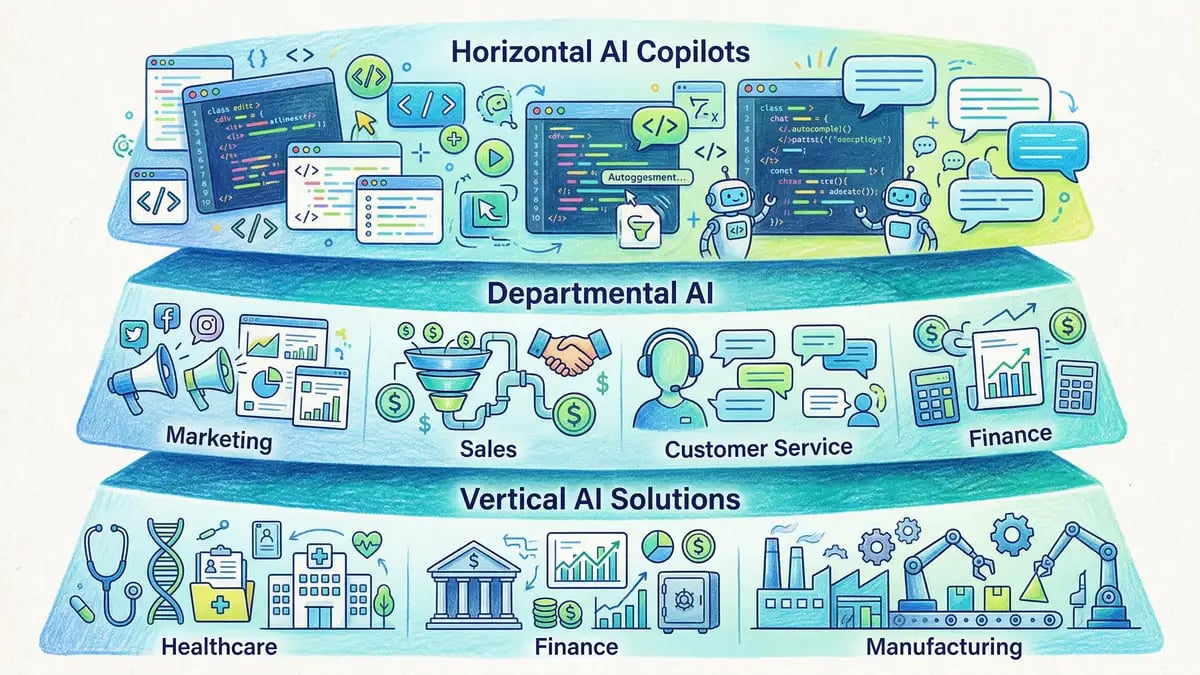
Understanding AI Software Development Scope
AI software encompasses three distinct categories: departmental applications solving problems within a single function (customer support chatbots, claims processing automation), vertical solutions addressing entire industry workflows (healthcare diagnostics, financial trading), and horizontal platforms providing capabilities across industries (content generation, code generation tools). Each category exhibits distinct development characteristics, cost structures, and team requirements.
AI software development differs fundamentally from traditional software in several critical ways. Traditional software development focuses on writing code that behaves as specified—if you code a sorting algorithm correctly, it sorts consistently. AI development focuses on training models that perform desired functions on data patterns they haven't explicitly seen before. This distinction means:
- Reproducibility is probabilistic, not deterministic. Two identical model training runs with different random seeds produce slightly different outputs. This requires establishing acceptable performance ranges rather than expecting perfect consistency.
- Quality assurance must account for fairness and bias. Traditional software testing verifies functionality; AI software testing must verify performance across different demographic groups, ensure demographic parity, and detect discriminatory patterns.
- Data is as critical as code. A model's behaviour is shaped by training data as much as by algorithms. Data quality, currency, and representativeness directly determine model performance and deployment risk.
- Production deployment requires continuous monitoring. Models degrade as the data they're applied to diverges from training data—a phenomenon called data drift. This requires ongoing retraining and performance monitoring, fundamentally different from traditional software maintenance.
Understanding these differences shapes every aspect of AI software projects—from team composition and development timeline to quality assurance approach and ongoing maintenance costs.
AI Software Development Cost Structures
Development costs vary dramatically by project complexity and scope. Research examining UK and international AI projects identifies three primary categories:
| Complexity Category | Cost Range | Typical Use Cases |
|---|---|---|
| Simple/Proof-of-Concept | £5,000–£15,000 | Basic classification, proof-of-concept validation, internal tools |
| Mid-Complexity Production | £60,000–£300,000 | Custom fine-tuned models, business system integration, customer-facing features |
| Enterprise-Grade Systems | £200,000–£500,000+ | Multi-model architectures, regulated industry requirements, real-time scaling |
Sector-specific complexity adds further cost variation. Healthcare AI solutions typically range £20,000–£50,000 due to clinical validation and regulatory requirements. Fintech applications exceed £50,000–£150,000 due to financial regulatory complexity. Legal AI systems exceed £30,000–£100,000 due to data sensitivity and compliance demands.
Labour comprises 60–80% of AI software development costs, making team composition a critical budget lever. UK-based software engineers command salaries reflecting experience: entry-level developers (0–2 years) earn £25,000–£35,000 annually, mid-level engineers (3–7 years) earn £45,000–£65,000, senior engineers (8+ years) earn £60,000–£85,000. AI-specialised roles command substantial premiums—AI engineers and data scientists frequently earn £120,000–£160,000, with top talent commanding substantially higher compensation.
The true cost of in-house development extends significantly beyond base salary. Full-loaded cost of an in-house developer reaches up to 2.7 times base salary when accounting for benefits (30–40%), training (£1,000–£3,000 annually), infrastructure and equipment (£3,000–£6,000 annually), onboarding (£4,100 per hire), and administrative overhead (£2,524 annually per employee). Employee replacement—occurring for 45% of software engineers within 1–2 years—costs 50–200% of annual salary, making team stability a significant financial concern.

Optimal Team Composition and Hiring Strategy
Team composition dramatically affects both development speed and cost. The optimal AI software development team for production deployments includes five core roles:
- AI/ML Engineer: Designs and implements models, selects appropriate algorithms and frameworks, conducts experimentation, and optimises model performance. This role provides the core AI capability.
- Data Engineer: Builds reliable data pipelines, establishes data infrastructure, manages databases and vector stores, implements ETL processes, and ensures data quality. Heavily data-driven projects require stronger data engineering capability.
- Software Engineer: Integrates AI components with production systems, builds frontends and backend APIs, ensures system reliability and security, and manages integration with existing infrastructure.
- MLOps Engineer: Sets up infrastructure for deploying and monitoring AI systems, establishes continuous integration/deployment pipelines, implements monitoring for model performance drift, and manages infrastructure costs. This role is critical for moving projects beyond experiments into reliable production systems, yet often neglected until deployment forces necessity.
- AI Product Manager: Defines requirements and success metrics, shapes product strategy, manages stakeholder alignment, and ensures projects deliver business value rather than technical elegance disconnected from business need.
For initial production deployments, 6–8 person teams provide specialisation necessary for production-grade work whilst remaining lean enough for mid-market organisations. For scaled AI initiatives deploying across multiple departments, teams expand to 10–15+ people, typically including a Head of AI providing strategic direction, multiple AI Engineers enabling domain specialisation, multiple Data Engineers managing sophisticated infrastructure, Data Scientists enabling research and experimentation, MLOps Engineers managing operations, and domain experts ensuring solutions reflect industry-specific requirements.
Hiring sequence matters significantly. Research based on practical experience suggests optimal hiring order is: AI Product Manager (defining the problem), AI Engineer (solving the problem), Data Engineer (establishing data infrastructure), MLOps Engineer (establishing operational reliability), Data Scientist (enabling experimentation), and governance specialists (establishing responsible AI frameworks). Starting with incomplete teams risks solving problems poorly or optimising for technical elegance disconnected from business value.
The UK AI talent market presents significant hiring challenges. According to the UK Government AI Sector Deal, despite 60,000 people employed in AI roles and a sophisticated tech ecosystem, demand exceeds supply. The same global technology companies competing for talent offer compensation packages exceeding mid-market organisations' budgets. Organisations should prepare for extended hiring timelines, consider hybrid models combining internal team members with contractors or consultants, and evaluate outsourced development or managed service partnerships for initial projects whilst building internal capability.
Technology Stack and Architecture Decisions
The selection of technology components, frameworks, and architectural patterns fundamentally shapes development timeline, deployment characteristics, maintenance burden, and scalability. Three primary approaches dominate AI architecture decisions, as outlined by the Alan Turing Institute AI Standards Hub:
1. API Integration and Prompt Engineering involves calling commercial large language models (OpenAI GPT, Anthropic Claude, Google Gemini) via APIs and engineering prompts to guide model output. This approach offers fastest time-to-market—functional prototypes in days—minimal infrastructure complexity, and offloads model maintenance to vendors. However, it introduces vendor dependency, provides limited customisation, and incurs inference costs scaling with usage volume.
2. Fine-Tuning Approaches involve training a pre-trained model on domain-specific data to specialise it for particular problems. Fine-tuning provides better performance on specific tasks than generic models, requires smaller datasets than training from scratch, and offers more control than API-only approaches. However, fine-tuning introduces complexity in data preparation and model training, requires infrastructure investment, and demands ongoing maintenance as new data emerges.
3. Retrieval-Augmented Generation (RAG) involves creating vector databases of documents or knowledge sources and retrieving relevant documents at query time to include in model prompts. RAG enables current information (avoiding reliance on training data), allows understanding which documents informed answers through citations, and provides flexibility to update knowledge without retraining. However, RAG introduces latency from retrieval, requires maintaining and updating document collections, creates computational costs for vector search, and risks retrieving irrelevant documents confusing the model.
Production systems often employ all three approaches in combination. A legal AI system might use RAG for recent court decisions, apply fine-tuning for firm-specific policies, and use prompt engineering for proper legal document formatting. This hybrid approach balances development speed, customisation, and knowledge freshness.
Technology choices matter less than team composition. The specific framework, cloud provider, or orchestration library used matters far less than having product managers defining requirements, engineers implementing solutions, data specialists managing infrastructure, and operations specialists ensuring reliable production deployment. Organisations frequently optimise for framework choice whilst neglecting team composition, producing technically elegant systems failing to deliver business value.
Development Lifecycle and Project Timeline
The timeline from initial concept to production AI software varies substantially based on project complexity, organisational maturity, and team composition. Proof-of-concept projects validating whether AI can address a specific problem achieve 4–8 week timelines with focused teams. These short timelines are possible because proof-of-concept work focuses narrowly on core AI problems without production-grade engineering.
Moving from proof-of-concept to production deployment introduces substantial additional work. Production systems require data engineering establishing reliable pipelines, quality assurance and testing procedures, model monitoring and governance infrastructure, security hardening, compliance review, and integration with existing systems. Research by Gartner and Boston Consulting Group examining large-scale enterprise AI transformations shows comprehensive implementations require 12–18 months for meaningful ROI.
A pragmatic approach involves starting with focused proof-of-concept deployments delivering value within 3 months, securing quick wins in specific high-value areas, then expanding to additional use cases. A project automating after-hours customer support for common queries delivers measurable value in 3 months. A project automating 40% of company support across all query types extends to 6–9 months. Organisation-wide transformations touching every department extend timelines to 12+ months.
The critical success factor is starting with narrow, well-defined problems where success is objectively measurable rather than attempting organisation-wide AI transformation immediately. This approach delivers early business value, builds internal capability, and establishes credibility for larger subsequent investments.
MLOps and Production Deployment
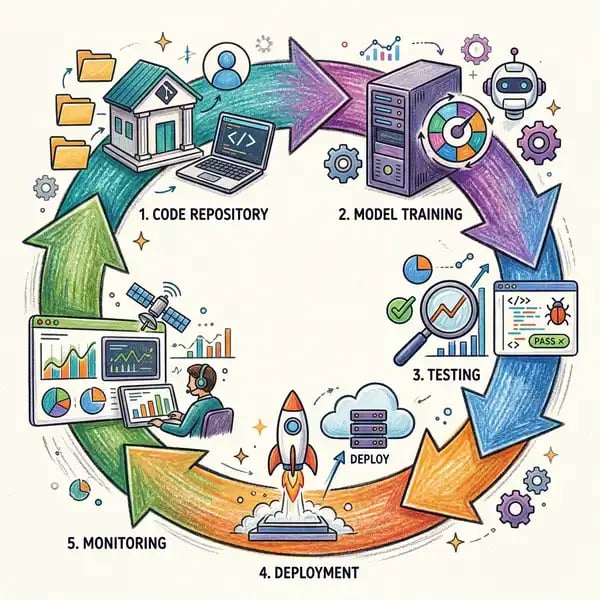
Applying continuous integration and deployment (CI/CD) principles to AI development requires adapting traditional practices to accommodate machine learning characteristics. Traditional CI/CD automates code building, testing, and deployment. AI systems require extending CI/CD to include continuous training and continuous evaluation of models, creating MLOps—the operational discipline of managing machine learning systems in production.
A typical CI/CD pipeline for AI systems includes four stages: source control where model code and training scripts are versioned, build stage where data is prepared and models are trained, test stage where models are evaluated against quality criteria, and deployment where validated models are promoted to production. However, AI testing differs fundamentally from traditional software testing. Rather than verifying code behaves as written, testing must verify models perform with acceptable accuracy, handle edge cases gracefully, and perform adequately across different demographic groups and data distributions.
Model drift—where models' performance degrades as the data they're applied to diverges from training data—creates a fundamental difference from traditional software. Effective MLOps establishes automated monitoring of model performance in production, triggers retraining when performance falls below acceptable thresholds, and validates newly trained models perform acceptably before deployment. This creates an ongoing, dynamic process rather than static deployment, fundamentally changing how organisations think about software maintenance and support.
For AI systems remaining in production multiple years, monitoring and maintenance costs exceed initial development costs. Organisations should expect ongoing annual maintenance and model management costs of approximately 20% of initial development cost, plus infrastructure costs proportional to inference volume. An AI system costing £150,000 to develop should budget approximately £30,000 annually for ongoing maintenance and model management, plus per-use infrastructure costs.
Build Versus Buy Decision Framework
Organisations deciding whether to build custom AI software, acquire off-the-shelf solutions, or pursue hybrid approaches should evaluate several critical dimensions. Build decisions are appropriate when problems are organisation-specific, competitive differentiation depends on AI capabilities, existing solutions require substantial customisation, or organisational AI maturity can sustain ongoing development. Buy decisions are appropriate when time-to-value is critical, problems are standard across industries, customisation requirements are modest, or internal team capacity is insufficient.
Build advantages include greater control, knowledge retention within organisation, flexibility to evolve with business needs, and potential competitive advantage. Build disadvantages include longer time-to-market, higher initial costs, ongoing maintenance responsibility, and dependency on internal talent availability.
Buy advantages include faster deployment, lower initial capital investment, vendor responsibility for maintenance and updates, and access to established best practices. Buy disadvantages include limited customisation, vendor dependency, potential cost increases over time, and less direct competitive differentiation.
Hybrid approaches combining internal teams with external specialists often deliver optimal balance between speed and capability building. This model accelerates time-to-market through specialist expertise whilst building internal capability for ongoing evolution. However, hybrid approaches require careful team integration and communication discipline.
Regulatory Compliance and Responsible AI Governance
The regulatory landscape for AI software in the UK is crystallising, with principle-based frameworks prevailing for now but binding regulation increasingly likely. The UK Government has announced plans to introduce legislation making voluntary AI agreements legally binding. EU regulatory approaches already in effect are beginning to shape global practice. Understanding the current regulatory environment and preparing for anticipated changes is essential.
UK GDPR, implemented as national law following Brexit, establishes the baseline for data protection in AI applications. GDPR requires that personal data be processed lawfully, fairly, and transparently; collected for specific, explicit, legitimate purposes; adequate and relevant but limited to necessity; kept accurate and current; retained no longer than necessary; and protected with appropriate security. These principles apply throughout the entire development and deployment lifecycle, from data collection through model serving.
Sector-specific regulators apply existing frameworks rather than establishing AI-specific rules. The Financial Conduct Authority requires that AI-powered financial products meet customer needs and provide fair value, communicating in ways meeting customer needs and providing appropriate support. Healthcare organisations must comply with standards for medical devices, patient confidentiality, and clinical validation requirements. Legal services must maintain client confidentiality and comply with Law Society technology guidance. Organisations building AI for regulated sectors should engage with sector regulators early, establishing that governance approaches meet expectations before making substantial capital investments.
Beyond regulatory requirements, organisations increasingly face expectations for responsible AI practices addressing fairness, transparency, accountability, and human oversight. Key principles include establishing human-in-the-loop oversight for high-impact decisions, ensuring decisions can be explained to affected individuals, assessing equality impact before deployment, maintaining audit trails for compliance, and implementing feedback mechanisms allowing affected parties to report harms. Building these practices into development processes from inception rather than treating them as compliance checkboxes yields systems that are more trustworthy and resilient to regulatory evolution.
Common Failure Patterns and Risk Mitigation
Research from Deloitte's State of AI in the Enterprise confirms that organisations undertaking AI software development frequently encounter predictable failure patterns. Understanding these patterns enables proactive mitigation:
Problem Definition Failures: Organisations frequently pursue AI solutions to poorly defined problems. The solution succeeds technically but fails to deliver business value because the underlying problem was misunderstood. Mitigation requires defining success metrics quantitatively before development begins and validating problem understanding with affected stakeholders.
Data Quality Issues: AI models perform only as well as training data. Organisations frequently discover during development that available data is insufficient, misaligned with the problem, or too biased to produce generalizable models. Mitigation requires conducting data quality assessments before committing to development and establishing processes for ongoing data governance.
Model Performance Plateaus: Organisations frequently discover that models reach performance levels inadequate for production deployment. Whilst technical improvements are possible, adding complexity increases maintenance burden without proportional performance gains. Mitigation requires realistic performance expectations and acceptance of simpler models that deliver adequate performance rather than pursuing marginal improvements requiring substantial complexity.
MLOps Neglect: Organisations frequently deprioritise MLOps infrastructure until deployment forces its necessity. This creates painful scrambles to productionise models never designed for operational reliability. Mitigation requires investing in MLOps expertise early in projects and establishing monitoring and retraining infrastructure from inception.
Scope Creep and Feature Explosion: Organisations frequently expand project scope through successive feature additions, extending timelines and increasing costs without proportional business value increase. Mitigation requires rigid scope discipline, prioritisation of minimal viable products, and clear criteria for future enhancements.
Regulatory Misalignment: Organisations frequently discover late-stage that governance approaches don't meet regulatory expectations, requiring substantial rework or preventing deployment. Mitigation requires early engagement with sector regulators and documented governance planning.
Evaluating and Selecting AI Development Partners
Selecting an AI software development partner requires evaluating multiple dimensions beyond simple cost comparison. The evaluation framework should assess:
Technical Expertise: Assessment should examine specific prior experience in your problem domain rather than general AI capabilities. A consultancy with strong healthcare AI experience may lack relevant expertise for fintech applications despite both being "regulated" sectors. A development firm experienced with fine-tuned language models may lack relevant expertise for computer vision systems. Portfolio assessment should focus specifically on projects of similar scope, complexity, and requirements.
Organisational Stability: A boutique consultancy staffed by highly skilled individuals may dissolve if key personnel depart. A large consultancy might deprioritise your engagement if it competes with higher-margin work. Assess financial health through external indicators like recent funding, sustainable profitability, or succession planning.
Team Composition and Capacity: Verify partners can staff projects with appropriate experience levels and specialisation. Confirm they can commit team members for project duration without reassignment. Assess whether they have in-house capabilities across needed specialisms or whether they subcontract substantial portions, which can introduce coordination complexity.
Communication Practices: Evaluate how partners ensure stakeholder alignment throughout engagement. Poor communication frequently generates misalignment about requirements, timelines, or success metrics. Assess communication frequency, escalation procedures, and how partners manage changing requirements.
Contractual Clarity: Ensure contracts clearly specify deliverables, success metrics, timeline, cost structure, intellectual property ownership, support duration, and governance responsibilities. Ambiguity here frequently generates disputes late in projects when it's most damaging.
References from previous clients and independent third-party assessments provide valuable perspective. Direct conversations with individuals who worked with the partner on similar projects offer more valuable insight than summary recommendations.
Maximising ROI and Measuring Success
Successful AI software investments deliver measurable business value. Organisations should establish quantitative success metrics before development begins and track them throughout implementation. Effective metrics directly measure business outcomes rather than proxy metrics like model accuracy.
For customer support AI systems, success metrics might include percentage of queries resolved without human escalation, average response time reduction, and customer satisfaction scores. For procurement automation, success metrics might include processing cost reduction, error rate reduction, and processing time reduction. For content generation systems, success metrics might include content production cost reduction, human editor time reduction, and quality consistency.
Organisations should expect that pilot deployments deliver different ROI than full-scale deployment. A pilot automating support for common query types might demonstrate 40% query resolution rate with £50,000 investment, suggesting 6-month payback period. Expanding to additional query types might require £150,000 additional investment for 65% resolution rate, with different payback economics. Understanding these economics shapes expansion strategy.
Successful AI implementations frequently recognise that technology is one component of success; organisational change, staff training, process redesign, and governance frameworks are equally critical. Organisations that invest in comprehensive change management achieve faster adoption and realise ROI more quickly than those treating AI as pure technical implementation.
Recommended Reading and Further Resources
For organisations pursuing AI software development, the following resources provide valuable context:
- Information Commissioner's Office AI guidance provides UK GDPR principles applied specifically to AI systems.
- UK Government AI Assurance Framework provides practical governance guidance for responsible AI deployment.
- McKinsey State of AI reports provide industry benchmarking and trend analysis.
- Gartner AI research and magic quadrant provides vendor evaluation and capability assessment frameworks.
- Helium42 AI for Business Guide provides comprehensive business-focused AI strategy guidance.
- Helium42 AI Strategy Guide offers frameworks for executive-level AI investment planning.
Understanding AI development cost structures and the build versus buy AI decision framework shapes initial strategic choices. For organisations pursuing development, understanding AI MVP development approaches and the AI development lifecycle establishes realistic expectations and timelines.
Organisations pursuing custom AI solutions should evaluate AI integration services and understand specialist capabilities like generative AI development services and AI chatbot development. For organisation-wide initiatives, AI agent development and AI/ML development services provide comprehensive development capabilities.
Governance and compliance requirements are critical. Understanding AI governance framework requirements and accessing AI consultancy guidance ensures regulatory compliance and responsible deployment.
Getting Started with AI Software Development
For UK organisations beginning AI software development journeys, the recommended approach is structured and pragmatic:
Phase 1 (Months 1–2): Define the specific problem you aim to solve with quantitative success metrics. Conduct data quality assessment. Establish governance framework and regulatory alignment with sector regulators. Select team members or external partners. Budget £5,000–£15,000 for proof-of-concept.
Phase 2 (Months 3–4): Develop proof-of-concept validating whether AI can address your problem. Establish technical feasibility and business value proposition. Secure stakeholder buy-in for expanded investment based on POC results.
Phase 3 (Months 5–16): Scale proof-of-concept to production deployment adding data engineering infrastructure, MLOps capabilities, comprehensive testing, compliance review, and system integration. Budget £60,000–£300,000 depending on complexity. Establish ongoing maintenance and monitoring processes.
Phase 4 (Ongoing): Monitor model performance, retrain as necessary, expand to additional use cases, refine governance frameworks based on deployment experience.
This phased approach manages risk through early validation, builds organisational capability progressively, delivers measurable value early, and establishes momentum for larger subsequent investments.
Ready to Develop Your AI Software Strategy?
AI software development requires different approaches than traditional software engineering. Helium42 provides AI development services tailored to UK organisations, from strategic assessment through proof-of-concept validation to production deployment. Our expertise in team building, technology architecture, and regulatory compliance accelerates time-to-value whilst establishing responsible governance frameworks.
We partner with organisations across financial services, healthcare, legal, and professional services sectors, delivering AI consultancy services grounded in practical implementation experience. Whether you're validating whether AI can solve your specific problem or scaling a successful pilot to enterprise deployment, we help navigate the full lifecycle from strategic planning through ongoing operations.
About this guide: This article synthesises research from UK and international AI development practices, regulatory frameworks, and deployment experience. Market data sourced from independent research firms including Gartner, McKinsey, and BCG. Cost and team composition data reflects current UK market rates and practical implementation experience. Guidance reflects responsible AI principles and evolving regulatory requirements as of March 2026.
AI proof of concept approaches