Published by

Machine Learning Development — Key Metrics
Machine learning has evolved from an experimental technology into a critical business capability for mid-market organisations seeking competitive advantage. Yet many UK businesses remain uncertain: when does your company actually need custom machine learning development, and when will you achieve measurable return on investment? This guide addresses that fundamental question by walking through the decision framework, cost structures, team composition, regulatory requirements, and practical steps required to build production-ready ML systems that deliver sustained business value.
The evidence is sobering. According to S&P Global Market Intelligence survey data reported by CIO Dive, 42% of companies abandoned most of their AI initiatives in 2025, up from 17% the previous year, and the average organisation scrapped 46% of its AI proofs of concept before they reached production. The organisations that do reach production tend to share the same habits: they scope carefully, address data quality early, and tie each model to a measurable business outcome such as lower inventory costs, fewer unplanned outages, or better-targeted retention effort. The difference between success and failure hinges on structured scoping, realistic expectations, and investment in data quality from day one.
When Your Business Actually Needs Machine Learning, Not Just AI
A fundamental mistake many organisations make is conflating "AI" with "machine learning." The terms are not synonymous. Generative AI (large language models, ChatGPT, image generation) follows different economics and success criteria than traditional ML. Robotic process automation (RPA) targets rule-based repetitive workflows. These approaches compete with machine learning for your budget and talent, but the decision about which approach to adopt depends on your data availability, outcome clarity, and regulatory requirements.
Machine learning is optimal when you meet three conditions:
Condition One: Sufficient Historical Data. You must have enough historical records with both input features (transaction history, customer demographics, device logs, sensor readings) and the outcome you wish to predict or classify (whether the customer churned, whether the transaction is fraudulent, whether the asset failed). How much is enough depends on the complexity of the problem and how rare the outcome is; most supervised models need thousands of labelled examples rather than hundreds. If you have only a small number of examples, a simple rule-based approach or transfer learning (fine-tuning a pre-trained model) becomes more appropriate than building ML from scratch.
Condition Two: Clear Outcome Variable. You must be able to define precisely what you are trying to predict. Not "improve customer satisfaction" but, for example, "reduce customer churn by identifying at-risk accounts with 80%+ accuracy." Not "reduce costs" but "forecast weekly demand within 10% accuracy to optimise warehouse inventory." This clarity allows you to measure model performance and tie ML investment to business outcomes.
Condition Three: Probabilistic Decision-Making Tolerance. Machine learning models output probabilities, confidence scores, and rankings, not absolute predictions. A churn prediction model might identify a customer as 78% likely to churn, not 100% certain. Your organisation must be willing to act on probabilistic intelligence — screening 100 high-risk customers for a sales intervention, even though 20 might not have churned anyway. If you require absolute certainty before acting, rule-based approaches are more transparent.

Machine Learning vs. Generative AI vs. RPA: A Decision Framework
Three competing approaches vie for your budget and engineering time. Understanding where each excels prevents mis-allocation of resources.
| Approach | Best For | Data Required | Main Cost Driver |
|---|---|---|---|
| Machine Learning | Structured data, clear outcome variable, predictions on new data | Substantial labelled historical data | Data engineering, model development, and ongoing retraining |
| Generative AI | Content generation, text analysis, unstructured data | Minimal; uses pre-trained models | Integration work and ongoing model usage fees |
| RPA | Rule-based, repetitive workflows, high-volume transactions | Process rules; no ML data needed | Process mapping, bot build, and platform licences |
Build costs for all three approaches depend heavily on scope. As a market guide, production AI builds range from about £8,000 to £250,000+, with data readiness and integration complexity the biggest variables.
Many organisations mistakenly treat these three as mutually exclusive, but they are often complementary. A financial services firm might use RPA to automate invoice processing (rule-based), ML to predict customer default risk (probabilistic), and generative AI to summarise compliance documents (unstructured data). The key is matching the approach to the problem.
The ML Development Lifecycle: From Scoping to Production Monitoring
A structured ML development process follows a repeatable sequence. Understanding this lifecycle prevents scope creep, misaligned expectations, and the costly rework that causes projects to exceed budget or timescales. The durations below are indicative and vary with data readiness.
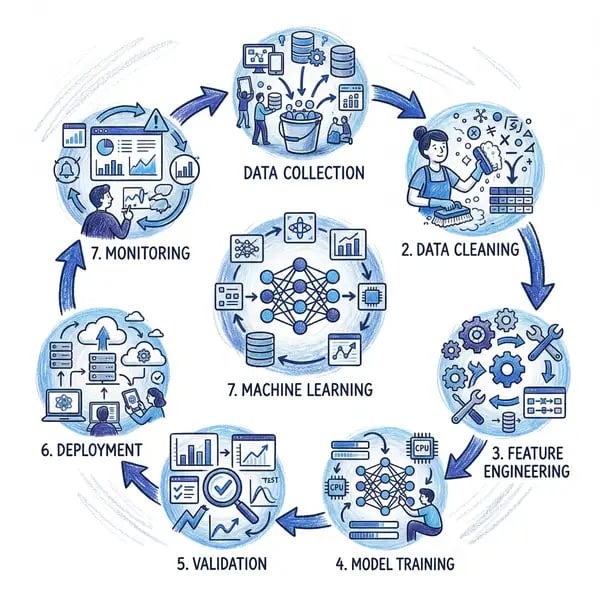
Phase One: Scoping and Feasibility Assessment (1–2 weeks). Your team and the ML development partner define the business problem, identify available data sources, estimate feasibility, and establish success criteria. This phase surfaces critical blockers early: insufficient data volume, poor data quality, regulatory constraints, or misaligned stakeholder expectations. Published UK market prices for discovery and readiness work of this kind range from £1,000 to £10,000.
Phase Two: Data Collection and Exploration (2–4 weeks). Data engineers extract and consolidate historical data from your business systems (CRM, ERP, billing, transaction logs, sensors). Data scientists perform exploratory analysis to understand data distribution, identify missing values, and assess predictive signal. This phase typically reveals data quality issues that demand cleansing or engineering, and data work is usually the largest single share of an ML budget.
Phase Three: Feature Engineering and Preparation (2–4 weeks). Raw data rarely feeds directly into ML models. Engineers create features (derived metrics) that represent business concepts: customer lifetime value, transaction recency, seasonality indicators, device fingerprints. This phase requires deep domain knowledge and iterative refinement.
Phase Four: Model Training and Experimentation (2–3 weeks). ML specialists train candidate models (logistic regression, gradient boosted trees, neural networks) on prepared data using frameworks such as scikit-learn for classical ML and PyTorch for deep learning, tune hyperparameters, and perform cross-validation. Multiple models are tested; the best performer advances.
Phase Five: Validation and Performance Audit (1–2 weeks). Trained models are evaluated on held-out test data. Business stakeholders review predictions to ensure outputs align with intuition and business rules. Bias auditing occurs here: does the model perform equally well across customer segments, geographies, or demographic groups?
Phase Six: Production Deployment and Monitoring (2–3 weeks). The model is integrated into production systems (CRM, BI platform, transaction processing pipeline) using MLOps practices such as those outlined in Google Cloud's MLOps guidance. Monitoring dashboards alert teams to model drift (where model accuracy degrades over time due to data distribution changes). Retraining schedules are established.
Phase Seven: Ongoing Retraining and Maintenance. Most models require periodic retraining as business conditions and data distributions shift; how often depends on how quickly your data changes. Ongoing monitoring, bug fixes, and compliance reviews should be budgeted as a recurring annual cost rather than treated as an afterthought.
Data Requirements and the Hidden Bottleneck of Data Preparation
Data preparation is the unglamorous bottleneck that typically consumes more of an ML project than any other phase. Most organisations underestimate this phase, expecting rapid model training and deployment. The reality is far different.

Your data must meet five requirements before model training can begin:
1. Completeness. All critical variables must be populated. A churn prediction model requires complete customer contact history, billing records, and support ticket volume. If, say, 40% of rows lack billing data, that information is simply discarded, reducing training set size and model accuracy. Data recovery or imputation strategies must be evaluated early.
2. Accuracy. Data must reflect ground truth. A demand forecasting model trained on inflated sales figures or promotional distortions will produce biased predictions. Data validation rules catch duplicates, invalid values, and impossible combinations (negative quantities, future dates, invalid categories).
3. Consistency. Data from multiple systems must be reconciled to a single definition. If your CRM records customer "acquisition date" differently than your billing system's "contract start date," data engineers must standardise these fields. Inconsistent encoding (is "churn" recorded as 1/0, True/False, or "Churned/Active"?) must be normalised.
4. Temporal Alignment. For prediction models, you must construct training examples where features (historical data) precede the outcome variable. If you are predicting customer churn three months forward, features must be measured three months prior. This temporal separation is often overlooked and causes information leakage (using future information to predict the past), producing models that perform excellently in testing but fail in production.
5. Sufficient Volume. Most production ML models require thousands of training examples, and some deep learning approaches demand far more. If your company has only a handful of historical examples of the outcome you wish to predict (rare events like equipment failure), you cannot train a robust ML model; alternative approaches (simulation, expert rules, augmentation) become necessary.
Common ML Use Cases and Measurable ROI for Mid-Market Businesses
The following use cases are among the most common starting points for UK mid-market organisations because their benefits can be measured directly against an existing baseline:
Demand Forecasting and Inventory Optimisation. ML models predict product demand weeks ahead using historical sales, seasonality, and the promotional calendar. The value comes from carrying less excess inventory, suffering fewer stockouts, and freeing working capital. Suitable for: retail, manufacturing, FMCG, distribution.
Customer Churn Prediction. Models identify customers likely to leave in the coming weeks or months using contract tenure, support ticket frequency, product usage, and pricing changes. Sales teams can then prioritise retention efforts on high-value at-risk accounts rather than spreading effort evenly.
Fraud Detection. Real-time transaction models classify payments as legitimate or fraudulent, reducing fraud losses while keeping false-positive rates low (crucial to customer experience). Suitable for: financial services, payments, e-commerce.
Predictive Maintenance. Models trained on sensor data, maintenance history, and operating logs flag likely equipment failures before breakdown, reducing unplanned downtime and helping to extend asset life. Manufacturing, utilities, and logistics benefit most.
Lead Scoring and Sales Prioritisation. Models rank inbound leads by conversion probability, allowing sales teams to focus on high-probability opportunities. Suitable for: SaaS, professional services, financial services.
Customer Lifetime Value Prediction. Models estimate which customers will be most profitable over several years, enabling targeted acquisition and retention strategies and a more efficient allocation of marketing spend.
In every case, measure the return against your current baseline (existing forecast error, current churn rate, current downtime) rather than against vendor benchmarks, which rarely transfer cleanly between organisations.
ML Project Cost Breakdown for Mid-Market Budgeting
The table below is an illustrative planning split for a hypothetical £100,000 project, intended to show where budget typically goes. It is not a market benchmark; your own allocation will depend on the state of your data and systems.
| Cost Category | Illustrative Share | Illustrative £100k Project | Notes |
|---|---|---|---|
| Data Extraction & Engineering | 40–50% | £40k–£50k | Extracting data from legacy systems, ETL pipelines, data cleansing |
| Data Science & Model Building | 20–30% | £20k–£30k | Exploratory analysis, feature engineering, model training, validation |
| Systems Integration & Deployment | 15–20% | £15k–£20k | Integration with CRM/BI platforms, APIs, monitoring dashboards |
| Governance, Compliance & Testing | 10–15% | £10k–£15k | Bias audits, UK GDPR compliance, explainability documentation |
| Project Management & Contingency | 5–10% | £5k–£10k | Stakeholder management, risk buffer |
Total project cost varies widely with scope. As a market guide, production AI builds run from about £8,000 to £250,000+: a focused demand forecasting or churn model built on clean, accessible data sits towards the lower end, while a real-time fraud detection or personalisation engine with complex integrations sits towards the upper end. If you buy in specialist expertise, published UK market day rates for specialist AI consultants typically fall between £900 and £1,500. These are market ranges, not Helium42's prices; our guide to AI consultancy pricing in the UK explains how they are derived.
Building Your ML Team: Roles, Skills, and Seniority Mix
A typical ML development team comprises four core roles, each essential to success:
Data Engineer (1–2 FTE). Responsible for data extraction, pipeline design, data validation, and systems integration. Because data work is the largest share of most ML projects, this role often accounts for the biggest slice of the budget. Senior data engineers with experience of your source systems shorten the critical path considerably.
Data Scientist (1–2 FTE). Leads exploratory data analysis, feature engineering, model selection, and validation. Senior data scientists bring judgement about which modelling approaches suit the problem and which results are genuinely significant.
Machine Learning Specialist (0.5–1 FTE). Specialises in advanced model architectures, hyperparameter tuning, production optimisation, and monitoring. This is a premium role, and many mid-market organisations engage it externally on a part-time basis rather than hiring permanently.
Business Analyst / Product Owner (0.5 FTE). Translates business requirements into technical specifications, defines success metrics, and manages stakeholder expectations.
For an illustrative 12-week project, you might allocate: one senior data engineer (12 weeks), one mid-level data scientist (12 weeks), one ML specialist (6–8 weeks), and one business analyst (4 weeks). This composition balances depth in data preparation (the critical bottleneck) with ML expertise.
Build vs. Buy: When to Develop ML In-House and When to Outsource
The build-versus-buy decision depends on three factors: data sensitivity, long-term model management capability, and access to internal expertise. For guidance on this decision, see our detailed article on build versus buy AI.
Buy (Use Pre-Built or SaaS Solutions) when: (1) your data is not confidential, (2) your use case is standardised (demand forecasting, churn prediction, and fraud detection are all offered by vendors), and (3) your team lacks ML expertise. Examples: Alteryx, DataRobot, and Google Cloud Vertex AI offer pre-built models and AutoML capabilities. Costs are typically a mix of set-up fees and recurring subscription or usage charges, and time to value is usually shorter than a custom build.
Build (Custom Development) when: (1) your data is sensitive or proprietary (customer behaviour, internal systems), (2) your use case is unique or highly competitive (fraud patterns specific to your business model), (3) you require full control over model explainability and compliance auditing, and (4) you plan to iterate and refine models over multiple years. Cost: as a market guide, production builds range from about £8,000 to £250,000+ by scope. Long-term cost: budget a recurring annual allowance for maintenance and retraining.
Most mid-market organisations benefit from a hybrid approach: buy pre-built models for standardised use cases (demand forecasting), build custom ML for competitive differentiation (proprietary churn signals, fraud patterns). Work with a partner such as Helium42's AI development services to identify which approach fits your situation.
UK Regulatory Requirements for ML: UK GDPR, Automated Decisions, and Explainability
Machine learning models that make decisions about individuals fall under UK regulatory scrutiny. Three frameworks shape your obligations:
UK GDPR Automated Decision-Making (Articles 22A–22D). The Data (Use and Access) Act 2025 replaced the old UK GDPR Article 22 with new Articles 22A to 22D, which came into force on 5 February 2026. The new framework is more permissive: organisations may make significant decisions based solely on automated processing in wider circumstances, provided they implement safeguards. If your ML model makes significant decisions about individuals without meaningful human involvement — such as automatically rejecting loan applications or dynamically adjusting insurance premiums — you must: (1) tell people about significant decisions made about them, (2) enable them to make representations about and challenge those decisions, and (3) enable them to obtain human intervention. Tighter restrictions remain where special category data is involved, and solely automated significant decisions cannot rely on the new "recognised legitimate interests" lawful basis. Maintaining audit trails that document the decision logic is good practice in every case.
UK Information Commissioner's Office (ICO) Guidance on Automated Decision-Making. The ICO's guidance on automated decision-making and profiling sets out what organisations must do in practice. Where processing is likely to result in a high risk to individuals (credit decisions, benefit eligibility, hiring), you must conduct a Data Protection Impact Assessment (DPIA) and be able to explain how decisions are reached. Models that cannot be explained in meaningful terms make transparency obligations much harder to meet.
The UK's Principles-Based Approach to AI Regulation. The UK has no AI Act. Instead, the Government's pro-innovation approach to AI regulation asks existing regulators (such as the ICO, the FCA, and the CMA) to apply five cross-sector principles within their own remits: safety, security and robustness; appropriate transparency and explainability; fairness; accountability and governance; and contestability and redress. If you place AI systems on the EU market, the EU AI Act, with its risk-based classification of AI systems, may also apply to you.
Your ML development must include: (1) data governance documentation (what data is used, retention policies, compliance audit trails), (2) bias audits (does the model perform equally well across demographic groups, geographies, or customer segments?), (3) explainability mechanisms (can you articulate why the model made a specific decision?), and (4) human oversight processes (can a human reviewer override or investigate model decisions?).
Why ML Projects Fail and How to Prevent Failure
S&P Global Market Intelligence found that 42% of companies abandoned most of their AI initiatives in 2025, citing cost, data privacy, and security risks as the top obstacles. The failure modes below are common in machine learning projects, with mitigation strategies for each:
Failure 1: Poor Data Quality. Data is incomplete, inaccurate, or inconsistent. Mitigation: Conduct a comprehensive data audit during the scoping phase (Phase One). Allocate a substantial share of the budget to data preparation. Use automated data quality tools to accelerate cleansing. Establish data governance before model training begins.
Failure 2: Insufficient Confidence in Model Accuracy. Models achieve acceptable accuracy in testing but perform poorly in production due to data drift (where data distribution changes over time). Mitigation: Define success thresholds during scoping, for example requiring production performance to stay within 5% of test accuracy. Establish baseline performance expectations (if existing rules have 75% accuracy, your ML model must exceed this). Implement monitoring dashboards that alert when model accuracy declines. Build retraining pipelines that trigger automatically when accuracy drops below threshold.
Failure 3: Misaligned Stakeholder Expectations. Business teams expect 100% accuracy or immediate returns; technical teams lack business context. Mitigation: Invest 1–2 weeks upfront in structured scoping with cross-functional teams (business, IT, finance). Define success metrics in advance (not post-deployment). Conduct monthly steering committee meetings reviewing progress, cost, and timeline.
Failure 4: Inadequate Data Infrastructure. Legacy systems lack data APIs or batch export capabilities, slowing data pipeline development. Mitigation: Assess data accessibility before committing to ML. Hold a contingency budget for unexpected data engineering challenges.
Failure 5: Insufficient Long-Term Maintenance Budget. Models are deployed but retraining is deferred due to cost pressures, accuracy degrades, and the model is abandoned. Mitigation: Budget a recurring annual allowance for ongoing monitoring, maintenance, and retraining. Treat ML as an operational asset requiring continuous investment, not a one-time project.
AI/ML Development Services and the AI MVP Approach
Many mid-market organisations begin with an AI MVP (minimum viable product) — a small, focused ML project designed to validate whether your business case holds before larger investment. A typical AI MVP targets a single high-impact use case (for example, demand forecasting or churn prediction) and demonstrates ROI potential before scaling to additional use cases. Published UK market prices for AI pilots range from £5,000 to £35,000; an MVP that needs substantial data engineering moves into production pricing, which runs from about £8,000 to £250,000+ by scope.
For detailed guidance on the MVP approach, see our articles on AI MVP development and the AI development lifecycle.
Custom AI Solutions: When Off-the-Shelf ML Is Insufficient
Some organisations require bespoke ML capabilities that extend beyond standard demand forecasting or churn prediction. Custom AI solutions address these specialised requirements: real-time recommendation engines for e-commerce, predictive maintenance systems for critical infrastructure, or proprietary fraud detection logic.
Custom solutions require deeper technical expertise, longer development cycles, and sit towards the upper end of the production range (about £8,000 to £250,000+ by scope). In return, they can deliver genuine competitive differentiation when they address core business value drivers.
ML Integration and Deployment: From Model to Production Value
A well-trained model that sits in isolation delivers zero business value. Integration into production systems is critical. AI integration services handle: API development to expose model predictions to downstream systems, embedding model outputs in CRM platforms or BI dashboards, real-time scoring architecture for high-frequency decisions, and monitoring systems that track model performance in production.
Frequently Asked Questions About ML Development Services
What exactly are machine learning development services?
Machine learning development services involve building custom predictive or classification models tailored to your business data and outcomes. Unlike rule-based automation or pre-built AI tools, ML services create algorithms that learn patterns from historical data and improve predictions over time. A typical engagement includes data collection and preparation, model training, validation, production deployment, and ongoing monitoring.
When should we choose machine learning instead of other AI approaches?
Machine learning is appropriate when you have: (1) sufficient labelled historical data (typically thousands of examples rather than hundreds), (2) a clear outcome variable to predict or classify (churn, fraud, demand, defect), and (3) tolerance for probabilistic rather than rule-based decisions. If you have limited data, need explainability above all else, or have simple rule-based processes, RPA or LLM-based solutions may be more cost-effective. Use the decision framework in this guide to assess which approach fits your situation.
What is the typical cost of an ML project for mid-market businesses?
Cost depends mainly on scope and on the state of your data. As a market guide, discovery and readiness work is typically priced at £1,000 to £10,000, pilots at £5,000 to £35,000, and production builds from about £8,000 to £250,000+. Specialist AI consultants in the UK typically charge day rates of £900 to £1,500. These are published market ranges, not a quotation.
How long does a typical ML development project take?
Timelines depend on data readiness. Working through the phases in this guide, from scoping to production deployment, typically takes a few months, and data preparation usually takes longer than any other phase. Projects with clean, accessible data and a single well-defined use case move fastest; complex initiatives such as real-time fraud detection or personalisation take longer. Ongoing monitoring and model retraining should be budgeted as a recurring annual cost.
Does machine learning fall under UK GDPR or automated decision-making regulations?
Yes. If your ML model makes significant decisions about individuals based solely on automated processing (hiring, credit decisions, benefit eligibility), the UK GDPR automated decision-making rules in Articles 22A to 22D apply. These were introduced by the Data (Use and Access) Act 2025 and came into force on 5 February 2026. You must tell people about such decisions, let them make representations and challenge the decision, and give them access to human intervention. The ICO provides guidance on automated decision-making, DPIAs, and explainability. The UK has no AI Act; regulators apply cross-sector AI principles within their existing remits. All ML projects should include data governance, bias auditing, and model explainability by design.
Why do so many ML projects fail, and how can we prevent failure?
S&P Global Market Intelligence found that 42% of companies abandoned most of their AI initiatives in 2025, up from 17% in 2024. Common causes in ML projects include poor data quality, low confidence in model accuracy once in production, and misaligned expectations between business and technical teams. Prevention requires: (1) data quality audit and cleansing before model training, (2) clear definition of success metrics during scoping, (3) business stakeholder alignment on probabilistic decision-making, (4) structured team roles with clear accountability, and (5) phased delivery with measurable checkpoints every 2–3 weeks rather than "big bang" deployment.
Related Reading
For the wider development picture, read our guides to AI software development, running an AI proof of concept, how to hire an AI development partner, choosing an AI software development agency, AI development cost, and the build versus buy AI decision.
To deepen your understanding of AI and ML implementation, explore these complementary articles from Helium42:
- AI MVP development — validating your AI business case with a focused pilot project
- AI development lifecycle — end-to-end process from scoping to production monitoring
- Custom AI solutions — bespoke implementations for unique business requirements
- AI integration services — embedding ML predictions into production systems
- Generative AI development — when generative models are more appropriate than traditional ML
- AI chatbot development — conversational AI as a specialised application
- AI agent development — autonomous systems combining multiple AI capabilities
- AI governance framework — risk management and compliance for ML in production
- AI implementation guide — practical roadmap for successful AI projects
- AI business case and ROI — building financial models for AI investments
Need Machine Learning Development Expertise?
Helium42 helps UK and European mid-market businesses determine whether ML is the right approach, and then build models designed to reach production and deliver measurable value. From initial scoping through deployment and ongoing optimisation, we apply disciplined processes that address the data, scoping, and expectation problems behind most abandoned AI initiatives.
Discuss Your ML Project →