

Published by

AI readiness for a marketing function is the combination of data, skills, governance, process, tooling and leadership alignment that lets a team turn AI tools into measurable results — and in 2026 it, not adoption, is what separates the marketing leaders pulling ahead from those stuck in pilots. Helium42 assesses and closes that readiness gap for UK marketing teams under the Education-to-Implementation Pathway, drawing on our founders' record of 200+ workshops delivered and 2,000+ professionals trained.
Almost every marketing leader now uses AI, yet very few are ready to scale it. Gartner's 2026 CMO survey found that 98% of CMOs are using or piloting AI, but only around 30% say their organisation is ready to scale it. That gap — between having the tools and being ready to use them well — is where marketing budgets are quietly wasted. This guide sets out what AI readiness actually means for a marketing function, the six dimensions that define it, the five maturity stages a team moves through, and how a marketing leader diagnoses their own readiness and closes the gap.
98%
of CMOs are using or piloting AI
~30%
say their organisation is ready to scale it
6%
of marketers have AI fully embedded in their workflow
95%
of enterprise gen-AI pilots deliver no measurable return
Sources: Gartner 2026 CMO survey; Supermetrics 2026 Marketing Data Report; MIT NANDA, The GenAI Divide: State of AI in Business 2025.
Key Takeaway
AI readiness is measured across six dimensions — data, skills, governance, process, tooling and leadership — not by how many tools a team has adopted. Marketing functions that assess their readiness honestly, then close the weakest dimensions in sequence, convert AI from scattered experiments into compounding results. The rest stay in the 95% whose pilots deliver nothing.
Why readiness, not adoption, now separates marketing winners
Adoption is no longer the differentiator in marketing AI — readiness is. Gartner describes a "competency trap" in which early, task-level productivity gains fool teams into thinking they are progressing, while the strategic value never arrives. The evidence for the gap is stark: MIT's 2025 GenAI Divide report found that roughly 95% of enterprise generative-AI pilots deliver no measurable profit-and-loss impact, and the difference between the successful 5% and the rest is organisational capability, not model quality. Readiness is that capability.
Maturity compounds. Gartner's AI maturity research indicates that only about 20% of low-maturity organisations keep their AI projects operational for three years or more, against roughly 45% of high-maturity organisations. In other words, readier teams do not just launch more — they keep more of what they launch. BCG's 2025 research put a figure on the spread: only around 5% of companies are "future-built" AI value leaders, with a further 35% scaling and beginning to generate value, which leaves roughly 60% not yet realising a return at all. For a marketing director, the practical implication is that assessing and building readiness is a higher-return activity than buying the next tool. This is the logic Helium42 applies through its education-first approach: capability before technology.

The six dimensions of marketing AI readiness
Marketing AI readiness is best diagnosed across six dimensions. A team is only as ready as its weakest dimension, because AI amplifies existing strengths and weaknesses alike. Assess each honestly before investing further in tools.
Data foundation
Clean, accessible, well-governed customer data. Adobe's 2026 research found only 39% of organisations have a shared customer data platform capable of supporting advanced AI, and fewer than half rate their data quality as adequate — the most common ceiling on marketing AI.
Skills and AI literacy
The team's ability to apply, direct and critically evaluate AI. The European Marketing Agenda 2026 (supported by the Chartered Institute of Marketing) found 45% cite lack of in-team expertise as the main difficulty in applying AI — the single most-cited barrier.
Governance and ethics
Clear rules on approved tools, data handling, disclosure and human oversight. Gartner has found around 61% of marketing teams operate with no formal AI governance policy — a readiness gap that becomes acute given the UK "AI trust penalty" (see below).
Process and workflow integration
Whether AI is embedded in repeatable workflows or used ad hoc. Supermetrics' 2026 report found only 6% of marketers have AI fully embedded in their workflow, despite 80% feeling pressure to adopt it — the adoption-to-embeddedness gap in a single statistic.
Technology and tooling
The right tools, integrated with the martech stack rather than bolted on. Tooling matters least of the six — it is necessary but rarely the binding constraint, because most teams over-index on tools and under-invest in the other five dimensions.
Leadership and strategy alignment
A clear AI vision from leadership tied to marketing goals. Supermetrics found 39% of marketers say they lack a clear AI strategy from leadership; Gartner found 65% of CMOs expect AI to change their role within two years, yet only 32% believe their own skill set needs to change — a leadership blind spot.
The five stages of marketing AI maturity
Readiness is not binary; marketing functions move through maturity stages. The model below synthesises the common stages across Gartner's AI maturity model and marketing-specific frameworks. Locating your team honestly is the first diagnostic step — and most UK marketing functions sit in stages one to three.
| Stage | What it looks like | Priority to advance |
|---|---|---|
| 1. Ad hoc | Individuals use AI tools privately ("shadow AI"); no shared approach, data or governance; results inconsistent | A usage policy + baseline literacy |
| 2. Experimenting | AI used to speed up tasks, but not consistently or measurably; value anecdotal | Scoped use cases with baselines |
| 3. Operational | AI embedded in a few core workflows with measured outcomes and basic governance | Data foundation + process integration |
| 4. Embedded | AI is standard across the function; skills widespread; governance mature; ROI tracked | Scale + advanced use cases |
| 5. Transformational | AI reshapes strategy and operating model; a durable competitive advantage | Continuous capability building |
Only a small minority reach the top: McKinsey's 2025 survey found that although 88% of organisations use AI in at least one function, just 7% have it fully scaled. To place your own marketing function on this model quickly, use Helium42's AI Readiness Assessment — a short diagnostic across the six dimensions.
Find out where your marketing function sits — and which dimension to fix first — with Helium42's free AI Readiness Assessment.
Take the AI Readiness Assessment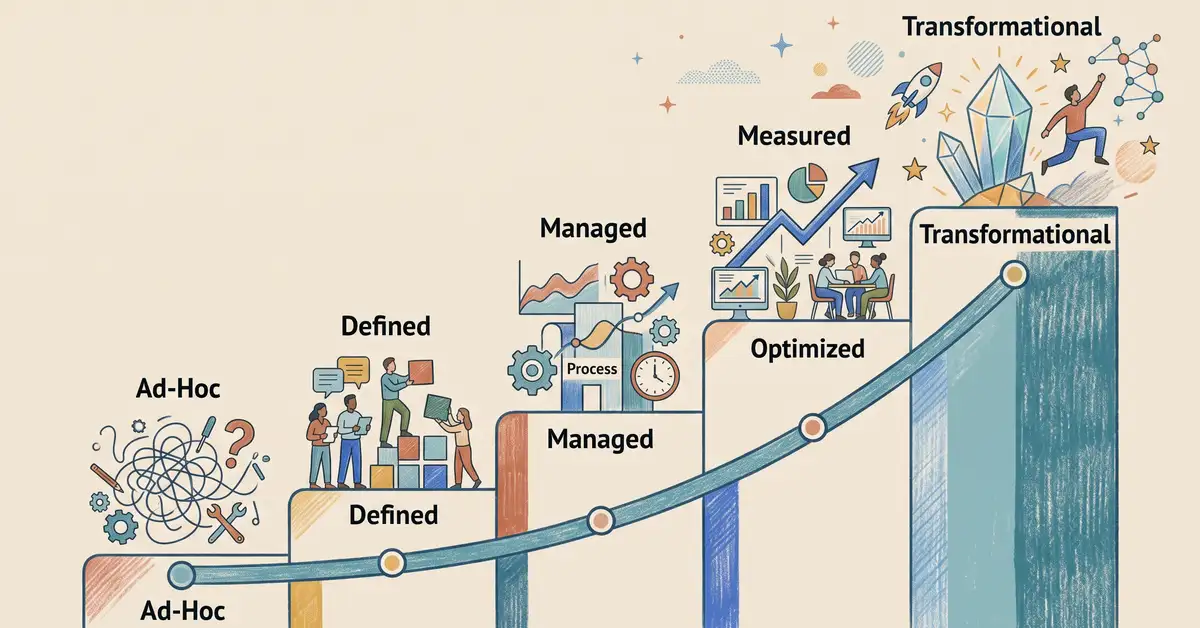
The readiness gaps holding UK marketing teams back
Four gaps account for most of the distance between adoption and readiness in UK marketing functions, and none of them is the technology itself. The skills gap is the most-cited: 45% of marketers name lack of in-team expertise as their main AI difficulty, and the European Marketing Agenda found only around 12% have professionalised and scaled their AI use. The governance gap is next: roughly 61% of marketing teams have no formal AI policy. The data gap is structural: fewer than half of organisations consider their data adequate for AI. And the leadership gap is the quiet one: 39% of marketers say they lack a clear AI strategy from the top.
In the UK there is a fifth, market-specific pressure: the "AI trust penalty". CIM and YouGov research found that 63% of UK consumers would lose trust in a company using AI-generated content, and 78% are uncomfortable with AI using their personal data. For UK marketing leaders this raises the stakes on the governance and data dimensions specifically — readiness here is not only about efficiency but about protecting brand trust. Meanwhile the ONS reported that 29% of UK businesses used at least one AI technology by June 2026, rising to 49% among firms with 250 or more employees, so the competitive floor is rising even as trust tightens.
How marketing leaders close the readiness gap
Closing the readiness gap is sequential, not simultaneous. The most reliable pattern is education-first: build the skills and governance that let people use AI well before scaling the tools, because MIT's data shows the successful minority win on capability and workflow design, not on model access. Helium42 structures this as the Education-to-Implementation Pathway — a 6–8 week sequence that takes a marketing team from AI literacy to a governed, measured deployment.
In practice, four moves close most of the gap. Establish a usage policy and baseline literacy first, so "shadow AI" becomes governed AI — start from our AI usage policy template. Fix the data foundation before chasing advanced use cases. Choose one or two scoped, measurable use cases and embed them in workflow rather than running scattered experiments — the discipline covered in our guide to AI for marketing teams. And measure against a baseline from day one so readiness converts into a defensible return, using the method in our AI marketing ROI framework.

From readiness to the board
Once a marketing function has diagnosed its readiness, the next step is usually funding the plan to close the gaps — which means a business case the board will approve. Readiness assessment and business case are complementary: the assessment tells you which dimensions are weak and what closing them requires, and the business case turns that into a phased, costed proposal. For that step, see our guide to building the board-ready business case for marketing AI. Readiness without funding stalls; funding without readiness fails — marketing leaders need both. The sequence matters too: a board is far more likely to approve investment when the marketing director can show a clear readiness diagnosis, name the specific dimension being fixed, and tie the spend to a measurable outcome rather than a general ambition to "use more AI". Readiness assessment is therefore not a preliminary — it is the evidence base for every subsequent decision, from tool selection to budget.
Frequently Asked Questions
What is AI readiness for a marketing team?
AI readiness is a marketing function's ability to turn AI tools into measurable results, assessed across six dimensions: data foundation, skills and literacy, governance, process integration, tooling, and leadership alignment. It is distinct from adoption — a team can use AI heavily yet score low on readiness, which is why most pilots fail to deliver return.
How do I assess my marketing team's AI readiness?
Score your function honestly against the six dimensions and locate it on the five-stage maturity model, from ad hoc to transformational. A structured diagnostic such as Helium42's AI Readiness Assessment does this quickly and shows which dimension is weakest, since a team is only as ready as its lowest-scoring dimension.
Why do most marketing AI initiatives fail?
They fail on readiness, not technology. MIT's 2025 research found about 95% of enterprise generative-AI pilots deliver no measurable return, with the difference driven by organisational capability — data, skills, governance and workflow design — rather than the AI model. Low readiness means AI amplifies existing weaknesses instead of creating advantage.
What is the biggest AI readiness gap in marketing?
Skills. Across UK and global surveys, lack of in-team expertise is the most-cited barrier — 45% name it as their main difficulty — ahead of data quality, governance and leadership strategy. This is why an education-first approach outperforms a tool-first one: capability is the binding constraint.
How long does it take to become AI-ready?
A marketing team can move from ad hoc to operational readiness in a matter of weeks with a focused, education-led programme — Helium42's Pathway runs over 6–8 weeks. Reaching embedded or transformational maturity takes longer and depends on data foundations and sustained capability building, not on buying more tools.
Diagnose your marketing function's AI readiness
Helium42 helps marketing leaders assess readiness across all six dimensions and close the gaps under the Education-to-Implementation Pathway — capability first, measurable results in 6–8 weeks.
Take the assessment Explore AI consultancySources: Gartner CMO AI survey (Feb 2026, via CMSWire); Supermetrics 2026 Marketing Data Report; Adobe 2026 AI and Digital Trends Report; McKinsey, AI at work but not at scale (2025); MIT NANDA, The GenAI Divide (2025).