

Published by

Winning board approval for AI in marketing depends less on the technology than on a business case the board can defend: a named problem, a scoped use case, a phased budget, a quantified return, and a credible plan to de-risk failure. Helium42's founders have guided leaders through exactly this decision across more than 200 workshops and over 2,000 professionals trained.
Most marketing AI proposals do not fail because the technology is wrong. They fail in the boardroom, where a marketing director cannot answer the question every chief financial officer asks: what is the measurable return, and what happens if it does not work? The board's caution is well-founded. MIT's 2025 research found that 95% of enterprise generative-AI pilots deliver no measurable return to the profit-and-loss account, and adoption in marketing specifically has stalled — Supermetrics' 2026 Marketing Data Report puts meaningful AI adoption at around 6%, with only 33% of marketers confident they can turn their data into action. That gap between pressure and proof is where budgets are lost. This guide sets out how to build a board-ready business case for marketing AI — the structure, the numbers, the objections, and the governance — so that the answer to "should we invest?" becomes evidence-based rather than enthusiasm-based.
95%
of enterprise generative-AI pilots deliver no measurable P&L return
42%
of companies abandoned most AI initiatives in 2025 (up from 17%)
46%
of AI proofs of concept are scrapped before production
45%
average marketing-efficiency gain on Helium42 MD engagements
Sources: MIT NANDA, The GenAI Divide: State of AI in Business 2025; S&P Global Market Intelligence, Voice of the Enterprise 2025; Helium42 engagement data.
Key Takeaway
A board-ready AI marketing business case is not a tool wishlist. It is five linked elements — problem, scoped use case, phased budget, quantified return, and a de-risking plan — presented in the board's language of payback, risk and accountability. Get the structure right and approval follows; lead with the technology and it stalls.
Why marketing AI business cases fail at the board
Marketing AI business cases fail at the board for three predictable reasons, and none of them is the technology. The first is hype fatigue: boards have heard the AI promise repeatedly and now discount it. The second is unquantified return — a proposal that asks for budget but cannot isolate the incremental value AI will create, or benchmark it, reads as a gamble. The third is the absence of a failure plan: with 42% of companies abandoning most of their AI initiatives in 2025 and 46% of proofs of concept scrapped before they reach production (S&P Global Market Intelligence), an experienced board will not approve spend that does not acknowledge and contain that risk.
The marketing director sits in a particular bind. The pressure to adopt is real, yet adoption in marketing has stalled at around 6% (Supermetrics, 2026) precisely because directors cannot yet prove the return the board demands. The way through is not a louder pitch. It is a business case structured the way the board already evaluates every other investment: a defined problem, a bounded commitment, a return that can be measured, and controls that make failure survivable. Helium42 builds this structure into every Marketing-Director engagement, because a strong case is what converts board pressure into board approval.

The five components of a board-ready AI marketing business case
A board-ready AI marketing business case contains five components, in order. Each answers a question the board will ask before it releases budget. Treat them as a sequence: later components depend on decisions made in the earlier ones.
The named problem
State the specific, costed marketing problem — slow content production, weak lead qualification, rising cost-per-acquisition — not "we should use AI". Boards fund solutions to problems they recognise, with a number attached.
The scoped use case
Define one or two specific AI use cases that address the problem — for example, AI-assisted content production or predictive lead scoring — with clear boundaries. A scoped pilot is far more fundable than an open-ended transformation.
The phased budget
Present the cost as phases — pilot, then scale — not a single lump sum. A £15,000–£50,000 pilot with a defined decision gate before any larger commitment lets the board approve a small, contained step rather than a leap.
The quantified return
Show the expected return against a baseline, with a method to measure it. This is where you reference a measurement framework rather than assert a number — see Helium42's AI marketing ROI framework for the calculation the board will expect.
The de-risking plan
Name the risks — adoption, data quality, vendor lock-in — and the controls that contain them. A case that acknowledges that 95% of enterprise gen-AI pilots show no measurable return and explains how this project avoids that fate earns more trust than one that ignores it.
These five components map directly onto how Helium42 structures a Marketing-Director engagement under the Education-to-Implementation Pathway — our framework for taking UK SMEs from AI literacy to measurable production deployments in 6–8 weeks, built on our founders' record of more than 200 workshops and over 2,000 professionals trained. The Pathway exists precisely so that the business case and the delivery plan are the same document, not two competing ones.
How to size the investment and present the numbers
Sizing the investment for a marketing AI business case means presenting cost and return as a phased sequence, so the board approves a contained first step rather than an open commitment. The table below sets out an indicative phasing for a mid-market marketing function. The figures are illustrative ranges drawn from typical UK engagements; the point is the structure — a small, gated pilot that proves value before any scaling spend is released.
| Phase | Timeline | Activity | Indicative cost | Board-facing outcome |
|---|---|---|---|---|
| Pilot | Weeks 1–8 | One scoped use case, education-led, measured against a control | £15k–£50k | Proven uplift or a clean stop |
| Decision gate | Week 8 | Board reviews pilot results against the agreed threshold | — | Go / no-go on scaling |
| Scale | Months 3–6 | Extend proven use case; build internal capability | £50k–£150k | Repeatable return, owned in-house |
Crucially, the business case quantifies return against a baseline rather than claiming all post-AI revenue as AI's contribution. The board will expect a defensible calculation — incremental return, total cost of ownership, and payback period. That calculation is a discipline in its own right; rather than reproduce it here, build the numbers using Helium42's AI marketing ROI measurement framework, and frame the wider organisational case with our guide to the business case for AI.
A worked example: the board case for AI content production
Consider a 300-person B2B SaaS company whose marketing team produces twelve long-form assets a month at roughly fourteen hours each. The named problem: content cost and cycle time cap pipeline growth, and output cannot scale without headcount the board will not fund. The scoped use case: AI-assisted drafting and repurposing across two content formats, with human editing retained for quality and compliance. The phased budget: a £30,000 eight-week pilot covering tooling, training and a measured control group, with a decision gate before any scaling spend. The quantified return: if AI-assisted production reduces time-per-asset by 40% — a planning assumption to validate in the pilot — the team reclaims around sixty-seven hours a month, a meaningful share of a full-time role redirected to higher-value work. The de-risking plan: an education-led rollout, a control group to isolate the gain, and a clean stop if the pilot misses its agreed threshold.
Presented this way, the board is not asked to bet on AI. It is asked to fund a £30,000 experiment with a defined payback and a defined exit, after which a larger commitment is either justified by evidence or declined on evidence. The decision gate is the mechanism that converts an uncertain technology question into a routine investment decision, and it is the single feature that most often separates an approved marketing AI case from a deferred one.
Helium42 helps marketing directors turn a pilot result into a board-approved AI programme. Discuss a scoped, measurable engagement with our team.
Book a consultation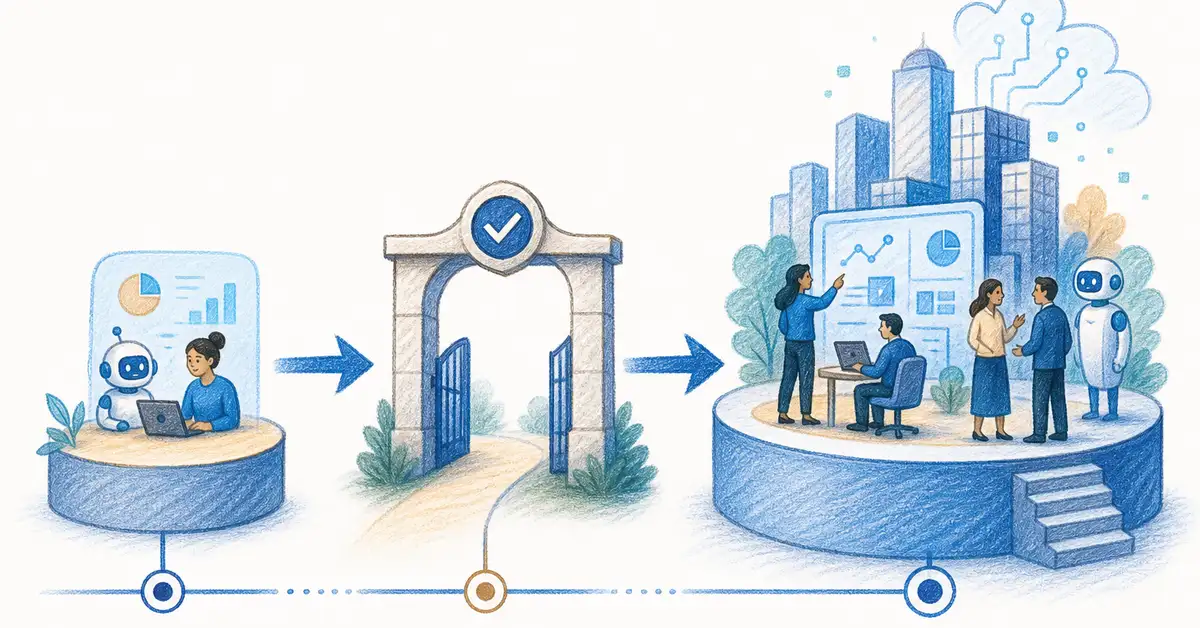
Answering the four questions every board asks
Every board interrogates an AI marketing proposal with the same four questions. Prepare direct answers to each, with evidence, and the conversation shifts from scepticism to scoping.
What happens if it fails?
Answer with the phasing. Because the commitment is a contained pilot with a decision gate, the downside is bounded to the pilot cost, and the pilot is designed to produce a clear result either way. A clean stop after an £15,000–£50,000 pilot is a far smaller risk than an unphased programme — and naming that protects the proposal.
Why now, and why not wait?
Answer with the adoption context. The ONS Business Insights and Conditions Survey (8 January 2026) found around 25% of UK businesses, and 44% of large firms, already using AI. Waiting widens a capability gap that the DSIT AI Labour Market Survey (2026) documents as a persistent AI skills shortage across UK businesses. The cost of delay is competitive, not just operational.
Should we build or buy?
Answer with proportionality. For most marketing use cases, buying proven tools and building internal capability around them beats custom development on cost and speed. Helium42's position is explicit: build internal capability so the organisation is never dependent on a vendor — the anti-lock-in posture boards increasingly require.
Who owns it after the consultants leave?
Answer with the education-led model. The business case should name the internal owner and the plan to build their capability. EY research found employees receiving more than 81 hours of AI training gain around 14 hours per week in productivity — proof that capability, not dependency, is what compounds the return.

De-risking the case: governance, phasing and proof
De-risking a marketing AI business case means converting the headline failure statistics into a set of controls the board can see. With 46% of proofs of concept scrapped before production (S&P Global) and MIT's 2025 research finding that 95% of enterprise generative-AI pilots deliver no measurable return, the board's caution is rational. The case earns approval by pre-empting it.
Three controls do most of the work. First, phasing with a decision gate, so no large spend is released before a small one has proven out. Second, an education-led rollout: most pilots fail on adoption and organisational learning rather than technology, so the business case must fund training and change, not only tools. Third, measurement against a baseline from day one, so the result is defensible. This is the logic of the Education-to-Implementation Pathway — a 6–8 week, education-first sequence that works precisely because it treats adoption and governance as part of the deliverable, not an afterthought.
From approval to accountability: reporting AI ROI to the board
Securing approval is the start of the marketing director's accountability, not the end of it. The business case should commit, up front, to a reporting cadence: the small set of board-ready metrics that will be tracked, the baseline they are measured against, and the review point at which the board decides whether to scale. Defining this before approval signals seriousness and makes the eventual scaling decision straightforward.
The metrics that survive a board conversation are the ones tied to pipeline and cost, not activity — incremental revenue influenced, cost-per-acquisition movement, content cost and cycle time, and payback period. Reporting them well is a measurement discipline; build the cadence on Helium42's AI marketing ROI framework, and for the broader selection of an AI partner, see our UK AI consultancy guide.
Common mistakes that sink a marketing AI business case
Most rejected marketing AI cases share a small set of avoidable errors. Test the proposal against these before it reaches the board.
- Leading with the tool, not the problem. A case that opens with the technology rather than a costed marketing problem invites scepticism. Name the problem and its cost first.
- Requesting an unphased lump sum. A single large number with no decision gate reads as a leap of faith. Phase the budget so the board approves a small, contained pilot before anything larger.
- Claiming all post-AI revenue as AI's return. Boards discount inflated attribution immediately. Quantify the incremental gain against a baseline, using a defensible measurement method.
- Ignoring the failure rate. A case that does not acknowledge that 46% of AI proofs of concept are scrapped before production looks naive. Name the risk and show the controls that contain it.
- Leaving ownership undefined. A proposal that does not say who runs the capability after launch invites the question that most often stalls approval. Name the internal owner and the plan to build their skills.
Frequently Asked Questions
How does a marketing director justify AI spend to the board?
By presenting a structured business case rather than a tool request: a named, costed problem; one or two scoped use cases; a phased budget with a decision gate; a return quantified against a baseline; and a plan that contains the risk of failure. Boards approve contained, measurable steps far more readily than open-ended transformation.
How much should a marketing AI pilot cost?
A scoped marketing AI pilot typically costs £15,000–£50,000 and runs over 6–8 weeks, with a decision gate before any larger commitment. Scaling a proven use case usually falls in the £50,000–£150,000 range. Phasing the spend this way limits the board's downside to the pilot cost.
What is the difference between this and measuring AI marketing ROI?
The business case is about winning approval and governing the investment; measuring ROI is the calculation you use within it and report against afterwards. They are complementary — build the case using this guide, and quantify the numbers with Helium42's AI marketing ROI measurement framework.
Why do most marketing AI projects fail?
Most fail on adoption and organisational learning, not technology — which is why MIT found that 95% of enterprise generative-AI pilots deliver no measurable return and 46% of proofs of concept are scrapped before production. An education-led rollout with phasing and baseline measurement is the most reliable way to avoid joining those figures.
How long before a marketing AI investment shows return?
A well-scoped pilot shows a measurable result within its 6–8 week window, with the decision to scale taken immediately after. Most marketing teams reach payback within 3–6 months of a scaled deployment, provided the return is measured against a proper baseline rather than assumed.
Build the business case the board will approve
Helium42 partners with marketing directors to scope, prove and scale AI investment under the Education-to-Implementation Pathway — measurable results in 6–8 weeks, owned by your team.
Explore AI consultancy Book a discovery callSources: MIT NANDA, The GenAI Divide: State of AI in Business 2025; S&P Global Market Intelligence, Voice of the Enterprise 2025; Supermetrics 2026 Marketing Data Report; ONS Business Insights and Conditions Survey, 8 January 2026; EY UK, AI talent gaps research (2025); Helium42 engagement data. diagnose your AI readiness across the six dimensions