Published by

AI legal drafting implementation is the operational work of embedding AI-assisted drafting into a law firm's supervision chain, precedent library, pricing model and client terms. It is distinct from choosing a tool. Most UK firms that stall do not stall because they picked the wrong platform. They stall because the rollout was designed as a technology project rather than as a change to how the firm supervises, prices and records legal work.
The regulatory position is now considerably firmer than it was twelve months ago. The Solicitors Regulation Authority updated its Effective Supervision guidance on 12 June 2026 with an explicit section on AI tools, and two High Court judgments in 2025 established what happens when verification fails. Together these define the minimum standard your rollout has to meet.
This guide assumes you have already decided to adopt AI drafting and already know which platforms exist. It covers the sequence, the roles, the controls and the measurement.
Key Takeaway
The SRA does not operate a separate AI regime. AI-assisted work must satisfy the existing duties of competence, supervision, confidentiality and integrity, and an authorised individual retains ultimate responsibility for anything delivered with AI assistance. Design your rollout inside your current supervision architecture, not alongside it.
The Regulator Has Already Defined the Rollout Constraints
There is no standalone AI rulebook for solicitors. The SRA's approach is principles-based, which means AI-assisted drafting is governed by the obligations your firm already carries. The SRA's Innovate compliance tips confirm that firms may use whatever technology they consider appropriate, subject to the Principles and Codes, data protection law, and the requirements governing automated decision-making.
The June 2026 update to the Effective Supervision guidance is the material development. It states that outputs produced with AI assistance must be subject to appropriate human review, scrutiny and professional judgement, and that authorised individuals retain ultimate responsibility for legal services delivered with AI assistance. AI cannot function as an unaccountable black box that produces work product without professional oversight.
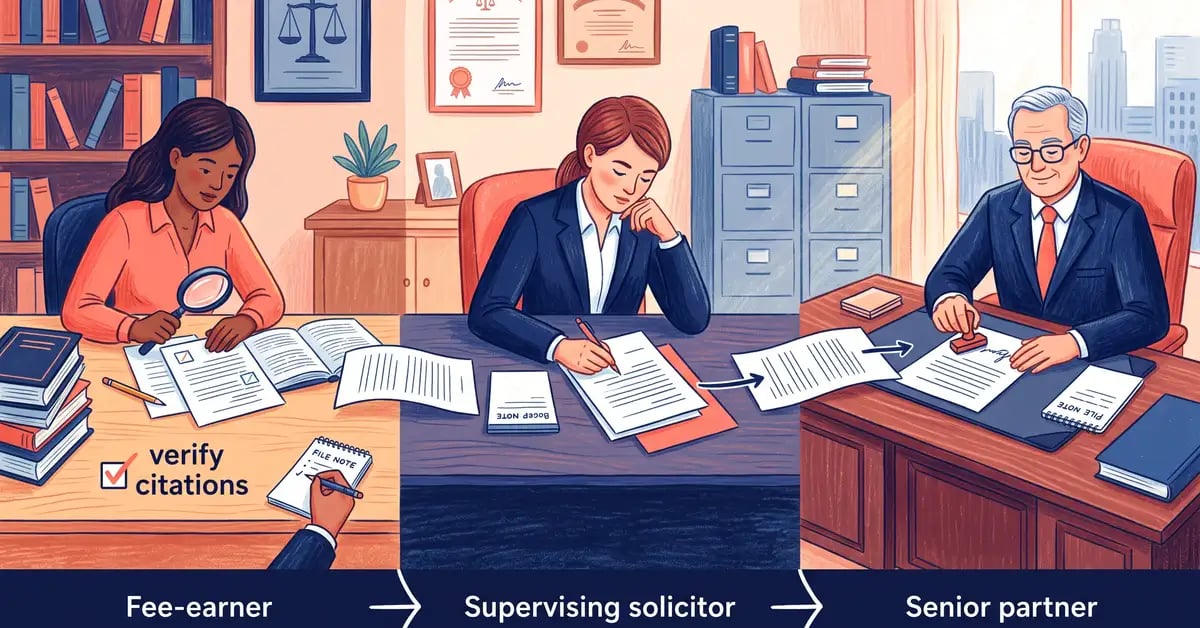
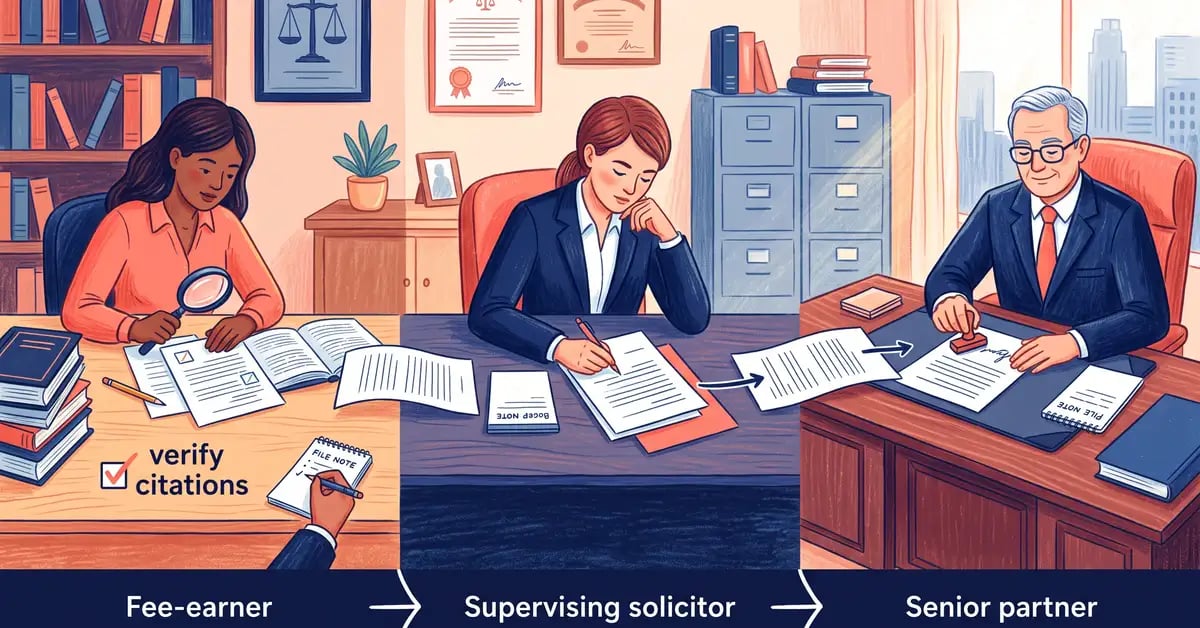
The guidance also sets a risk-based supervision expectation that translates directly into rollout design. Supervisors should either hold effective knowledge of every matter their supervisees are progressing, or monitor a meaningful sample, with the choice driven by risk. For AI drafting this means you must decide, in advance and in writing, which document types demand individual partner sign-off and which are adequately controlled by sampling.
Two established good-practice examples in the guidance carry over almost unchanged. First, protocols that prohibit filing court documents without partner or senior solicitor sign-off. Second, evidencing supervision through emails, file notes and time records. Both are directly applicable to AI-assisted work, and both are cheap to implement before a single licence is purchased.
Two High Court Judgments Set the Verification Standard
The consequences of inadequate verification are no longer hypothetical. Two 2025 High Court matters, analysed in detail by the British Institute of International and Comparative Law, established the standard your protocols must satisfy.
In Ayinde v London Borough of Haringey, grounds for judicial review drafted by a paralegal misstated section 188(3) of the Housing Act 1996 and cited five non-existent cases. The court could not conclusively establish that AI produced the fabrications, but found the drafter had included non-existent authorities recklessly, without caring whether they existed. The supervising solicitor, once alerted that the cases did not exist, took only inadequate steps to remedy the position. The drafter and the law centre were each ordered to pay £2,000, and the matter was referred to the Hamid judge.
In Al-Haroun v Qatar National Bank, a £89.4 million commercial claim, a witness statement cited 45 authorities of which 18 did not exist, with several genuine authorities inaccurately quoted or cited for propositions they did not support. The AI-generated references had been supplied by the client. The instructing solicitor relied on them without independent checking, and subsequently self-referred to the SRA. The court described the reliance as a lamentable failure to comply with the basic requirement to check material put before the court.
| Case | Verification failure | Outcome | Rollout implication |
|---|---|---|---|
| Ayinde v Haringey (2025) | Five non-existent cases; statute misstated; supervisor took inadequate steps once warned | £2,000 each against drafter and law centre; referral to the Hamid judge | Paralegals and trainees must not file AI-assisted work without documented verification and active supervision |
| Al-Haroun v QNB (2025) | 45 authorities cited, 18 fabricated; AI research supplied by the client and accepted unchecked | Judicial criticism as a grave professional error; solicitor self-referred to the SRA | Client-supplied AI research requires the same independent verification as your own |
Source: BIICL analysis of the 2025 High Court judgments. Figures as reported in that analysis.
The pattern across both matters is that the courts attribute responsibility to the professionals rather than to the technology. The judgments also noted the wider inadequacy of training and supervision, placing responsibility on organisational systems rather than individual lapses alone. Your verification protocol is therefore a governance artefact, not a checklist for individuals.
The Confidentiality Line Has Moved
Analysis from Norton Rose Fulbright reports that the Upper Tribunal has confirmed that uploading documents to open-source AI tools breaches confidentiality and waives legal professional privilege, treating the upload as disclosure to a third party.
Client consent does not cure this. Consent may record that the client accepts a risk, but privilege is a legal protection that can still be lost. Your policy must prohibit confidential client material in consumer-grade AI interfaces, not merely discourage it.
Your Precedent Library Determines the Quality Ceiling
AI drafting quality depends on the quality of the material the firm can point it at. Firms that succeed treat precedent preparation as the first workstream rather than a later refinement. The work is unglamorous: identifying which precedents are current, retiring superseded versions, standardising clause language, and tagging documents so that retrieval returns the right template for the right matter type.
This is knowledge management, and it is the single most common reason a technically sound pilot produces disappointing drafts. A model asked to draft from an inconsistent precedent bank will faithfully reproduce that inconsistency at speed. Budget for this work explicitly, and assign it to whoever owns knowledge management rather than to whoever owns IT.
Scope the First Pilot Around Risk, Not Enthusiasm

The instinct is to pilot on the work that consumes the most time. The better instinct is to pilot where a verification failure would be recoverable. First-pilot candidates share three characteristics: the document type is high-volume and reasonably standardised, the output is reviewed internally before it reaches a client or a court, and the matter does not turn on novel legal argument.
Internal research summaries, first-draft standard contracts and routine correspondence generally qualify. Court filings, formal advice and anything involving novel points do not belong in a first pilot, precisely because those are the categories the SRA guidance and the 2025 judgments treat as demanding partner-level scrutiny.
Published UK evidence on pilot duration and sample size is genuinely thin. Firms rarely publish internal pilot design, and there is no large-scale UK study establishing benchmarks. Treat any specific figure you are offered by a vendor as a hypothesis to test rather than a target to adopt, and set your own baseline before the pilot begins. Without a pre-pilot measurement of time-per-document on comparable work, you will have no defensible basis for claiming a gain.
Train by Role, and Gate Access on Competence
Training a whole firm on a single generic AI session is the cheapest way to waste the budget. The competence a partner needs to supervise AI-assisted work differs from the competence a paralegal needs to produce it. Structure training around what each role is permitted to do.
Fee-earners producing drafts need to understand where models fail, how to verify authorities against primary sources, and which document types they are authorised to draft with AI assistance. Supervisors need enough understanding of failure modes to interrogate a draft rather than approve it, which is a materially different skill. Support staff need to know what may never be entered into a tool.
The pragmatic control is to gate tool access on demonstrated competence rather than on job title. A firm that can evidence which individuals were trained, on what, and when, is in a considerably stronger position if the SRA later asks how it satisfied itself that supervision was effective.
The Billing Question Partners Actually Ask
If AI drafting reduces the time a standard document takes, and the firm bills by time, the firm has engineered a revenue reduction. This is the question partners raise first and the one most implementation plans avoid.
The honest position is that the UK evidence base here is weak. There is no robust independent study quantifying how AI drafting has affected UK firm margins. What can be observed is directional: Legal Futures reports that smaller UK firms are adopting AI while simultaneously moving away from hourly billing towards fixed fees, which suggests adoption and pricing reform are proceeding together rather than sequentially.
Three responses are available, and firms are choosing between them rather than discovering a single answer. Hold pricing and take the margin on fixed-fee work. Reduce price to reflect lower cost and compete on it. Or restructure the offer so that the fee is explicitly attached to judgement, risk allocation and outcome rather than elapsed time. The third is the most defensible and the hardest to execute, because it requires the engagement letter and the client conversation to change, not just the invoice.
What does not work is leaving the pricing model untouched and hoping clients do not notice. Where AI genuinely halves drafting time on a commoditised document type, some clients will ask for a corresponding adjustment, and a firm without a considered position will concede it under pressure rather than by design. For a structured view of the numbers behind this decision, our guide to AI consultancy pricing in the UK sets out comparable cost bands.
Client Disclosure Requires a Decision, Not a Default
Neither the SRA nor the Law Society currently mandates a specific AI disclosure clause in engagement letters. That absence is not permission to stay silent. The SRA's compliance tips emphasise obligations to explain how personal data will be processed and to comply with requirements on automated decision-making, both of which are engaged when AI processes client material.
Commercial drafting resources now publish model provisions for this purpose. Thomson Reuters Practical Law offers a generative AI use provision for engagement letters, framing AI as a tool that supports more efficient service while making explicit that it does not substitute for the professional judgement of the lawyers, who remain responsible for accuracy and appropriateness. The existence of such standard clauses indicates where market practice is heading.
Firms are landing in three places: a general statement that technology including AI may be used, a specific clause where AI plays a substantial role in the matter, or disclosure through the privacy notice where the concern is principally data processing. Choose deliberately and apply it consistently across engagement terms, privacy notice and website. Inconsistency between those three documents is the exposure, not the disclosure itself.
Measure Against Your Own Baseline, Because No UK Benchmark Exists
There is no publicly available, large-scale UK study quantifying time savings, error rates, supervision load or financial impact of AI drafting across multiple firms. Vendor projections circulate widely and are directionally useful at best. This means your measurement framework must be internal and must be defined before the pilot, not reconstructed afterwards.
Four metric families matter. Efficiency: time per document and matter turnaround on comparable work, measured before and after. Quality: correction frequency in AI-assisted drafts, incidence of fabricated or misquoted authorities, and the number of supervisor interventions required. Supervision load: the additional time supervisors spend reviewing AI-assisted drafts, tracked to establish whether it falls as competence grows or persists and erodes the efficiency gain. Commercial: matter margin by work type, which is the only metric that answers whether the rollout paid for itself.
Adoption rate is worth tracking as a leading indicator. LexisNexis research from a survey conducted between 3 and 19 January 2024 found 26% of UK lawyers and legal support staff using generative AI at least monthly, up from 11% in July 2023, with the proportion having no plans to adopt falling from 61% to 39%. Those figures are now dated, and are best used as a historical baseline for the direction of travel rather than as a current benchmark.
A Defensible Sequence for the First Ninety Days
The order matters more than the speed. Firms that begin with tool selection tend to revisit every earlier decision later.
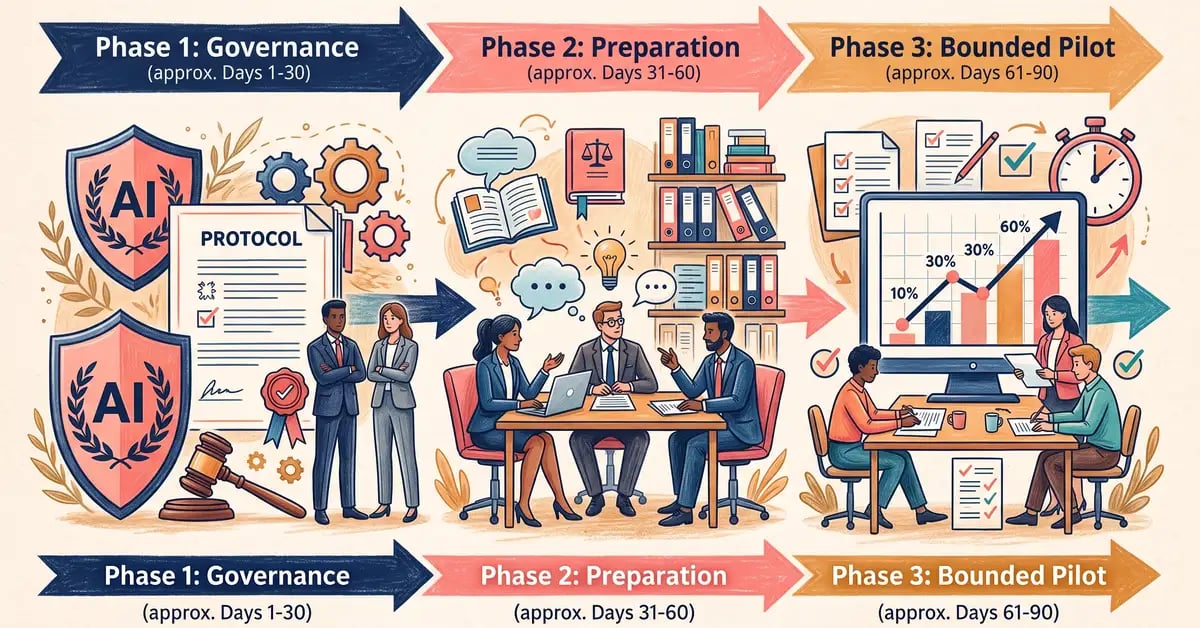
Weeks one to three establish the governance position: agree which document types are in scope, write the supervision and verification protocol, decide the confidentiality boundary on what may be entered into a tool, and set the pre-pilot measurement baseline. Weeks four to six prepare the precedent material and deliver role-based training with an access gate tied to competence. Weeks seven to twelve run a bounded pilot on the agreed low-risk document types, with the verification protocol operating and supervision load measured deliberately.
Only after that does scaling become a sensible conversation, and it should be a conversation about pricing and precedent coverage as much as about licences. At Helium42 we sequence engagements through the Education-to-Implementation Pathway, which places leadership literacy and role-based capability before pilot design, and managed scaling only once a pilot has produced evidence. In a regulated setting that sequence is not a preference. The supervision obligation makes capability a precondition of deployment.
Deciding which platform fits the workflow you have just designed?
Compare AI Tools for UK Law FirmsWhere Rollouts Stall
Four failure modes recur, and none of them are technical.
The first is treating supervision as a later addition. A pilot that runs without an agreed verification protocol generates work product nobody is confident to sign, and the pilot quietly stops. The second is an unprepared precedent bank, which produces drafts of a quality that convinces sceptical partners the technology does not work. The third is an untouched pricing model, which turns a genuine efficiency gain into a revenue problem and removes partner support. The fourth is the absence of a baseline, which leaves the firm unable to demonstrate whether anything improved and therefore unable to justify scaling.
Each of these is a decision that can be taken before procurement, at no licence cost. That is the practical argument for sequencing governance ahead of tooling.
Related Reading
This guide covers rollout mechanics. For adjacent decisions, see our comparison of the best AI tools for UK law firms and our assessment of AI platforms for legal drafting. On the confidentiality question, our guide to private and secure AI deployment for law firms sets out the four deployment models and what data residency actually means. Firms starting without budget should review free AI tools for legal drafting and the compliance limits that apply. For the governance document itself, adapt our AI policy template. For the wider sector position, see AI for law firms.
Frequently Asked Questions
- Does the SRA require us to disclose AI use to clients?
- There is currently no SRA rule mandating a specific AI disclosure clause. However, the SRA's compliance guidance requires firms to explain how personal data will be processed and to meet requirements on automated decision-making, which are engaged when AI processes client material. Most firms are therefore adopting either an engagement letter provision or a privacy notice disclosure, and the practical risk lies in inconsistency between those documents rather than in disclosure itself.
- Who is responsible if AI produces a fabricated citation that reaches court?
- The authorised individual. The SRA's June 2026 supervision guidance states that authorised individuals retain ultimate responsibility for legal services delivered with AI assistance. The 2025 High Court judgments applied that principle in practice: consequences fell on the drafter and the supervising solicitor, and in one matter on the organisation, with costs orders and a referral to the Hamid judge. Responsibility is not transferable to the tool or to a client who supplied the research.
- Can we use ChatGPT or Claude for drafting if the client consents?
- Consent does not resolve the privilege question. Analysis of Upper Tribunal guidance indicates that uploading documents to open-source AI tools breaches confidentiality and waives legal professional privilege, because the upload constitutes disclosure to a third party. Client consent may record acceptance of a risk, but it does not restore a privilege that has been lost. Confidential client material requires a tool configured so that data is not shared externally.
- Which document types should a first pilot cover?
- Document types that are high-volume, reasonably standardised, reviewed internally before leaving the firm, and not dependent on novel legal argument. Internal research summaries, first drafts of standard contracts and routine correspondence generally qualify. Court filings and formal advice do not, because those are the categories that regulatory guidance and the 2025 judgments treat as requiring partner-level scrutiny.
- How long should an AI drafting pilot run?
- There is no published UK benchmark, and firms rarely disclose internal pilot design. A defensible approach is to run long enough to accumulate a meaningful sample of comparable documents across more than one fee-earner, having established a pre-pilot baseline for time per document. The duration matters less than whether you measured the same work type before you began.
- Will AI drafting reduce our revenue if we bill by the hour?
- It will, on commoditised document types, unless the pricing model changes alongside the rollout. UK evidence on the scale of this effect is thin, but the observable trend is that smaller firms adopting AI are moving towards fixed fees at the same time. The three viable responses are holding price and taking margin on fixed-fee work, reducing price to compete, or restructuring the fee around judgement and outcome rather than time. Choosing none of them is the option that erodes margin by default.
Planning an AI Drafting Rollout?
Book a free 30-minute discovery call. We will review your supervision position, precedent readiness and pricing exposure, and set out a realistic sequence before you commit to a platform.