
Published by

Key Takeaway
How Helium42 Prices AI Work
The rates set out below are the UK market. Helium42 prices differently, and the distinction matters if you are trying to build a budget: we do not quote a project figure before discovery, because until a workshop has run, neither party knows what is being bought.
How the cost builds up. The first commitment is a discovery workshop across the departments that will use AI — a contained piece of work with a defined output: recommendations and a sequenced plan. Everything after that is priced against the plan rather than against a guess. Some organisations stop there and execute the strategy themselves. Others continue on a monthly retainer. Others commission specific builds, and those genuinely vary — a dashboard might take days, an integration across existing systems might take months. Any supplier quoting a firm figure for the second stage before completing the first is estimating blind.
What that looks like in practice. In one engagement, a day and a half with senior management produced the recommendations and strategy the client's own team then executed, and the work was complete at that point. In another, an initial workshop led to a monthly retainer and then to several development projects. Same starting point, very different totals — because the scope came out of discovery rather than a rate card.
Who we are. Helium42 was founded by Clwyd Probert, previously of the HubSpot Diamond partner agency Whitehat, and Peter Vogel, who has led digital marketing transformation programmes for over 500 organisations across the UK and Europe. Between them they have delivered more than 200 workshops and trained over 2,000 professionals. We work from London and Hamminkeln.
Where to start. The free 30-minute AI webinar for business leaders covers the budgeting decisions that most often cause overruns. The AI readiness assessment gives you a structured view of the scope you are likely to need before you approach anybody for a quote.
The rate cards, pricing models and hidden costs set out below apply across the UK market, whichever supplier you choose.
UK AI consultancy pricing spans £500-£2,500+ per day depending on consultant type, with typical SME projects costing £25,000-£150,000. Hidden costs for data preparation and infrastructure often add 40-60% to budgets. Understanding pricing models and building proper contingency into scopes can reduce cost overruns by 20-30%.
£500-£2,500
Daily Rate Range
Freelancers to Big Four
£25k-£150k
Typical SME Project
PoC through full deployment
40-60%
Hidden Costs
Data, infrastructure, training
12-24mo
Payback Period
ROI realisation timeframe
Sources: Tech UK Industry Report 2025, market analysis Q1 2026
How UK AI Consultancy Pricing Breaks Down
The UK AI consultancy market divides into four distinct supplier tiers, each with different cost structures and service breadth. Freelance practitioners command daily rates from £400 to £800, suitable for initial assessments and advisory work. Boutique specialists—offering deep domain expertise in specific industries—charge £1,200-£2,500 per day for niche implementations. Mid-tier consultancies balance breadth with depth at £900-£1,600 daily, whilst Big Four and enterprise firms impose premiums of £1,500-£3,000+ daily for brand recognition and full-service integration. Understanding which tier aligns with your project type, timeline, and complexity is the primary cost lever for UK SMEs. Our complete guide to AI consultancy in the UK covers broader evaluation criteria beyond pricing.
Most UK SMEs (80-1,500 employees, £20M-£250M revenue) find optimal value in mid-tier or boutique specialists for proof-of-concept work, reserving Big Four engagement for large-scale transformation or brand-critical initiatives. Regional variation across the UK remains modest—only 8-12% differential between London and regional markets—though London consultancies do command 10-15% premiums for equivalent expertise.
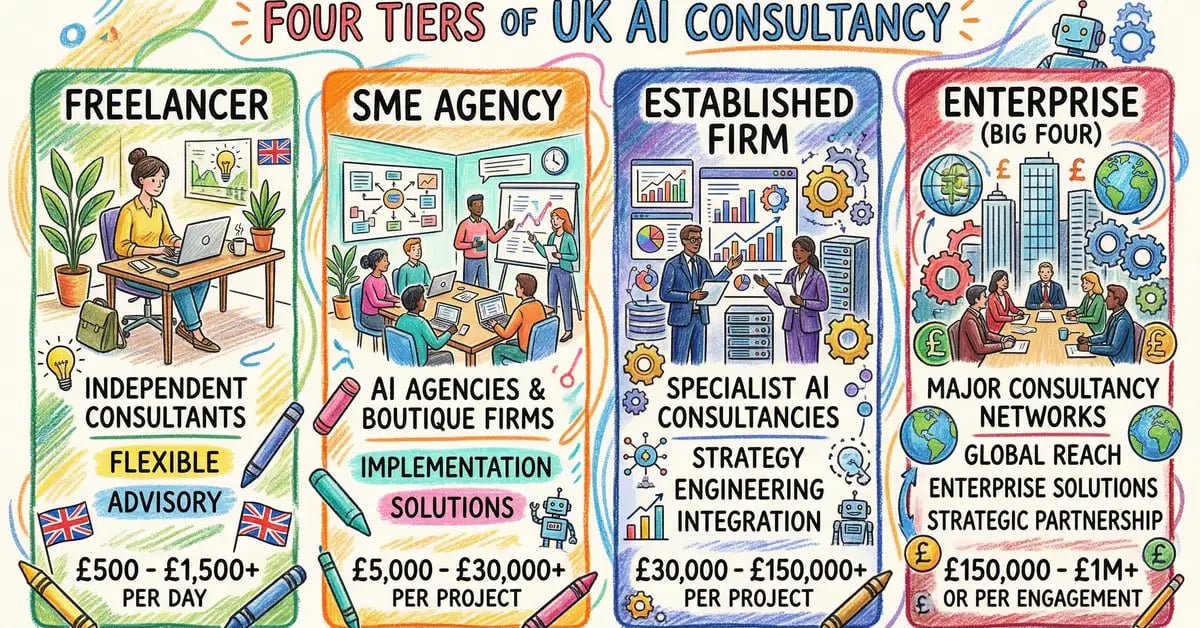
Pricing for AI consultancy makes commercial sense only inside a methodology that defines what you are buying. Helium42's Education-to-Implementation Pathway sets those boundaries: phase one funds leadership literacy, phase two funds a measurable pilot, phase three funds managed scaling. Each phase suits a different pricing model — daily rates fit literacy, fixed-fee fits pilot delivery, outcome-based fits scaling. We have applied this Pathway with over 500 leaders across UK and German mid-market organisations. The pricing models below map directly to those phase choices.
UK AI Consultant Day Rates and Hourly Rates at a Glance
The figures above set out in a single reference table, because the day rate is the number most buyers are trying to establish before anything else.
| Supplier tier | Day rate (UK, 2026) | What it is appropriate for |
|---|---|---|
| Freelance practitioner | £400–£800 | Initial assessments and advisory work; single-discipline input |
| Mid-tier consultancy | £900–£1,600 | Breadth plus depth; the common choice for SME proof-of-concept work |
| Boutique specialist | £1,200–£2,500 | Deep sector expertise for niche implementations where domain knowledge is the constraint |
| Big Four and enterprise | £1,500–£3,000+ | Large-scale transformation, multi-jurisdiction work, or where board and regulator credibility is the requirement |
Hourly rates. Where work is billed hourly rather than daily, UK AI consultancy time and materials rates run £150–£400 per hour. Hourly billing is generally used for advisory input, review and ad-hoc support. Delivery work is almost always quoted daily or as a fixed fee, because hourly billing on a build gives neither side a predictable number.
Regional rates: London, Scotland and the rest of the UK. Geographic variation across the UK is narrower than most buyers expect — roughly 8–12% between London and regional markets, with London-based consultancies commanding a 10–15% premium for equivalent expertise. The more important point is that remote delivery has largely decoupled rate from client location: a London-headquartered firm delivering to a client in Scotland, Manchester or Belfast typically charges its London rate, because the cost base sits with the supplier rather than with you. The differential you actually pay is therefore driven by where your supplier is based, not where you are. Firm-to-firm variation within any one tier is consistently wider than the gap between regions, so comparing two suppliers in the same tier will tell you more than comparing quotes by city.
Small businesses and lower budgets. Organisations below the mid-market band should expect to work at the freelance or lower mid-tier end, and should scope to a single measurable outcome rather than a broad programme. A £5,000–£25,000 training engagement or a tightly bounded assessment delivers more at that budget than a diluted version of a larger programme. The pricing models below set out which structure fits which budget.
Five Pricing Models and Which Suits SMEs Best
UK consultancies deploy five distinct pricing structures for AI engagements. Time and materials (T&M) billing at £150-£400 per hour offers flexibility but creates budget uncertainty, with typical SME projects running £15,000-£60,000 over 3-4 months. Fixed-price models—currently dominant at 45-55% of SME engagements—provide cost certainty (£25,000-£150,000 for typical projects) but require detailed upfront specification. Outcome-based pricing remains niche at 12-18% adoption, tying fees to measurable business results but introducing complexity around attribution and measurement.

Retainer-based engagements (£3,000-£15,000 monthly for on-call advisory) suit organisations needing continuous evolution and support post-implementation. Blended licensing-plus-services models (40-60% software, 40-60% services) are increasingly common in mid-market but create vendor lock-in risks. For most SMEs, fixed-price models represent the safest path to budgetary control, with 10-12% contingency built in as default. Market observation suggests informed buyers can negotiate contingency down from the typical 15-20% built into quotes after detailed scoping workshops.
Typical Project Costs and What They Actually Cover
AI consultancy costs for UK SMEs vary sharply by engagement type. Strategy and diagnostic workshops typically cost £12,000-£35,000 over 2-4 weeks, delivering AI capability assessments, opportunity prioritisation, and preliminary business cases. A proof-of-concept (PoC) for a single use case—often the first tangible step—runs £25,000-£85,000 over 6-12 weeks. Full production implementations cost £75,000-£250,000 over 12-26 weeks and include hardened systems, automated data pipelines, monitoring infrastructure, and staff training. Training programmes (capability building without implementation) range £5,000-£25,000 depending on cohort size and duration.
| Project Type | Duration | Typical Cost | Key Deliverables |
|---|---|---|---|
| Strategy Workshop | 2-4 weeks | £12k-£35k | AI roadmap, use case prioritisation, business cases |
| PoC Implementation | 6-12 weeks | £25k-£85k | Prototype, validation metrics, rollout playbook |
| Full Deployment | 12-26 weeks | £75k-£250k | Production system, pipelines, training, post-launch support |
| Training Programme | 4-8 weeks | £5k-£25k | Curriculum, materials, delivery, certification |
| Managed Services | Monthly retainer | £3k-£15k/month | Ongoing advisory, optimisation, evolution support |
Sources: Market analysis Q1 2026, consultancy rate cards
The critical insight for SMEs: these quoted costs typically cover consultant time only. Hidden expenses for data preparation, cloud infrastructure, staff training, and change management often add 40-60% to budgets. A £50,000 PoC quoted by the consultant frequently carries £52,000-£109,000 in total realisation cost when infrastructure, hidden scope, and internal resource allocation are included. UK SMEs chronically underestimate implementation complexity, understaffing change management and data quality audits by 30-50% compared to consultant recommendations. Our AI implementation roadmap provides a structured framework for budgeting across all cost categories.
The Hidden Costs Most SMEs Miss
Four categories of unbudgeted expense derail most UK SME AI projects. Data infrastructure (ETL pipelines, data warehousing, cloud storage) typically adds £5,000-£20,000 when pre-existing systems are inadequate. Change management and staff training—often dismissed as "soft costs"—consume 15-20% of project budgets but receive only 5-10% allocation in most SME scopes, predicting adoption failures. Staff time for workshops, testing, and handover represents 15-25% of consultant cost but remains invisible in external budgeting.
Data Quality & Preparation
Unbudgeted ETL work, data cleansing, and validation often add £5,000-£20,000. 35-45% of implementations exceed timelines by 3-6 months due to unexpected data quality issues.
Cloud Infrastructure & Licensing
Compute, storage, and third-party tool licenses often total £2,000-£10,000 for PoCs, £10,000-£40,000+ for production. Monthly operational costs frequently exceed initial setup.
Change Management & Training
Change readiness assessments, workshop facilitation, user training, and resistance management typically require £8,000-£15,000 as standalone budget items.
Internal Resource Allocation
Staff time for requirements gathering, testing, pilot participation, and knowledge transfer—typically 15-25% of consultant cost—is rarely budgeted as an internal project expense.
Integration complexity with legacy systems creates the most unpredictable cost overruns, adding 20-40% to timelines and budgets when pre-existing infrastructure is poorly documented or fragmented. The build vs buy AI decision significantly impacts these hidden costs. Regulatory and compliance requirements (healthcare, finance, utilities) add further 15-25% scope inflation. To avoid these pitfalls, budget 30% contingency for PoCs and 40-50% for full implementations, allocating specific line items for data infrastructure, change management, and internal resource time in parallel with consultant fees.

Four-Step Framework for Evaluating Consultancy Proposals
A structured evaluation process prevents costly mismatches between consultant capability, project complexity, and organisational readiness. Start by scoring technical capability (25% weight)—verify relevant past projects, team credentials, and industry depth through references. Assess commercial terms (20% weight): fixed-price proposals with contingency in the 10-12% range signal realistic scoping, whilst 20%+ contingencies or purely T&M engagement suggest undefined scope. Weight change management depth at 15%—proposals allocating 15-20% of budget to change methodology, training, and resources indicate mature delivery practices, whilst minimal change planning predicts adoption failures. Our AI implementation guide details the evaluation criteria that predict project success.
Score Technical, Commercial & Change Dimensions
Evaluate on 0-5 scale: technical capability (25%), commercial terms (20%), change management (15%), knowledge transfer (15%), timeline realism (10%), risk management (10%), post-launch support (5%). Use publicly available scoring rubric to ensure consistency across proposals.
Conduct Structured Reference Checks
Call at least two previous clients in similar industries/project types. Ask about budget realisation, hidden costs, data quality management, ROI achievement, staff adoption rates, post-launch support responsiveness, and what they would do differently. Hesitation, qualified answers, or mention of unbudgeted costs are red flags.
Validate Data Readiness & Assumptions
Request explicit documentation of data quality assumptions (data availability, completeness, accuracy baselines). Poor data quality assumptions are the leading cost/timeline driver. Insist on a pre-engagement data audit (£2,000-£5,000, 1-2 weeks) to validate scope before signing fixed-price contracts.
Negotiate Post-Launch Support & Knowledge Transfer
Clarify post-launch support duration, response SLAs (4-hour critical, 24-hour standard is market standard), and escalation procedures. Ensure knowledge transfer commitment: documentation, code repository, 2-3 days staff training on solution architecture, model maintenance, operational processes. Weak knowledge transfer indicates vendor lock-in risk.
Use a weighted scoring approach: scores above 4.0 justify confident proceed (assuming cost aligns with benchmarks); 3.0-4.0 indicate conditional proceed with negotiation on key dimensions; below 3.0 suggests significant concerns and alternative consultation.
Comparing Pricing Models: Time & Materials vs Fixed vs Outcome-Based
Time and materials (T&M) billing suits exploratory or advisory work where scope remains genuinely uncertain. Hourly or daily rates (£150-£400/hour, £1,000-£2,200/day) provide flexibility but create budget unpredictability; SMEs experience 15-25% average project overruns under T&M engagement. Use this model only for capability-building, advisory workshops, or investigations where defining scope upfront is genuinely impossible—not as a default for implementation work. Our guide to choosing an AI consultant details evaluation criteria beyond pricing alone. Fixed-price engagements provide cost certainty and align consultant incentives with efficiency, making them the dominant SME preference (45-55% market adoption). However, fixed-price requires detailed upfront specification, carries less flexibility if business requirements evolve, and only works if data quality and scope are well-understood before engagement.
Time & Materials
Best for: Advisory, exploratory work, unknown scope. Risk: Budget overruns 15-25%. Cost: £150-£400/hour.
Fixed-Price
Best for: Well-defined scope, cost certainty. Advantage: Budget control. Caution: Requires detailed spec; less flexibility.
Outcome-Based
Best for: Clear, measurable outcomes. Advantage: Risk-sharing. Adoption: Still niche (12-18% market).
Outcome-based pricing (10-25% of incremental benefit realised, plus £8,000-£20,000 base retainer) remains niche at 12-18% market adoption, though growing rapidly. This model works when business outcomes are measurable and attributable—cost savings, revenue uplift, efficiency gains—but fails for capability-building or strategic initiatives. Outcome-based pricing strengthens business cases internally but introduces measurement disputes and typically requires 6-12 months to realise full benefit, making it unsuitable for immediate-need projects. Hybrid models—fixed project fee plus 5-10% success bonus if targets are met—are gaining traction, balancing risk-sharing with simplicity. For most SMEs, fixed-price with 10-12% contingency and a data-readiness audit phase (1-2 weeks) provides optimal balance of cost control and scope flexibility.
Claiming R&D Tax Relief and Other UK Funding Options
UK SMEs significantly underutilise available tax relief and grant funding for AI projects, missing opportunities to reduce net consultancy costs by 20-40%. HMRC R&D tax relief eligibility for AI projects remains inadequately understood: fewer than 30% of UK SMEs claim available relief on qualifying consultancy work. If your AI project involves developing novel solutions, extending existing capabilities, or resolving technical uncertainties (rather than using off-the-shelf tools), your consultancy costs likely qualify for HMRC R&D tax relief. Relief covers 130% of qualifying external consultancy spend for large companies, 230% uplift for SMEs—translating to direct tax savings of 23-33% on consultancy fees. Documentation requirement is rigorous (HMRC expects contemporaneous records proving novel technical problem-solving), so ensure your consultant maintains detailed project journals and technical decision logs.
Innovate UK grant schemes provide additional funding pathways: Innovation Grants (£25,000-£500,000), Smart Grants for R&D partnerships (£25,000-£2M), and Venture-Led Growth (£2M-£15M for scaling ventures). These schemes fund 50-80% of eligible project costs but carry 8-12 week application timelines and 3-6 month funding-receipt delays—plan cash flow carefully. Tech Nation digital membership (free for scale-ups) provides low-cost access to AI training and mentoring. The Department for Science, Innovation and Technology (DSIT) AI Readiness Programme offers free maturity assessments, often preceding subsidised consulting support. Regional variation matters: London consultancies carry 10-15% location premium over regional alternatives, so Yorkshire, Manchester, or Edinburgh consultancies can deliver equivalent capability at 8-12% cost savings for many SME use cases.
R&D Tax Relief Is Not Automatic
Common mistake: Assuming any AI project qualifies for R&D relief. HMRC requires contemporaneous evidence that your team was solving novel technical problems, not simply implementing existing solutions or commercial products.
The reality: Work with your accountant and consultancy to ensure detailed project journals document technical uncertainties, solution approaches, and decisions made. Poor documentation forfeits relief; HMRC audits increase if claims lack supporting evidence. Budget £1,000-£2,000 in admin time to compile relief claim. Claim within two years of project completion to maximise benefit.
Negotiating Terms and Avoiding Common Pricing Traps

Effective negotiation begins before engagement discussions start, ideally alongside developing a clear AI strategy for your business. Research market benchmarks for your project type and consultant tier: ensure proposed rates align with the ranges outlined in this article. Request detailed scope documentation (statement of work) before fixed-price quotes; vague scopes allow consultancies to build 20%+ contingency buffers defensible but negotiable. Insist on a scoping/discovery phase (1-2 weeks, £2,000-£5,000) as a separate engagement before committing to fixed prices—this phase funds data quality assessment, stakeholder interviews, and detailed requirements definition, dramatically reducing subsequent project risk. For fixed-price proposals, negotiate contingency from the typical 15-20% down to 10-12% after rigorous scoping; this incentivises realistic estimates without introducing unreasonable delivery pressure. Request milestone-based delivery with staged payment (e.g., 30% on signature, 40% at prototype delivery, 30% on go-live)—this protects cash flow and ensures consultant accountability at each stage.
Common pricing traps include retainers with undefined "unlimited consultation" scope (clarify advisory vs implementation; set monthly hour budgets explicitly), blended vendor-software-plus-services models that create lock-in (negotiate right to use solutions on alternative platforms or with other consultants post-engagement), and T&M engagements without monthly spend caps or defined outcome milestones (cap T&M projects with fixed monthly budgets and quarterly reforecasting gates). Consultancies often propose "team augmentation" models at £80,000-£150,000 annually (embedded staff) as ongoing solutions to internal talent shortages; evaluate whether this cost justifies the continuity vs hiring permanent staff. Finally, always clarify post-launch support terms explicitly: duration (typically 4-8 weeks), response SLAs (4-hour critical, 24-hour standard), and what constitutes "critical" (production outage vs performance degradation). Vague support terms lead to disputes when issues arise post-delivery.
Specialist Skills Command Premium Pricing—What's Worth It
Certain AI specialisations command 25-50% premiums above general AI consulting rates in 2026. Generative AI and large language model (LLM) integration expertise attracts +30-50% premium (£1,500-£3,500/day), reflecting emerging demand and limited supply. Responsible AI and governance consulting—increasingly demanded by regulated industries and risk-conscious enterprises—attracts +25-40% premium (£1,300-£3,200/day). Data privacy and regulatory compliance specialisation commands +20-35% premium, reflecting GDPR complexity and sector-specific requirements. Industry-specific AI expertise (healthcare AI, financial services AI, manufacturing AI) attracts +15-30% premium because domain knowledge shortens discovery cycles and improves solution fit.
Evaluate whether premium specialisation truly justifies additional cost: if your project is a routine data science PoC in a non-regulated sector, general AI consultants deliver equivalent value. However, if you are implementing LLM solutions for customer-facing applications, operating in healthcare or financial services, or managing complex multi-stakeholder governance, specialist expertise typically delivers better outcomes and fewer costly rework cycles. Boutique specialists—often founded by senior consultants leaving Big Four—frequently offer better value than large enterprise firms on niche problems, particularly when the decision between custom AI and pre-built tools favours bespoke development, charging 20-30% less whilst providing deeper domain expertise. Request specific case studies and references from specialists demonstrating success in your sector before committing to premium pricing.
Five Questions to Ask Before Signing an Engagement Agreement
Clarify scope, deliverables, and risk before engagement. Our AI consultancy service starts with a structured discovery workshop ensuring shared understanding.
Explore Our ApproachBefore committing to engagement, ask your shortlisted consultancy five critical questions that expose misalignment early. First: "What are your explicit data quality assumptions, and how will you validate them in discovery?" Poor data quality predicts 35-45% of implementation overruns; consultancies should propose a pre-engagement data audit, not assume clean data exists. Second: "Walk me through your change management approach and resource allocation—what percentage of project budget covers change support?" Credible answers allocate 15-20% of budget to change; lower percentages indicate insufficient adoption planning. Third: "If discovered issues (scope expansion, data complexity, stakeholder alignment delays) emerge during delivery, how will you handle contract renegotiation?" Expect consultant response: phased discovery followed by revised fixed-price or scope adjustment, not open-ended T&M overruns. Fourth: "Describe your post-implementation support model—duration, SLAs, and escalation process—and any additional costs." Weak or vague support terms indicate likely vendor lock-in. Fifth: "Reference me to two clients in my sector who completed similar projects within the last 18 months"—industry peers provide credible validation of delivery capability and realistic outcomes.
Frequently Asked Questions on AI Consultancy Costs
Is it cheaper to hire a freelancer vs a mid-tier firm? Freelancers (£400-£800/day) cost 40-60% less than mid-tier consultancies (£900-£1,600/day), but often lack breadth for complex implementations and availability constraints limit project velocity. Freelancers suit strategy work, small PoCs, and advisory engagements; mid-tier firms justify higher cost for larger, time-critical projects with integration complexity.
Should we use Big Four consultancies for SME projects? Big Four (£1,500-£3,000+/day) add brand insurance and full-service ecosystem but typically cost 60-150% more than mid-tier. Most SME projects achieve better value with mid-tier or boutique specialists unless your board values enterprise brand reassurance or you require multi-geography rollout.
How accurate are fixed-price quotes from consultancies? Fixed-price proposals typically build 15-20% contingency. Well-scoped quotes (following a 1-2 week discovery phase) vary ±10% from final costs. Quotes without prior scoping audit carry ±30-40% variance, predicting disputes.
What hidden costs should we budget separately from consultant fees? Cloud infrastructure (£2,000-£40,000 depending on scale), data ETL pipelines (£5,000-£20,000), software licenses (£5,000-£50,000 annually), internal staff time (15-25% of consultant cost), change management (15-20% of project), and post-launch support (4-8 weeks, £10,000-£30,000). Total hidden costs typically run 40-60% of consultant fees.
What ROI can we expect from AI consulting investments? UK businesses report 12-24 month payback periods for AI investments, with early adopters in financial services and retail seeing returns within 12 months. PoCs that progress to full implementation show better outcomes than isolated PoCs; success rates sit around 55-65% for PoC-to-production progression. Outcomes depend heavily on change management quality and executive alignment—insufficient stakeholder buy-in predicts project shelving within 6-12 months post-launch. Our AI transformation playbook addresses the organisational readiness factors that drive ROI realisation.
Is outcome-based pricing worth exploring? Outcome-based pricing (base retainer plus success fee) aligns consultant incentives with results but remains niche (12-18% adoption) due to measurement complexity. Consider this model if your outcomes are measurable and attributed to the AI solution; otherwise, fixed-price with clear success metrics (adoption rate, time savings, cost reduction) provides equivalent accountability with less measurement overhead.
Ready to evaluate your AI consultancy options?
We help UK SMEs navigate consultancy selection, scope discovery, and pricing negotiation to unlock AI value without budget surprises. Our diagnostic workshop clarifies opportunities, realistic costs, and organisational readiness—ensuring your investment delivers measurable ROI.
Peter Vogel
AI Strategy Lead, Helium42
Peter leads AI strategy and implementation for UK SMEs, advising on consultancy selection, capability roadmaps, and ROI optimisation. He has led digital marketing transformation programmes for over 500 organisations and now applies that experience to AI implementation, specialising in untangling budget myths and identifying hidden cost pitfalls before they derail projects.
Sources: Tech UK Industry Report 2025, HMRC R&D Tax Relief Guidance, Innovate UK Grant Schemes, Office for National Statistics, market analysis Q1 2026 sales pipeline optimisation
Get a Costed Proposal for Your Own Project
Book a free 30-minute discovery call and we will scope your requirement and give you a realistic price range before you commit to anything.