Published by

Correction, 1 November 2026. Earlier versions of this page, published between April and October 2026, included adoption, spend and return on investment figures that we could not verify against any primary source, among them an average annual AI spend of £15.94 million per organisation. That figure, and the others like it, should not have been published, and we have withdrawn them. We have rebuilt the page, and the downloadable report at the same address, on official data from the Office for National Statistics. If you cited a figure from the earlier version, please refer to the figures below instead. We apologise for the error.
This tracker follows the use of artificial intelligence by UK businesses through the Office for National Statistics (ONS) Business Insights and Conditions Survey (BICS), which has asked businesses about AI every quarter since September 2023. The latest figures come from Wave 165, fielded between 21 September and 4 October 2026 and published on 8 October 2026. We report what the survey measures, show where a change is large enough to rely on, and say plainly where it is not.
In short: AI use has roughly tripled in three years, but fewer than one UK business in three uses it, most users use it lightly, and most spend very little on it.
Key findings from the September 2026 data
29.7%
of UK businesses use at least one AI technology (September 2026), up from 9.4% in September 2023. Base: all businesses.
22.2 pts
gap between businesses with 250+ employees (50.9%) and 0–9 employees (28.7%), up from 9.6 points in 2023. Helium42 analysis of ONS data.
14.1%
of construction businesses use AI; 81% do not. Information and communication stands at 60.0%.
15.1%
of businesses using AI (or unsure) use it extensively; 61.4% use it on a limited basis.
47.7%
of businesses using AI (or unsure) have trained no staff in its use. At 10+ employees: 33.9%.
44.4%
of businesses using AI (or unsure) invested less than £10,000 in it over 12 months; 32.7% invested nothing.
Bases differ. "All businesses" is every trading business in scope; "using AI (or unsure)" is the group ONS asks its follow-up questions; "10+" is businesses with ten or more employees.
AI adoption has roughly tripled since 2023, but the latest quarter is flat
In September 2023, 9.4% of UK businesses used at least one AI technology. By September 2026 the figure was 29.7%, a little more than three times the starting level. The other side of that number is just as important: 64.1% of businesses say they do not use AI at all, and the rest of the non-adopters are not sure whether they do.
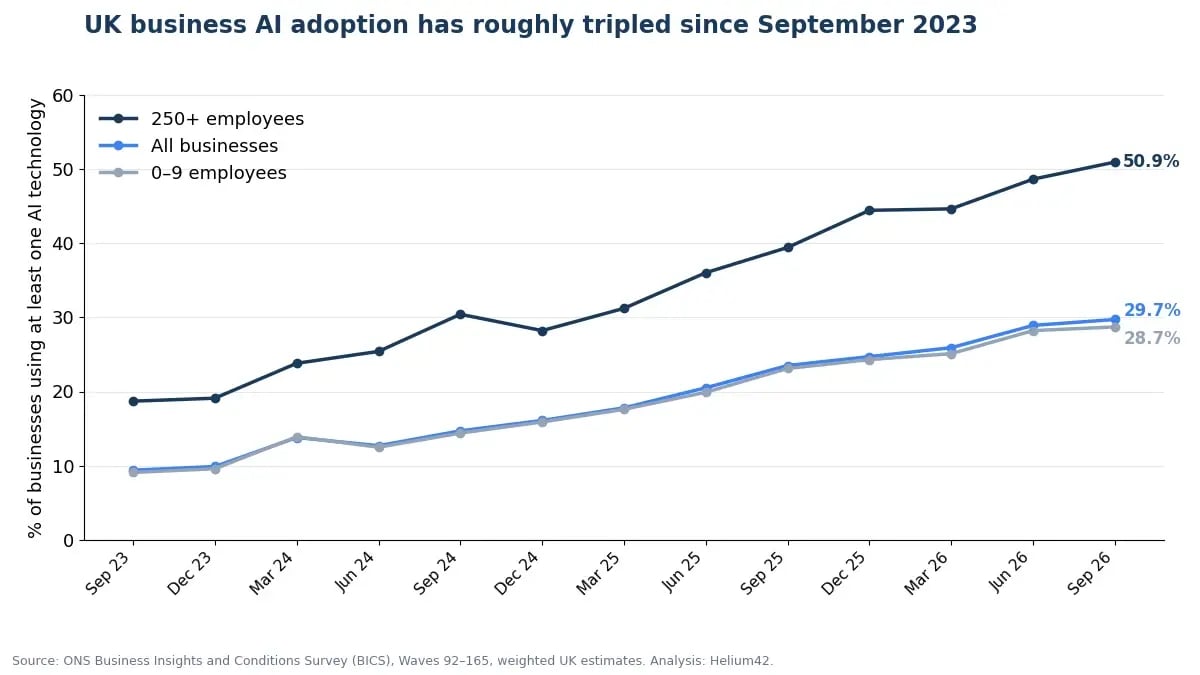
Figure 1. Share of UK businesses using at least one AI technology, 13 quarterly waves. Source: ONS BICS; analysis by Helium42.
The year-on-year change is real. Adoption rose from 23.5% in September 2025 to 29.7% in September 2026, a rise of 6.2 points, which is well outside the margin of error of plus or minus 2.8 points on the all-business estimate.
The quarter-on-quarter change is not. Between June 2026 (28.9%) and September 2026 (29.7%) adoption moved by 0.8 points, comfortably inside the margin of error. Statistically, the latest quarter was flat, so we do not describe adoption as accelerating; the data do not support that claim. The series has paused before, between March 2024 (13.8%) and June 2024 (12.7%), before resuming its climb.
| Wave (fielded) | All businesses | 0–9 employees | 10+ employees | 250+ employees | Construction | Information and communication | Professional, scientific and technical |
|---|---|---|---|---|---|---|---|
| 92 (Sep 2023) | 9.4 | 9.1 | 11.9 | 18.7 | 1.9 | 32.0 | 15.6 |
| 117 (Sep 2024) | 14.7 | 14.4 | 17.8 | 30.4 | 4.5 | 40.5 | 26.3 |
| 141 (Sep 2025) | 23.5 | 23.1 | 27.2 | 39.4 | 9.4 | 48.9 | 36.5 |
| 159 (Jun 2026) | 28.9 | 28.2 | 34.9 | 48.6 | 13.0 | 58.3 | 45.8 |
| 165 (Sep 2026) | 29.7 | 28.7 | 38.1 | 50.9 | 14.1 | 60.0 | 42.0 |
Source: Office for National Statistics, Business Insights and Conditions Survey, Waves 92 to 165, licensed under the Open Government Licence v3.0. "Using at least one AI technology" is derived by Helium42 as 100% minus "does not currently use" minus "not sure", which reproduces the ONS published figures. All 13 quarterly waves are in the downloadable report.
The gap between large and small businesses has more than doubled
Every size band has increased its use of AI since 2023, but larger businesses have moved further. Businesses with 250 or more employees went from 18.7% to 50.9%. Businesses with fewer than ten employees went from 9.1% to 28.7%. The gap between the two widened from 9.6 points in September 2023 to 22.2 points in September 2026.
This size-gap measure is our derived analysis of ONS data, not an ONS headline figure. It is robust: the 250+ band is a full census stratum with no sampling error, and the margin on the 0–9 band is plus or minus 3.1 points, far smaller than the 12.6-point widening.
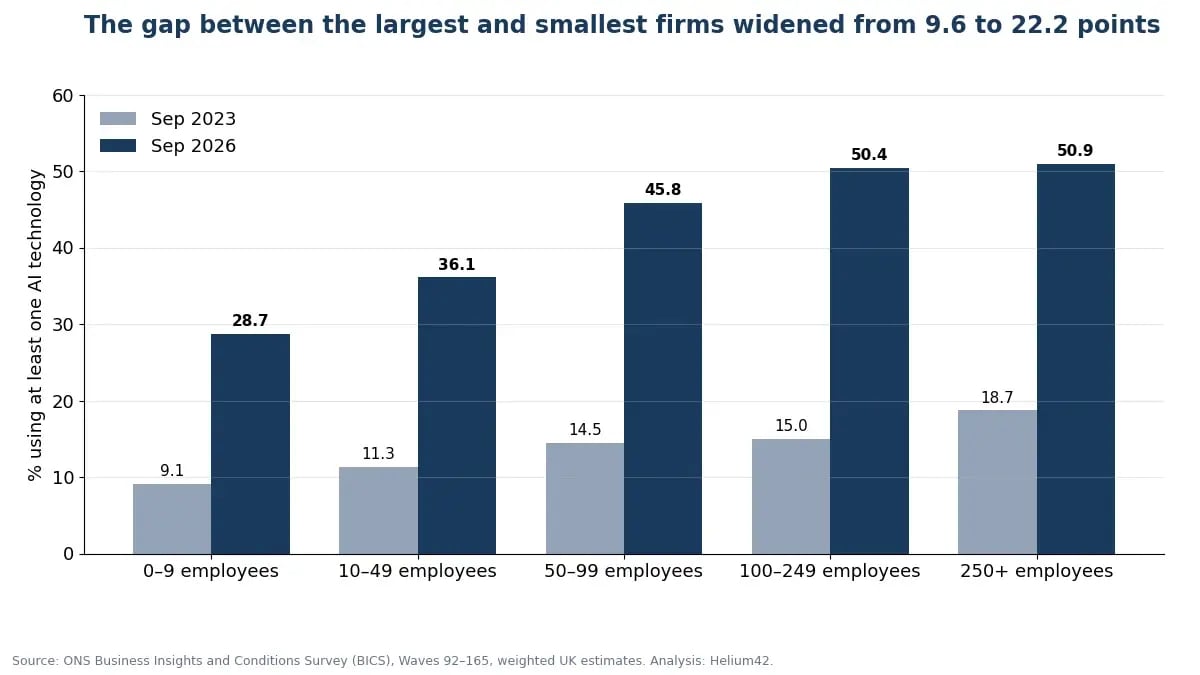
Figure 2. AI adoption by employee size band, September 2023 and September 2026. Source: ONS BICS; analysis by Helium42.
The middle of the market is where the picture has changed most. Businesses with 100 to 249 employees rose from 15.0% to 50.4%, and are now level with the largest firms. Businesses with 50 to 99 employees reached 45.8%, and those with 10 to 49 employees reached 36.1%. Across all businesses with ten or more employees, adoption stands at 38.1%.
AI adoption by industry: information and communication first, construction near the bottom
Industry differences are wide. In September 2026, 60.0% of information and communication businesses used AI, against 42.0% in professional, scientific and technical activities, 32.0% in wholesale and retail, 20.2% in manufacturing and 14.1% in construction. The all-business average was 29.7%.
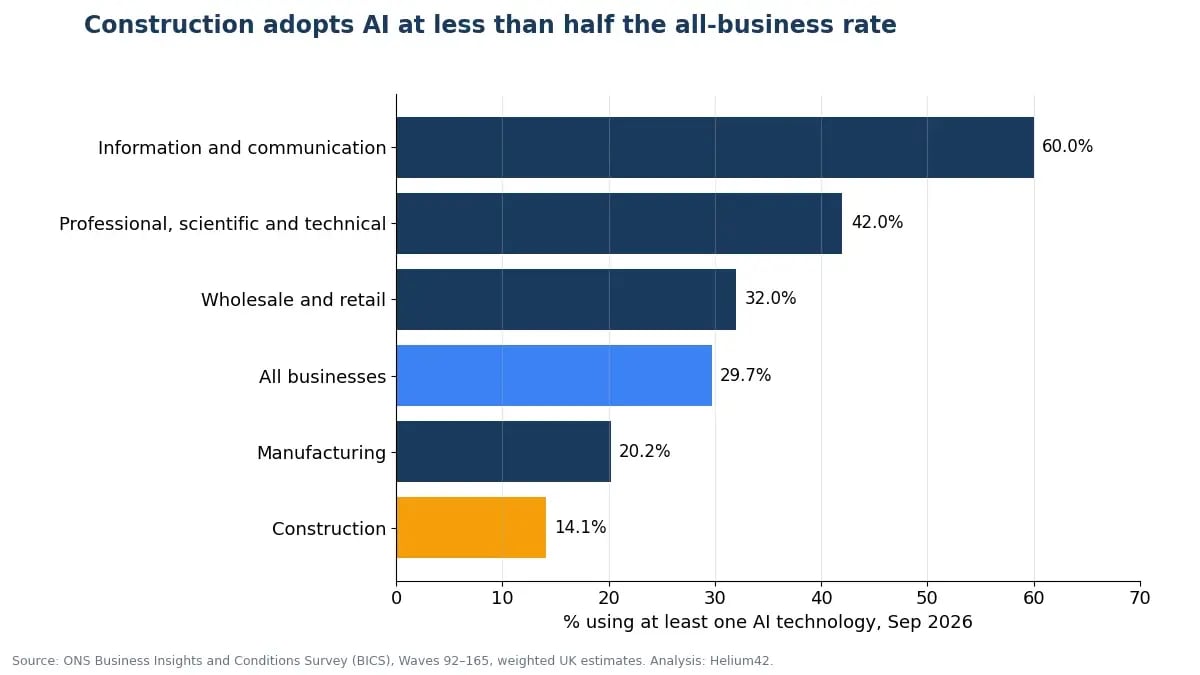
Figure 3. AI adoption by selected industry, September 2026. Source: ONS BICS Wave 165; analysis by Helium42.
Sector margins of error are wider than the national one, from plus or minus 5.9 points (construction, professional services) to 9.3 points (information and communication), so treat small quarterly movements with caution.
Construction has risen from 1.9% in September 2023 to 14.1%, yet 81% of construction businesses say they do not use AI (confidence interval 75% to 87%). It is among the lowest-adopting industries in the survey. Health and social work (13.1%) and other service activities (10.9%) have lower point estimates, but margins too wide to rank. For practical starting points in the sector, see our guide to free AI tools for construction estimating.
Professional, scientific and technical activities moved from 45.8% in June 2026 to 42.0% in September. That change is within the margin of error, so it is not a decline. Legal services sit inside this group and cannot be separated in the ONS data; our article on how UK law firms are adopting AI covers that sector in more detail.
Depth of use: broad adoption, shallow integration
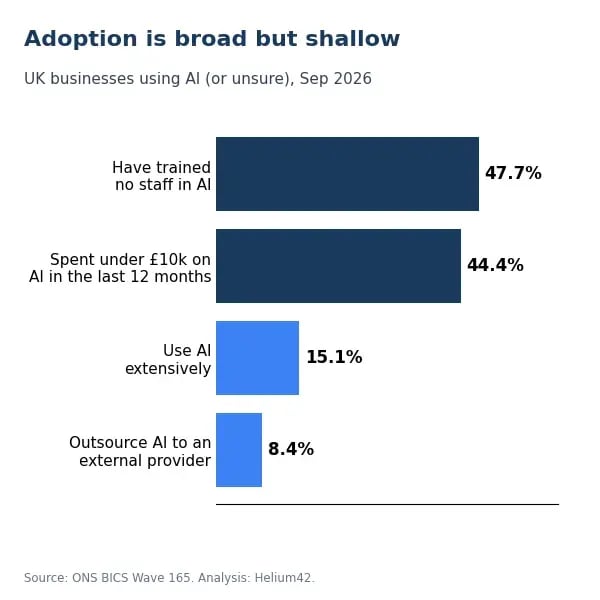
A business whose staff use a general-purpose chatbot and one that has rebuilt a core process around AI both count as users in the headline measure. Since June 2026, ONS has asked a separate question that tells them apart.
Among businesses using AI or unsure whether they do, 15.1% say they use it extensively and 61.4% on a limited basis. A further 2.2% use it only for testing or pilots, and 13.4% are not sure. In other words, roughly three in four businesses in this group use AI in a limited way or less.
The depth question has been asked in only two waves, so there is no trend to report yet. We will add one as further waves are published.
Training and investment remain modest
Training. Among businesses using AI or unsure, 47.7% have trained none of their staff in its use. Among businesses with ten or more employees the figure is 33.9%, and a further 22.3% of that group are not sure whether anyone has been trained. Our {a('/blog/ai-skills-gap-uk-2026', 'analysis of the UK AI skills gap')} and our guide to AI training for business look at this in more depth.
Investment. Among businesses using AI or unsure, 44.4% invested less than £10,000 in adopting AI in the last 12 months, 32.7% invested nothing, and 17.6% were not sure. Only 3.9% invested between £10,000 and £49,999; ONS suppresses the higher bands for this group because the counts are small. Among businesses with ten or more employees, 35.0% invested less than £10,000, 23.4% invested nothing and 7.8% invested between £10,000 and £49,999; only 1.1% invested £500,000 or more.
These are the figures that replace the average spend we withdrew. Business AI investment in the UK is, for the large majority, small and incremental.
How businesses adopt AI and what holds them back
Most businesses adopt AI through software they buy or tools that are free. Among businesses using AI or unsure (respondents could choose more than one route):
- 45.3% adopted it through purchased, ready-to-use software;
- 41.2% used free-to-use software;
- 14.7% developed it in-house;
- 8.4% outsourced it to external providers, rising to 14.6% among businesses with ten or more employees.
As an AI consultancy, we note the last figure plainly: only a minority of businesses buy external help with AI. Most are working it out with the tools in front of them.
When ONS asks all businesses what has prevented or delayed AI adoption in the last three months, the most common answers are lack of AI expertise (9.3%), lack of trust in the safety or transparency of AI products (9.2%), cost (7.7%), security concerns (6.8%) and difficulty identifying use cases (6.2%). Almost half of businesses (49.0%) say nothing has prevented or delayed them, and 21.8% have not attempted to use AI. Among businesses with ten or more employees, expertise (13.7%) and cost (11.5%) are cited more often.
Earlier versions of this page claimed that more than 60% of businesses cite a skills gap as their primary barrier; nothing in the ONS data supports a figure of that size. Trust and security, meanwhile, are governance questions as much as technical ones; our AI governance readiness benchmark sets out how prepared UK organisations are to answer them.
Workforce effects among businesses with ten or more employees
Among businesses with ten or more employees that use AI or are unsure, administrative and clerical roles are the most affected (37.9%), followed by creative or design roles (24.1%) and data analysis roles (21.9%).
Effects on headcount are small so far. In the same group, 60.2% report no change in overall headcount because of AI, and 5.8% report a reduction. ONS suppresses the share reporting an increase because the count is too small to publish. On this evidence, AI is changing the content of jobs, particularly administrative work, faster than it is changing the number of them.
Return on investment: what the official data cannot tell you
BICS measures whether businesses use AI, how, and at what cost. It does not measure whether AI pays back. Commercial surveys fill that gap, but with different samples and definitions, so they are not comparable with the ONS series.
One such survey is useful if read with its scope. In a survey of 500 senior decision-makers in UK businesses, conducted by Censuswide and commissioned by the product studio Studio Graphene, 31% of businesses using AI said they had seen any positive return on their investment. The findings were reported by Consultancy.uk on 18 March 2026. The survey was vendor-commissioned and covers businesses that already use AI, not all UK businesses, so the 31% is not a national rate.
To set and measure your own return, see our guides to building an AI business case and to sequencing the work with an AI implementation roadmap.
What the data means for UK mid-market leaders
The figures do not prescribe a strategy, but five practical points follow from them.
Benchmark against your size band, not the national average. The 29.7% headline is pulled down by the large number of micro-businesses. For a business of 50 to 99 people the relevant comparison is 45.8%; at 100 to 249 people it is 50.4%.
Treat depth, not access, as the real gap. With 61.4% of users working with AI on a limited basis, the useful question is which processes AI has actually changed, and whether anyone measures the result.
Train before you scale. Among businesses with ten or more employees that use AI or are unsure, 33.9% have trained no staff in it. Untrained use tends to stay limited and feeds the trust and security concerns cited as barriers.
Size the first step to the evidence. Most businesses spend less than £10,000 a year on AI. Published UK market prices for external AI discovery work run from £1,000 to £10,000, and for pilots from £5,000 to £35,000, according to our UK AI Consultancy Price Index. The two data sets are consistent with each other; we draw no causal link between them. A bounded discovery or pilot, with success measures agreed in advance, is a proportionate way to move beyond limited use.
Address trust and security early. They are easier to resolve before use spreads than after; a short usage policy and clear rules on data handling remove much of the uncertainty.
If you would like to discuss what these findings mean for a business of your size and sector, we are happy to talk it through. Contact the Helium42 team and we will arrange a conversation; there is no obligation.
Method and limitations
This tracker uses the ONS Business Insights and Conditions Survey, which ONS publishes as official statistics in development under the Open Government Licence v3.0. The AI questions run quarterly, in the September, December, March and June waves; there have been 13 AI waves since Wave 92 in September 2023. All figures are weighted estimates. Please read them with the following points in mind.
- Derived measure. ONS does not publish a single "uses at least one AI technology" column. We derive it as 100% minus "does not currently use" minus "not sure". This reproduces the ONS published figures exactly, for example 29.7% for all businesses (published as 30%) and 60.0% for information and communication (60%).
- Margins of error. ONS publishes confidence intervals on the "does not use" estimate, which we use as a proxy for uncertainty in adoption. Half-widths for September 2026 are plus or minus 2.8 points for all businesses, 2.0 for 10+ employees and 3.1 for 0–9 employees; sector half-widths are wider. The 250+ band is a full census stratum, so it carries no sampling error. We describe a change as real only when it clearly exceeds these margins.
- Response. BICS is voluntary, and the response rate is about 26%.
- Coverage. The survey covers the private sector only. It excludes agriculture, finance and insurance, energy, public administration, and public education and health. Construction, retail and services cover Great Britain; production industries cover the UK.
- What it measures. Use of at least one AI technology; not the return on it, and depth only since June 2026.
- Legal services cannot be separated; they sit within professional, scientific and technical activities.
- Exclusions. We omit the ONS regional AI tables (unweighted) and single-wave values for education, health and real estate (too noisy).
The size-gap calculation, the selection of findings and the commentary are Helium42 analysis of ONS data. They are not ONS statements.
Download the tracker and next update
UK AI Adoption Tracker (PDF). All 13 quarterly waves, every chart, the full method and the correction notice.
No email required.
Next update. ONS fields its next AI wave in mid-December 2026, with publication expected around early January 2027. We refresh this tracker after each AI wave, in January, April, July and October.
Frequently asked questions
What share of UK businesses use AI?
According to the Office for National Statistics Business Insights and Conditions Survey, 29.7% of UK businesses used at least one AI technology in September 2026, up from 9.4% in September 2023. Among businesses with 10 or more employees the figure was 38.1%, and among businesses with 250 or more employees it was 50.9%.
Is AI adoption in UK businesses still accelerating?
The data do not show acceleration. The year-on-year rise, from 23.5% in September 2025 to 29.7% in September 2026, is larger than the margin of error and is real. The latest quarter, from 28.9% in June 2026 to 29.7% in September 2026, sits within the margin of error of plus or minus 2.8 points, so adoption was flat over that quarter.
Which UK industries use AI the most and the least?
Information and communication businesses have the highest adoption, at 60.0% in September 2026, followed by professional, scientific and technical activities at 42.0%. Construction is among the lowest at 14.1%, and 81% of construction businesses say they do not use AI. Estimates for some smaller sectors, such as health, are too uncertain to rank reliably.
How much do UK businesses spend on AI?
Most spend very little. Among businesses using AI or unsure whether they do, 44.4% invested less than £10,000 in AI in the last 12 months and 32.7% invested nothing. Among businesses with 10 or more employees, 7.8% invested between £10,000 and £49,999. These figures replace the average spend figure published in earlier versions of this page, which we have withdrawn.
What stops UK businesses from adopting AI?
Among all businesses, the most common factors that prevented or delayed AI adoption in the last three months were lack of AI expertise (9.3%), lack of trust in AI products (9.2%), cost (7.7%) and security concerns (6.8%). Almost half of businesses (49.0%) said nothing had prevented or delayed them. Among businesses with 10 or more employees, expertise (13.7%) and cost (11.5%) were cited more often.
Why was this page corrected?
Earlier versions of this page (April to October 2026) carried adoption, spend and return on investment figures that we could not verify against any primary source. We withdrew them on 1 November 2026 and rebuilt the page on official ONS data. If you cited a figure from the earlier version, please use the figures on this page instead.
Source: Office for National Statistics, Business insights and impact on the UK economy, 8 October 2026, and the accompanying BICS dataset, Wave 165 (21 September to 4 October 2026) and earlier waves. Contains public sector information licensed under the Open Government Licence v3.0. Analysis and commentary: Helium42. First published 1 April 2026; rebuilt on ONS data 1 November 2026.