
Published by

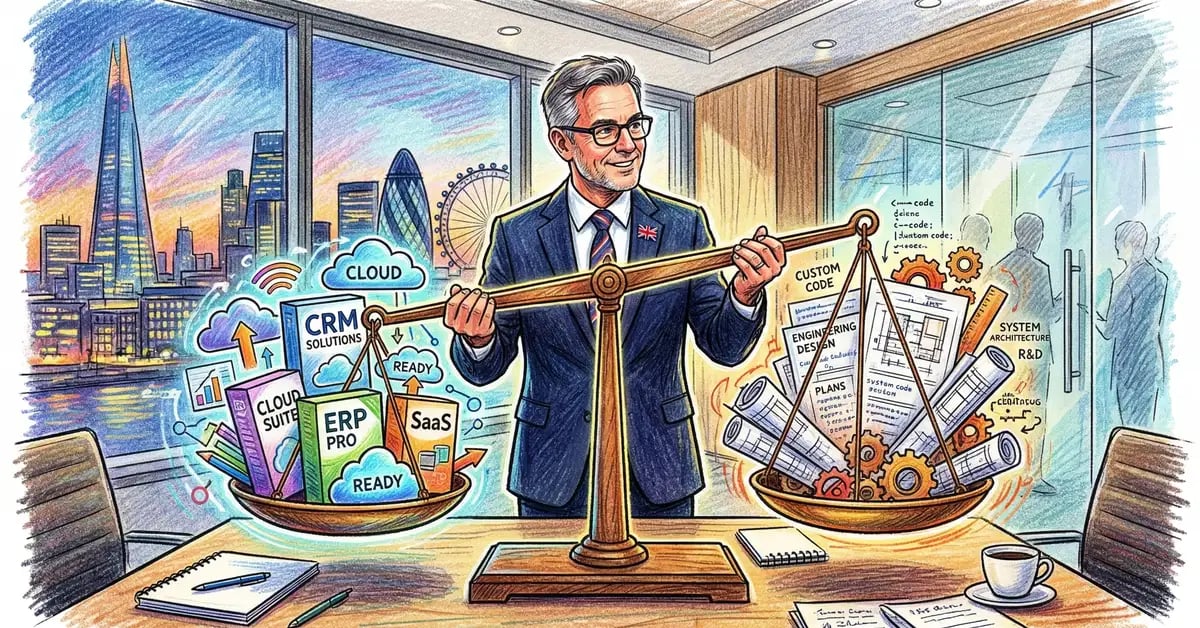
The build vs buy decision for AI is not a binary choice — it is a strategic sequencing question. UK mid-market businesses that purchase AI solutions from specialist vendors succeed approximately 67% of the time, compared with just 33% for purely internal builds, according to MIT research published in 2025. The most effective approach for organisations with 150 to 1,500 employees is a staged hybrid model: buy first to validate the business case, extend with custom layers, then build where genuine competitive advantage demands it. Helium42's implementation work with 500+ UK and European businesses consistently demonstrates that this "buy to learn, build to last" progression delivers sustainable ROI 60% faster than committing entirely to either path.
Key Takeaway
Do not treat build vs buy as an either/or decision. 65% of enterprises now deploy hybrid AI architectures combining commercial APIs with custom models. The right question is not "should we build or buy?" but "what should we buy first, and what should we build later?" Organisations following this staged approach achieve measurable ROI 60% faster than those jumping straight to custom development.
67%
Buy Success Rate
Vendor-led implementations
33%
Build Success Rate
Internal development only
65%
Hybrid Adoption
Enterprises using blended approach
60%
Faster ROI
Hybrid vs pure-build approaches
Sources: MIT/Fortune 2025, Gartner/Zartis 2025
Why the AI Build vs Buy Decision Is Different from Traditional Software
The build vs buy decision for AI differs fundamentally from traditional enterprise software procurement. With conventional software, requirements are well-understood, development timelines are predictable, and the technology stack is stable. AI introduces three complications that change the calculus entirely.
First, AI models degrade over time. Unlike traditional software that works until something breaks, AI systems experience data drift as the real-world patterns they were trained on change. Research from Coherent Solutions indicates that continuous model retraining consumes 22% more resources than the initial deployment. A custom-built sentiment analysis model trained on 2024 customer data may produce unreliable results by 2026 without ongoing investment in retraining infrastructure.
Second, AI talent commands a substantial premium. UK-based machine learning engineers earn £93,330 to £142,365 annually, with senior data scientists commanding £85,095 to £105,520, according to 2026 salary research from Alcor. A typical custom AI project requires two to three ML engineers, one to two data engineers, and one to two data scientists — representing £480,000 to £1,040,000 in salary cost full breakdown of AI development costs in the UKs alone for a six-to-twelve-month project, before infrastructure, training data, and overhead.
Third, 95% of enterprise AI pilot structured AI MVP development processs fail to deliver measurable returns. MIT's NANDA initiative documented that the vast majority of AI pilots stall and deliver little to no measurable impact on profit and loss statements. The core issue is not model quality but the "learning gap" — generic AI tools excel for individuals because of their flexibility, but they stall in enterprise contexts because they do not learn from or adapt to organisational workflows.
These three factors mean that the build vs buy decision for AI carries higher stakes, greater uncertainty, and more hidden costs than any equivalent technology procurement choice. Organisations that treat it like a standard software evaluation frequently underestimate the ongoing commitment required for either path.
The True Cost of Building Custom AI
Custom AI development costs vary significantly based on complexity, but most UK mid-market organisations underestimate the total investment required. Building a custom AI solution is not a one-time project — it is an ongoing operational commitment that compounds over multiple years.
| Complexity Tier | Examples | Development Cost | Annual Maintenance |
|---|---|---|---|
| Basic | Chatbots, recommendation engines, sentiment analysis, basic predictive analytics | £20,000–£80,000 | £3,000–£20,000 (15–25%) |
| Advanced | Customer segmentation, workflow automation, fraud detection, computer vision | £50,000–£150,000 | £7,500–£37,500 (15–25%) |
| Enterprise Custom | Trading platforms, predictive maintenance, medical diagnosis, bespoke NLP | £100,000–£500,000+ | £15,000–£125,000 (15–25%) |
Sources: Coherent Solutions 2026, McKinsey maintenance cost analysis
The figures above represent development costs only. A realistic three-year total cost of ownership for an advanced custom AI project (£150,000 initial build) includes annual maintenance at 15–25% of initial cost, infrastructure at £30,000 to £100,000 monthly, model retraining cycles, and talent retention. Multi-year TCO frequently reaches £1.5 to £2.5 million for a single custom solution.
Infrastructure costs deserve particular scrutiny. GPU compute for model training and inference is expensive whether hosted on cloud or on-premises. However, Lenovo's 2026 TCO analysis demonstrates that on-premises deployment achieves breakeven within four months for high-utilisation workloads, with five-year costs of approximately £663,000 compared with £6.2 million for equivalent AWS cloud infrastructure. For organisations committed to sustained, high-volume AI workloads, on-premises infrastructure offers dramatic cost advantages — but requires significant upfront capital expenditure that most mid-market businesses cannot justify for initial AI implementations.

The True Cost of Buying AI Solutions
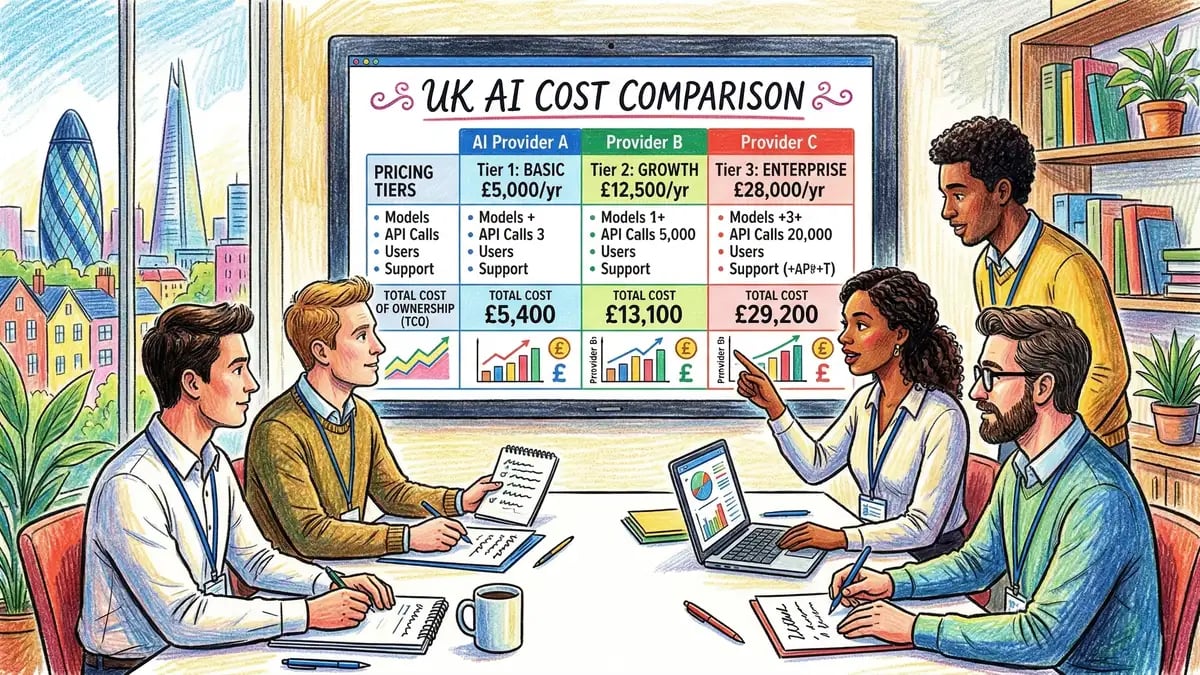
Purchasing AI solutions eliminates upfront development costs but introduces different financial dynamics that UK businesses must understand. The headline licensing or subscription fee represents less than 40% of actual implementation costs for most AI purchases.
SaaS pricing has become increasingly volatile. Average SaaS spend per employee reached £6,110 in 2025, representing 12.5% of total organisational expenditure, according to the 2026 SaaS Management Index. Major vendors have introduced AI features bundled into existing plans at 10–20% price premiums regardless of whether customers use the functionality. For a UK mid-market business with 500 employees, this translates to approximately £3 million in annual SaaS expenditure — with AI-related price increases adding £300,000 to £600,000 annually whether the features are fully adopted or not.
Hidden Costs of Buying AI
Integration and customisation: Enterprise organisations report that integration costs frequently equal or exceed software licensing fees. A 2023 Forrester study found that average mid-sized enterprises spend approximately £250,000 annually on SaaS customisations across their technology stack.
Vendor lock-in: Switching providers requires 6–12 months of replatforming effort and substantial financial investment. Once dependent on a vendor's AI infrastructure, the cost of migrating data, retraining staff, and rebuilding integrations creates a material barrier to changing course.
Pricing escalation: SaaS pricing increased approximately 11.4% year-over-year in 2025, compared with 2.7% general market inflation. Organisations committing to vendor AI solutions face compounding costs that erode initial ROI projections over three to five years.
Consumption-based pricing models create additional budgeting challenges. Microsoft Copilot costs $30 per user per month (requiring existing Microsoft 365 licensing). Salesforce Agentforce charges $2 per conversation. OpenAI charges per token, with pricing varying by model tier. These variable costs make it difficult to predict monthly AI expenditure as adoption scales across an organisation.
When Building Custom AI Is the Right Decision
Custom AI development is justified when specific conditions are met. Building makes strategic sense in the following scenarios, each of which Helium42 has observed across implementation engagements with UK mid-market businesses.
Proprietary Data Creates Competitive Advantage
When your organisation possesses unique datasets — customer behaviour patterns, industry-specific compliance records, proprietary operational data — that no vendor solution can replicate. A logistics company with 15 years of route optimisation data has a genuine competitive moat that justifies custom model development.
Regulatory Requirements Demand Full Data Control
Financial services firms, healthcare organisations, and government contractors handling sensitive data may require complete data residency control that vendor solutions cannot guarantee. Custom development ensures data never leaves your infrastructure, with custom access policies and full audit trail ownership.
Vendor Solutions Meet Less Than 60% of Requirements
KPMG's 2026 decision framework recommends buying when vendor solutions meet more than 80% of needs. Below this threshold — particularly below 60% — the customisation effort to bridge the gap often exceeds the cost of building purpose-built systems from the outset.
AI Is Core to Your Business Strategy, Not a Support Function
When AI capabilities represent your primary product or service differentiation — not merely an efficiency tool — custom development ensures you control the roadmap. A fintech building AI-driven risk assessment as its core product needs to own that technology entirely.
Source: KPMG Agentic AI Untangled 2026
Even when these conditions are met, Helium42 advises most organisations to validate the business case with a purchased solution before committing to a full custom build. The 33% success rate for internal builds underscores why proving the use case first — even imperfectly — reduces risk substantially.
Need help deciding whether to build or buy? Helium42's AI Development Services include decision framework workshops that map the optimal path for your specific requirements.
Explore AI Development ServicesWhen Buying AI Solutions Is the Right Decision
Purchasing pre-built AI delivers faster time-to-value and lower implementation risk for the majority of use cases. Vendor solutions typically achieve deployment within 3 to 9 months compared with 12 to 24 months for custom development, according to HP's 2026 enterprise AI framework. For organisations in competitive industries where speed matters, this timeline difference is often decisive.
Buying is the right decision when the AI application addresses a commodity problem — one that many organisations face and where vendor solutions have been validated across hundreds of similar deployments. Customer service automation, CRM-integrated lead scoring, marketing content generation, and financial forecasting all fall into this category. When competitors have access to the same tools, the competitive advantage comes from implementation quality and organisational adoption, not from the underlying AI technology.
Buying is also appropriate when your organisation lacks internal AI expertise. Only 7% of UK businesses pursue AI through strategic enterprise-wide plans, according to SAP and Oxford Economics research. For the 93% operating without a mature AI strategy, building custom solutions before understanding how AI integrates into business workflows is premature. Purchased solutions provide the practical experience needed to make informed build decisions later.
Finally, buying suits organisations that need to demonstrate AI value quickly to stakeholders. Board members and investors increasingly expect AI competence from leadership teams. A well-implemented purchased solution delivering measurable results within six months builds the organisational confidence and executive support needed for larger AI investments — including potential custom development — further down the line.
The Hybrid Approach: Buy to Learn, Build to Last
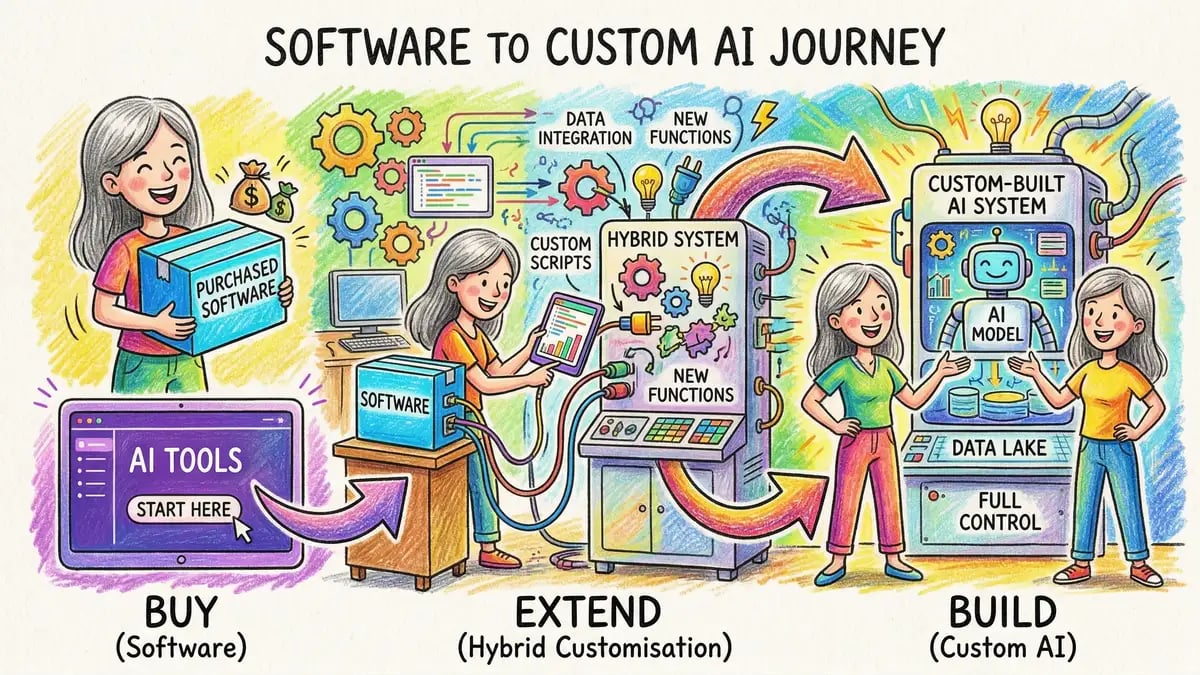
The most effective strategy for UK mid-market businesses combines purchased and custom AI capabilities in a staged progression. Gartner research indicates that 65% of enterprises now deploy hybrid AI architectures, and Forrester documents that this approach achieves sustainable ROI 60% faster than pure-build strategies. Helium42's three-phase maturity framework structures this progression for practical implementation.
| Phase | Approach | Timeline | What Happens |
|---|---|---|---|
| Experiment | Buy off-the-shelf | 4–8 weeks | Purchase pre-built AI capabilities to validate business cases and build internal confidence. Aim for proof-of-value, not perfection. Helium42 pilots typically achieve measurable outcomes within 6–8 weeks. |
| Extend | Hybrid customisation | 3–6 months | Combine vendor APIs with orchestration layers and lightweight customisation. Connect AI to proprietary CRM, ERP, or data systems. Apply prompt engineering and fine-tuning for improved accuracy on company-specific use cases. |
| Evolve | Strategic custom build | 6–18 months | Develop custom-built systems addressing strategic priorities where proprietary data and unique business logic create genuine competitive advantage. Internal teams now have the AI literacy and operational experience to execute effectively. |
This progression works because each phase reduces risk for the next. The Experiment phase validates whether AI solves the business problem at all — answering the "should we invest" question before committing £500,000+ to custom development. The Extend phase reveals which specific capabilities require customisation beyond vendor defaults, providing precise requirements for any eventual custom build. The Evolve phase benefits from organisational AI maturity built through the first two phases, significantly increasing the likelihood of successful custom development.
A practical example illustrates the hybrid approach. A mid-market financial services firm might begin by purchasing an AI-powered customer support tool, achieving 30% reduction in call handling time within weeks (Experiment phase). The firm then connects the tool to its proprietary CRM, retrains responses on company-specific FAQs, and builds custom reporting dashboards (Extend phase). After 12 months of validated AI value and internal capability building, the firm develops a proprietary risk assessment model trained on its unique transaction data — creating genuine competitive differentiation that no purchased tool could replicate (Evolve phase).
Helium42's Build vs Buy Decision Framework
Based on implementation experience with 500+ UK and European organisations, Helium42 has developed a practical scoring framework that maps organisations to the right approach. The framework evaluates five critical dimensions, each scored from 1 (strongly favours buying) to 5 (strongly favours building).
| Dimension | Buy Signal (Score 1–2) | Build Signal (Score 4–5) | Weight |
|---|---|---|---|
| Competitive Differentiation | AI supports operations (HR, finance, marketing tools) | AI is the core product or primary differentiator | 30% |
| Data Sensitivity | Standard business data, vendor compliance acceptable | Highly sensitive IP, regulated data, full residency required | 25% |
| Internal AI Capability | No ML engineers, limited data science experience | Established data team, ML engineering experience, infrastructure in place | 20% |
| Time-to-Value Pressure | Need results within 3–6 months, competitive urgency | 12–24 month horizon acceptable, strategic long-term play | 15% |
| Budget Availability | Under £100k for AI initiative, payback required within 12 months | £500k+ available, willing to invest for 18–24 month payback | 10% |
Score interpretation: A weighted score of 1.0–2.5 points strongly toward buying. A score of 2.5–3.5 indicates the hybrid approach is optimal (buy first, then build selectively). A score of 3.5–5.0 supports building custom solutions, provided the organisation has validated the use case through a pilot first. Most UK mid-market organisations score between 1.5 and 3.0, confirming that buying or hybrid approaches are appropriate for the majority.
Risk Assessment: What Can Go Wrong with Each Approach
Understanding failure modes helps organisations mitigate risk regardless of which path they choose. Both approaches carry distinct risks that require proactive management.
Build Risks
Timeline overrun: Initial 12-month estimates routinely expand to 18–24 months due to underestimated data preparation (68% of organisations underestimate these costs), integration complexity, and evolving requirements.
Talent retention: UK ML engineers commanding £100k–£160k annually are frequently targeted by larger competitors. Losing a key engineer mid-project can set development back by months.
Technology obsolescence: Rapid AI model advancement means custom systems built on specific architectures may become outdated within 12–18 months, requiring continuous platform investment.
Buy Risks
Vendor lock-in: Once dependent on a vendor's infrastructure, switching requires 6–12 months of replatforming and substantial investment. Data portability limitations compound the problem.
Pricing escalation: With SaaS pricing increasing 11.4% year-over-year versus 2.7% market inflation, multi-year AI vendor commitments face compounding cost increases that erode projected ROI.
Differentiation erosion: When competitors access identical tools, AI becomes a cost of doing business rather than a competitive advantage. Organisations relying solely on purchased AI risk strategic commoditisation.
UK regulatory considerations add a further dimension. The UK Data and AI Ethics Framework requires organisations to maintain appropriate transparency, fairness, and accountability in AI systems — obligations that apply equally to built and bought solutions. Under UK GDPR, organisations must complete Data Protection Impact Assessments before processing personal data through AI, regardless of whether the system is custom or vendor-supplied. For organisations building custom solutions, this means embedding compliance into system design. For those buying, it requires rigorous vendor due diligence and contractual protections.
ROI Measurement: How to Know If You Made the Right Decision
Only 31% of UK businesses using AI report achieving positive ROI, according to Consultancy.uk research. Less than half can define what success looks like when implementing AI. This measurement gap affects both build and buy approaches — organisations that cannot define success metrics before implementation have no basis for evaluating outcomes afterwards.
Effective ROI measurement requires establishing baseline metrics before implementation across four dimensions: efficiency gains (labour time freed multiplied by fully loaded labour cost), revenue generation (incremental revenue from AI-enabled capabilities), risk mitigation (reduced probability of adverse outcomes multiplied by financial impact), and business agility (faster decision-making and market responsiveness). Helium42's implementation methodology includes pre-engagement baseline measurement across all four dimensions, ensuring organisations can quantify AI impact precisely.
When AI implementations do succeed, the financial returns are substantial. SAP research indicates that average UK business AI investment generates 17% returns currently, forecast to reach 32% by 2027. Deloitte documents cost reductions of 20–30% and revenue improvements of 10–15% in successful implementations. Independent Forrester research commissioned by Writer documented 333% ROI over three years for enterprise AI implementations that followed structured methodology.
Making the Decision: A Practical Checklist
For UK mid-market businesses preparing to make the build vs buy decision, the following checklist distils the framework into actionable steps. This checklist reflects the key decision criteria identified by KPMG, Gartner, and Helium42's own implementation experience.
Define the Business Problem First, Not the Technology
What specific business outcome do you need? What does success look like in measurable terms? If you cannot articulate the problem and success criteria clearly, you are not ready for either build or buy.
Audit Your Data Readiness
Is your data clean, accessible, and representative? Data quality is the most common bottleneck for both approaches. If data preparation will take months, start there before committing to any AI investment.
Run the Scoring Framework
Score your organisation on the five dimensions above (competitive differentiation, data sensitivity, internal capability, time pressure, budget). Let the weighted score guide your approach rather than assumptions or vendor pressure.
Start with a Pilot, Regardless of Direction
Whether you lean toward building or buying, validate the business case with a focused pilot first. Helium42's pilot engagements typically deliver proof-of-value within 6–8 weeks at £15,000–£25,000 — a fraction of the cost of committing to a full build or enterprise licence.
Plan for the Full Lifecycle, Not Just Launch
Calculate three-year TCO, not first-year costs. Include maintenance (15–25% annually for custom), pricing escalation (11.4% annually for SaaS), retraining cycles, and change management. The right decision at year one may be the wrong decision at year three.
Frequently Asked Questions
How much does it cost to build custom AI versus buying an off-the-shelf solution?
Custom AI development ranges from £20,000 for basic solutions to £500,000+ for enterprise-grade systems, with annual maintenance adding 15–25% of the initial cost. Purchased AI solutions typically cost £10,000–£150,000 in implementation plus ongoing licensing. Three-year total cost of ownership for custom solutions frequently reaches £1.5–£2.5 million when accounting for talent, infrastructure, and maintenance — though organisations with high-volume, sustained workloads can achieve significant cost advantages through custom on-premises deployment.
How long does it take to implement custom AI compared to buying a solution?
Purchased AI solutions typically deploy within 3–9 months, with focused implementations achieving initial results in 4–8 weeks. Custom AI development requires 6–24 months from initiation to production deployment. Helium42's pilot engagements demonstrate proof-of-value within 6–8 weeks using purchased or hybrid approaches, allowing organisations to validate the business case before committing to longer custom development timelines.
What is the success rate for building AI internally versus buying from vendors?
MIT research documents that organisations purchasing from specialist vendors succeed approximately 67% of the time, compared with 33% for purely internal builds. The primary failure factor for internal builds is the "learning gap" — enterprise AI requires organisational adaptation, not just technical capability. Organisations following a hybrid "buy to learn, build to last" approach achieve sustainable ROI 60% faster than those committing entirely to custom development.
Can we start by buying AI and switch to building later?
Yes — this is the recommended approach for most UK mid-market businesses. The hybrid maturity model begins with purchased solutions to validate business cases (Experiment phase), progresses to vendor APIs combined with custom layers (Extend phase), then transitions to strategic custom development where competitive advantage demands it (Evolve phase). This staged progression reduces risk, builds organisational AI literacy, and ensures custom development investment targets genuinely differentiating capabilities.
What are the main risks of vendor lock-in with purchased AI?
Vendor lock-in creates three primary risks: pricing escalation (SaaS pricing increased 11.4% year-over-year in 2025), switching costs (6–12 months of replatforming effort), and data portability limitations. Organisations can mitigate these risks through contractual protections (price caps, data portability clauses, termination assistance), multi-vendor strategies that avoid dependence on a single provider, and ensuring data remains accessible in standard formats regardless of the vendor relationship.
How do UK data protection regulations affect the build vs buy decision?
UK GDPR requires Data Protection Impact Assessments before processing personal data through any AI system, whether custom-built or purchased. Custom solutions provide complete data residency control and audit trail ownership. Purchased solutions require vendor due diligence on data processing practices, infrastructure location, and international data transfer mechanisms. The UK's pro-innovation regulatory approach applies existing laws through sector regulators rather than creating blanket AI-specific regulation, making compliance achievable through either approach with appropriate governance frameworks.
Ready to Make the Right Build vs Buy Decision?
Helium42 helps UK mid-market businesses navigate the build vs buy decision with structured frameworks, pilot programmes, and end-to-end implementation support. Our 500+ client engagements deliver proven 40% efficiency gains in 6–8 weeks.
Peter Vogel
AI Transformation Strategist, Helium42
Peter leads Helium42's AI implementation practice, helping UK and European businesses navigate the build vs buy decision through structured frameworks and pilot programmes. With experience across 500+ client engagements, he specialises in translating AI capability into measurable business outcomes.
generative AI development services
machine learning development services
running an AI proof of concept
evaluating AI development partners
enterprise AI application development
selecting an AI software development agency