
Published by

34%
of UK organisations have active generative AI projects in production, yet 60–70% of custom development opportunities remain untapped by mid-market firms.
Generative AI has moved from research novelty to business reality. According to McKinsey's State of AI research, most organisations have experimented with ChatGPT or Claude. But off-the-shelf models handle only 60–70% of real-world use cases. The remaining 30–40% require domain-specific customisation, integration with proprietary data, or AI agents that can reason across multiple business systems. This is where generative AI development services come in. This guide walks you through the scope, costs, and strategic choices for custom generative AI projects in the UK mid-market.
What Are Generative AI Development Services?
Generative AI development services cover the full spectrum of custom AI projects: from bespoke chatbots and content generation systems to AI-powered document processing, reasoning agents, and end-to-end automation workflows. Unlike off-the-shelf solutions, custom development tailors AI systems to your specific business data, compliance requirements, and operational workflows.
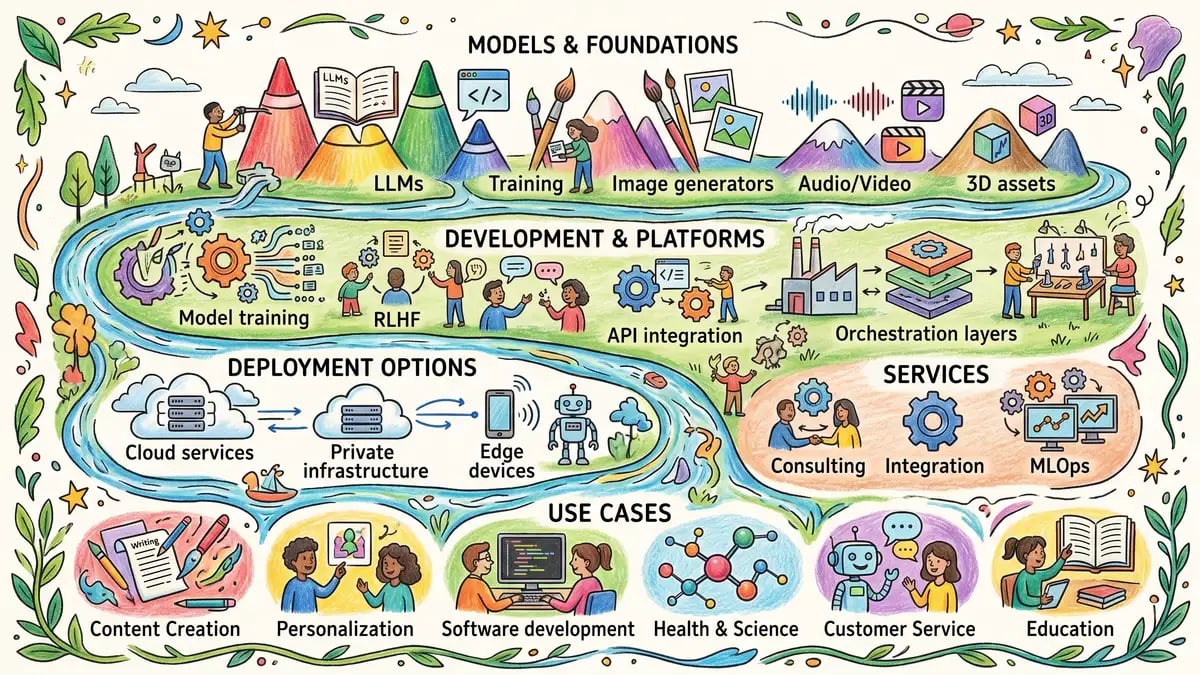
Key service categories include:
- LLM Integration & Customisation: Fine-tuning models on proprietary data, prompt engineering for domain-specific tasks, and API integrations with ChatGPT, Claude, Gemini, or open-source alternatives.
- RAG (Retrieval-Augmented Generation): Systems that retrieve relevant context from your data before generating responses, ensuring accuracy and up-to-date knowledge without retraining.
- Document Processing: Automated extraction, classification, and analysis of unstructured documents (PDFs, contracts, invoices, emails).
- AI Agents: Multi-step autonomous systems that reason across tools and data sources—e.g., a sales agent that retrieves customer data, generates proposals, and logs interactions.
- Content Generation at Scale: Automated production of product descriptions, marketing copy, social media content, or internal documentation.
- Knowledge Graphs & Semantic Search: Graph-based systems that model relationships between entities and enable intelligent search and discovery.
The common thread: all require domain expertise, architectural design, and integration work—not just prompt tinkering.
Why Custom Generative AI Development Matters
Off-the-shelf AI tools like ChatGPT or Copilot deliver broad capability at low cost. But they fall short in mission-critical scenarios:
- Data Privacy & Compliance: Public APIs may log your inputs; custom deployments can run on-premise, in a VPC, or with data isolation guarantees.
- Domain Specificity: Generic models lack specialised knowledge (e.g., legal precedent, medical terminology, engineering standards). Fine-tuning or RAG adds precision.
- Integration Complexity: Real business workflows require connecting AI to CRMs, ERPs, document stores, and communication platforms—beyond a chatbot UI.
- Cost Efficiency at Scale: High-volume use cases (processing 10,000+ documents/month) become expensive on pay-per-API-call models; custom solutions with on-premise inference cost less per transaction.
- Audit & Explainability: Regulated industries (finance, healthcare) demand traceability of AI decisions. Custom systems can log reasoning, retrieval sources, and confidence scores.
According to Forrester's 2024 enterprise AI research, 63% of UK companies cite data governance and privacy as the top barrier to scaling AI. Custom development solutions directly address this constraint.
Scope of Generative AI Development Projects
Project scope varies dramatically based on use case, complexity, and integration depth. Here is a realistic breakdown:
Small Pilot (4–8 weeks, £20,000–£50,000)
Typical scope: Single use case, limited data volume, proof-of-concept validation.
- Discovery workshop (2–3 days) to define problem, data requirements, and success metrics.
- Build a prototype RAG system or fine-tuned model on sample data.
- Integrate with one data source or API (e.g., internal knowledge base, Slack).
- Deploy to a test environment; evaluate accuracy, latency, and cost.
- Deliverables: working prototype, cost model, roadmap for production.
When to choose: Proof-of-concept, exploring feasibility, or validating ROI before larger investment.
Medium-Scale Deployment (12–24 weeks, £100,000–£250,000)
Typical scope: Production-ready system, multiple use cases, moderate integration.
- Architecture & design phase (3–4 weeks): define data pipelines, model selection, and integration points.
- Build core AI system: RAG pipeline, fine-tuning, or agentic workflows.
- Integrate with 2–4 business systems (CRM, ERP, document store, analytics).
- Implement monitoring, logging, and cost optimisation.
- User testing, feedback loops, and iterative refinement.
- Deliver production-ready system with runbooks and support handoff.
When to choose: Solving a critical business problem, justifiable ROI, or departmental scale (one team, 1,000–10,000 transactions/month).
Enterprise Transformation (24–52 weeks, £500,000+)
Typical scope: Organisation-wide platform, multiple departments, significant change management.
- Multi-phase roadmap: discovery (4–6 weeks), foundation (8–12 weeks), expansion (12–16 weeks), optimisation (4–8 weeks).
- Build a reusable AI platform (APIs, SDKs, fine-tuning infrastructure) used by multiple teams.
- Integrate with 5+ critical systems (ERP, CRM, HRIS, document management, business intelligence).
- Establish governance, compliance, and risk frameworks.
- Change management: training, documentation, and post-launch support (3–6 months).
- Ongoing platform optimisation and model refinement.
When to choose: Digital transformation, competitive advantage, or significant operational efficiency gains (100+ FTE impact).
Cost Breakdown for Generative AI Development
Cost drivers in custom AI projects typically include:
Discovery & Architecture (10–15% of total cost)
- Stakeholder interviews & workshops: Understand business goals, data availability, technical constraints.
- Data audit: Assess data quality, completeness, and readiness (often reveals data silos or compliance gaps).
- Model & architecture selection: Choose between fine-tuning, RAG, agentic workflows, or hybrid approaches based on use case and cost sensitivity.
- Proof-of-concept: Validate model performance on sample data before full build.
Core AI Development (40–50% of total cost)
- Model development & fine-tuning: Curating training data, training runs, hyperparameter tuning, evaluation.
- RAG pipeline engineering: Building retrieval indexes, prompt chains, context window optimisation.
- Integration layer: APIs, middleware, data pipelines to connect AI to business systems.
- Testing & evaluation: Unit tests, integration tests, performance benchmarking, bias & safety testing.
Infrastructure & Operations (15–25% of total cost)
- Infrastructure setup: Cloud compute (GPU instances for inference), databases, vector stores, API gateways.
- Monitoring & logging: Model performance dashboards, cost tracking, error handling.
- Security & compliance: Encryption, access controls, audit logs, GDPR/FCA compliance automation.
- Deployment & scaling: CI/CD pipelines, containerisation, auto-scaling policies.
Change Management & Training (10–15% of total cost)
- User training and documentation.
- Change communication and stakeholder alignment.
- Post-launch support (6–12 weeks).
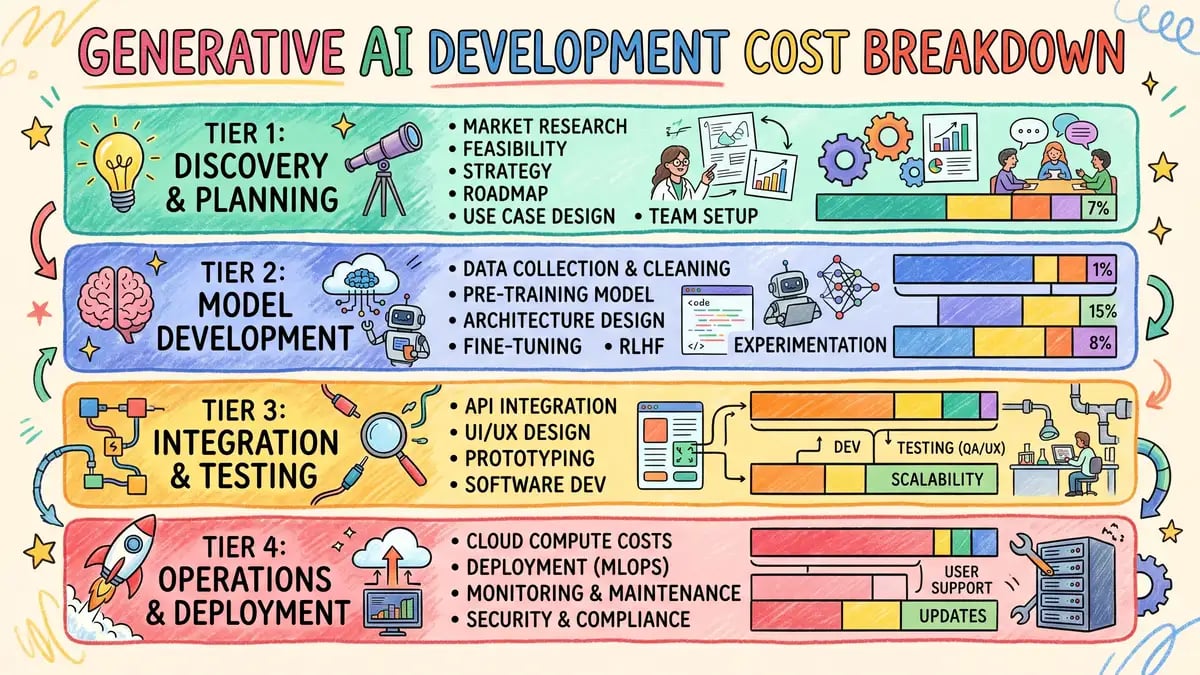
Ongoing costs (post-launch, typically 20–30% of Year 1 cost annually):
- API/inference costs (if using hosted models like ChatGPT or Anthropic Claude).
- Infrastructure and compute (on-premise or cloud).
- Model retraining and fine-tuning (as new data or use cases emerge).
- Maintenance and bug fixes.
- Continuous monitoring and optimisation.
Real-world example: A mid-market legal firm spent £180,000 building an AI-powered contract analysis system (12 weeks). Discovery and architecture cost £18,000; core development £90,000; infrastructure and deployment £45,000; training and handoff £27,000. Post-launch, they run approximately £12,000/year in inference and cloud costs, and allocate £20,000/year for model refinement. ROI: The system saves 5 hours/week per paralegal (£120,000 annual savings across the team), yielding breakeven within 18 months and £360,000+ net benefit over 3 years.
Key Decisions in Custom Generative AI Projects
Several strategic choices shape cost, timeline, and outcome:
1. Model Selection: Proprietary vs. Open-Source
- Proprietary (ChatGPT, Claude, Gemini): Latest capabilities, strong out-of-the-box performance, lower upfront engineering cost. Ongoing API/licensing costs; data may be logged by providers (check their terms).
- Open-Source (Llama 2/3, Mistral, Phi): Full control, no per-request fees, can run on-premise for data privacy. Requires more engineering (deployment, fine-tuning, security hardening); often lower performance without fine-tuning.
- Hybrid: Use open-source for non-critical tasks, proprietary models for reasoning-heavy or novel tasks, or use proprietary for development, open-source for cost-optimised production.
2. Deployment Model: Cloud vs. On-Premise vs. Hybrid
- Cloud-Hosted (AWS, Azure, GCP): Scalable, minimal ops burden, integrates with cloud-native stacks. Higher per-transaction costs; potential latency if data residency is a concern.
- On-Premise: Maximum control and data privacy, lower long-term costs at high transaction volumes. Higher upfront infrastructure investment, ops complexity, and liability.
- Hybrid/Edge: Sensitive inference on-premise, non-sensitive workloads in the cloud; edge devices for real-time use cases.
3. Build vs. Buy vs. Partner
- Build: Full custom development. Highest control and differentiation; longest timeline and highest cost.
- Buy (Platforms): SaaS platforms with AI features (e.g., Salesforce Einstein, HubSpot AI tools). Faster to value, lower cost, less customisation flexibility.
- Partner: Work with a specialist vendor or consulting firm. Recommended for most mid-market firms—balances speed, cost, and risk.
4. Fine-Tuning vs. RAG vs. Agentic Workflows
- Fine-Tuning: Train the model on your domain data. Expensive (requires GPUs and expertise), slower to iterate, but yields highest accuracy for narrow tasks.
- RAG (Retrieval-Augmented Generation): Retrieve relevant context from your data and feed it to a pre-trained model. Cheaper, faster to build, excellent for knowledge-based tasks; requires good data indexing and retrieval logic.
- Agentic Workflows: AI agents that orchestrate multiple steps (retrieve data, call APIs, refine answers). Most flexible; requires thoughtful API design and error handling.
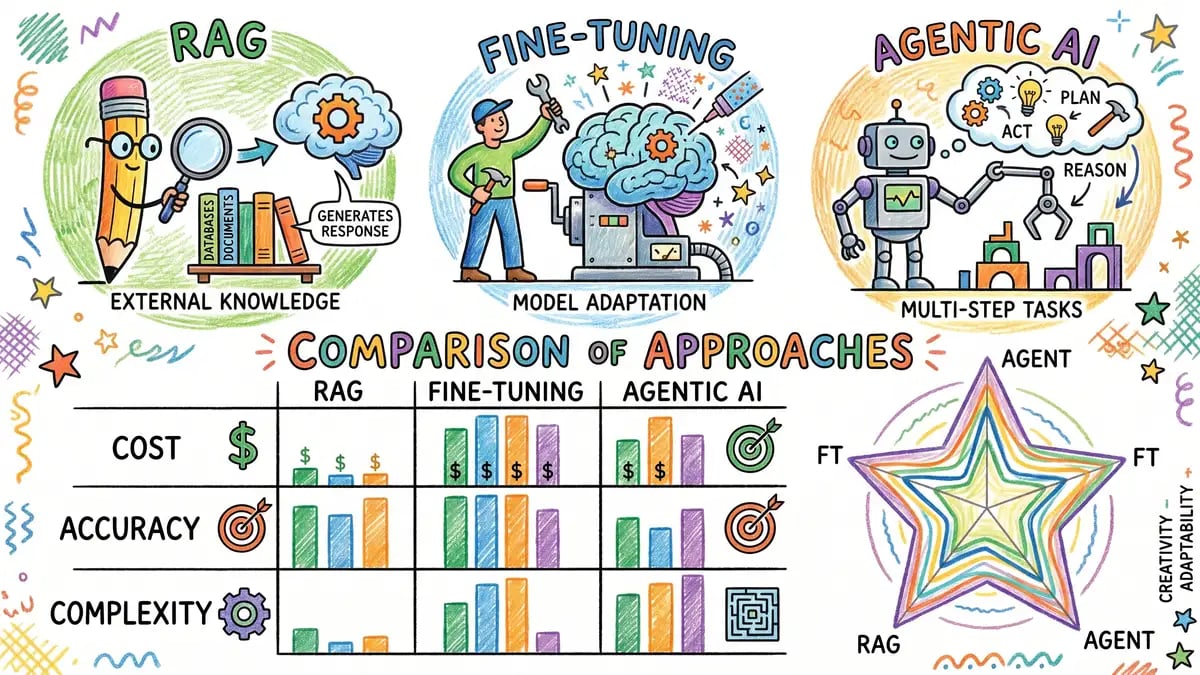
Most mid-market projects start with RAG: it offers a good balance of cost, speed, and effectiveness. Fine-tuning and agentic workflows are added later if needed.
Evaluating AI Development Partners
If you're considering working with an external partner (consultant, agency, or vendor), here's what to look for:
- Domain Expertise: Do they understand your industry's compliance, data, and workflow constraints? Ask for case studies or references in your vertical.
- Technical Depth: Can they explain the difference between RAG, fine-tuning, and agentic systems? Do they have experience with both proprietary and open-source models? Can they architect for scale and cost efficiency?
- Delivery Rigor: Do they follow a structured discovery process? Can they articulate a phased roadmap? Do they include testing, monitoring, and post-launch support?
- Data & Privacy Practices: How do they handle sensitive data? What compliance frameworks do they follow (GDPR, FCA, ISO 27001)? Do they offer on-premise or VPC-isolated deployments if needed?
- Cost Transparency: Can they provide realistic estimates and break down costs by phase? Watch for "variable scope" or lack of clear milestones—common red flags.
- References & ROI Evidence: Ask for customer testimonials and measurable outcomes (accuracy improvements, cost savings, time saved). Be sceptical of generic success stories.
Getting Started: A Roadmap for Decision-Makers
If you're considering custom generative AI development, here is a practical next step roadmap:
Phase 1: Opportunity Assessment (1–2 weeks, internal)
- Identify high-impact use cases (e.g., document processing, customer service, content generation, data analysis).
- Estimate potential ROI: How much time would automation save? What is the hourly cost per employee?
- Assess data readiness: Is your data organised, accessible, and of sufficient quality?
- Understand constraints: Security, compliance, budget, timeline, and internal capability gaps.
Phase 2: Partner Selection & Scoping (2–3 weeks)
- Shortlist 2–3 potential partners (consultants, agencies, or vendors) based on domain expertise and delivery track record.
- Conduct discovery workshops with each partner to refine scope and validate approach.
- Evaluate proposals against the criteria above (domain expertise, technical depth, delivery rigor, cost transparency).
- Negotiate a pilot or phased approach to limit risk.
Phase 3: Pilot or Proof-of-Concept (4–12 weeks)
- Start with a narrow, high-confidence use case to validate the approach and build internal momentum.
- Define clear success metrics (accuracy, speed, cost, user adoption).
- Include your team in development to build internal capability and understanding.
- Plan the transition to production: runbooks, training, ongoing support.
Phase 4: Production Deployment & Scaling (12+ weeks)
- Expand to additional use cases or departments based on PoC learnings.
- Invest in governance, monitoring, and continuous improvement.
- Plan for post-launch support, retraining, and optimisation cycles.
Conclusion: Is Custom Generative AI Development Right for You?
Custom generative AI development is justified when:
- Off-the-shelf tools do not meet your requirements (domain specificity, data privacy, integration complexity).
- The use case has clear ROI and can justify the investment (cost savings, revenue, risk reduction).
- Your data is reasonably mature and accessible for training or retrieval.
- You have the budget and timeline to execute a phased approach.
If your situation aligns with the above, the next step is to assess specific use cases, identify a partner with domain expertise, and scope a proof-of-concept to validate feasibility and ROI before larger investment.
At Helium42, we help mid-market firms assess whether custom generative AI development makes sense, scope a PoC, and build a roadmap to production.