
Published by

90%
of AI projects never progress beyond proof of concept to production deployment. Understanding the full development lifecycle is the first step to beating those odds.
Artificial intelligence projects look deceptively straightforward from the boardroom. Build a model, deploy it, capture the business value. In reality, the AI development lifecycle bears little resemblance to traditional software development. It is longer, more iterative, more dependent on data quality, and far more prone to failure at the transition from experiment to production. Research from McKinsey's State of AI report confirms that most organisations still struggle with operationalising AI beyond initial experimentation.
This comprehensive guide walks you through every phase of the AI development lifecycle—from problem definition through post-deployment monitoring. Whether you are planning your first AI project or scaling your third, understanding these phases will help you avoid the pitfalls that cause 90 percent of AI initiatives to stall at proof of concept.
What Is the AI Development Lifecycle?
The AI development lifecycle is a structured process for taking an organisation from identifying an AI opportunity through to building, deploying, and maintaining a machine learning system in production. Unlike traditional software development—where requirements are fixed upfront and the primary variables are engineering complexity and team velocity—AI projects operate under fundamentally different constraints.
In traditional software development, you define requirements, build to those requirements, test against them, and deploy. In AI development, the requirements are often discovered iteratively. You begin with a business problem, collect and explore data, experiment with models, and only then understand what is achievable and what will actually drive business value.
This difference explains why AI projects are 2–3 times longer than comparable software projects, why they consume more budget, and why so many organisations underestimate the effort required. A traditional mobile app might take 6–12 months from conception to launch. A production AI system at a mid-market organisation typically takes 12–18 months, with small focused pilots completing in 3–4 months and complex enterprise deployments extending to 24 months or beyond.
Understanding this lifecycle is not merely academic. It directly influences how you staff your team, allocate budget, set expectations with stakeholders, and govern the risk as your model moves from the lab to production.
The Seven Phases of AI Development
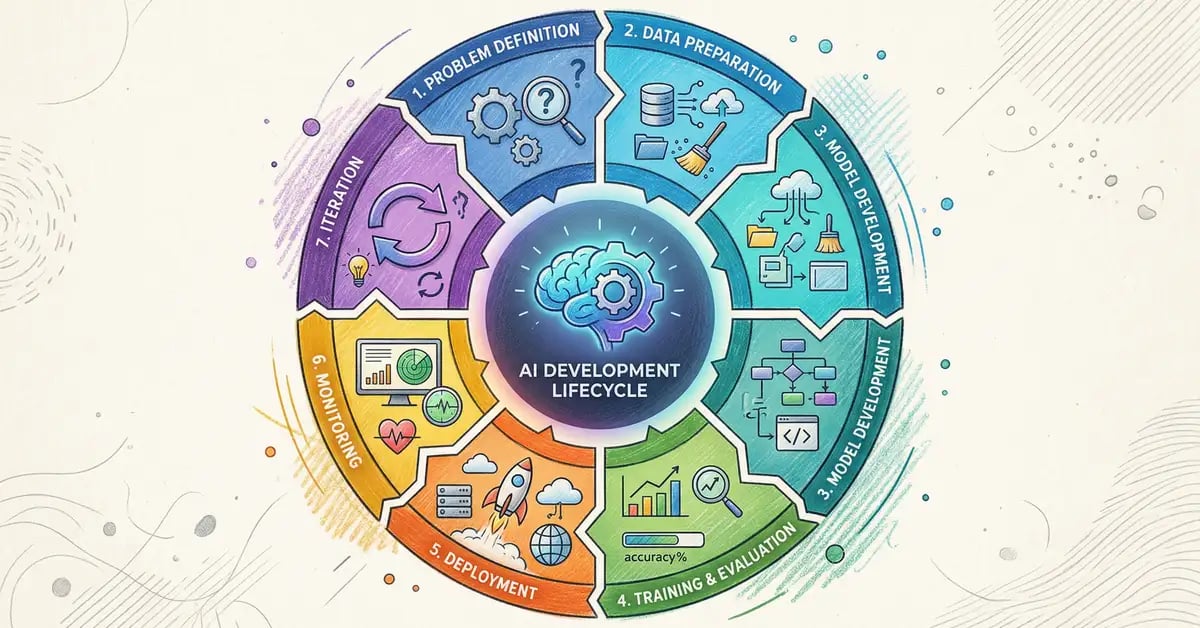
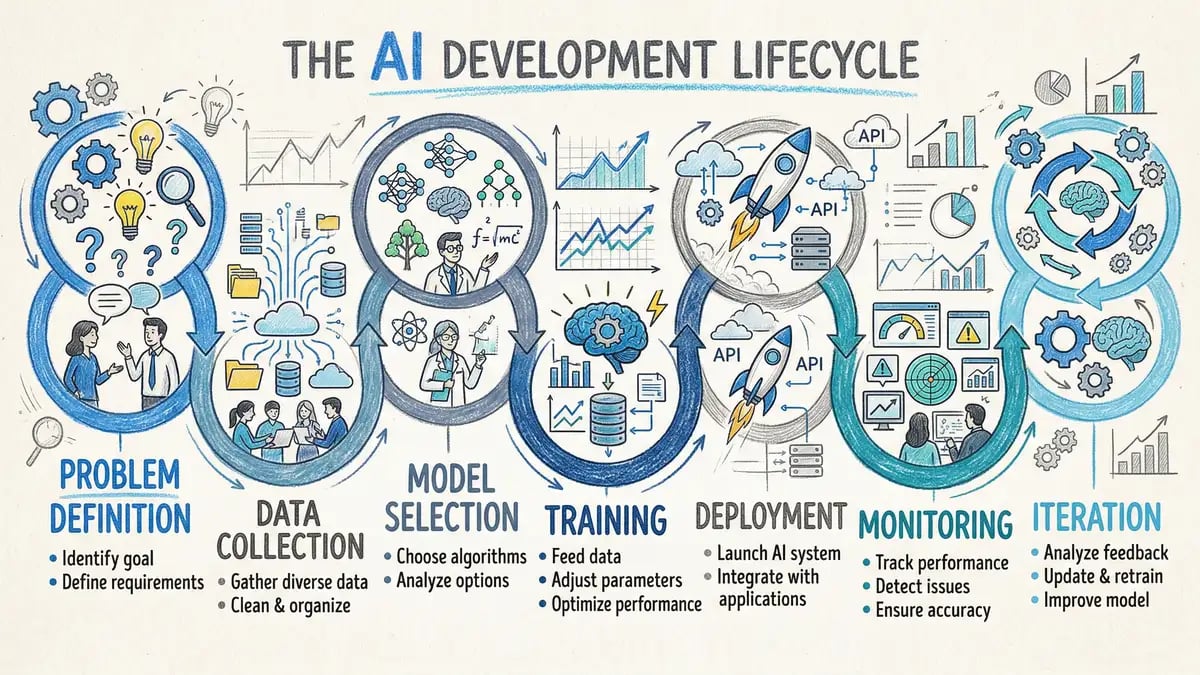
The AI development lifecycle can be divided into seven distinct phases. Each has different objectives, risk profiles, and resource requirements. Understanding this progression is critical for realistic planning and governance.
| Phase | Duration | Key Deliverable |
|---|---|---|
| Problem definition & business alignment | 2–4 weeks | Scope document, success metrics |
| Data collection & preparation | 8–16 weeks | Clean, labelled training dataset |
| Model selection & architecture | 2–6 weeks | Approved technical approach |
| Training, testing & evaluation | 4–12 weeks | Model meeting acceptance criteria |
| Deployment & integration | 6–12 weeks | Model running in production |
| Monitoring & maintenance | Ongoing | Performance dashboards, alerts |
| Iteration & retraining | Ongoing | Updated models, improved accuracy |
Across mid-market organisations in the UK, the full lifecycle from problem definition to stable production typically requires 12–18 months. However, this is highly variable depending on data availability, complexity, and organisational maturity.
Phase 1: Problem Definition and Business Alignment
Most AI initiatives fail not because of technical shortcomings, but because the problem was never properly defined. This first phase is where clarity is established around what you are trying to solve, why it matters, and how you will measure success.
During problem definition, you work with business stakeholders to articulate the challenge. Is this about automating a manual process? Improving forecast accuracy? Enhancing customer segmentation? Each of these requires different data, different model types, and different deployment patterns.
Equally important is establishing success metrics before you build anything. If your goal is to reduce customer churn, you must define what a successful model looks like: Is it a 5 percent improvement in retention rates? A 10 percent reduction in churn velocity? These metrics anchor all subsequent decisions about data collection, model selection, and evaluation.
Key Takeaway
Spend 2–4 weeks on problem definition. This phase is where stakeholder alignment happens. Without it, you risk building a technically perfect model that solves the wrong problem.
Phase 1 also establishes resource commitments, project sponsorship, and governance structures. Who owns the business outcome? Who will be accountable for model performance in production? What is the decision-making cadence? These organisational questions matter as much as the technical architecture.
Phase 2: Data Collection and Preparation
Here is where the work truly begins. Between 60 and 80 percent of AI project effort is consumed by data collection, cleaning, labelling, and validation. This single fact is the most commonly underestimated aspect of AI development and the primary driver of project delays.
Many organisations begin with inadequate data. You may have transaction logs, customer records, or sensor data, but they are often inconsistent, incomplete, or poorly labelled. Before any model training can happen, this data must be brought into a usable state.
Data preparation involves several interconnected activities:
- Collection: Gathering data from disparate systems—CRM platforms, databases, cloud storage, APIs. This often requires custom integration work.
- Cleaning: Handling missing values, removing duplicates, standardising formats, and correcting known errors.
- Labelling: If your model is supervised learning (most classification and regression tasks are), you need labelled examples. A model to predict customer churn needs historical data marked as "churned" or "retained". This labelling is frequently done manually and is both expensive and time-consuming.
- Validation: Ensuring the data is representative, balanced, and free of bias. A training dataset that over-represents one customer segment will produce a model that performs poorly for others.
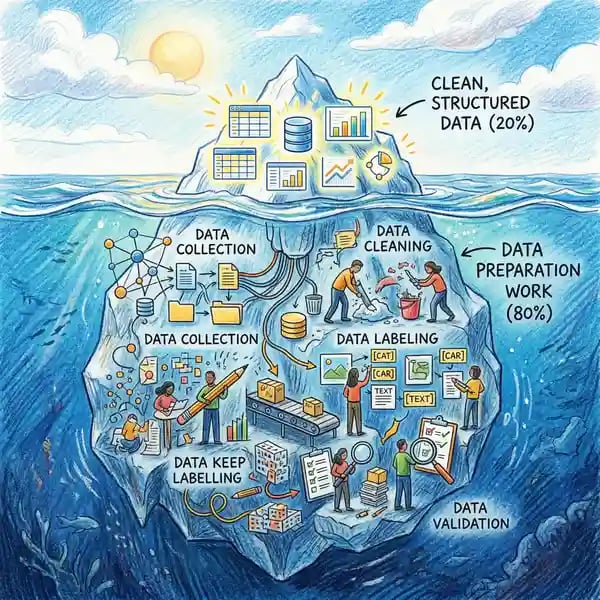
The data preparation phase is where many mid-market organisations underestimate effort by 200–300 percent. What looks like "we have the data, let us build the model" often translates to months of cleaning, validation, and integration work. External data sources—industry benchmarks, demographic data, market signals—may also need to be sourced and integrated, further extending this phase.
A critical output from this phase is a data dictionary and governance framework. What does each field mean? Where does it come from? How frequently is it updated? How will you maintain data quality once the model is in production? These questions must be answered before model development begins.
⚠ Warning
Do not underestimate data labelling. If your dataset requires manual labelling and you have 100,000 records with a labelling cost of £1 per record, you are looking at £100,000 in labelling costs alone. Budget accordingly and consider whether synthetic data or transfer learning approaches might reduce this burden.
Phase 3: Model Selection and Architecture
Once you have clean, labelled data, you must decide what type of model or approach best suits your problem. This is less about choosing between "neural networks" and "random forests" and more about understanding the trade-offs between different methodologies.
For many mid-market organisations beginning their AI journey, the decision is simpler: build a custom model versus use a pre-built solution. This is the build versus buy decision for AI. A pre-built model—such as a large language model for document classification or a commercial fraud detection system—can be deployed within weeks. A custom model requires months of training and validation but may perform better on your specific use case.
Common architectural choices for mid-market AI projects include:
- Traditional machine learning: Gradient boosting, logistic regression, decision trees. Fast to train, interpretable, suitable for structured data.
- Transfer learning: Starting with a pre-trained model (from ImageNet, BERT, etc.) and fine-tuning it on your data. Reduces training time significantly.
- Retrieval-augmented generation (RAG): Combining a large language model with your proprietary data to answer domain-specific questions. Popular for customer service, knowledge management. See our guide on generative AI development services for a deeper exploration of these approaches.
- Fine-tuned language models: Taking a foundation model like GPT-4 or a smaller open-source model and training it on your domain-specific data. Organisations pursuing this route often benefit from custom AI solutions tailored to their specific domain and data.
- Agentic systems: Models that can iterate, call tools, and make decisions autonomously. More complex but increasingly common for automation.
Model selection should be driven by your data, your use case, and your operational constraints. Do you need real-time inference? Explainability? The ability to run offline? Each architectural choice has implications for deployment, monitoring, and ongoing maintenance.
Phase 4: Training, Testing, and Evaluation
Once the architecture is approved, the work of training and evaluating the model begins. This phase is iterative: train a model, evaluate its performance, adjust hyperparameters or features, and repeat until you have a model that meets your success criteria.
Model evaluation involves several types of testing:
- Validation set performance: Testing on data held out during training to estimate real-world accuracy.
- Business metric alignment: Does the model improve the metric you care about? If your goal is to reduce churn by 5 percent and the model only reduces it by 2 percent, it may not be worth deploying.
- Bias and fairness testing: Does the model perform equally well for all customer segments, geographies, or demographics? Biased models can damage reputation and create legal risk. The ICO's AI guidance sets clear expectations for fairness and transparency in automated decision-making.
- Edge case testing: How does the model perform on unusual or extreme inputs? A customer service chatbot trained only on common queries may fail spectacularly on rare or adversarial requests.
This phase typically takes 4–12 weeks depending on model complexity and the amount of iteration required. Many models are rejected or substantially revised during this phase because they fail to meet acceptance criteria. This is not a failure; it is a sign that the evaluation process is working.
Key Takeaway
A model that is 95 percent accurate but is inaccurate on 5 percent of transactions involving your highest-value customers is worse than a 90 percent accurate model that is evenly reliable across all segments. Precision on important subgroups matters more than overall accuracy.
A critical output from this phase is the model card—a document describing what the model does, how it was trained, its performance characteristics, known limitations, and recommendations for use. This becomes essential documentation for the operations team that will maintain the model in production.
Phase 5: Deployment and Integration
A model that works beautifully in a Jupyter notebook may be wholly inadequate for production. This phase bridges the gap between experiment and operational reality.
Deployment requires several components working in concert: the model itself, APIs that expose the model for prediction requests, infrastructure to serve those requests reliably, logging and monitoring, and rollback procedures if something goes wrong. Many organisations underestimate this phase because they conflate "model is ready" with "system is ready to deploy".
Common deployment patterns include:
- Batch prediction: Run the model on a scheduled basis (nightly, weekly) and store results in a database. Suitable for forecasting, scoring, and non-urgent applications.
- Real-time APIs: Expose the model through an API endpoint that applications call synchronously. Requires careful attention to latency, throughput, and error handling.
- Embedded models: Deploy the model directly in an application (on-device machine learning). Useful for mobile applications and offline scenarios.
- Streaming inference: Process data streams in real-time. Common in anomaly detection, fraud prevention, and monitoring applications.
Organisations that need to connect AI models with existing business systems should consider dedicated AI integration services to manage the complexity of enterprise deployment. This phase also involves testing in a production-like environment before full rollout. A/B testing is common: run the new model alongside the existing system or rule-based approach, and compare performance in production. This is often called a "champion-challenger" comparison and helps build confidence that the model genuinely performs better in the wild than in testing.
Many mid-market organisations find that the deployment and integration phase takes longer than the model development itself. Budget 6–12 weeks for this phase and ensure your infrastructure team is engaged early.
Phase 6: Monitoring, Maintenance, and Iteration
Once the model is in production, the work does not end. It has, in fact, fundamentally changed. During development, your focus was on accuracy and performance on historical data. In production, your focus shifts to ensuring the model continues to perform as expected and to detecting when it begins to drift.
Model drift occurs when the real-world data distribution changes in ways that were not present in the training data. A customer churn model trained on 2024 data might perform poorly in 2026 if customer behaviour has shifted due to market changes, competitor actions, or seasonal effects. Model drift is silent—your model is still running, still returning predictions, but those predictions are increasingly inaccurate. This is why monitoring is critical.
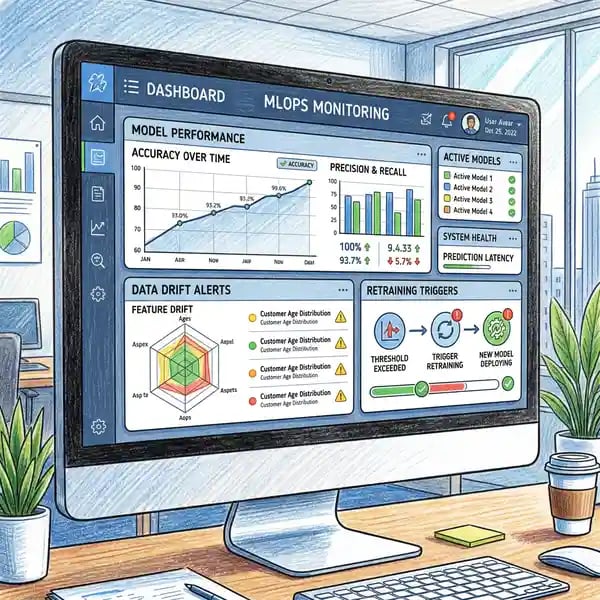
Effective production monitoring includes:
- Performance monitoring: Tracking accuracy, precision, recall, or business metrics over time. If accuracy drops below a threshold, alerts trigger for investigation and potential retraining.
- Data drift detection: Monitoring the statistical properties of input data to detect when new data looks significantly different from training data.
- Prediction drift: Tracking whether the distribution of model predictions is changing over time. Sudden shifts can indicate model drift or data quality issues.
- Infrastructure monitoring: Tracking latency, error rates, throughput, and resource utilisation. A degraded model is useless if the API serving it is timing out.
- Governance and audit logging: Recording all predictions for compliance, transparency, and debugging. The UK government's pro-innovation approach to AI regulation emphasises the importance of maintaining audit trails for AI systems.
Many organisations implement automated retraining pipelines. When performance metrics fall below a threshold, the system automatically retrains the model on recent data and deploys it if it meets acceptance criteria. This reduces the manual operational burden and keeps the model current.
The monitoring phase is often underestimated because it feels like overhead rather than value creation. In reality, the difference between a well-monitored model that you catch and fix when it drifts, versus a poorly-monitored model that slowly decays over months without anyone noticing, is substantial.
Phase 7: Iteration and Continuous Improvement
The final phase is not a discrete endpoint but an ongoing cycle. Once a model is in production and performing acceptably, the next phase of work is understanding how to improve it further.
Improvements come from several sources:
- Feature engineering: Discovering new input variables or combinations of variables that improve model performance.
- Data enrichment: Incorporating new data sources that provide additional signal.
- Model architecture changes: Experimenting with different algorithms or ensemble approaches.
- Addressing edge cases: Using production error logs to identify scenarios where the model fails and retraining to handle them better.
This cycle typically happens every 3–6 months, though frequency varies by use case and data volatility. The key is treating production models as living systems that require ongoing investment, not static artifacts that are "done".
Common AI Development Methodologies
Several formal methodologies exist for structuring AI projects. The most widely used is CRISP-DM, employed in approximately 60 percent of data science projects according to industry surveys.
CRISP-DM (Cross-Industry Standard Process for Data Mining) defines six phases: business understanding, data understanding, data preparation, modelling, evaluation, and deployment. It is iterative—you move forward but frequently loop back to earlier phases with new insights. CRISP-DM is particularly valuable for organisations with limited AI experience because it provides a clear structure and governance checkpoints.
MLOps methodologies focus on the production and operational side of AI. Rather than treating model development as a discrete project, MLOps treats it as a continuous process with automated testing, deployment, and monitoring. Google's MLOps framework outlines three maturity levels for automation and monitoring. This approach is increasingly common in organisations with mature AI practices and is essential for scaling from one or two models to dozens or hundreds.
Agile approaches adapt traditional Agile software development to AI, breaking the project into two-week sprints with regular retrospectives and adjustments. This works well for organisations with strong Agile cultures but requires discipline to avoid treating AI projects as traditional software projects.
Most mid-market organisations benefit from a hybrid approach: use CRISP-DM structure for problem definition, data preparation, and initial model development, then transition to MLOps practices once the model is in production. This balances the need for careful upfront planning with the flexibility to iterate and improve.
Where AI Projects Fail: The Five Critical Pitfalls
Ninety percent of AI projects never progress beyond proof of concept to production. The research reveals five consistent failure modes:
1. Underestimating data preparation (60–80 percent of effort): Projects run out of time or budget before they reach modelling because data work was underestimated. The fix: allocate 8–16 weeks to data collection, cleaning, and labelling. This is not padding; this is reality.
2. Unclear success metrics: The team builds a model that is technically sound but does not drive the business outcome because success was never clearly defined. The fix: before any code is written, articulate exactly how you will measure success. "Improved customer satisfaction" is not a metric. "Reduce average customer service response time by 20 percent" is.
3. The PoC-to-production gap: A proof of concept demonstrates promise but requires extensive engineering work to make it production-ready. The team assumes "the hard part is done" and allocates insufficient resources to deployment and integration. The fix: budget as much time for deployment and integration as for model development. Often more.
4. Model drift and silent failure: The model is deployed and runs unchanged for 12 months while its accuracy slowly decays. No one notices because monitoring was not implemented. The fix: implement monitoring and automated retraining from day one. This is not optional overhead; it is essential infrastructure.
5. Insufficient stakeholder alignment: The AI team builds something impressive from a technical perspective, but it does not fit the operational reality of how the business works. The fix: involve business stakeholders throughout the project, not just at the beginning and end. Get feedback during model development, not after deployment.
Avoiding these pitfalls requires discipline, realistic planning, and an organisational culture that understands AI development is fundamentally different from traditional software development. It also requires engaging the right partners. Many mid-market organisations lack the in-house AI expertise to navigate these challenges alone.
Need Help Navigating the AI Development Lifecycle?
Helium42 guides UK and European mid-market organisations through every phase—from problem definition to production monitoring. Our education-first approach means your team understands the process, not just the output.
Discuss Your AI Project →Frequently Asked Questions
Bringing It Together: A Framework for Success
Understanding the AI development lifecycle is the first step towards success. The second is applying this knowledge with realistic planning, appropriate resource allocation, and honest assessment of your organisation's readiness.
The most successful AI initiatives we see in mid-market organisations share several characteristics. First, they start small. Rather than attempting a complex enterprise-wide transformation, they pick a single high-impact use case and execute it well. Second, they invest heavily in data preparation upfront rather than pushing it to later phases. Third, they treat deployment and integration as equal in importance to model development. Fourth, they establish monitoring and governance before moving to production, not after. And fifth, they view the first production model as the beginning of a journey, not the end of a project.
For many mid-market organisations, engaging an external AI partner provides significant value not just for building the initial models, but for transferring knowledge to your team and establishing the processes and governance structures that will serve you as you scale. This AI implementation guide provides a deeper framework for planning your first AI project. We have also published detailed guides on AI development costs, building the business case for AI, and AI governance frameworks that complement this guide.
Research from the Alan Turing Institute's AI Standards Hub reinforces the importance of structured approaches to AI development. The organisations that are currently pulling ahead in AI are those that understood the development lifecycle early and planned accordingly. They are not building faster; they are building smarter. By allocating appropriate time and resources to each phase, monitoring the transition from experiment to production, and treating production models as sustained investments rather than one-off projects, they are capturing real business value from AI. This comprehensive understanding of the lifecycle is the foundation that separates successful AI implementations from the 90 percent that stall at proof of concept.
Your next step: Define your first AI use case using the framework in this guide. Identify which phase your organisation is currently in. Assess where the biggest risks and knowledge gaps lie. Then engage an AI consultancy or build the internal team needed to move forward with confidence. The difference between a well-executed AI initiative and a failed one often comes down to this: understanding the lifecycle and allocating resources accordingly. Now you understand the lifecycle. The execution is up to you.
proof of concept before full investment