

Published by

Application Layer Spending
£14.25 Billion
Global 2025
Coding AI Spend
£3 Billion
55% of departmental AI
UK Market Position
Third Largest
Global AI economy
Productivity Gain
+15%
Development team velocity
Key Takeaway
Enterprise organisations are moving beyond AI pilots to production deployments at scale. The application layer now captures over £14 billion in global spending annually, representing a fundamental shift away from infrastructure investment towards user-facing solutions that deliver measurable business value. For UK mid-market organisations, this transition creates both opportunity and urgency: adoption barriers have lowered dramatically through accessible development tools and vendor solutions, but competitive pressure is intensifying as peers move to production systems.
Understanding the Enterprise AI Application Landscape
The enterprise artificial intelligence market has undergone a fundamental transformation in the past two years. Global spending on generative AI reached £27.6 billion in 2025, representing a 3.2-fold increase from £8.6 billion in 2024. This acceleration masks a more consequential shift: enterprise capital has reallocated decisively from infrastructure investment to the application layer—the user-facing products and software solutions that actually deliver business value.
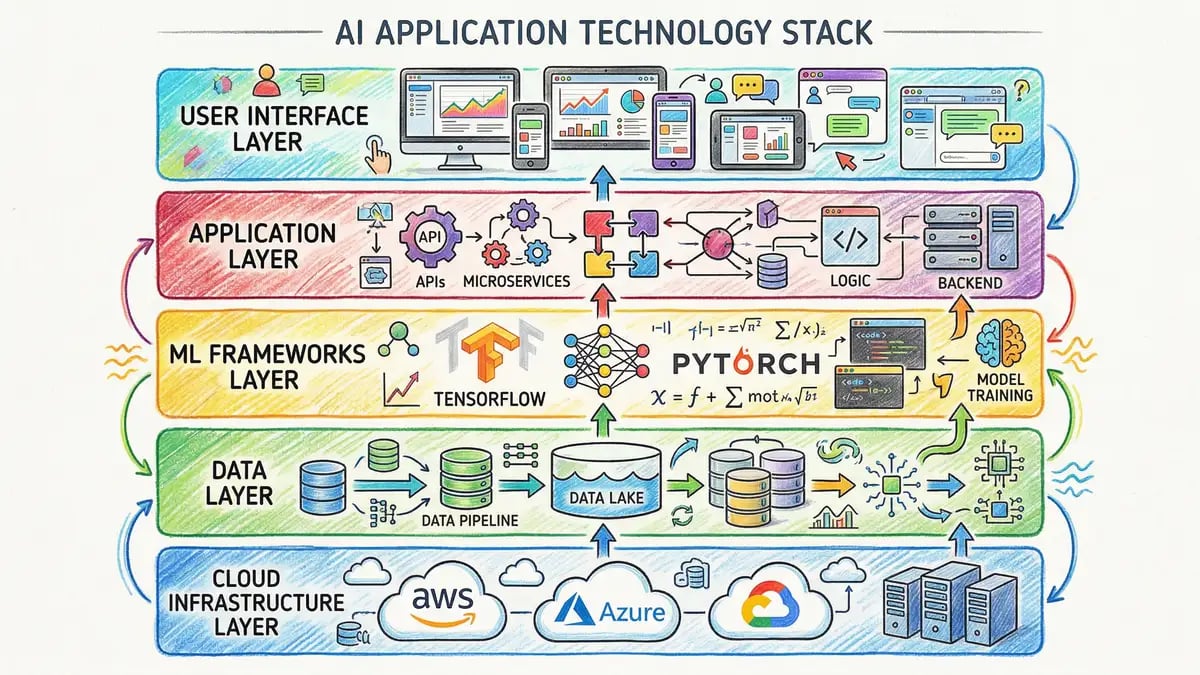
Application layer spending captured more than half of all generative AI expenditure in 2025, representing a fundamental reorientation in how organisations approach AI investment. Rather than funding proprietary model development or infrastructure buildouts, enterprises concentrate capital on deploying proven applications that address specific operational challenges. This shift has profound implications for mid-market decision-makers: successful AI adoption no longer requires access to cutting-edge research or massive computational infrastructure. Instead, competitive advantage flows from selecting, integrating, and optimising applications that align with business strategy.
The UK context amplifies this opportunity. The UK AI sector generated £72.3 billion in market value in 2024, positioning Britain as the world's third-largest AI economy, trailing only the United States and China. This market leadership extends beyond London's financial technology cluster. Edinburgh has emerged as a centre of excellence for data science and analytics. Manchester anchors advanced manufacturing and Industry 4.0 applications. These distributed AI hubs create a rich ecosystem of local expertise, venture-backed specialised vendors, and growing infrastructure explicitly designed to support AI adoption at scale.
Departmental AI: The Coding Revolution
The most dramatic concentration of enterprise AI investment has formed around departmental AI applications—software designed for specific functional roles. Departmental AI captured £5.48 billion in spending globally during 2025, representing more than a 4-fold increase year-over-year. Within this category, coding emerges as the undisputed champion, accounting for £3 billion (55 percent) of all departmental AI spending.
This concentration reflects a fundamental economic reality: software developers are high-cost resources, and even modest productivity improvements translate to enormous value across any organisation with significant development operations. Development teams deploying AI tools across the entire software development lifecycle—from initial prototyping through code refactoring, design-to-code conversion, quality assurance, pull request management, and site reliability engineering—report velocity improvements exceeding 15 percent.
For organisations with distributed development teams or chronic capacity constraints, these gains directly address critical bottlenecks. More significantly, the coding AI category is diversifying rapidly. Code completion tools have grown to £1.725 billion in spending. Code agents and AI app builders have exploded from near-zero to capture substantial spending, indicating that enterprises are moving beyond simple autocomplete functions to sophisticated agentic systems that handle multi-step development tasks autonomously.
Beyond coding, departmental AI spending distributes across multiple functions. According to UK Government guidance on AI development, IT operations tools captured £525 million in spending in 2025, driven primarily by automation of incident response and infrastructure management. Marketing platforms reached £495 million, concentrated in content generation and campaign optimisation. Customer success tools acquired £472.5 million, focused on intelligent ticket routing, sentiment analysis, and proactive customer outreach.
For mid-market organisations evaluating departmental AI deployment, these patterns suggest a clear priority ordering. Applications addressing high-volume, repetitive tasks—particularly those involving knowledge work—should form the foundation of initial deployment strategies. A practical approach involves auditing internal operations to identify departments where AI tools could address capacity constraints, reduce repetitive work, and free skilled staff for higher-value activities.
Horizontal and Vertical AI: Choosing Your Development Path
Beyond departmental applications, the AI market divides into horizontal and vertical solutions, each with distinct value propositions and implementation requirements. Horizontal AI applications, designed to increase productivity across all business functions, captured £6.3 billion in spending during 2025. These applications address cross-cutting challenges: general document processing, knowledge management, workflow automation, and business intelligence.
The appeal to mid-market organisations is that horizontal applications generate value across multiple departments without requiring function-specific customisation. A document processing system that automates invoice handling, contract analysis, and expense categorisation delivers value to finance, operations, and procurement simultaneously. However, this category requires careful governance and change management because deployment often disrupts established workflows and necessitates significant employee retraining.
Vertical AI applications, customised for specific industries such as healthcare, finance, manufacturing, and legal services, captured £2.625 billion in spending during 2025. For mid-market organisations competing within defined industries, vertical AI solutions often deliver higher relevance and faster value realisation than generic horizontal tools. UK venture capital has concentrated significantly in vertical applications, particularly in life sciences and manufacturing.
The strategic decision between horizontal and vertical approaches depends on organisational circumstances. Horizontal solutions work best for organisations spanning multiple industries or where business operations align with standard industry-agnostic processes. Vertical solutions suit organisations operating within tightly defined industries where specialised domain knowledge significantly enhances application relevance. Many successful organisations adopt a hybrid approach, combining vertical solutions for industry-specific challenges with horizontal tools for cross-cutting productivity needs.
Technology Stacks and Development Frameworks
Successful AI application development requires thoughtful selection of programming languages, frameworks, and infrastructure platforms. Python has emerged as the dominant programming language for AI development, supported by a mature ecosystem of libraries, frameworks, and tooling optimised specifically for machine learning and generative AI applications. This language concentration creates a powerful advantage: developers trained in Python can move rapidly between projects and organisations, and hiring challenges that plagued earlier AI adoption cycles have partially resolved through increased training and market supply.
The foundational framework landscape has consolidated around two dominant platforms: TensorFlow and PyTorch. TensorFlow, developed by Google and emphasising production-grade deployment, dominates enterprise deployments where reliability and long-term support are critical. PyTorch, developed by Meta and emphasising ease of use and research flexibility, dominates academic settings and development teams prioritising experimentation velocity. For mid-market organisations building custom AI solutions, PyTorch typically proves more accessible for initial development because its design reduces the friction between prototyping and experimentation. However, TensorFlow often provides superior long-term operational characteristics once applications move to production.
Beyond foundational frameworks, a specialised ecosystem of Python libraries enables practical AI application development. LangChain has emerged as the dominant framework for building applications that chain together large language models with external data sources, memory management, and structured workflows. Research from the Alan Turing Institute indicates that LangChain's complexity often exceeds requirements for simpler use cases: approximately 80 percent of early-stage applications can be delivered more efficiently using lightweight approaches.
LlamaIndex specifically addresses the challenge of preparing custom enterprise data for use with large language models, handling the complex task of chunking documents, managing embeddings, and optimising retrieval performance. For organisations planning to build AI applications that draw insights from proprietary unstructured data—customer communications, internal documentation, research reports—LlamaIndex provides essential infrastructure. The Transformers library from Hugging Face continues to serve as the de facto standard for accessing pre-trained models across natural language processing and computer vision applications.
Cloud Infrastructure and Deployment Platforms
Enterprise AI deployment requires specialised infrastructure delivering high-performance computing capacity, sophisticated networking, and seamless integration with data storage and analytics systems. The cloud platform landscape has consolidated around three major providers: AWS, Azure, and Google Cloud, each with distinct strategic positioning and particular strengths.
AWS dominates overall market share with 41 percent of enterprises hosting generative AI workloads on its platform. However, the competitive dynamics become more nuanced when examining enterprise-specific penetration and primary deployment platforms. Azure demonstrates the strongest momentum in primary generative AI deployment, with 42 percent of enterprises naming it as their primary platform for new generative AI initiatives, exceeding AWS's 40 percent adoption. Google Cloud captures 17 percent of overall generative AI workload hosting but shows exceptionally strong enterprise adoption penetration—88 percent of enterprise firms use Google Cloud.
Beyond aggregate market share, the strategic positioning of each platform matters significantly for mid-market organisations. Google Cloud has invested heavily in Tensor Processing Units optimised specifically for large-scale model training. Azure provides the deepest integration with enterprise software stacks, particularly for organisations already standardised on Microsoft technologies. AWS offers the broadest service ecosystem and deepest legacy integrations for organisations with established cloud infrastructure.
For mid-market organisations evaluating cloud platform selection, practical considerations often prove more decisive than market share statistics. Organisations with existing AWS infrastructure should evaluate the cost and complexity of multi-cloud strategies versus consolidating AI workloads on AWS. Organisations already committed to Microsoft enterprise software (Office 365, Dynamics 365, Power Platform) typically find Azure integration reduces deployment friction and operational complexity. Greenfield organisations evaluating cloud platforms for the first time should assess total cost of ownership including data transfer costs, storage pricing, and compute capacity pricing, as these vary significantly across providers.
Development Methodologies: From Agile to MLOps
Traditional software development methodologies prove inadequate for AI application development because AI systems introduce non-determinism, complex model lifecycle management, and continuous evolution requirements absent from conventional applications. Successful AI organisations have evolved specialised development approaches that extend agile principles to account for unique challenges posed by machine learning systems.
Agile methodologies, when properly adapted for AI systems, provide a practical framework for managing the inherent uncertainty and rapid iteration cycles characteristic of AI application development. The iterative development principle, core to agile approaches, aligns particularly well with AI development because models improve through successive refinement cycles as new data becomes available and requirements evolve. User feedback collection, another agile cornerstone, proves essential for AI systems: continuous gathering of user responses to model outputs enables teams to identify performance degradation, bias emergence, and changing requirements far earlier than traditional testing would enable.
The adaptability that agile methodologies emphasise becomes critical as AI systems must operate reliably in dynamic real-world environments where initial assumptions frequently diverge from actual deployment conditions. Rather than treating the pre-deployment model as the final product, agile AI organisations embed continuous improvement processes that monitor model performance post-deployment and trigger retraining when performance degrades or data distributions shift. This approach requires embedding quality assurance and testing practices directly into AI development processes, creating feedback loops that identify and address emerging issues before they impact production systems.
MLOps: Production-Grade Machine Learning Operations
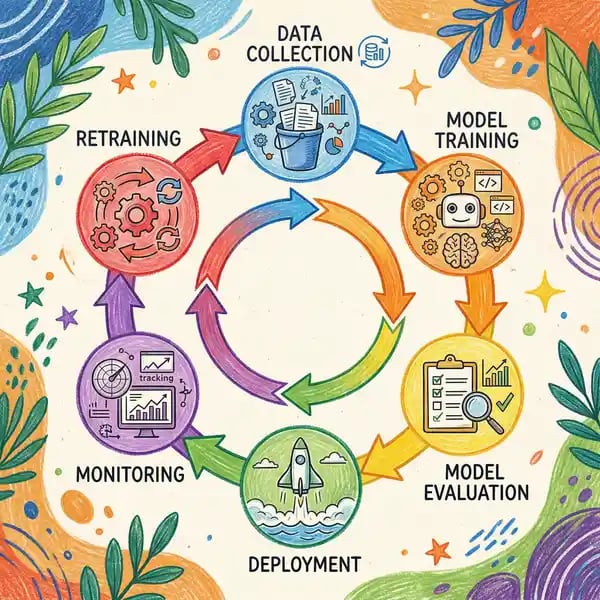
MLOps—the application of operations principles to machine learning systems—represents perhaps the most critical distinction between successful production AI deployments and failed experiments. MLOps encompasses the full lifecycle of AI systems from data ingestion through model training, validation, deployment, and ongoing monitoring. Unlike traditional software operations where deployed code remains static until the next release cycle, ML operations require continuous model management, data quality monitoring, performance tracking, and retraining as underlying data distributions evolve.
Machine learning pipelines automate much of this complexity. A complete ML pipeline architecture includes data pipelines that ingest raw data and create training datasets, training pipelines that develop and validate models, and serving pipelines that deliver predictions to production systems. The data pipeline continuously collects new data aligned to the original features and labels used to train the initial model, enabling the training pipeline to develop improved models on a scheduled or trigger-based cadence. The validation pipeline compares newly trained models against the existing production model using held-out test data, automatically selecting the new model only when performance improvements are statistically significant and reliable.
This architecture ensures that the production model continuously improves as new data becomes available and organisational requirements evolve. Critically, MLOps pipelines must incorporate monitoring systems that detect data drift—situations where real-world data distributions diverge from training data—and trigger retraining cycles automatically. Without these monitoring mechanisms, production models gradually degrade as the real-world environment diverges from the conditions under which the model was trained.
For mid-market organisations implementing MLOps, practical tools have emerged that reduce implementation complexity. According to McKinsey research on machine learning operations, open-source platforms like Kubeflow and commercial solutions from cloud providers (AWS SageMaker, Google Vertex AI, Azure Machine Learning) provide template-based pipeline deployment that automates much of the infrastructure complexity whilst maintaining flexibility for custom workflows.
Cost Benchmarks and Investment Requirements
Understanding realistic costs represents one of the most consequential decisions mid-market organisations face when evaluating AI application development. The cost landscape has shifted dramatically in recent years, fundamentally changing the economics of AI adoption.
AI development tools represent the most cost-effective entry point. AI coding assistants—tools that augment human developers by suggesting code completions, generating entire functions, and automating testing—cost between £6 and £30 per user monthly in the UK market. For a five-person development team, annual costs range from £360 to £1,800, representing trivial costs compared to any alternative development approach. GitHub Copilot dominates enterprise adoption due to its deep integration with Visual Studio Code and established development workflows, priced at £6-23 per user monthly. Cursor, designed explicitly for AI-augmented development, costs £12-24 monthly. Claude Code offers increasingly sophisticated capabilities at £12-119 monthly depending on tier. Amazon Q Developer provides free tiers extending to £11.25 monthly.
The most significant insight for mid-market finance teams is that these tool costs are trivial compared to specialist talent costs. A junior developer in the UK costs £25,500 to £30,000 annually when accounting for salary, employer National Insurance contributions, and pension obligations. Even the highest-tier AI development tools cost only 2-5 percent of junior developer compensation. Evidence from UK Government research on AI adoption demonstrates that developers using AI coding assistants saved an average of 42 minutes per working day, equivalent to 21 additional working days annually per developer. With this productivity profile, even a single developer using an AI coding tool generates sufficient additional output to justify the full investment.
For organisations lacking in-house development capacity, external agencies deliver complete AI application development projects at substantially higher cost. Traditional agency project costs in the UK range from £22,500 to £60,000 for internal tools and applications. These pricing models typically reflect fixed-price engagement for scoped projects lasting 8-12 weeks, with deliverables including specification documentation, code, testing, and deployment support. More complex applications requiring sophisticated integrations or custom machine learning models command premium rates extending to £75,000-150,000.
Mid-level contractor day rates for AI developers have stabilised at £250-£450 depending on specialisation and location. Senior developers and architects command rates of £400-£600 daily. For team augmentation strategies, contractors represent a flexible approach enabling organisations to rapidly scale capacity without permanent headcount commitments. However, contractor-based development introduces operational complexity: team cohesion, knowledge retention, and long-term code maintainability require careful project management.
Build Versus Buy: Strategic Framework
One of the most consequential decisions mid-market organisations face is whether to develop custom AI applications or purchase off-the-shelf solutions. This decision deserves rigorous analysis because it shapes technical architecture, cost structures, and long-term competitive positioning. The framework for this analysis centres on three core dimensions: competitive differentiation, integration requirements, and cost-benefit analysis.
Build strategies suit organisations where AI capability directly drives competitive advantage or where proprietary data integration is critical. A healthcare organisation developing proprietary AI diagnostic tools that represent competitive advantage should pursue internal development to protect intellectual property and maintain control over the technology roadmap. An organisation deploying AI for customer service chatbots can typically source off-the-shelf solutions because chatbot technology has become commoditised and does not represent significant competitive differentiation.
Buy strategies work better for commodity use cases, organisations with limited development capacity, or situations where rapid deployment is essential. Acquiring a pre-built marketing automation solution typically delivers faster time-to-value and lower total cost of ownership than developing custom AI marketing tools. Pre-built solutions handle ongoing maintenance, security updates, and feature development at scale—costs that would be prohibitive for a mid-market organisation to bear independently.
The practical reality for most organisations involves a hybrid approach: custom development for differentiating capabilities combined with off-the-shelf solutions for standard functions. A professional services firm might develop custom AI tools for analysing client engagements and identifying upsell opportunities (differentiating capability), whilst deploying standard AI-powered accounting or project management software for operational functions that do not drive competitive advantage.
Regulatory Compliance and Governance Requirements
UK organisations developing AI applications must navigate an evolving regulatory landscape that extends far beyond traditional software compliance requirements. The UK AI Bill of Rights, published by the Department for Science, Innovation and Technology, establishes principles for trustworthy and accountable AI systems. Whilst not legislation, the framework provides guidance influencing regulatory development and establishing expectations for responsible AI deployment.
The Information Commissioner's Office has published detailed guidance on AI and data protection. This guidance requires appropriate data protection impact assessments for AI systems that process personal data, explainability mechanisms for high-risk systems, and audit trails demonstrating how personal data informed decision-making. The guidance also establishes requirements for subject access requests—individuals must be able to request and understand what data informed algorithmic decisions about them.
The Online Safety Bill regulates harmful content including content generated or modified by AI systems. The Financial Conduct Authority enforces governance of AI in financial services. Organisations operating within financial services must document governance procedures and implement audit trails for accountability. The NHS and public sector organisations face additional compliance requirements under public sector equality duties requiring impact assessments for AI systems that may affect protected characteristics.
For mid-market organisations, practical compliance involves conducting impact assessments before deploying AI systems, documenting governance procedures including human oversight mechanisms, implementing monitoring systems that detect potential bias or performance degradation, and establishing audit trails enabling retrospective analysis of algorithmic decisions. Many organisations benefit from working with specialist legal and compliance advisers experienced in AI governance, particularly when deploying systems that make consequential decisions about individuals.
Measuring Success: ROI Frameworks and Key Performance Indicators
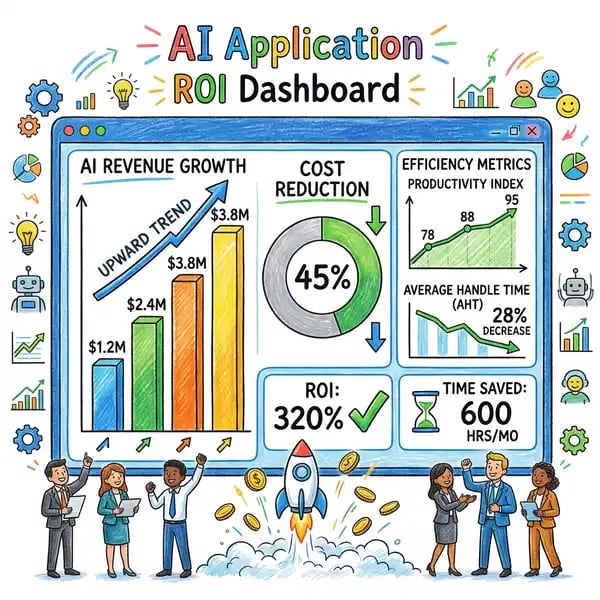
Measuring success for AI application development projects requires comprehensive frameworks extending beyond traditional software metrics. Effective measurement encompasses business metrics, user adoption metrics, technical metrics, and operational metrics, each tracking different dimensions of project success.
Business metrics quantify impact on organisational objectives: revenue impact from increased sales, cost reduction from process automation, throughput improvement from increased productivity, or quality improvements from enhanced decision-making. A customer service organisation deploying AI chatbots should measure cost savings per customer interaction, reduction in call volume requiring human intervention, and average handling time reduction. These metrics connect AI investment directly to financial impact.
User adoption metrics track how extensively employees or customers actually use deployed AI systems. High-performing AI applications achieve engagement rates exceeding 60 percent within the employee population using them. User satisfaction scores (Net Promoter Score or similar metrics) indicate whether users perceive the system as valuable. Retention curves revealing usage decline over time suggest that the system failed to deliver sustained value.
Technical metrics monitor system performance: model prediction accuracy, inference latency, system uptime and availability, false positive and false negative rates. For production systems, these metrics must be continuously monitored because model performance degrades over time as real-world data distributions diverge from training data. Systems without continuous monitoring often experience dramatic performance degradation over 6-12 month periods.
Organisations should establish baseline metrics before deployment, implement continuous monitoring systems that track performance against targets, and periodically review performance during business review cycles to justify continued investment. Many organisations establish project steering committees that review metrics quarterly, enabling early identification of underperforming initiatives and reallocation of resources to higher-value projects.
Team Structure and Talent Requirements
Successful AI application development requires teams combining business expertise, technical depth, and operational excellence. The required team structure depends on project scope, technology choices, and organisational maturity in AI development. A minimal viable team for building custom AI applications typically includes a product manager responsible for defining requirements and prioritising features, a machine learning engineer or data scientist responsible for model development, a backend software engineer responsible for integrating models into production systems, and a devops engineer responsible for infrastructure and deployment pipelines.
Organisations pursuing internal development should prioritise hiring generalist engineers with strong fundamentals over specialists with narrow expertise. The AI market evolves rapidly, and engineers who understand core computer science principles adapt more readily to changing technologies than specialists trained on particular tools that become obsolete. A backend engineer with strong software engineering fundamentals can learn PyTorch or TensorFlow more readily than a PyTorch specialist can learn production software engineering practices if they lack that background.
For organisations implementing hybrid approaches combining internal development with external agency support, clear governance structures prevent knowledge silos and ensure continuity when agencies complete engagement. Assigning internal engineers responsibility for code review, architecture decisions, and long-term system maintenance preserves organisational knowledge and enables smoother transitions when agencies complete their engagements.
The talent shortage in AI development, widely discussed in technology media, has partly eased in recent years as universities expanded AI curriculum and training bootcamps proliferated. However, senior talent with production experience remains scarce. Many organisations address this through contractor-based engagement of senior architects for critical decisions and governance, supplemented by permanent hire of generalist engineers who handle day-to-day development.
From Pilot to Production: Implementation Framework
Many AI initiatives stall in the pilot phase, never transitioning to production deployment where they create business value. The difference between successful production deployments and failed pilots centres on several practical factors that organisations must address systematically.
Successful implementation begins with rigorous scoping that defines measurable success criteria before development starts. Rather than vague objectives like "improve customer service", successful initiatives define specific targets: "reduce average customer service response time from 4 hours to 2 hours" or "reduce customer service cost per interaction from £15 to £10". These specific targets enable objective assessment of whether the project succeeded.
Organisations should favour starting with high-value, low-complexity use cases that deliver visible success early. Early success builds organisational confidence in AI capabilities, justifies continued investment, and generates momentum for subsequent initiatives. Many organisations that attempted organisation-wide transformation failed because they started with ambitious projects of enormous scope and complexity. Organisations that succeeded typically started with clearly defined pilots demonstrating concrete value, then scaled successful approaches.
Data readiness represents a critical gating factor that many organisations underestimate. AI systems require high-quality training data with appropriate features and labels enabling models to learn. Organisations with significant data quality issues, undocumented data semantics, or fragmented data sources across multiple systems face substantial pre-development work preparing data. Auditing data availability and quality before committing to development timelines prevents disappointing project delays when data challenges emerge during development.
Governance and change management require early attention. Deploying AI systems often disrupts established processes and workflows. End users may resist systems that change familiar procedures. Effective governance includes clear decision rights about when AI recommendations replace human judgment and when humans review and approve AI recommendations. User training and change management communication ensure that affected employees understand why changes are occurring and how to use new systems effectively.
Strategic Pathways for Mid-Market AI Development
The evidence demonstrates that UK mid-market organisations now possess unprecedented opportunity to deploy AI applications at scale. The technology has matured beyond experimental status. Cost barriers have lowered dramatically through accessible development tools and vendor solutions. Regulatory frameworks provide clear guidance on responsible AI deployment. The critical question mid-market organisations face is not whether to pursue AI development but how to allocate limited resources strategically across competing opportunities.
Successful organisations approach this decision through systematic analysis of organisational capabilities, business strategy, competitive positioning, and available resources. Understanding AI development costs enables realistic budgeting. Evaluating build versus buy AI decisions ensures resources flow to the most strategically valuable initiatives. Learning from other organisations' experiences through AI MVP development approaches enables de-risking through structured piloting.
The AI development lifecycle extends far beyond initial model development—encompassing data preparation, model training, validation, deployment, and continuous monitoring. For organisations building custom AI solutions, understanding this lifecycle prevents under-estimating development scope and resource requirements. AI integration services address the complexity of connecting AI systems to existing enterprise infrastructure.
For organisations evaluating specific AI development approaches, practical frameworks exist for evaluation. AI agent development enables autonomous systems that handle multi-step tasks. Generative AI development services address applications leveraging foundation models. AI chatbot development enables conversational interfaces for customer and employee interaction.
For organisations developing comprehensive AI capabilities, AI and ML development services encompass full-stack development from data preparation through production deployment. AI software development practices ensure that AI systems meet production quality standards. AI proof of concept approaches enable structured evaluation of feasibility before committing to full development.
Many organisations benefit from expert guidance when navigating these decisions. Hiring an AI development partner with proven experience in mid-market implementation accelerates decision-making and reduces risk of strategic missteps. Specialised AI consultancy services provide unbiased assessment of technology fit, organisational readiness, and optimal implementation approaches.
Organisations seeking structured strategic guidance should consult comprehensive guides to AI for business alongside detailed AI strategy guidance tailored to specific organisational circumstances.
Key Considerations for Implementation Success
The path from strategic decision to operational AI system involves dozens of technical, organisational, and operational decisions. The most successful organisations approach implementation with clear understanding of their own organisational context, realistic assessment of available resources, and honest acknowledgement of capability gaps. Rather than attempting to build comprehensive internal capability across all AI disciplines, organisations typically succeed by focusing initial efforts on high-value use cases that leverage existing strengths, then progressively expanding to more ambitious initiatives as team capability and organisational confidence grow.
The evidence from hundreds of organisational AI initiatives demonstrates consistent patterns separating successful deployments from failed pilots. Successful organisations establish clear governance structures before development begins. They invest in data quality audits before committing development resources. They prioritise production MLOps infrastructure alongside model development. They implement continuous monitoring that detects performance degradation. They establish regular review cadences that assess whether deployed systems deliver expected business value.
The competitive landscape has fundamentally shifted. The question is no longer whether AI application development is technically feasible or economically justified for mid-market organisations. The question is which organisations will invest systematically in building AI capability and which will delay until competitive pressure forces reactive implementation. The evidence indicates clearly that early adopters gain significant competitive advantage as markets mature and AI becomes standard operational infrastructure.
Ready to Transform Your Organisation with AI?
Our AI consultancy team helps mid-market organisations navigate application development decisions with confidence. Whether you are evaluating build versus buy, scoping your first production deployment, or scaling AI capability across your organisation, we provide independent strategic guidance grounded in research and practical implementation experience.