
Published by

The AI Software Development Market in 2026
Key Takeaway
The AI software development market has matured dramatically. Cost is no longer the primary selection driver; domain expertise, regulatory compliance capability, and integration methodology now determine success rates. Specialist vendors delivering domain-specific solutions achieve 67% success versus only 33% for generalist, internally-built projects. Your agency selection should prioritise depth over breadth, proven track records in comparable industries, and explicit contractual clarity on data ownership and regulatory liability.
Understanding the Current AI Software Development Landscape
The UK AI services market is experiencing unprecedented growth, with the market size projected to reach £337.75 billion by 2032, expanding from £53.03 billion in 2024—representing a compound annual growth rate of 26.40%. This expansion reflects not merely incremental growth in traditional software development services, but the emergence of entirely new service categories: AI-native application development, generative AI integration, large language model customisation, and domain-specific AI platforms.
Software represents the dominant component of this market expansion, accounting for approximately 48.1% of the UK AI market in 2024. Cloud-based deployment is accelerating faster still, growing at 28.0% compound annual growth rate during the forecast period—nearly double the rate of on-premise deployments. This shift reflects both organisational preferences for operational flexibility and what the Alan Turing Institute identifies as the fundamental economics of cloud-native AI, where infrastructure costs scale dynamically with workload rather than requiring upfront capital expenditure.
Investment patterns underscore the ecosystem's maturation. UK AI startups raised a record £1.92 billion in venture capital during the first half of 2025, accounting for 30% of all venture capital funding in the country, up from just 13% a decade ago. This concentration of venture capital into specialist AI-focused startups signals a critical redistribution of where innovation happens: no longer in traditional consultancies, but in vertically integrated, venture-backed scaleups. For mid-market organisations evaluating agency partners, this means cutting-edge capabilities increasingly reside in specialist startups rather than generalist consulting firms.
Pricing Models and Budget Expectations
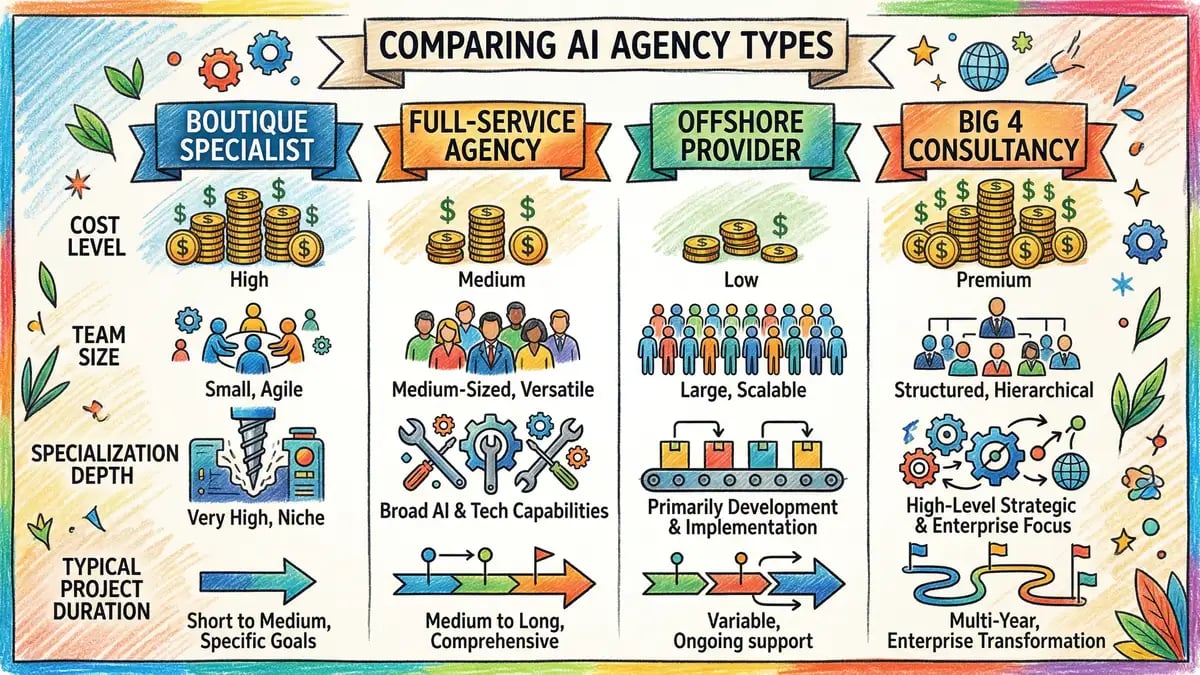
Understanding the cost structure of AI software development is essential for accurate budgeting and rational comparison across potential partners. Mid-market AI development agencies charge between £800–£1,500+ per day, with typical project budgets ranging from £50,000 to £250,000 depending on complexity, specialisation, and team seniority. This represents a significant premium over contract-based individual developer rates, which median at £550 per day across the UK (approximately £44.10 per hour), with London commanding premium rates of £563 per day—approximately 3% above the UK average.
However, cost differential should not drive selection decisions in isolation. The research data reveals a counterintuitive finding: the most expensive agencies and the most inexpensive contractors often achieve similar failure rates when proper integration methodology and domain focus are absent. What differentiates successful implementations is not cost, but methodological rigour, team seniority, domain depth, and contractual accountability.
When evaluating pricing proposals, demand transparency on the following components:
- Team composition. What is the ratio of senior architects to mid-level developers? What is the expected team stability across the project lifecycle?
- Knowledge transfer methodology. How will the agency transfer domain knowledge and implementation patterns to your internal team?
- Infrastructure and tooling. Are cloud infrastructure costs, third-party model APIs, and development tools included or excluded from daily rates?
- Post-launch support. What is included in the quoted fee? Does it include bug fixes, performance optimisation, and regulatory compliance updates?
- Contingency and change management. How are scope changes and unforeseen technical challenges priced?
Domain Expertise and Vertical Specialisation
One of the most surprising findings from current market research is the dramatic impact of vertical specialisation on project success. A 2025 study by Trullion and MIT Sloan research found that 95% of generative AI pilots fail to deliver measurable impact on profit and loss statements. However, success is heavily concentrated: specialist vendors delivering domain-specific, workflow-integrated solutions achieved a 67% success rate, whilst internally-developed, generalist approaches achieved only a 33% success rate.
This gap—from 95% failure to 67% success—is the difference between vendor specialisation and generic approaches. Specialist vendors possess deep understanding of industry workflows, regulatory requirements, data schemas, and existing system integrations. They have refined their implementation patterns across dozens of comparable projects.
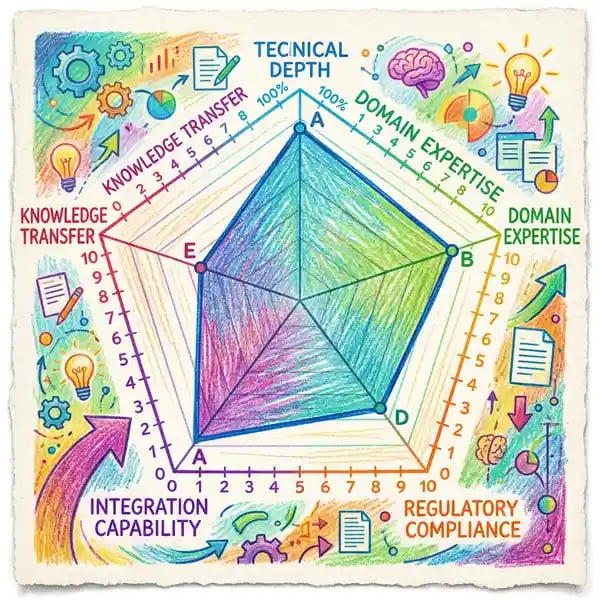
When evaluating an agency's domain expertise, request the following:
- Case studies from organisations within your specific industry vertical, with quantified business outcomes (not merely technical metrics)
- Published research, white papers, or thought leadership demonstrating deep domain knowledge
- Team credentials: how many practitioners have 5+ years of experience in your specific industry?
- Integration experience: what systems and platforms do they typically integrate with in your sector?
- Regulatory familiarity: do they document their approach to sector-specific compliance requirements?

Distinguishing AI Coding Platforms from Enterprise AI Platforms
A critical distinction that many organisations overlook is the difference between "AI coding platforms" and "context-aware enterprise AI platforms." The former—tools like GitHub Copilot, Claude Code, and similar LLM-based coding assistants—accelerate individual development tasks. They reduce boilerplate coding time and improve productivity for individual engineers by 30-40%. However, they operate at the task level and lack persistent organisational context.
Enterprise AI platforms, by contrast, maintain persistent business context across teams, governance frameworks, and the entire software development lifecycle. They integrate with existing systems, enforce data governance, support audit trails, and enable knowledge transfer. Agencies deploying truly mature AI development methodologies combine both: using AI coding platforms to accelerate individual tasks while maintaining enterprise-grade governance, integration, and compliance frameworks.
When evaluating agency proposals, clarify whether their methodology includes only coding acceleration or a complete enterprise platform approach. The most sophisticated agencies document how they combine both to optimise for speed without sacrificing governance or integration quality.
Regulatory Compliance and Data Governance Requirements
Regulatory complexity is expanding rapidly, and compliance cannot be treated as a post-implementation consideration. The EU AI Act creates binding obligations for UK companies serving EU markets, with penalties up to €35 million or 7% of global turnover for non-compliance. Simultaneously, the UK Information Commissioner's Office (ICO) is developing a statutory code of practice on AI and automated decision-making, with implementation expected in autumn 2025.
Sector-specific regulations are evolving continuously: the Financial Conduct Authority (FCA) is tightening rules around algorithmic trading and AI-powered lending decisions; the Medicines and Healthcare Products Regulatory Agency (MHRA) is establishing frameworks for AI in medical devices; and data protection regulators across jurisdictions are developing guidance on large language models and generative AI systems.
Contractual clarity is essential. Organisations must ensure clarity on the following before engaging external AI development partners:
- Data ownership. Who owns the data generated, processed, or refined during the development project? What happens to proprietary datasets after the engagement ends?
- AI-generated improvements. If the agency's AI systems generate code, architectural patterns, or optimisations that become part of your product, who owns the resulting intellectual property?
- Indemnification. Who bears liability if the delivered solution violates emerging AI regulations or data protection laws?
- Audit rights. Do you have the contractual right to audit the agency's AI development processes, training data provenance, and governance controls?
- Transparency and explainability. Can the agency explain how algorithmic decisions are made, and what bias testing or fairness audits have been performed?
Organisations serving EU markets must request explicit confirmation that the agency understands and can support compliance with the EU AI Act, including risk classification, conformity assessment, and documentation requirements for high-risk AI systems.
Building In-House Capability versus Outsourced Delivery
The strategic decision between building AI software development capability in-house versus outsourcing to an external agency has fundamentally shifted in 2026. AI-enabled development—using large language models and code generation tools—reduces software creation costs by up to 70%, dramatically shortening the payback period for internal development. What previously required multi-year return on investment models now breaks even within 12–18 months for mid-market organisations spending £150,000+ annually on software development.
However, this cost reduction has not eliminated the outsourcing case. Instead, it has repositioned the decision. The critical factors are no longer pure economics, but capability gaps, time-to-market pressure, and risk tolerance. Current market data indicates that 79% of organisations are still running AI pilot initiatives, suggesting that operationalisation and scaling remain the critical bottleneck. Additionally, 41% of organisations cite data quality as their primary implementation concern—a structural problem that neither in-house teams nor external agencies can entirely solve, but that specialist agencies have refined approaches to address.
The optimal approach is hybrid: partner with a specialist agency for discovery, initial build, and methodological refinement, whilst simultaneously developing internal capability. This transfers knowledge, builds team competency, and creates a foundation for future internal innovation. The most successful implementations combine specialist vendor capabilities with internal knowledge transfer and governance, rather than pursuing pure outsourcing or pure in-house development.
Evaluating Technical Architecture and Integration Capability
Technical architecture decisions made during the design phase have consequences that extend throughout the product lifecycle. When evaluating an AI software development agency, demand that they walk you through their reference architecture for comparable projects. Key questions include:
- How do they structure the integration between AI components (models, inference engines) and traditional application logic?
- What approach do they take to model versioning, testing, and deployment? Do they treat AI models with the same rigour as application code?
- How do they handle data pipelines? What quality assurance do they apply to training data and inference data?
- What observability and monitoring frameworks do they implement for AI systems in production?
- How do they approach cost optimisation for model inference? What cost control mechanisms do they build into the architecture?
Request a detailed technical review or architecture document for a comparable reference project (with client consent). This reveals whether the agency's approach is ad-hoc and project-specific, or methodical and repeatable. The most mature agencies have documented architectural patterns, technology choices, and integration approaches that they refine across multiple projects rather than inventing from scratch for each engagement.
Track Record and Reference Validation
Evaluating past project success requires moving beyond superficial case studies to genuine reference validation. When an agency provides case study materials, follow these steps:
- Verify industry relevance. Do the reference projects operate in your specific industry or a closely related domain? Success in one vertical does not reliably transfer to another.
- Quantify outcomes explicitly. Look for specific metrics: cost reduction (%), revenue impact (£), time-to-market improvement, error rate reduction, or customer satisfaction improvement. Avoid qualitative claims ("improved efficiency") without numbers.
- Contact references directly. Request contact details for project sponsors or technical leads. Ask specifically about scope management, timeline adherence, team responsiveness, and how challenges were handled.
- Explore failure cases. Ask the agency about projects that did not meet expectations. How did they respond? What lessons were learned? Agencies that acknowledge and learn from failures are often more mature than those claiming universal success.
- Assess knowledge transfer quality. Ask references whether their internal team now has the capability to maintain and evolve the delivered solution independently, or whether they remain dependent on the agency for all changes.
The most valuable reference validation includes speaking with organisations that have moved beyond the initial build phase to production operations. Success is not delivery of a working system; success is sustained business value creation months or years later.
Service Level Agreements and Accountability Mechanisms
Clear service level agreements (SLAs) and accountability mechanisms protect your organisation from delivery risk. When negotiating contracts with potential agencies, insist on the following clarity:
- Delivery timeline and milestone definitions. What constitutes completion of each project phase? How are delays defined and remedied?
- Quality standards. What testing, security, and code review standards will the delivered software meet? How is code quality measured?
- Performance and reliability targets. For AI-driven systems, what inference latency, accuracy, and uptime guarantees are committed?
- Post-launch support. What is included in the engagement after delivery? How long is the agency responsible for bug fixes or performance optimisation?
- Escalation procedures. How are disputes about quality or timeline adherence escalated and resolved?
- Team stability and continuity. What happens if key team members leave the project? Who is responsible for onboarding replacements?
The presence of detailed, measurable SLAs indicates agency maturity and confidence in their delivery methodology. Vague commitments or resistance to specific performance guarantees are warning signs.
Cost and ROI Comparison Framework
Once you have narrowed potential partners to 3-4 candidates, develop a structured comparison framework that moves beyond daily rates to total cost of ownership and expected return on investment. The table below illustrates a typical comparison structure:
| Evaluation Factor | Agency A | Agency B | Agency C |
|---|---|---|---|
| Daily rate (£) | £950 | £1,200 | £800 |
| Estimated duration (days) | 180 | 140 | 220 |
| Total project cost (£) | £171,000 | £168,000 | £176,000 |
| Domain expertise (1-5) | 5 | 4 | 2 |
| Regulatory compliance capability (1-5) | 5 | 3 | 2 |
| Reference success rate (%) | 85% | 72% | 58% |
| Post-launch support included (months) | 12 | 6 | 3 |
| Weighted risk score (0-10) | 2 | 4 | 7 |
| Adjusted cost (risk premium at 5% per point) | £175,420 | £176,640 | £198,080 |
This framework reveals that the lowest-cost proposal (Agency C at £800/day) becomes the most expensive once risk factors are considered. Agency A, despite a higher daily rate, delivers superior value when domain expertise, regulatory capability, and post-launch support are factored in.
The Vendor Selection Decision: Synthesis and Recommendation
Selecting an AI software development agency involves synthesising multiple dimensions of evaluation: cost structure, domain expertise, regulatory compliance capability, technical architecture, team stability, reference validation, and contractual accountability. No single factor should drive the decision.
The selection process should follow these steps:
- Define selection criteria explicitly. Weight factors based on your specific priorities: if you operate in a regulated sector (finance, healthcare), compliance capability becomes critical. If you are building a differentiated product, domain expertise and architecture capability carry more weight. If you have tight time-to-market constraints, delivery speed and team availability matter more.
- Screen for minimum capability thresholds. Establish non-negotiable minimum requirements: regulatory compliance understanding if operating in regulated sectors, minimum 5+ years of domain experience, team seniority profile that aligns with project complexity, and SLA accountability mechanisms.
- Conduct deep reference validation. Contact at least two references from comparable organisations. Ask specific questions about scope management, team responsiveness, quality outcomes, and post-launch support quality.
- Request detailed technical proposals. Do not accept marketing materials; request architecture documents, integration plans, and implementation timelines with sufficient detail to evaluate feasibility.
- Negotiate and finalise contractual terms. Use the selection process to identify your preferred partner, then invest time in contractual negotiation. Ensure clarity on data ownership, IP rights, regulatory indemnification, and post-launch support scope.
As Gartner's AI strategy research confirms, the most successful organisations approach AI software development not as a transactional procurement exercise, but as a strategic partnership. You are not purchasing a service; you are choosing a team that will transfer knowledge, shape your architecture, and influence your organisation's AI capability for years to come. Select based on long-term capability building, not short-term cost minimisation.
Beyond Delivery: Building Lasting AI Capability
The engagement with an AI software development agency should not end with project delivery. The most mature organisations treat the post-launch period as critical for knowledge transfer, capability maturation, and governance embedding.
Plan for a 6-12 month post-launch support phase during which the agency remains available for:
- Operational stabilisation. Performance monitoring, debugging, and optimisation as the system encounters real-world usage patterns.
- Knowledge transfer. Pairing between agency architects and your internal team to build understanding of architectural decisions, integration patterns, and operational requirements.
- Capability building. Training programmes to equip your internal team with the skills to maintain and evolve the delivered system independently.
- Governance embedding. Working with compliance, data governance, and security teams to operationalise the governance and regulatory controls built into the solution.
- Feedback loop integration. Collecting learnings from the initial implementation to inform future AI development strategy and vendor selection for subsequent projects.
For more comprehensive guidance on integrating AI into your broader technology strategy, read our guide to AI for business and AI strategy guide. These resources provide context for positioning AI software development within your broader digital transformation roadmap.
The decision to partner with an external AI software development agency is significant, but it is increasingly necessary. The alternative—attempting to build cutting-edge AI capability in-house without external support—has become empirically less successful, with 95% of internally-driven pilots failing to deliver business value. By applying structured evaluation processes, prioritising domain expertise and regulatory compliance, and maintaining realistic expectations about timelines and change management, organisations can significantly improve their probability of success.
Related Reading
Build a more comprehensive understanding of AI software development and agency partnerships by exploring these related articles:
- AI development costs — Understanding pricing models and budget allocation
- Build versus buy AI — Strategic framework for make-or-buy decisions
- AI MVP development — Starting small with proof-of-concept approaches
- AI development lifecycle — End-to-end methodology for AI project delivery
- Custom AI solutions — Building tailored systems for specific business challenges
- AI integration services — Integrating AI systems with existing technology stacks
- AI agent development — Autonomous systems and decision automation
- Generative AI development — Leveraging large language models and generative systems
- AI chatbot development — Conversational AI systems and chatbot platforms
- AI and ML development services — Machine learning and AI engineering capabilities
- AI software development — Building production AI systems and applications
- AI proof of concept — Validating AI solutions before full-scale development
- Hiring an AI development partner — Talent and vendor acquisition strategies
- AI application development — End-to-end application development with AI components
Ready to Select Your AI Development Partner?
Let our AI consultancy team guide your agency selection process. We conduct independent vendor evaluation, negotiate on your behalf, and ensure your chosen partner meets your governance and capability requirements.
Explore AI Consultancy ServicesEvaluating AI Development Partners?
Book a free 30-minute discovery call to discuss your project scope, technical requirements and delivery timeline.