

Published by

The UK faces an AI workforce crisis that no amount of technology spending can fix alone. Our analysis of government surveys, industry research, and salary benchmarking reveals a stark reality: in the AI Labour Market Survey 2025 commissioned by the Department for Science, Innovation and Technology, 97% of the 119 organisations surveyed identified at least one AI skills gap, and EY research estimates that UK employers are missing 40% of potential AI productivity gains because of gaps in their talent strategy.
This is not a future problem. It is happening now, across every sector and every function, from the boardroom to the front line. The question is no longer whether your organisation has an AI skills gap — it almost certainly does. The question is what you intend to do about it before competitors that invest earlier in capability pull further ahead.

The Digital Divide That Technology Cannot Fix
The Department for Science, Innovation and Technology's 2025 AI Labour Market Survey found that 57% of surveyed businesses face technical AI skills gaps — requiring specialised knowledge in programming, machine learning, and advanced modelling — whilst 30% face non-technical gaps in AI literacy and conceptual understanding. What makes this particularly concerning is that the technical gap has widened since 2020, from 55% to 60% for foundational AI concepts, despite five years of accelerating adoption. That adoption is now widespread: the ONS Business Insights and Conditions Survey reported that around 30% of UK businesses, and 51% of those with 250 or more employees, used at least one AI technology in September 2026, up from 9% when the question was introduced in September 2023, yet capability has not kept pace.
The consequences are no longer theoretical. A full 28% of surveyed organisations confirm that skills shortages have directly impacted their ability to achieve business objectives. This is not a marginal recruitment inconvenience — it is a material constraint on strategic execution.
One bright spot: apprenticeships have surged from just 3% of AI hires in 2020 to 19% in 2025, suggesting employers are finding alternative pathways into AI careers. Yet 88% of organisations still rely on informal on-the-job training rather than structured education, and, according to EY’s 2025 Work Reimagined Survey, fewer than 5% of UK employees use generative AI in genuinely advanced ways, even though 83% now use it at work. The gap between exposure and competence is vast.
For a deeper analysis of how UK businesses are approaching AI adoption more broadly, see our companion AI Adoption in UK Business 2026 benchmark report.
The Salary Arms Race: What AI Talent Actually Costs
UK AI salaries are high, particularly in London. Prompt engineers and generative AI specialists — roles that barely existed three years ago — command typical salaries of £55,000 to £90,000, according to Harvey Nash's 2025 UK Hiring Outlook, which bases its ranges on London market rates. On the same basis, machine learning engineers typically earn £70,000 to £110,000 and MLOps engineers £75,000 to £115,000. Senior leadership roles command more, although published benchmarks for them vary widely.
Perhaps the most telling statistic: University of Oxford research covering more than 10 million UK job postings, published by the World Economic Forum, found that roles requiring AI skills advertise salaries 23% higher than otherwise comparable roles — more than a Master's degree (13%) or Bachelor's degree (8%). AI skills now outperform traditional educational credentials in immediate labour market returns.
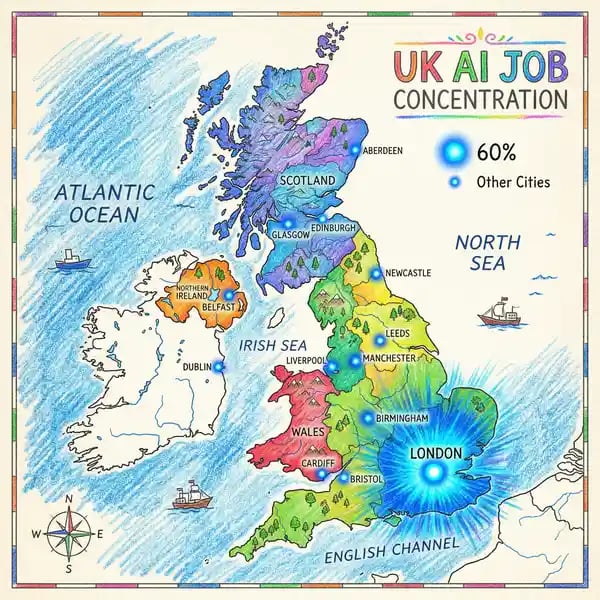
The geographic concentration compounds the challenge. In 2023, 60% of expert-level AI vacancies were advertised in London and the South East, according to Lightcast analysis in the government's AI Skills for Life and Work research, creating a talent desert for regional businesses. A manufacturer in the Midlands or a professional services firm in Manchester must either pay London premiums, support full remote arrangements, or invest in upskilling from within.
Closing a skills gap is not a training problem alone; it is a question of converting new capability into applied work. At Helium42, we address this through the Education-to-Implementation Pathway, built on our founders' record of more than 200 workshops delivered and over 2,000 professionals trained in digital marketing transformation. The figures below quantify the cost of training; the Pathway is designed to ensure that investment translates into applied productivity, not unused credentials.
The Training Paradox: 81 Hours of Training, 14 Hours Per Week Return
Here is the data point that should change how every business leader thinks about AI skills. EY research found that employees receiving more than 81 hours of annual AI training experience average productivity gains of 14 hours per week — nearly two full working days. That is not incremental improvement. That is transformation.
Yet only 38% of UK organisations are prioritising AI upskilling for employees across all roles, according to IBM’s Race for ROI study, and 60% of UK businesses say their employees have not completed comprehensive AI training, according to SAP research with Oxford Economics. The economics favour training more often than many leaders assume: external recruitment of experienced AI specialists carries agency fees, long vacancy periods and onboarding time, whereas training builds on staff who already understand the business. Costs vary widely by role and provider, so compare quotes for your own situation rather than relying on headline averages.

There is a catch. Employees who receive intensive AI training are 59% more likely to leave for better-compensated roles elsewhere. This creates the paradox: organisations that invest most in training also face the highest retention risk. The solution is not to avoid training — EY found that organisations with weak talent strategies saw AI productivity gains lag by over 40% — but to combine training with deliberate talent strategy: career pathways, compensation alignment, and genuine AI integration into roles rather than bolt-on skills.
Only 37% of UK employers are currently on course to achieve what EY terms "Talent Advantage" — the integration of training, culture, and compensation that unlocks the full value of AI investment. The remaining 63% risk leaving much of that value unrealised. For practical guidance on building an AI implementation roadmap that accounts for skills development alongside technology deployment, start with our step-by-step guide.
What the Report Contains
The full AI Skills Gap 2026 report delivers a comprehensive analysis across ten areas of the UK skills gap, built from government data, industry surveys, and salary benchmarking:
Whether you are a marketing director trying to build AI capability within your team, a sales operations leader assessing whether to hire or train, or a COO evaluating AI consultancy partners, this report provides the data you need to make evidence-based decisions.
Download the Full Report
Get the complete 15-page AI Skills Gap 2026 analysis with salary benchmarks, sector breakdowns, training ROI data, and strategic recommendations.
Download Free PDF ReportNo registration required. 14 pages. Instant download.
Frequently Asked Questions
How severe is the UK AI skills gap in 2026?
The evidence points to a significant gap. In the AI Labour Market Survey 2025, commissioned by the Department for Science, Innovation and Technology, 97% of the 119 organisations surveyed identified at least one AI skills gap, 57% reported a technical skills gap and 28% said technical skills shortages had affected their ability to achieve business goals. Most respondents were small firms developing AI products. More broadly, ManpowerGroup's 2026 Talent Shortage Survey found that, for the first time, AI skills were the skills UK employers had most difficulty finding.
What do AI professionals earn in the UK?
UK AI salaries vary significantly by role and seniority. Harvey Nash's 2025 UK Hiring Outlook, based on London market rates, gives typical salaries of £55,000 to £90,000 for prompt engineers and generative AI specialists, £70,000 to £110,000 for machine learning engineers and £75,000 to £115,000 for MLOps engineers. Research on more than 10 million UK job postings found that roles requiring AI skills advertise salaries 23% higher than comparable roles.
Is it cheaper to hire AI talent or train existing staff?
Training is often cheaper in direct costs, because external recruitment of experienced AI specialists carries agency fees, long vacancy periods and onboarding time. Costs vary widely by role and provider. However, EY found that employees receiving more than 81 hours of AI training a year are 59% more likely to leave their employer, meaning organisations must pair training investment with a retention strategy.
Which UK sectors have the worst AI skills shortages?
No published survey ranks UK sectors by AI-specific skills shortages. ManpowerGroup's 2026 Talent Shortage Survey found that 92% of UK automotive businesses struggle to find skilled talent of any kind, against a 73% average across other industries, with engineering the hardest skill to find. AI adoption, which drives demand for AI skills, is highest in information and communication, where around 60% of businesses used an AI technology in September 2026, according to the ONS.
What is the ROI of AI training programmes?
The ROI is substantial but non-linear. EY found that UK employees receiving more than 81 hours of AI training a year report an average productivity boost of 14 hours per week, against a median of eight hours. The government estimates that if its AI Skills Boost training unlocks an additional 1% of output for 10 million workers, this would be equivalent to over £7.5 billion in higher gross value added a year. However, only 37% of UK employers are currently on course to achieve the integrated talent strategy that EY associates with capturing these gains.
Methodology: This article draws on the DSIT AI Labour Market Survey 2025 (Gardiner & Theobald, published January 2026), the government AI Skills for Life and Work research and AI Skills Boost explainer, the EY 2025 Work Reimagined Survey, IBM's Race for ROI study, SAP and Oxford Economics research, ManpowerGroup's 2026 Talent Shortage Survey, University of Oxford wage-premium research published by the World Economic Forum, Harvey Nash's 2025 UK Hiring Outlook and the ONS Business Insights and Conditions Survey (8 October 2026). Figures on this page were checked against these primary sources in November 2026. Full source list available in the downloadable report.