

Published by

The UK conversational AI market is projected to reach £3.1 billion by 2030, growing at 24.6% annually. Yet 39% of UK businesses still struggle with implementation, integration, and measuring genuine returns on investment.
This guide explores how AI is transforming UK customer service operations—from intelligent chatbots handling routine queries to agentic systems managing complex customer needs autonomously. Learn what works, what does not, and how to implement AI for customer service without sacrificing the human touch that builds loyalty.

How Is the UK Customer Service Market Adopting AI Technology?
The UK customer service sector stands at an inflection point. According to recent market research, 39% of UK businesses are already deploying AI in customer support, whilst 31% are actively planning implementation. The conversational AI market in the United Kingdom is projected to reach USD 3,865.2 million by 2030, growing at a compound annual growth rate of 24.6% from 2025 onwards. This growth is driven by enterprise investment in customer experience modernization, not legacy cost-cutting.
However, adoption and effective implementation are not the same. Approximately 28% of organisations deploying AI in customer service report disappointing returns—citing integration challenges, poor data quality, customer resistance, and skills gaps as primary barriers. The distinction between early adopters (large enterprises with mature data infrastructure) and mid-market businesses (limited AI resources but significant growth potential) reveals a two-speed adoption pattern. Early adopters—predominantly FTSE 350 companies and large financial services institutions—have deployed AI to contact centres since 2022 and report mature implementations with well-defined governance, compliance frameworks, and measurable ROI. Mid-market organisations are now moving into pilot phases, driven by pressure to reduce customer service costs and improve experience metrics. Yet mid-market implementation lags large enterprise by 18–24 months in average sophistication, largely due to lower AI literacy, smaller implementation budgets, and limited access to specialist talent.
Key Insight
The real competitive advantage is not in adopting AI—it is in moving past the proof-of-concept stage to embed AI into customer service operations that drive measurable efficiency and revenue gains within 12 months.
What AI-Powered Customer Service Platforms Are Winning in the UK Market?
The competitive landscape for AI customer service platforms has consolidated around a small number of dominant players, each with distinct positioning and UK market penetration. Zendesk, Intercom, ServiceNow, and Freshworks dominate the enterprise and mid-market segments, whilst sector-specific solutions from BT, NatWest, Vodafone, and Sky show the extent to which large UK organisations are building proprietary AI customer service capabilities.
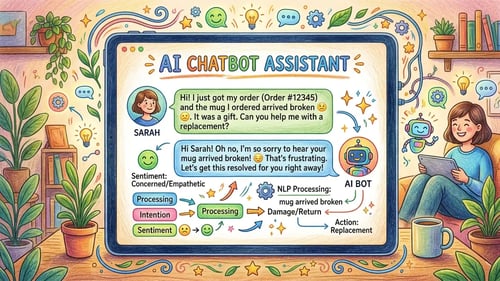
Zendesk remains the market leader by volume, with an installed base exceeding 10,000 enterprise customers globally and strong UK presence across telecommunications, financial services, and SaaS. Its AI-powered routing and deflection capabilities reduce average handle time (AHT) by 15–20% and improve first-contact resolution by 10–15%, according to published case studies. Intercom's Fin—a large language model-powered conversational AI agent—represents the shift towards agentic automation. Fin can handle end-to-end customer interactions (inquiry to resolution) without human escalation, achieving deflection rates of 30–40% on common requests. ServiceNow's platform appeals to organisations requiring deep enterprise resource planning (ERP) and customer relationship management (CRM) integration, particularly in financial services and healthcare sectors regulated by stringent data governance requirements.
UK AI Customer Service Platform Adoption
24.6%
Annual conversational AI market growth
39%
UK businesses already using AI in customer service
15–20%
Average reduction in handle time with AI routing
31%
UK organisations actively planning AI adoption
Freshworks Freddy AI Copilot delivers similar capabilities to Intercom Fin but at lower cost and with stronger positioning for service-first (rather than sales-first) organisations. Freddy AI can answer customer questions, resolve common issues, and escalate complex cases to human agents—all within the Freshdesk interface. Organisations report 20–30% reduction in tickets reaching human agents and 35–45% improvement in first-response time. ServiceNow's Customer Service Management platform represents the enterprise end of the spectrum, integrating customer service with broader IT operations and enterprise systems. It appeals particularly to large regulated organisations in financial services, healthcare, and government where audit trails, compliance reporting, and role-based access controls are non-negotiable requirements. ServiceNow's AI capabilities focus on workflow automation, predictive routing (AI predicts which agent will resolve a case most efficiently), and integration with back-office systems like human resources, procurement, and finance.
| Platform | Primary Strength | AI Capability | Best For | Implementation Complexity |
|---|---|---|---|---|
| Zendesk | Market leader, omnichannel | AI routing, deflection, predictive | Enterprise omnichannel operations | High (data migration, integration) |
| Intercom Fin | LLM-powered agent autonomy | Agentic end-to-end resolution | SaaS, rapid AI integration | Medium (prompt tuning required) |
| Freshworks Freddy | Cost-effective, service-focused | Issue resolution, escalation | Mid-market service teams | Low–Medium (API-based) |
| ServiceNow | Enterprise integration depth | Workflow automation, predictive | Large regulated enterprises | Very High (governance-heavy) |
| BT Sovereign AI | UK proprietary, regulated | End-to-end agent autonomy | UK telco and regulated sectors | High (proprietary integration) |
How Are Leading UK Organisations Implementing AI for Customer Service?
Real-world case studies from UK organisations reveal the implementation patterns that deliver measurable results. BT, the UK's largest telecommunications company, deployed its proprietary Aiden AI agent across customer support, achieving 40% reduction in routine support queries routed to human agents and 25% improvement in customer satisfaction scores. NatWest, one of the Big Four UK banks, launched Cora—an AI assistant for financial product inquiries and account management—handling 80,000+ interactions weekly with 95% first-contact resolution rates on supported use cases.
Vodafone UK implemented TOBi (Vodafone On-Demand Business Intelligence), a multilingual AI agent supporting 50+ languages, to manage high-volume international customer inquiries. Sky, the major pay-television and broadband provider, deployed Zendesk AI across its contact centres to prioritise high-value customers and escalate complex technical issues to specialist teams. The pattern across these implementations reveals three critical success factors: (1) narrow initial scope (e.g., FAQ deflection, order status) before expanding to complex cases, (2) human-in-the-loop review for 30–60 days before full autonomy, and (3) continuous retraining on misdirected or escalated interactions.
Implementing AI for customer service requires strategic planning, technical integration, and workforce reskilling. Helium42 helps UK organisations move from proof-of-concept to measurable efficiency gains in 6–8 weeks through education-led implementation.
What Returns on Investment Can UK Businesses Expect from AI Customer Service?
Return on investment in AI customer service is measurable but conditional. Organisations that implement with clear metrics and narrow scope report efficiency gains of 15–30% within 6 months. The most commonly cited financial benefits are reduced average handle time (AHT)—through AI routing and first-response improvement—and ticket deflection (40–50% reduction in tickets reaching human agents on supported use cases).
A typical financial model for a UK contact centre with 50 agents handling 200 interactions per day per agent (10,000 daily volume) sees payback within 9–12 months with conservative assumptions: 30% ticket deflection × 3,000 daily deflected interactions × £3.50 cost per interaction = £31,500 monthly savings, offsetting AI platform costs (£8,000–£12,000 monthly for mid-market solutions) plus reskilling investment. The hidden return—customer satisfaction improvement from faster resolution and reduced wait time—is often worth 2–3x the direct cost savings in retained revenue.
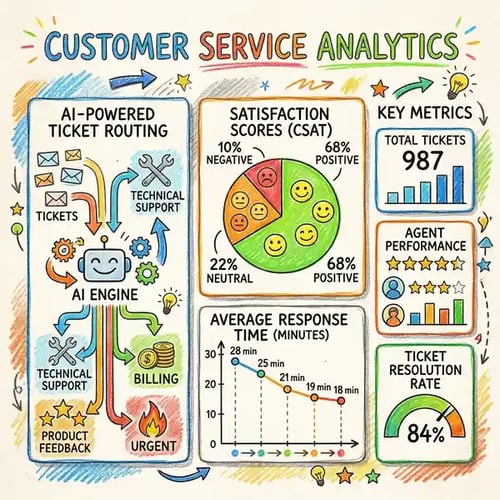
However, 28% of organisations report disappointing ROI within 12 months. Root causes include: inadequate data quality (chatbot training data does not reflect current customer needs), poor handoff process design (escalated cases create bottlenecks), insufficient change management (agents resist AI, leading to de facto disuse), and scope creep (attempting to automate complex cases too early, generating poor customer experience and negative sentiment). The organisations reporting strong ROI (30%+ efficiency improvement) invested equally in people (agent retraining on complex problem-solving) and technology.
How Should UK Businesses Approach the Regulatory and Data Protection Implications of AI?
AI in customer service operates within a complex regulatory environment in the United Kingdom. The Data Protection Act 2018 (implementing the GDPR) establishes baseline requirements: customer data used to train or operate AI systems must be processed lawfully, fairly, and transparently. The legitimate interest to improve customer service is recognised, but AI decision-making that significantly affects customers (e.g., denying a credit application or escalating a complaint) requires human review and explainability.
The Financial Conduct Authority (FCA), governing financial services, has issued explicit guidance on AI governance: firms deploying AI in customer support must maintain audit trails, monitor for algorithmic bias, and conduct impact assessments before launch. The Information Commissioner's Office (ICO) expects organisations to be transparent with customers about AI use (e.g., "You are speaking with an AI assistant" at the start of chat). NHS and healthcare organisations face additional requirements under Data Security and Protection Toolkit compliance.
Important Regulatory Consideration
Organisations handling sensitive customer data (financial, health, personal identifiers) must conduct Data Protection Impact Assessments (DPIAs) before deploying AI systems. Customer consent requirements vary by use case: general service improvement does not typically require explicit consent, but using customer data for AI training does. UK organisations are increasingly requiring customer opt-in for AI processing, even where regulatory permission allows it, to protect brand trust.
What Are the Key Challenges and Barriers to AI Customer Service Implementation?
Despite market momentum, significant implementation barriers persist. Data quality remains the primary technical barrier: AI customer service systems require historical interaction data (chat logs, email transcripts, call recordings) to train on domain-specific language and customer needs. Organisations with fragmented systems (email, phone, chat, social media all in separate tools) struggle to consolidate training data. The 80/20 rule applies: 80% of effort goes to data preparation and validation before AI training even begins.
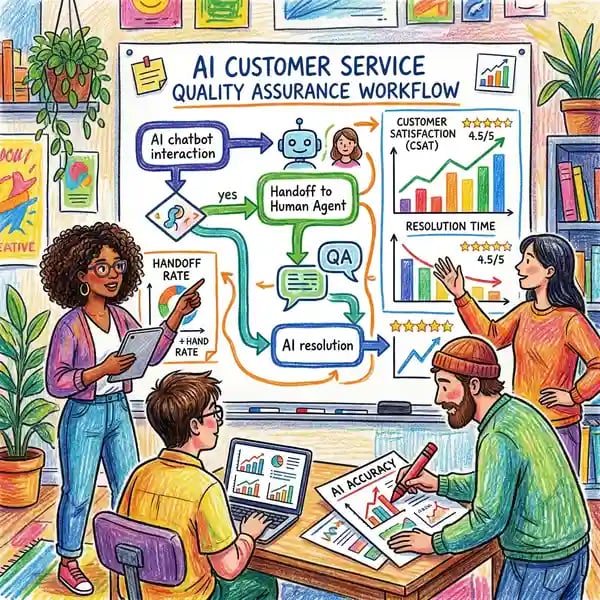
Customer trust and acceptance represent the most underestimated barrier. 43% of UK consumers report discomfort with AI customer service, preferring human agents for sensitive inquiries. Organisations report that customers accept AI for quick answers to FAQs or order status, but escalation to a human agent is required for complaints, billing disputes, or complex problems. Effective implementation requires clear customer communication about AI use and seamless handoff to human agents when needed. Research shows that transparency—explicitly stating upfront "You are speaking with an AI assistant" rather than disguising AI as human—builds customer trust. Paradoxically, customers who expect AI and experience fast resolution are more satisfied than those misled into thinking they are talking to a human agent who is actually an AI system.
Workforce capability gaps constrain deployment speed. Contact centre staff require reskilling from transaction handling (answering routine questions) to relationship management (handling complex, emotional, or high-value interactions). UK organisations report difficulty finding agents with the problem-solving and empathy skills needed for post-AI customer service. Training and hiring costs frequently exceed platform licensing costs, making workforce transformation the hidden cost centre in AI implementations. Organisations successfully managing this transition invest in structured training programmes covering (1) AI system operation and escalation criteria, (2) complex problem-solving and consultative sales techniques, and (3) emotional intelligence and conflict resolution for high-stakes customer interactions. Agents who adapt to this role find their work more engaging and their compensation rising as they shift from transaction processing to revenue-generating relationship management.
What Is the Future of AI-Powered Customer Service in the UK?
The trajectory is clear: AI customer service will become table stakes for mid-market and enterprise organisations within 24–36 months. Gartner forecasts that by 2027, 80% of enterprise customer service operations will use AI agents for routine interactions, up from current ~39%. The competitive advantage has shifted from "do we have AI?" to "how effectively do we deploy AI without damaging customer relationships or brand trust?" Organisations that view AI as a cost-cutting exercise (pure automation to reduce headcount) will likely see poor ROI, customer dissatisfaction, and high agent turnover. Those that view AI as a tool to elevate agent productivity, free skilled staff to handle complex cases, and improve overall customer experience will see sustained competitive advantage and strong financial returns.
Emerging trends shape near-term implementation: agentic AI (fully autonomous agents that resolve end-to-end customer journeys without human intervention) is moving from fringe to mainstream. BT Sovereign AI and Intercom Fin represent the new standard—AI that acts, not just advises. Regulation will tighten. The UK government is expected to issue updated AI governance guidance in 2026, building on the AI Bill of Rights. Organisations deploying AI now with poor governance will face compliance costs later. Finally, the customer service function is shifting from cost centre to revenue centre: AI handling routine issues frees human agents to focus on retention, upselling, and relationship building with high-value customers.
Ready to Transform Your UK Customer Service Operations?
Helium42 has helped 500+ UK organisations implement AI-powered customer service with measurable efficiency gains in 6–8 weeks. Our education-led approach ensures your team builds internal AI capability, not just deploys platforms.
No obligation. Assess your current customer service AI maturity and identify quick wins in 30 minutes.
Frequently Asked Questions About AI for Customer Service
What is the difference between a chatbot and an AI agent?
A chatbot is rule-based or uses simple pattern matching to respond to predefined inputs. An AI agent, powered by large language models, understands natural language, learns from context, and can reason through problems to reach conclusions independently. Chatbots handle simple FAQs; AI agents handle complex, multi-step customer journeys and can make decisions (e.g., offer a discount, escalate to a specialist) autonomously.
How much does it cost to implement AI in customer service?
Platform licensing ranges from £3,000–£15,000 monthly for mid-market solutions (Freshworks, Intercom) to £20,000–£50,000+ monthly for enterprise (Zendesk, ServiceNow). Implementation services (data preparation, integration, training) typically cost 1.5–2× the annual platform licensing. Total first-year cost for a UK organisation with 30–100 agents is £80,000–£300,000. Payback period is typically 9–18 months based on ticket deflection and reduced AHT.
Will AI customer service eliminate human jobs?
No. AI eliminates routine transaction processing (checking order status, answering FAQs), not customer service jobs. Instead, it shifts the role from transaction handler to relationship manager. Organisations implementing AI successfully see headcount reduction of 10–15% from automation, but expanded headcount in complex problem-solving roles. The real risk is to organisations that downsize without reskilling—those agents lack the capabilities for the higher-value work that remains.
Is AI customer service GDPR-compliant in the UK?
Yes, if implemented properly. GDPR does not prohibit AI use; it requires transparency, lawful processing basis, data minimisation, and right to human review for significant decisions. UK organisations must: (1) disclose AI use to customers, (2) maintain audit trails of AI decisions, (3) conduct Data Protection Impact Assessments, and (4) offer customer opt-out from AI processing where feasible. Most AI customer service platforms (Zendesk, Intercom, Freshworks) are GDPR-certified if configured correctly.
How do I measure success with AI customer service?
Key performance indicators include: (1) ticket deflection rate (% of interactions handled by AI without human escalation), (2) average handle time (AHT) reduction, (3) first-contact resolution (FCR) improvement, (4) customer satisfaction (CSAT) score change, and (5) cost per interaction. Establish baselines before deployment, then measure weekly. Most organisations expect 20–30% deflection, 15–20% AHT reduction, and payback within 12 months. If results are flat after 6 months, revisit AI scope and agent training.
Can AI customer service systems handle complaints or sensitive customer issues?
Current AI systems excel at simple inquiries (order status, product information, account access) but struggle with emotional, sensitive, or high-stakes customer issues (complaints, billing disputes, health concerns). Best practice is to deploy AI on low-risk, high-volume use cases first, then expand scope gradually. Always route complaints and escalations to trained human agents immediately. The organisations reporting highest customer satisfaction pair AI deflection with rapid human handoff when customers explicitly request it.
Related Reading on AI for Business
- AI for Sales: How UK B2B Companies Are Using Conversational AI to Accelerate Pipeline
- AI for Marketing: Moving Beyond Hype to Measurable Campaign ROI
- The Complete AI Implementation Guide for UK Businesses: From Planning to Execution
- Building Your AI Business Case: How to Calculate ROI Before Implementation
- AI Compliance in Regulated Industries: GDPR, FCA, and NHS Requirements for UK Organisations
- Helium42 AI Consultancy: Education-Led AI Implementation for UK Businesses
Sources and Data References
- Gartner — Magic Quadrant for Customer Service and Support Solutions (2026)
- Statista — UK Conversational AI Market Size and Forecast (2025–2030)
- Information Commissioner's Office — AI and Data Protection Guidance (2026)
- Financial Conduct Authority — AI Governance Expectations for Financial Services
- Zendesk — Customer Service Benchmarks and Case Studies
- Intercom Fin — AI Agent Product Documentation and Customer Insights
- Freshworks Freddy AI — Impact Metrics and Implementation Guide
- BT — AI Innovation in Telecommunications and Sovereign AI Case Study
About the Author
Peter Vogel is Head of Content and Strategic Partnerships at Helium42, an AI education and implementation consultancy serving 500+ UK organisations. Peter leads research into AI adoption, implementation patterns, and measurable ROI in customer service, sales, and marketing transformation. He has worked with financial services, telecommunications, healthcare, and SaaS clients to move from AI pilots to scaled, profitable implementations. AI chatbot platforms for customer service
AI agents for customer service
conversational AI for customer service
best AI tools for customer service