

Published by

Artificial intelligence is fundamentally reshaping how UK finance teams operate. According to Xero and Cebr's 2025 research, 98 per cent of UK accounting AI tools for accounting practices practices now use AI, saving each practice an average of 18 hours and 53 minutes per week. Yet only 31 per cent of businesses see positive return on investment from AI adoption, and 46 per cent cannot define clear success criteria. This guide explains what AI can genuinely deliver for finance operations, which tools matter, how to navigate the regulatory landscape, and how to build the capability your team needs to compete.
What Is AI for Finance and Accounting?
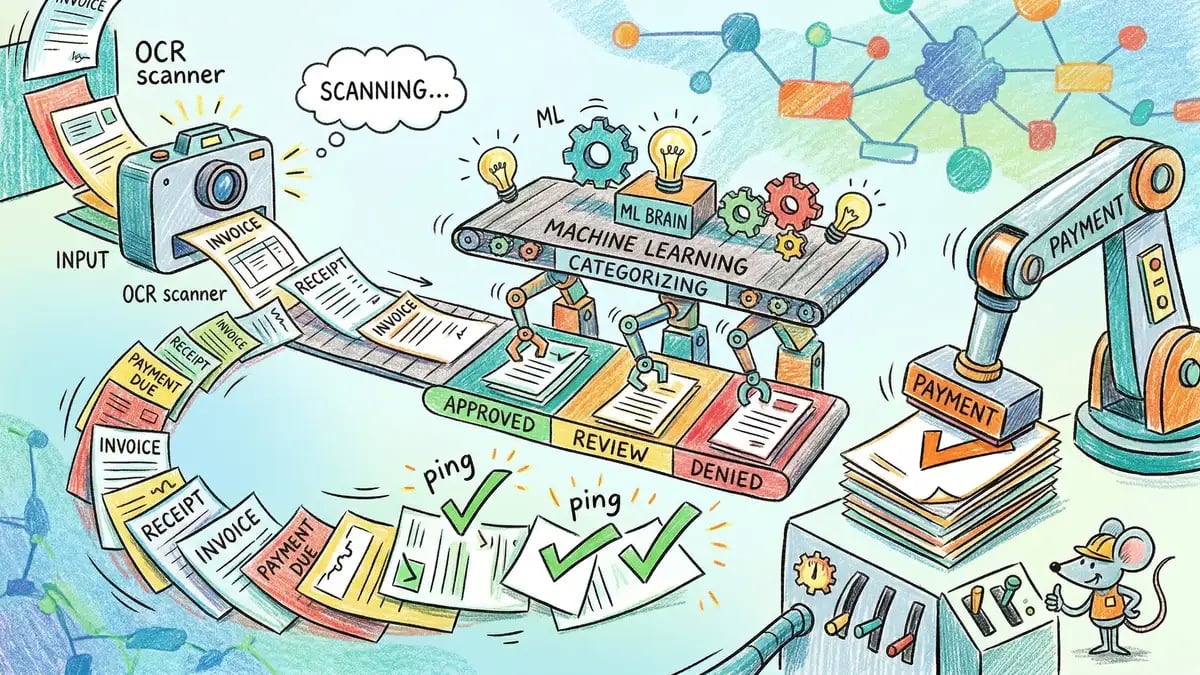
AI in finance refers to the use of machine learning, large language models, and process automation to augment or replace manual financial tasks. Unlike generalised AI tools, finance-specific AI focuses on structured, repetitive work: invoice processing, expense categorisation, cash application, reconciliation, and forecasting. The key distinction is augmentation versus replacement. Most successful implementations use AI to handle high-volume routine work, freeing finance professionals to focus on analysis, strategy, and exception handling.
The landscape spans three categories: specialist finance tools (Trullion, BlackLine, HighRadius), general-purpose automation platforms (UiPath, Automation Anywhere), and large language models (ChatGPT, Claude, Gemini) used in supplementary roles. Each serves different needs. Trullion, for instance, specialises in transaction matching and anomaly detection; HighRadius optimises cash application and order-to-cash workflows. The choice depends on your specific pain points.
Key Takeaway
AI in finance is not a single technology — it is a portfolio of tools designed to automate specific, high-volume tasks. Success comes from matching the right tool to the right process, not from deploying technology first and finding problems second.
How Are UK Businesses Using AI in Finance Today?
Adoption is accelerating. The Lloyds Business Barometer 2026 reported that 66 per cent of UK businesses have invested in AI in some capacity, up sharply from prior years. In accounting specifically, the Xero and Cebr research shows adoption is near-universal (98 per cent), though the maturity and scope of implementation vary widely.
The most common use cases are:
- Invoice and receipt processing: Optical character recognition (OCR) and machine learning extract data, reducing manual data entry and cycle time from 17 days to as little as 3 days (an 82 per cent reduction).
- Expense categorisation and coding: AI learns historical patterns and automatically assigns general ledger codes, reducing time and error.
- Cash application and reconciliation: Machine learning matches incoming payments to open invoices, dramatically improving accuracy and reducing days sales outstanding (DSO).
- Month-end close acceleration: Automation of routine close tasks—journal entries, reconciliations, accruals—reduces cycle time by 30–50 per cent.
- Fraud detection and anomaly flagging: Pattern recognition identifies suspicious transactions, reducing financial errors by up to 75 per cent.
- Forecasting and scenario modelling: LLMs and predictive models help finance leaders simulate budget scenarios and predict cash flow.
What distinguishes real-world usage from hype is the financial impact. Among UK accounting practices, the average productivity gain was 18 hours 53 minutes per week per practice, and the accounting sector saw a combined profitability uplift of £338 million. However, these figures mask a critical truth: only profitable adopters—those with clear governance and integration—achieve meaningful ROI. The Lloyds 2026 report found that 48 per cent of profitable AI adopters saw an 11 per cent or greater uplift in operating performance. Among unprofitable adopters, the story is different: they report higher costs, implementation friction, and no measurable benefit.
66%
UK Businesses Invested in AI
Lloyds Business Barometer 2026
98%
UK Accounting Practices Use AI
Xero and Cebr 2025
18h 53m
Weekly Time Saved Per Practice
Xero 2025
31%
Adopters Reporting Positive ROI
Lloyds 2026
Sources: Lloyds Business Barometer 2026, Xero and Cebr Accounting Practices Report 2025
What Productivity Gains Can Finance Teams Expect from AI?
The productivity gains from AI in finance are real but highly dependent on implementation scope and data quality. The most widely cited figures come from specific use cases rather than broad organisational transformation.
Invoice processing offers one of the clearest ROI stories. Kraft Heinz, a multinational food company, reduced invoice processing time from 17 days to 3 days using AI-powered OCR and matching—an 82 per cent reduction. This matters because invoice cycle time directly impacts cash flow and working capital.
The month-end close cycle is another high-impact target. Kraft Heinz also saw a 30–50 per cent reduction in close time through automation of routine accruals, reconciliations, and consolidations. This frees finance leaders from administrative drudgery and creates time for analysis and planning.
Error reduction is equally important. Trullion, a specialist in transaction matching and anomaly detection, reports that their AI platform reduces financial errors by up to 75 per cent through automated three-way matching and anomaly flagging. HighRadius, which focuses on cash application, reports 90 per cent-plus accuracy in matching customer payments to invoices—compared to 70–80 per cent for manual processes.
The Xero and Cebr research showed that 31 per cent of accounting practices saw task completion accelerated by an average of 31 per cent. In aggregate, this translates to the 18 hours 53 minutes per week saved across the practice.
Cash conversion and DSO improvement is a critical but often overlooked metric. HighRadius reports that customers see a 15–30 per cent reduction in days sales outstanding when AI-powered cash application is combined with automated collection workflows. For a £50 million revenue business, a 15-day DSO improvement releases £2 million in working capital.
However, it is important to acknowledge the variance. The BCG 2025 AI impact study found that median AI ROI across finance was only 10 per cent, whilst the leading quartile of organisations achieved 20 per cent or higher. This 2x difference reflects differences in data quality, change management, and integration depth.
Which AI Tools Are UK Finance Teams Using?
The finance software landscape is fractured into three overlapping categories, each serving different needs and maturity levels.

| Category | Examples | Primary Use | Best For |
|---|---|---|---|
| Specialist Finance AI | Trullion, BlackLine, HighRadius, Concur | Transaction matching, reconciliation, cash application | Mid-to-large organisations with complex processes |
| Process Automation | UiPath, Automation Anywhere, Blue Prism | Robotic process automation for multi-step workflows | Teams with IT resources and engineering capability |
| General-Purpose LLMs | ChatGPT, Claude, Gemini, Copilot | Analysis, explanation, drafting, brainstorming | All organisations; supplementary use |
Note: Most mid-market UK finance teams use a combination of specialist tools (primary) and LLMs (supplementary).
Specialist Finance AI Tools: These are purpose-built for accounting and finance. Trullion specialises in automated matching and anomaly detection for three-way reconciliation (PO, receipt, invoice). Its AI learns tolerance levels and flags exceptions that fall outside historical norms. BlackLine offers a comprehensive suite covering reconciliation, close management, and intercompany accounting. HighRadius focuses exclusively on order-to-cash optimisation, using AI to predict customer payment behaviour and optimise collection strategies.
Robotic Process Automation (RPA): Platforms like UiPath and Automation Anywhere are software robots that mimic human actions—clicking, typing, copying data between systems. They excel at multi-step workflows that span legacy systems. RPA is less intelligent than ML-based solutions but is deterministic: if the rule is clear (e.g., "if invoice amount is between £500 and £5,000, route to Team B"), RPA can handle it reliably. The trade-off is that RPA requires significant upfront development; it is an engineering discipline, not a business user tool.
Large Language Models (LLMs): General-purpose AI models like ChatGPT and Claude are increasingly used by finance teams for supplementary tasks: drafting explanatory emails, generating variance analysis narratives, explaining complex accounting rules, and rapid prototyping of analysis logic. The key limitation is that LLMs are not integrated with your data; they require manual input and do not automatically execute transactions. They are most valuable when paired with domain expertise and human judgment.
The choice of tool depends on three factors: (1) the complexity and uniqueness of your processes, (2) your data infrastructure maturity, and (3) your team's technical capability. A mid-sized manufacturing firm with straightforward invoice processing would benefit more from specialist finance AI. A multinational with 50+ legacy systems and bespoke workflows might justify RPA investment. Most UK finance teams should start with an LLM pilot or a single specialist tool, learn what works, and expand from there.
Important Caveat: Vendor Lock-In and Data Portability
Common mistake: Committing to a specialist finance AI platform without clarifying data export options and contractual exit terms.
The reality: Some vendors embed switching costs intentionally. Before committing, verify data portability, API access for extraction, and exit clauses. This matters particularly for mid-market firms that may not have the technical resources to rebuild data pipelines if a tool fails to deliver ROI.
Discover how Helium42's AI Education for Business programme equips finance teams with practical AI skills.
View AI TrainingWhat Does the UK Regulatory Framework Mean for AI in Finance?
Regulatory uncertainty is the second-biggest barrier to AI adoption in UK finance, after data quality concerns. However, the regulatory framework is clearer than many assume—and it is principles-based, not prescriptive, which creates both flexibility and responsibility.

The FCA's AI Principles (2022, updated 2025): The Financial Conduct Authority does not ban AI in finance; instead, it requires firms to manage AI risk using existing regulatory frameworks. The FCA's AI governance guidance emphasises four principles:
- Transparency and explainability: Finance teams must understand why an AI system made a specific decision, especially in high-stakes contexts like credit decisions or fraud flagging.
- Fairness and non-discrimination: AI models must not inadvertently discriminate against protected groups. This requires bias testing during development and ongoing monitoring.
- Robustness and resilience: AI systems must handle edge cases gracefully, fail safely, and not catastrophically amplify human error.
- Accountability and governance: Someone in your organisation must own AI risk and be able to demonstrate that the system was validated, monitored, and governed.
Importantly, these principles apply differently to different financial institutions. A large bank deploying AI to price mortgages faces stricter scrutiny than a mid-market finance team using AI to categorise expenses. The Bank of England's AI principles for prudential regulation similarly adopt a risk-proportionate approach.
Data Protection and GDPR: The ICO's guidance on AI and GDPR makes clear that using personal data to train AI models requires a lawful basis (e.g., consent, legitimate interest) and transparency. If your finance team uses AI to analyse employee expense claims or vendor payment patterns, and that data is linked to individuals, GDPR applies. This does not prohibit AI use; it requires clear policies and consent management.
Making Tax Digital (MTD): HMRC's Making Tax Digital programme requires qualifying businesses to file tax returns using compatible software. Most modern finance AI tools are MTD-compatible, but compatibility must be verified. Failure to use compatible software can result in penalties.
Professional Bodies: The ICAEW, ACCA, and CIMA have all published AI guidance for accountants. These are non-regulatory but influential; they set professional expectations for competence and due diligence. If you are deploying AI and the professional body guidance explicitly advises against it or demands specific controls, following that guidance is essential for your professional liability coverage.
The pragmatic takeaway: UK regulation of AI in finance is not onerous if you have clear governance. Maintain an inventory of AI systems in use, document why you chose each tool, test for bias, ensure explainability where it matters, and monitor performance. This is not novel work—it is good financial control practice applied to AI.
How Should Finance Leaders Approach AI Implementation?
Implementation success hinges on clarity of purpose, phased rollout, and investment in capability building. The difference between a 20 per cent ROI adoption and a failed pilot often comes down to governance, not technology.
Step 1: Define Success Criteria Before Selecting Tools
The Lloyds research found that 46 per cent of mid-sized adopters cannot define success criteria for AI investment. This is the root of most failures. Start by identifying the specific process pain: Is it invoice cycle time? Is it month-end close duration? Is it error rate? Is it cash flow visibility? Once you have named the pain, set a measurable baseline (e.g., "average invoice processing time today is 17 days; we want 5 days") and a financial target (e.g., "we want to redeploy 1.5 FTE from manual processing to analytics").
Step 2: Audit Data Quality
Data quality is the biggest barrier to AI success. The industry survey found that 52 per cent of organisations cite data quality as their biggest constraint. Before pilots, assess: Are invoice fields consistently populated? Do GL codes map cleanly to accounts? Are payment references standardised? If your data is messy, clean it first. No AI tool can extract signal from noise.
Step 3: Run a Focused Pilot (8–12 Weeks)
Choose one tool and one process. Do not try to transform everything at once. Pilot invoice processing with Trullion, or cash application with HighRadius, or month-end close automation with BlackLine. Run the pilot in parallel with your existing process for 8–12 weeks. Measure accuracy, cycle time, and resource spend. If the pilot hits your success criteria, expand. If not, diagnose why (tool mismatch, data quality, process design) and iterate.
Step 4: Invest in Team Capability
This is the most commonly overlooked step. Your team needs to understand what the AI is doing, how to interpret its outputs, and when to override it. Build this into your change plan. Run workshops, assign a power user, create runbooks, and schedule regular reviews. Many failed implementations were due not to tool failure but to lack of user confidence and understanding.
Step 5: Govern and Monitor
Once deployed, establish governance. Who owns the AI system? Who reviews outputs for accuracy? What is the escalation process if the system flags an unusual exception? How often do you recalibrate the model? Create a quarterly review cycle and a dashboard tracking key metrics: accuracy, cycle time, cost per transaction, error rate. This is not a one-time implementation; it is ongoing stewardship.
Define Success Criteria
Identify a specific process pain, set a measurable baseline (e.g., "invoice processing takes 17 days"), and define a financial target before selecting any tool.
Audit Data Quality
Assess completeness, consistency, and accuracy of your financial data. Clean messy data first — no AI tool can extract signal from noise.
Run a Focused Pilot (8-12 Weeks)
Choose one tool and one process. Run in parallel with existing workflows. Measure accuracy, cycle time, and resource spend against your baseline.
Invest in Team Capability
Equip your team to understand AI outputs, identify errors, and override when needed. Run workshops, assign power users, create runbooks.
Govern and Monitor
Establish ownership, review cadence, and a dashboard tracking accuracy, cycle time, cost per transaction, and error rate. This is ongoing stewardship, not a one-time setup.
What Skills Do Finance Teams Need for AI Adoption?
AI is changing the skills profile of finance work. The demand for AI expertise in finance has surged whilst capability is scarce. According to Harvey Nash research, AI is now the second-most in-demand skill in financial services—with a 260 per cent increase in job postings for AI-literate roles over 18 months.

At the same time, only 9 per cent of financial services executives feel prepared to manage AI regulation and governance—a dangerous gap. The Xero research found that 76 per cent of accounting practices say AI has influenced their hiring strategy, but most do not know what skills to prioritise.
Finance teams need three layers of capability:
| Skill Layer | What It Includes | Impact |
|---|---|---|
| AI Literacy (Foundational) | Understanding what AI is, what it can do, limitations, ethical risks, basics of prompting LLMs | Enables all staff to contribute ideas, use LLMs safely, and understand AI-driven change |
| Tool Expertise (Intermediate) | Deep knowledge of chosen AI tools (Trullion, BlackLine, UiPath), configuration, monitoring, troubleshooting | Ensures tools are used correctly, reduces workarounds, accelerates issue resolution |
| AI Engineering (Advanced) | Data science, model training, validation, evaluation. Rarely needed in-house; often outsourced | Enables custom models and advanced optimisation; high cost-to-benefit for most mid-market firms |
Most UK finance teams should prioritise foundational AI literacy and tool expertise. Foundational literacy means your team understands the basics: What is machine learning versus RPA? What is an LLM? Why is data quality important? What are the risks of bias? This is not technical; it is conceptual and is the foundation for successful adoption.
Tool expertise is where ROI comes from. If you deploy Trullion for invoice matching, your power users need to understand the three-way matching logic, how to interpret exceptions, how to retrain the model on new GL codes, and how to diagnose false positives. This takes time to build but is the difference between a tool that delivers 20 per cent ROI and one that is abandoned.
Advanced AI engineering (data science, model building) is rarely justified for mid-market finance teams. If you need custom models, hire consultants. Focus your team on understanding the models you use, not building new ones.
Key Takeaway
AI adoption success requires three things: clarity of purpose (what problem are you solving?), data quality (is your data ready?), and team capability (does your team understand how to use and govern the system?). Tools alone do not deliver ROI. Governance and capability do.
Frequently Asked Questions
Is AI in finance secure? Can I trust it with sensitive data?
Security depends on the specific tool and your data handling. Most specialist finance AI tools (Trullion, BlackLine, HighRadius) are SOC 2 Type II certified and encrypt data in transit and at rest. However, security also depends on your implementation: Are you using secure APIs? Are credentials managed correctly? Have you tested disaster recovery? Choose vendors with strong security credentials (SOC 2, ISO 27001) and audit your own data handling practices. For highly sensitive data (e.g., credit card numbers), some organisations mask or tokenise data before feeding it to AI systems. This reduces risk but adds complexity.
How do I know if my data is good enough for AI?
Data quality assessment is straightforward but time-consuming. Check: (1) Completeness—are key fields populated? (2) Consistency—are GL codes used the same way across all transactions? (3) Accuracy—do random samples match reality? (4) Timeliness—is data recorded promptly? A simple audit: randomly sample 100 invoices or expense claims; manually verify them against source documents. If accuracy is below 95 per cent, clean the data first. You can improve data quality through tighter controls (e.g., mandatory fields in your ERP) or manual cleanup. Both take time but are essential.
How much does AI in finance cost?
Costs vary widely. Specialist finance tools range from £30,000–£200,000+ per year depending on scale (transaction volume) and feature set. RPA platforms (UiPath, Automation Anywhere) are typically £50,000–£150,000+ per year plus significant implementation costs. LLMs (ChatGPT, Claude) cost pennies per transaction but require integration work. Most mid-market finance teams spend £50,000–£100,000 in the first year (tool + implementation + training) and £30,000–£60,000 per year in maintenance. Payback period is typically 12–24 months if you focus on high-volume, repetitive processes. Use the following formula: (Annual cost) ÷ (Annual time saved × loaded hourly cost) = payback period in years.
Will AI replace finance jobs?
The evidence suggests augmentation, not replacement. AI automates routine, repetitive work—invoice data entry, expense coding, bank reconciliation. The demand for these roles is declining, but demand is rising for roles that require judgment, analysis, and strategic thinking: FP&A, tax strategy, fraud investigation, business partnering. Organisations that adopt AI successfully are not cutting headcount; they are redeploying people to higher-value work. The Xero research found that 76 per cent of accounting practices say AI has influenced hiring, but most are hiring analysts and business partners, not losing staff. The risk is not job loss but skill obsolescence: if your team cannot adapt to new tools, you may struggle to compete.
What is the ROI of AI in finance, realistically?
Realistic ROI depends on starting point, scope, and governance. The BCG 2025 study found median ROI of 10 per cent across finance organisations; the top quartile achieved 20 per cent or higher. The Lloyds 2026 research found only 31 per cent of adopters report positive ROI, but profitable adopters saw average uplifts of 11 per cent or more. The variance reflects the critical importance of execution: tool selection, data quality, change management, and ongoing governance are more important than the technology itself. Start with a focused pilot on a high-volume, high-cost process (e.g., invoice processing or month-end close). If your pilot delivers 15–20 per cent improvement in cost or cycle time, expand. If not, diagnose why and iterate.
How do I stay updated on AI regulation in finance?
Follow guidance from: (1) FCA (fca.org.uk/firms/ai), (2) Bank of England prudential regulation, (3) ICO (ico.org.uk), (4) Your professional body (ICAEW, ACCA, CIMA), (5) Your industry body (BBA for banking, etc.). Most guidance is updated quarterly to annually. Set a calendar reminder to review guidance twice per year and assess whether your governance frameworks need updating. Regulation is moving slowly but steadily towards greater clarity; do not wait for perfect clarity before acting, but do not ignore guidance either.
Ready to Transform Your Finance Operations with AI?
Helium42 helps UK finance teams move from AI experimentation to measurable results. Our education-led approach ensures your team builds lasting capability, not just tool dependency.
Peter Vogel
Founder and Head of AI Strategy, Helium42
Peter leads Helium42's AI strategy and education programme. He has advised over 500 companies on AI adoption across finance, operations, and commercial functions, with a focus on closing the gap between AI hype and measurable business outcomes through education-led implementation.
Related Reading AI for legal departments:
- The AI Transformation Playbook—A step-by-step guide to moving from experimentation to scaled AI implementation
- AI Strategy for Business—How to align AI investments with business objectives
- AI Implementation Guide—A practical roadmap for deploying AI in your organisation
- AI Tools for Business—An overview of the most widely adopted AI tools across finance, marketing, and operations
- The Complete Guide to AI for Business—Our pillar hub covering strategy, implementation, and governance
AI for HR and recruitment AI for healthcare AI for retail AI for procurement and sourcing
AI-powered financial forecasting