

Published by

Manual expense management remains one of the most inefficient processes in UK finance teams. Despite decades of digital transformation, 60-70% of mid-market organisations still rely on spreadsheets, email attachments, and manual receipt collection. Finance administrators spend weeks processing expense reports, categorising receipts, and chasing missing documentation. Policy violations slip through undetected. VAT reclaims get delayed. HMRC compliance becomes a quarterly scramble.
Artificial intelligence is transforming this landscape. AI-powered expense management platforms now handle the entire lifecycle automatically: capturing receipts via mobile apps, extracting data with 92-98% accuracy, enforcing policies in real time, and routing approvals in minutes instead of days. For UK finance teams navigating both making tax digital (MTD) Phase Two requirements and rising pressure to control costs, AI expense management is no longer a nice-to-have, it is essential infrastructure.
This guide explores how AI transforms expense management, which platforms lead the market, and how to build a phased implementation plan that delivers measurable ROI in under 18 months.
Key Takeaway
AI expense management reduces processing time from 8-12 days to 1-2 days, identifies 25-40% more policy violations and duplicate claims than manual review, and typically delivers 12-18 month payback. With HMRC P11D requirements and MTD Phase Two compliance obligations, automation is becoming essential for mid-market finance teams.
60-70%
Still Using Manual Processes
80%+
Reduction in Manual Data Entry
25-40%
More Violations Detected by AI
12-18mo
Typical Payback Period
Why UK Finance Teams Are Rethinking Expense Management
The cost of manual expense processing is hidden in spreadsheets and overwhelmed finance teams. Processing a single expense manually costs between £2-4 when you factor in staff time, systems access, and compliance checks. Duplicate claims go undetected. Policy violations are discovered in quarterly audits, not in real time. Employees wait weeks for reimbursement, damaging morale and cash flow.
Regulatory pressure is accelerating change. HMRC now requires all businesses with turnover over £85,000 to use compatible software and submit returns through Making Tax Digital. P11D car allowance reporting requires precise mileage and expense tracking. Claiming VAT on expenses demands proper categorisation and audit trails. Finance directors cannot afford system gaps that create compliance risk.
Meanwhile, employee expectations have shifted. Workers accustomed to mobile-first applications expect to photograph a receipt and move on, not submit forms and wait for processing. Companies unable to offer frictionless expense submission lose talent to competitors who have. The gap between legacy systems and modern employee experience has become a recruitment and retention issue.
How AI Transforms the Expense Lifecycle
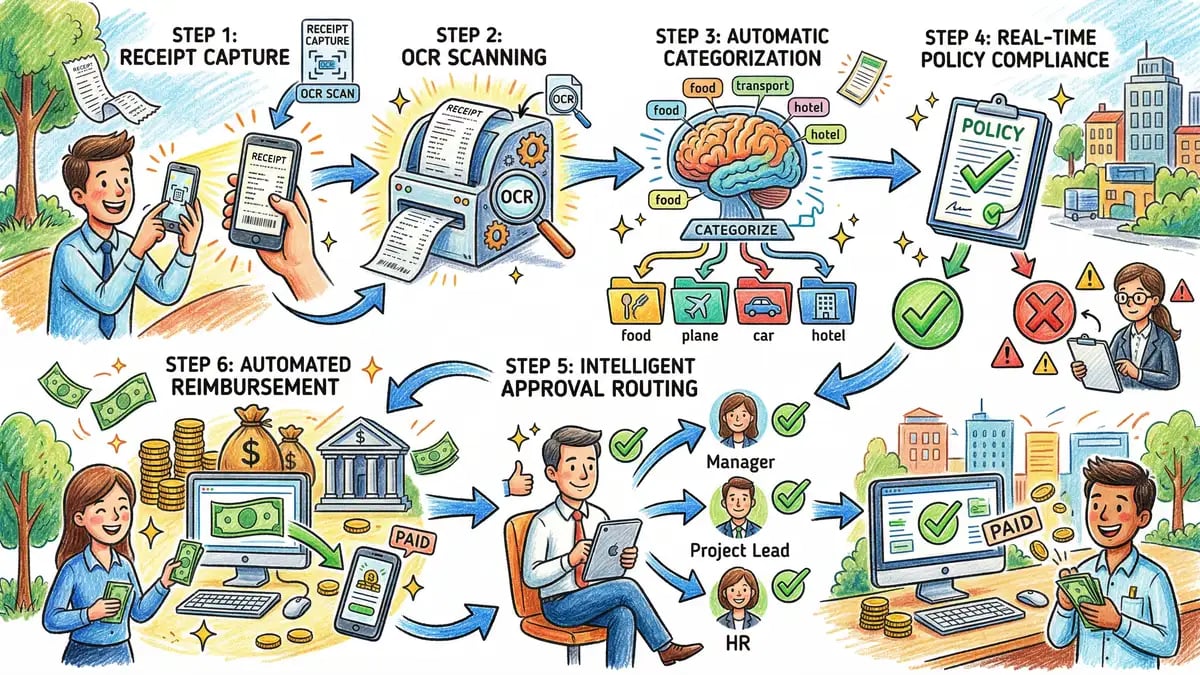
Traditional expense processes follow a linear path: employee submits receipt, administrator manually extracts data, accountant codes transaction, manager approves, finance team reconciles. Each handoff introduces delay and error. AI collapses this timeline by automating every step simultaneously.
Receipt Capture and Digitisation. Employees photograph a receipt with a mobile app. AI optical character recognition (OCR) extracts vendor name, date, amount, and line-item detail in under 5 seconds with 92-98% accuracy. Handwritten receipts, faded thermal paper, and multiple currencies are handled automatically. Manual typing of receipt data is eliminated, reducing data entry time by 80% or more.
Automatic Categorisation. Machine learning models analyse receipt content, employee role, business context, and historical patterns to assign cost code, project code, and department automatically. A software subscription is coded to capex, a meal is coded to travel, a taxi to client entertainment. Categorisation accuracy improves over time as the model learns organisational patterns. Finance teams eliminate the "wrong code" problem that usually requires rework.
Real-Time Policy Enforcement. AI rules engines check every expense against company policy before it is submitted. Per diem limits breached. Unauthorised vendors flagged. Missing approvals requested. Policy violations are caught at source, not in audit. This reduces rejected expenses by 40-60%, which decreases resubmission cycles and accelerates reimbursement.
Intelligent Duplicate Detection. AI identifies duplicate claims by matching receipt vendor, date, amount, and description across the entire expense dataset. It catches both identical duplicates and near-duplicates (same restaurant, same day, slightly different amount). Manual review misses 25-40% of duplicates. AI detection is continuous and systematic.
Streamlined Approval Routing. Expenses are routed to appropriate approvers based on amount, department, cost code, and policy rules. A £50 meal is approved instantly by a manager. A £5,000 hotel booking is escalated to the CFO. Approval flows happen in hours, not days. Notifications are sent automatically; bottlenecks are visible in real time.
Seamless GL Integration. Approved expenses are posted directly to the accounting system with correct GL codes, cost centres, and tax treatment already assigned. No manual journal entries. Reconciliation is automatic. Month-end close accelerates because expense processing no longer backs up the finance team.
Key Capabilities of AI-Powered Expense Platforms
Not all expense platforms are created equal. The most sophisticated systems combine OCR, machine learning, policy enforcement, and integration capabilities that transform the entire process. Here are the core capabilities that deliver measurable value:
Multi-Currency and Multi-Language Support. For UK organisations with international teams or global clients, automatic currency conversion and multilingual receipt processing are essential. The best platforms handle 150+ currencies and recognize receipts in 40+ languages without manual configuration.
Mobile-First Submission. Employees should be able to submit an expense with a single photograph and one tap. No typing, no form-filling, no delays. Mobile-first platforms achieve submission rates 40-60% higher than web-based systems because friction is eliminated.
Corporate Card and Virtual Card Integration. When expense and card payment data are unified, duplicate claims disappear. Merchants are matched automatically. Reconciliation is instant. Platforms that embed corporate card programmes (not just integrate with them) deliver the highest fraud detection rates. Research from the Association of Certified Fraud Examiners confirms that organisations using automated monitoring detect fraud 50% faster than those relying on manual audits.
Travel Booking Integration. For organisations with high travel spend, platforms that integrate with booking systems (Amadeus, Concur, Sabre) eliminate receipt collection entirely. Flights, hotels, and car rentals are captured automatically. Per diem policies are enforced against booked accommodation, not claimed receipts.
Advanced Analytics and Spend Intelligence. AI platforms provide dashboards that reveal patterns: which departments spend most, which vendors are used repeatedly, where policy violations concentrate. These insights enable proactive cost management, not just reactive control. Spend patterns are analysed in real time.
HMRC and VAT Compliance. UK-specific platforms understand P11D reporting requirements, MTD submission formats, and VAT reclaim rules. They automatically categorise expenses as recoverable or non-recoverable VAT, maintain audit trails for tax authorities, and generate compliance reports. This eliminates the most common source of tax penalties.
Comparing AI Expense Management Platforms for UK Mid-Market
The market for AI expense management has matured significantly. Six platforms now dominate the UK mid-market segment (£20M-£250M revenue, 150-1,500 employees). The right platform depends on your team size, integration requirements, and budget.
| Platform | Cost/User/Month | Deployment | Key Capability | UK Compliance | Best For |
|---|---|---|---|---|---|
| SAP Concur | £25-50 | 8-12 weeks | Enterprise integration, 400+ connectors | P11D + VAT + MTD | Large, complex organisations |
| Expensify | £6-15 | 2-4 weeks | Mobile-first, fastest OCR (92-96%) | Basic, partner-driven | Fast-growing, mobile-heavy teams |
| Navan | £18-35 | 4-6 weeks | Travel + expense unified, real-time policy | P11D + VAT + MTD | High-travel mid-market organisations |
| Pleo | £8-18 | 3-5 weeks | Embedded corporate card + expense | P11D + VAT support | Organisations wanting unified spend control |
| Spendesk | £10-20 | 4-6 weeks | Virtual cards + expense, European focus | MTD support, multi-currency | European teams with multicurrency spend |
| Payhawk | £12-24 | 4-8 weeks | Corporate card + travel, strong AR integration | P11D + VAT + MTD | Travel-heavy mid-market with Xero/QuickBooks |
For most UK mid-market organisations, Navan and Payhawk offer the best balance of capability, compliance support, and cost. Navan leads in organisations with high travel spend and real-time policy requirements. Payhawk excels for teams using Xero or QuickBooks and wanting embedded travel booking. Expensify is ideal for cost-conscious organisations prioritising mobile submission speed.

SAP Concur remains the default choice for enterprise organisations (over £1B revenue) with complex integrations, but the cost and deployment timeline make it unrealistic for mid-market teams. Most mid-market organisations will achieve better ROI and faster time-to-value with Navan or Payhawk.
Implementation costs vary significantly. For a 200-person organisation with mid-tier platform like Navan, expect Year 1 spend of £53,000-105,000 (including platform fees, deployment, training, and integration work). For simplified platforms like Expensify, Year 1 cost is £19,000-38,000. For enterprise deployments with SAP Concur, Year 1 typically ranges £103,000-210,000.
Integration with Your Finance Stack
The value of AI expense management multiplies when integrated seamlessly with accounting software, ERP systems, and business intelligence tools. Most organisations run one of four finance stacks: SAP, Oracle, Sage, or cloud platforms like Xero and QuickBooks.
Cloud Accounting Integration (Xero, QuickBooks). This is the easiest integration scenario. Payhawk and Navan both offer native connectors that push approved expenses directly to bank reconciliation and GL posting. Expenses appear in profit and loss within hours of approval. No manual journal entries. For most mid-market organisations on cloud platforms, this is plug-and-play.
ERP Integration (SAP, Oracle, Infor). Enterprise systems require API integration or middleware (like Zapier or custom development) to bridge expense platforms and GL posting. SAP Concur is built for this and offers 400+ pre-built connectors. Integration effort typically takes 4-8 weeks but delivers the most robust audit trails and cost centre mapping.
Payroll and HRMS Connection. Linking expense management to payroll systems enables automatic gross-up of non-taxable expenses (mileage allowances, subsistence limits under HMRC thresholds). This reduces payroll tax complexity and ensures compliance. Most mid-market organisations integrate via HRMS (SAP SuccessFactors, Workday, BambooHR) rather than directly.
Business Intelligence and Reporting. Modern expense platforms export data to analytics tools (Tableau, Power BI, Looker). This enables real-time spend analytics, departmental dashboards, and forecasting. The best organisations use BI integration to identify cost reduction opportunities and policy gaps proactively, not in quarterly audits.
Helium42 works with finance teams across all four stack types to plan integrations that preserve existing workflows while adding AI capabilities. The goal is never to replace finance systems, but to augment them with automation that frees finance staff from data entry and enables strategic work.
UK Regulatory and HMRC Compliance
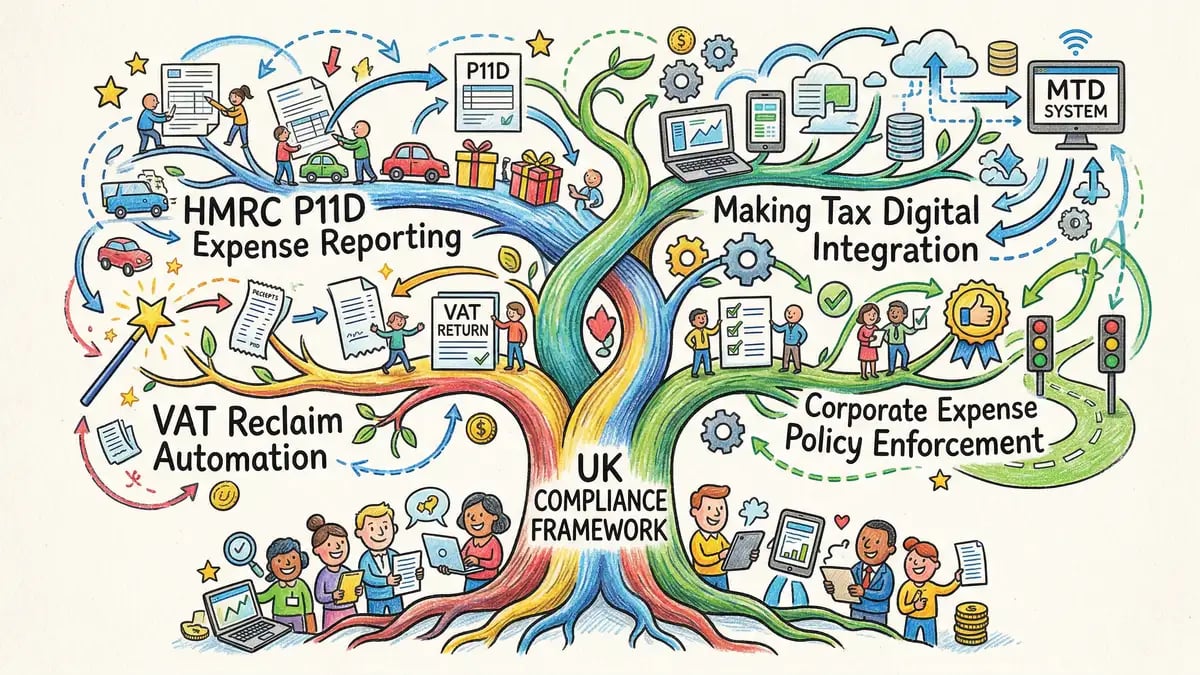
UK expense management cannot ignore HMRC requirements. Three regulatory frameworks shape how organisations must handle expenses: P11D reporting, VAT reclaim rules, and Making Tax Digital (MTD) compliance.
P11D Reporting. HMRC requires employers to report expenses benefits on P11D forms unless they fall within specific exemptions (mileage under the statutory rates, subsistence within HMRC limits, accommodation for temporary work locations). AI expense platforms must categorise expenses automatically as P11D-reportable or exempt, maintain detailed records for each employee, and generate P11D schedules for tax return filing. Failure to do so results in tax penalties and interest.
VAT Reclaim Accuracy. UK VAT regulations require that only expenses with valid VAT invoices can be reclaimed, and that the invoice must match the company's VAT registration number or a suitable partner invoice if from a third party. AI platforms must validate that every reclaim-eligible receipt contains a VAT invoice with proper details, flag missing information, and prevent recovery of non-recoverable expenses (car fuel, entertainment, some travel). Incorrect VAT claims trigger HMRC challenges and are costly to remediate.
Making Tax Digital Phase Two. From April 2026, all UK businesses with turnover exceeding £85,000 must use compatible software to maintain records and submit returns. MTD Phase Two extends this to quarterly VAT reporting and requires digital records for purchases. Expense platforms must output data in MTD-compatible formats and maintain audit trails that HMRC can inspect. Many legacy platforms are not MTD-compatible, which means they will be non-compliant within 12 months.
The best AI expense platforms build these compliance checks into their core workflow. Navan, Payhawk, and Pleo all include P11D categorisation, VAT validation, and MTD reporting. Choosing a platform without these features creates compliance debt that will require manual remediation when HMRC reviews arrive.
Compliance Tip: Run a VAT audit of your current expenses before implementing AI expense management. Check that your team understands which expenses are recoverable, which require VAT invoices, and which are blocked from reclaim. AI platforms can automate these rules once you establish them, but they cannot interpret bad data in legacy systems. Clean data is the foundation of compliance automation.
Implementation Roadmap: From Manual to Automated Expenses
Moving from manual to AI-powered expense management is not a one-day migration. It requires planning, testing, and phased rollout to ensure staff adoption and system stability. Here is a proven four-phase roadmap:
Phase 1: Discovery and Platform Selection (Weeks 1-4)
Audit current expense process: who submits, how often, volume, typical cost per submission. Map integrations required (accounting system, payroll, travel booking, corporate card). Define policy rules (per diems, approval hierarchies, VAT reclaim rules, P11D categorisation). Identify pain points (approval delays, duplicate claims, compliance gaps). Run proof-of-concept with platform provider on 20-30 test expenses. Evaluate against procurement criteria (cost, deployment time, compliance support, integration capability). Select platform and negotiate contract (typically 12-36 month terms).
Phase 2: Configuration and Integration (Weeks 5-12)
Platform vendor configures system: GL mappings, cost centre codes, approval hierarchies, policy rules. IT team configures integrations: API connections to accounting system, payroll, travel booking, corporate card (if applicable). Set up single sign-on (SSO) integration with identity provider (Azure AD, Okta). Configure email notifications and approval workflows. Load historical expense data (optional, for migration testing). Establish pilot group (25-50 power users across departments) for testing and feedback.
Phase 3: Pilot and User Training (Weeks 12-16)
Pilot group uses new platform for all expenses. Finance team monitors submission quality, OCR accuracy, categorisation errors, and approval flow. Collect feedback and iterate on policy rules. Train all finance staff on review workflows, analytics dashboards, compliance reporting. Conduct train-the-trainer sessions so department heads can support their teams. Establish support helpdesk (internal or vendor-provided) to handle questions. Run parallel testing: compare AI categorisation against manual records to validate accuracy (target: 95%+ match on GL codes).
Phase 4: Full Rollout and Optimisation (Weeks 16+)
Disable legacy expense submission channels (email, forms, spreadsheets). Require all employees to use new platform for future expenses. Archive historical data in compliant storage. Monitor adoption metrics (submission rate, approval time, OCR accuracy). Establish monthly reporting: cost per transaction, policy violation trends, approval delays, VAT and P11D compliance. Review after 90 days and make refinements to policy rules based on real-world usage. Run efficiency analysis: measure time savings, cost reduction, and reimbursement speed improvement. Plan next phase: consider travel booking integration or corporate card issuance if applicable.
The entire implementation typically takes 16-20 weeks. Total project cost (platform, integration, training, change management) is usually recovered within 12-18 months through reduction in processing time, labour cost, and compliance risk.
Measuring ROI: What AI Expense Management Delivers
ROI from AI expense management is measurable and typically exceeds expectations. Here is how to quantify value:
Labour Cost Reduction. Processing time drops from 8-12 days to 1-2 days. A finance team of 5 FTE handling 5,000 expenses per month spends approximately 200 hours per month on manual processing (40 hours per person, 4 weeks). With AI automation, this drops to 30 hours (elimination of data entry, OCR, basic categorisation, and rejection handling). Cost saving: 170 hours per month at average £20/hour (loaded) = £40,800 per year for a 5-person team.
Duplicate Claim Prevention. AI detects 25-40% more duplicates than manual review. In a 200-person organisation with average annual expense value of £8,000 per employee (travel, meals, supplies), typical duplicate claim rate is 2-3% (£32,000-48,000 annually). AI detection might recover 40% of these duplicates that manual processes miss: £12,800-19,200 per year.
Policy Violation Prevention. Enforcing per diem and category limits in real time prevents employees from submitting non-compliant expenses. This also reduces the cost of rejection processing (rejected expenses require resubmission and approver re-work). Assuming 5% of expenses are non-compliant and rejection processing costs £8 per transaction, preventing 50% of rejections (£2 savings × 5,000 expenses × 5% violation rate × 50% prevention) = £2,500 per year.
Faster Reimbursement and Employee Satisfaction. Reducing approval time from 12 days to 2 days improves employee cash flow and satisfaction. While difficult to monetise, faster reimbursement reduces expense-related support tickets and improves retention (expense delays are a top 10 employee complaint in surveys). Conservative estimate: £5,000 per year in reduced support cost.
VAT and P11D Compliance Accuracy. Implementing AI expense categorisation with built-in VAT validation and P11D rules prevents compliance failures that trigger HMRC penalties. Avoiding even one significant compliance challenge (which can cost £15,000-50,000 in penalties and remediation) justifies implementation. Estimate: £10,000 per year in avoided compliance risk.
Total Year 1 ROI for a 200-Person Organisation:
- Labour savings: £40,800
- Duplicate prevention: £16,000
- Rejection reduction: £2,500
- Support cost reduction: £5,000
- Compliance risk avoidance: £10,000
- Total value created: £74,300
Against Year 1 implementation cost of £53,000-105,000 (depending on platform), payback occurs between months 8-17 for mid-tier platforms. Cost of platform licence alone (approximately £25,000-35,000 for 200 users on Navan or Payhawk) is recovered by labour savings in the first 6-9 months.
Beyond Year 1, annual platform cost is 50-60% lower (no implementation fees), and value continues to accrue from ongoing labour savings, compliance prevention, and spend intelligence. Year 2 and 3 ROI is typically 300-400%.
Common Challenges and How to Overcome Them
Implementing AI expense management is not frictionless. Most organisations encounter common challenges during rollout. Understanding them in advance prevents costly mistakes.
OCR Accuracy on Poor-Quality Receipts. Thermal receipts fade. Handwritten receipts are unclear. Multi-line items are ambiguous. OCR accuracy typically ranges 92-98%, but drops to 60-80% on poor receipts. Solution: set realistic expectations with staff. Provide clear receipt submission guidelines (good lighting, straight angle, entire receipt in frame). Most platforms have manual review workflows for flagged low-confidence extractions. Train finance staff to spot and correct errors quickly.
Categorisation Disagreements. AI assigns a £50 lunch to team entertainment, but the employee claimed it as client entertainment (different policy). The ML model learns from historical patterns, but those patterns may be inconsistent or non-compliant. Solution: establish clear categorisation rules in your policy before system deployment. Use the pilot phase to refine rules based on feedback. Over time, the system learns and agreement improves. Run quarterly policy audits to ensure rules are current.
Integration Delays with Legacy Accounting Systems. SAP, Oracle, and some Sage implementations require custom API development. Integration timelines slip. GL code mappings are incomplete. Solution: involve your accounting system vendor or IT partner early in platform selection. Ensure they have confirmed integration capability before contract signature. Budget 8-12 weeks for integration and include contingency. Some organisations choose to run parallel systems temporarily (submit expenses to both old and new systems) until integration is stable.
Low User Adoption. Employees accustomed to email submission resist learning a new app. Mobile-first platforms have better adoption than web-based systems. Solution: make mobile submission the default and simplest path. Provide in-person training for non-technical staff. Celebrate early adopters. Consider a brief transition period where both email and new system are accepted, but clearly communicate the sunset date. Most organisations see adoption rates exceed 80% within 6-8 weeks once staff realise submission takes seconds.
Compliance Rule Conflicts. HMRC allows mileage claims at statutory rates (45p per mile for cars) without receipts. Your policy might restrict mileage to actual fuel cost (lower rate). Policy-enforcement rules must be configured correctly or you create blockers for valid claims. Solution: engage your tax advisor and finance business partner before system deployment. Map exact rules for P11D-exempt categories, VAT reclaim, and mileage. Test these rules on historical expenses to verify they do not create false rejections.
Organisations that plan for these challenges and address them proactively achieve smooth rollout with minimal impact to operations.
Future of Expense Management: Virtual Cards and Continuous Auditing
The expense management landscape is evolving rapidly. Two emerging trends will reshape how organisations manage spending over the next 24-36 months.
Virtual Card Proliferation. Rather than issuing physical corporate cards or asking employees to pay out-of-pocket and seek reimbursement, organisations are issuing virtual cards for specific expenses. A virtual card is generated for a business meal, pre-loaded with the per diem limit, and destroyed after use. Virtual cards eliminate receipt collection (the card is the transaction record), prevent overspending (the card cannot exceed its limit), and reduce duplicate claims (no cash changing hands). Spendesk and Payhawk both embed virtual card issuance. This technology will become standard within 3-5 years.
Continuous Auditing with AI. Today, expense audits happen quarterly or annually. Tomorrow, AI will audit expenses continuously. Machine learning models will flag anomalies in real time: an employee who never claimed meals now submitting £500 in entertainment receipts. A pattern shift suggesting policy misuse. Suspicious vendors (shell companies, policy-ineligible merchants). Continuous auditing detects fraud and waste as it happens, not months later.
Organisations implementing AI expense management today are not just automating a process, they are laying the foundation for next-generation spend control. The platforms that lead the market in 3-5 years will be those that combine receipt automation, policy enforcement, virtual cards, and continuous fraud detection in a seamless experience. Starting now positions your organisation to leverage these capabilities as they mature.
Frequently Asked Questions About AI Expense Management
How much manual data entry will really be eliminated?
Most organisations report 80-90% reduction in manual data entry once AI systems are live. This assumes good receipt quality and clear expense policies. OCR extracts merchant, amount, and date automatically. ML categorisation assigns GL codes without human intervention. The remaining 10-20% of manual work is typically edge cases: receipts with multiple vendors on one line, unusual currencies, or policy exceptions that require human judgment.
What happens to historical expenses in a manual system?
You do not need to migrate old expenses. Most implementations focus on new expenses going forward. Historical data remains in your old system and is archived for compliance purposes. Some organisations choose to migrate the most recent 6-12 months of expenses if they want to run spend analytics on a longer history. This is optional and not required for compliance.
Is AI expense management secure and GDPR-compliant?
Leading platforms (Navan, Payhawk, Expensify) are ISO 27001 certified and comply with GDPR requirements for data storage and processing. ICO guidance requires that personal data (receipt photos, employee identifiers) are encrypted at rest and in transit. Most platforms offer UK data residency (data stored in UK data centres), which reduces GDPR compliance complexity. Request the vendor's security documentation and data processing agreement (DPA) before contract signature.
Can AI expense platforms handle international expenses and multi-currency?
Yes. Leading platforms handle 150+ currencies and convert automatically to your reporting currency using daily exchange rates from financial data providers. They also recognise receipts in 40+ languages. For UK organisations with international teams or client work, this is table-stakes capability. Ensure your platform supports the currencies and languages your team uses before signing the contract.
What is the typical time from contract to live deployment?
Deployment timeline depends on platform choice and integration complexity. Expensify: 2-4 weeks (no integration, simple setup). Navan or Payhawk: 4-8 weeks (integration with accounting system required). SAP Concur: 8-12 weeks (complex enterprise integration). Assume 16-20 weeks for full rollout including pilot, user training, and stabilisation. Plan accordingly.
Do we need to issue corporate cards to use AI expense management?
No. AI expense management works with both out-of-pocket submission (employee pays, submits receipt for reimbursement) and corporate cards. However, corporate card integration improves ROI significantly: receipts are captured automatically from card transactions, duplicate claims are eliminated, reconciliation is instant. If your organisation does not have corporate cards, AI expense platforms still deliver value through OCR and policy automation. Adding cards later amplifies the benefit.
Taking the Next Step
Implementing AI for expense management is not a distant future project, it is a strategic priority now. The financial case is clear: 12-18 month payback through labour savings and compliance risk reduction. The operational case is compelling: 40-60% reduction in processing time and 25-40% improvement in policy violation detection. The compliance case is mandatory: HMRC MTD Phase Two requirements demand digital-first systems by April 2026.
For most UK mid-market finance teams, the decision is not whether to implement AI expense management, but how quickly and at what cost. Starting with a platform evaluation (weeks 1-2) and proof-of-concept (weeks 3-4) lets you validate assumptions before commitment. Most organisations complete this discovery phase and make a platform decision within 4-6 weeks.
Helium42 works with finance directors and CFOs to plan and implement AI expense management strategies that reduce cost, improve compliance, and free finance teams from manual work. We analyse your current expense process, map regulatory requirements, evaluate platform options, and guide implementation from procurement through full deployment and optimisation.
Ready to Automate Your Expense Process?
Schedule a 30-minute consultation with our finance automation specialists. We will review your current process, quantify the ROI opportunity, and outline a platform-agnostic implementation roadmap tailored to your budget and timeline. No obligation, no sales pitch, just actionable insights.
The finance teams that move first will gain 12-18 months of operational advantage. They will have solved the compliance challenge before HMRC tightens MTD enforcement. They will have established spend control foundations that enable next-generation initiatives: virtual cards, continuous auditing, and predictive analytics. Now is the moment to act.
Related Reading: For deeper context on AI applications in finance, read our guides on AI for finance and accounting, AI for accounting operations, AI for accounts payable, and AI for financial forecasting. We also cover AI for regulatory reporting, AI for treasury operations, and AI for audit and compliance in our expanded series.
This article draws on analysis from the Association of Certified Fraud Examiners, ICAEW and CIMA financial technology resources, and proprietary data from leading expense management platforms (SAP Concur, Navan, Payhawk). All figures reflect 2026 market conditions for UK mid-market organisations. Platform pricing and features are subject to change; verify current terms with vendors directly.