

Published by

Manual invoice processing costs UK mid-market finance teams £8–£12 per invoice. Artificial intelligence reduces this to £1.50–£2.50, cutting accounts payable operational costs by 70–80% whilst simultaneously improving accuracy, reducing fraud exposure, and accelerating cash management. This guide shows finance leaders how AI automates invoice capture, approval workflows, and payment execution—with proven ROI delivery in 6–9 months.
Key Takeaway
AI-powered accounts payable automation delivers 70–80% cost reduction, 85–95% early payment discount capture, and fraud detection that prevents hundreds of thousands of pounds in losses. UK organisations adopting AI AP in 2026 will gain 2–3 years of competitive advantage as mandatory e-invoicing (April 2029) and Making Tax Digital (April 2026) reshape finance operations.
Why UK Finance Teams Are Automating Accounts Payable Now
Accounts payable has been the forgotten child of finance automation. Whilst accounts receivable and general ledger modernisation grabbed attention, AP remained labour-intensive, error-prone, and operationally disconnected. This is changing rapidly. The global accounts payable automation market stood at £4.1 billion in 2025 and is projected to reach £7.5 billion by 2030, growing at a compound annual rate of 11.9–14%. For UK organisations, the convergence of three forces is creating urgency: Making Tax Digital (MTD) Phase Two goes mandatory in April 2026 according to HMRC guidance, mandatory e-invoicing arrives April 2029, and 74% of UK AP departments now plan AI adoption within the next 12–18 months.
Beyond regulatory compliance, the financial case is stark. Manual invoice processing cost per invoice sits between £8 and £12 in the UK mid-market. This includes data entry, approval routing, exception handling, and payment processing. AI automation reduces this cost to £1.50–£2.50 per invoice—a 70–80% reduction. For a mid-sized organisation processing 50,000 invoices annually, this difference amounts to £325,000–£500,000 in annual savings. Add faster early payment discount capture (from 21% manual achievement to 85–95% automated), reduced fraud exposure (invoice fraud cost the UK £629.3 million in H1 2025 alone according to UK Finance), and accelerated cash forecasting, and the business case becomes unavoidable.
70–80%
Cost reduction per invoice
700%
First-year ROI (typical)
6–9 months
Payback period
0.8–0.9%
Error rate (automated vs 5%+ manual)
How AI Transforms the Accounts Payable Workflow
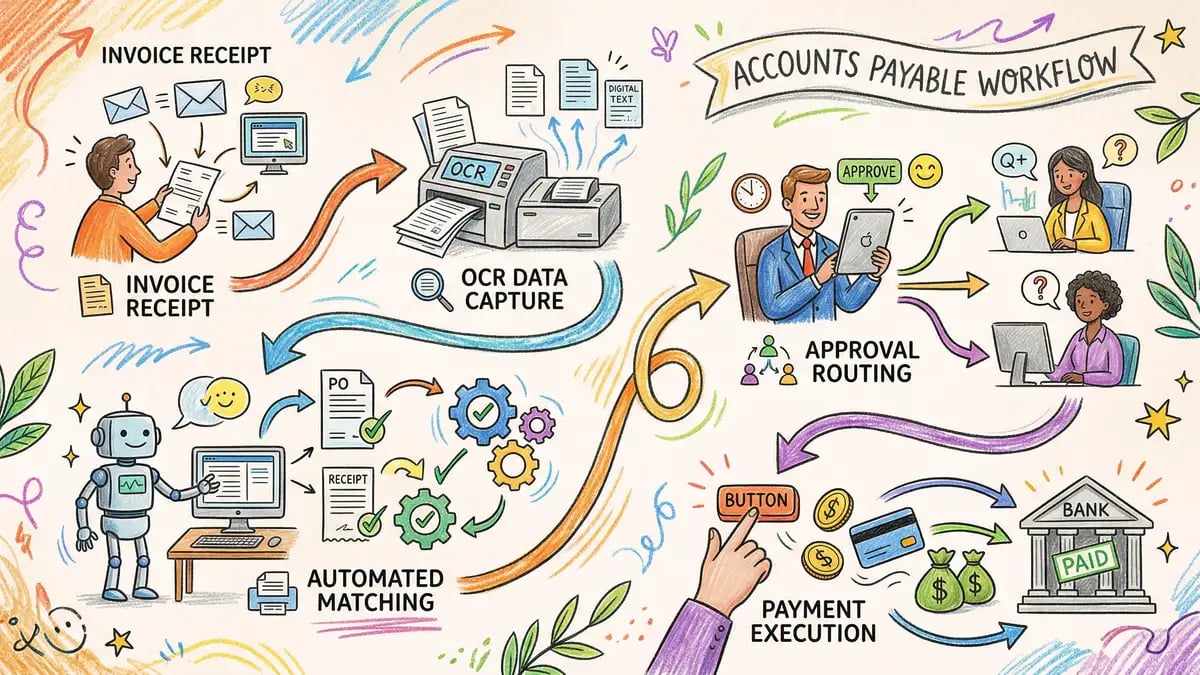
Traditional accounts payable workflows follow a linear, manually intensive path: invoices arrive via email, post, or supplier portals; AP teams manually enter data into the ERP or accounting system; line items are checked against purchase orders and receipts (three-way matching); invoices route through approval chains (often involving physical signatures or email threads); and finally, payments are scheduled and executed. Each step introduces delay, error risk, and fraud vulnerability.
AI-powered automation restructures this workflow into a touchless, continuous process. When an invoice arrives—regardless of format (PDF, scanned image, email attachment, EDI message)—intelligent document capture uses optical character recognition (OCR) and machine learning to extract key data: vendor name, invoice number, amount, due date, line items, and tax codes. This happens in seconds. The extracted data is immediately validated against your purchase orders and goods receipt records (automatic three-way matching). AI systems learn your organisation's approval rules and route invoices intelligently: routine purchases to finance staff, items requiring manager sign-off to the appropriate budget holder, and high-risk invoices (unusual vendors, amounts outside normal range, duplicate detections) to compliance specialists. Approved invoices are automatically scheduled for payment according to your cash position, early payment discount windows, and supplier terms. Payment instructions flow directly to your bank, and reconciliation updates your ledger automatically.
The result is what vendors call "touchless processing"—a target of 70–90% of invoices requiring zero manual intervention. Best-in-class AP operations achieve 3.1 days average processing time, compared to 9.2 days in traditional manual workflows. Error rates drop to 0.8–0.9% (automated) versus 5% or higher (manual). And because AI systems maintain complete audit trails and flag anomalies in real-time, fraud detection improves dramatically.
Key Capabilities of Enterprise AI AP Solutions
Modern AI accounts payable platforms share a common architectural foundation, though individual solutions differ in depth, integration maturity, and out-of-the-box configuration. Understanding these core capabilities helps finance leaders evaluate solutions and set realistic implementation expectations.
Intelligent Document Capture is the foundation. When invoices arrive in any format—PDF attachments, scanned paper, email body text, or structured EDI/API feeds—the system uses advanced OCR and machine learning to extract invoice data with 99%+ accuracy. Unlike traditional template-based OCR (which breaks when suppliers change invoice layouts), AI-powered capture learns from your document patterns and adapts to variations. The system extracts not only key headers (vendor, invoice number, total) but also line-item details (description, quantity, unit price, tax), supporting complex multi-line invoices with nested schedules.
Automated Matching and Validation accelerates the approval gate. The system automatically performs two-way matching (purchase order to invoice) or three-way matching (purchase order, goods receipt, invoice) within seconds. Mismatches—overages, missing line items, price variances above tolerance thresholds—are flagged immediately without blocking processing. The system learns your organisation's tolerance rules (allow 5% price variance for this supplier, require manager approval for that one) and applies them consistently across all invoices. This eliminates the 2–3 day manual investigation loop that plagues traditional AP operations.
Intelligent Approval Routing replaces static approval chains with dynamic, context-aware workflows. Rather than "all invoices over £50,000 go to the finance director," the system learns who should approve what based on vendor relationship, cost centre, invoice type, and historical patterns. If a buyer has a track record of approving office supplies up to £10,000, routine invoices from that supplier route directly to payment. If a supplier submits an invoice 30% above their average, it routes to procurement for investigation. Manager exceptions are recorded and fed back into the model, allowing the system to continuously refine routing logic.

Fraud Detection and Prevention operates continuously across the entire invoice population. AI systems train on your historical fraud patterns, supplier networks, and payment behaviours. When an invoice arrives from a vendor with a slightly misspelled name (a common fraud indicator), from a new bank account for an established supplier (wire fraud indicator), or with amounts that deviate significantly from historical norms, the system flags it automatically. Machine learning models trained on external fraud datasets (industry benchmarks, known fraud patterns) supplement internal learning, providing protection even for first-time fraud scenarios. AI for Regulatory Reporting explores how these controls integrate with broader compliance frameworks.
Early Payment Discount Optimisation captures cash discounts automatically. Traditional AP teams manually review supplier terms ("2/10 net 30" means 2% discount if paid within 10 days) and make payment timing decisions based on cash forecasts. This process is slow and error-prone; many organisations capture only 21% of available discounts. AI systems integrate your cash position, forecasted inflows, discount opportunities, and supplier payment preferences into a continuous optimisation engine. The system automatically schedules payments to maximise discount capture (typically 85–95% of available discounts) whilst maintaining optimal cash position. On a £20 million annual spend, moving from 21% to 95% discount capture yields £300,000–£400,000 in additional cash savings annually.
Real-Time Reporting and Cash Forecasting replaces end-of-month scrambles with continuous visibility. As invoices flow through the approval pipeline, the system updates committed spend, outstanding payables, and cash flow forecasts in real-time. Finance teams access dashboards showing invoice aging, approval bottlenecks, early payment opportunities, and vendor payment patterns without running manual reports. This visibility enables better working capital management and earlier cash flow predictions.
Comparing Leading UK Accounts Payable Platforms
Six platforms dominate UK mid-market accounts payable automation. Each delivers the core capabilities above but differs in integration breadth, pricing model, and target customer profile. The right choice depends on your ERP platform, complexity of supplier base, and strategic roadmap.
| Platform | Core Positioning | UK Annual Pricing | Best For | Consideration |
|---|---|---|---|---|
| Medius | Specialised AP automation with embedded payment execution | £25k–£75k | Fraud-sensitive orgs, complex multi-currency approvals | Excellent fraud detection; limited P2P breadth beyond AP |
| Sage Intacct | Cloud ERP with integrated AP, GL, billing | £20k–£60k | Sage ERP users, unified finance stack strategy | Strong GL integration; less AI-advanced than specialised platforms |
| Tipalti | Procure-to-pay with global supplier payments | £20k–£70k | International suppliers, multi-currency payment orchestration | Excellent vendor self-service; slightly less mature on AR side |
| Quadient AP | AI-powered document automation, multi-entity processing | £30k–£80k | Complex multi-entity/multi-country environments | Strong OCR and document handling; payment execution basic |
| Yooz | AI P2P for SME and mid-market, user-friendly | £1.5k–£5k+ | Price-sensitive mid-market, simpler tech stacks | Good value; less sophisticated fraud detection |
| Basware | Enterprise P2P with e-invoicing readiness | £40k–£100k+ | Large mid-market, April 2029 e-invoicing preparation | Built-in e-invoicing compliance; premium pricing |
Pricing typically combines a platform fee (annual subscription), transaction-based components (per invoice processed or payment executed), and optional modules (advanced fraud detection, bank integration, e-invoicing). Request detailed quotes that itemise processing volumes and assume your projected transaction growth.
Ready to Transform Your AP Function?
Helium42 helps finance teams implement AI-powered automation with measurable ROI in 6–8 weeks.
Integration with Existing Finance Systems and Workflows
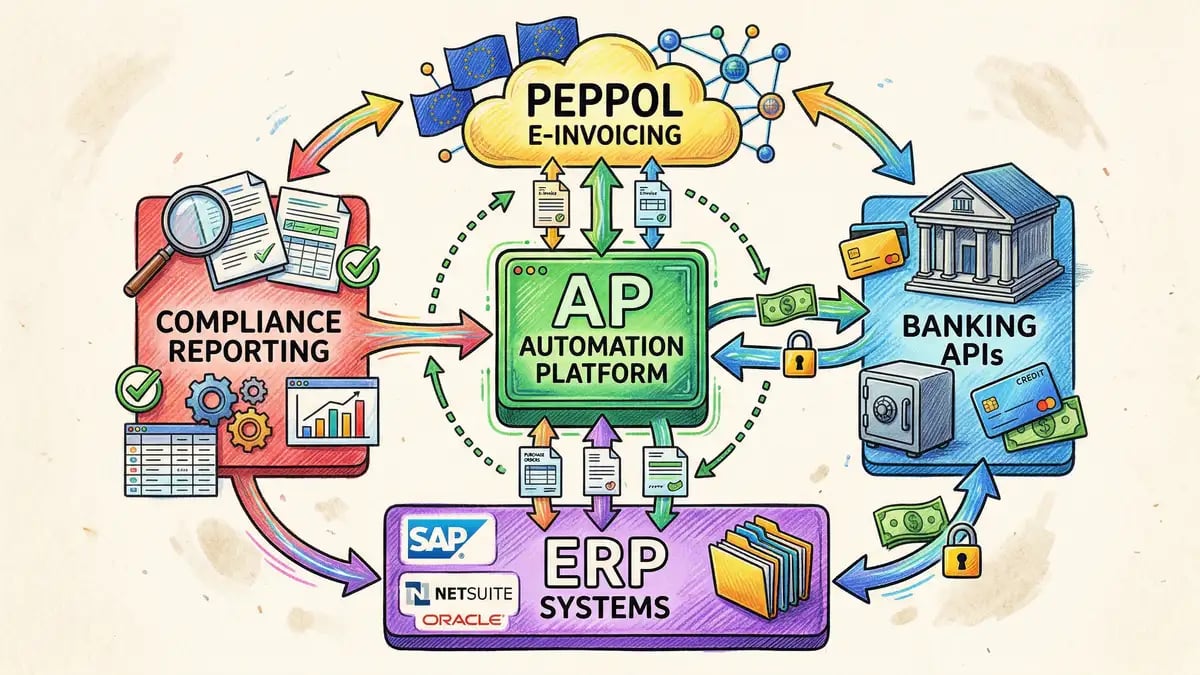
One of the most critical technical decisions in AP automation is integration depth with your existing systems. Finance teams typically operate across multiple platforms: an ERP (SAP, Oracle, NetSuite, Sage Intacct, or Microsoft Dynamics), a general ledger, a procurement system, bank connections, and potentially a separate treasury system for cash management. A poorly integrated AP automation platform becomes an island—with data silos, manual reconciliation, and duplicate entry undermining the automation benefits.
Leading platforms offer integration via multiple pathways. Application programming interfaces (APIs) provide real-time, bidirectional data flow: invoices imported from the AP platform flow directly into your ERP, purchase orders and goods receipts from procurement systems update the AP platform instantly, and payment confirmations write back to your general ledger. Flat-file integrations (CSV uploads and downloads) provide a simpler but more manual fallback. Embedded connectors (pre-built integrations) work out of the box with common systems like SAP, Oracle, and NetSuite; if your ERP is less common, custom integrations add cost and implementation time.
For e-invoicing readiness, integration also means support for structured invoice standards: the PEPPOL network (Pan-European Public Procurement On-Line), which becomes mandatory for UK public sector and many private sector suppliers from April 2029. Basware, Medius, and other platforms with e-invoicing roadmaps offer PEPPOL-native processing; others require additional configuration or third-party middleware. If your supplier base includes government contracts or large enterprises with e-invoicing mandates, confirm your platform's PEPPOL maturity before purchasing.
For bank integration, ensure your platform connects to your primary banking relationship (most UK banks support API-based payment file uploads via the Open Banking standards or proprietary APIs). Some platforms offer embedded payment services (Medius, Tipalti); others require a separate bank connection. Verify latency: does the platform execute payments same-day, or do you need to batch process? For organisations capturing early payment discounts, same-day payment capability is critical.
Regulatory Compliance: MTD, E-Invoicing, and Fraud Prevention
UK finance teams operate within a rapidly tightening regulatory environment. Making Tax Digital Phase Two (MTD) becomes mandatory on 1 April 2026 for most VAT-registered businesses. Mandatory e-invoicing arrives on 1 April 2029. And fraud prevention controls are increasingly expected by auditors, insurers, and board-level risk committees. An AI accounts payable platform, properly configured, addresses all three compliance dimensions simultaneously.
Making Tax Digital Phase Two requires organisations to maintain digital records for tax purposes and file VAT returns directly to HMRC via software that connects to the tax authority's systems. Invoices and supporting documentation must be stored digitally, searchable, and retrievable within audit periods (typically six years). An AP automation platform provides the digital audit trail: every invoice is captured, matched, approved, and paid with complete traceability. Integration with MTD-compliant accounting software (Sage, Intacct, Xero) ensures VAT codes are extracted correctly and VAT returns are accurate. The platform's real-time reporting gives you certainty that your VAT position is correct before the filing deadline.
E-Invoicing Standards and PEPPOL represent the next major regulatory shift. From April 2029, suppliers to public sector and large private sector organisations must issue invoices in structured digital formats (typically PEPPOL-compliant, machine-readable XML rather than unstructured PDFs). This shift will cascade through supply chains: large enterprises will require smaller suppliers to adopt e-invoicing, and those suppliers will expect their technology partners to handle it seamlessly. A platform with native e-invoicing support (Basware, Medius, Tipalti) positions you to operate efficiently in this environment. Platforms without it will require additional middleware or manual intervention, adding cost and friction post-2029.
Fraud Prevention and Control Effectiveness directly reduce your organisation's liability. Invoice fraud cost UK organisations £629.3 million in H1 2025 alone (UKFin data). AI-powered detection systems identify anomalies (unusual vendors, price variations, duplicate submission attempts, payment method changes) that manual review would miss. Most importantly, they create audit evidence. When an anomaly is flagged and a human approver rejects it, the system records the reason and creates a control narrative. This documentation is invaluable during external audit, regulatory investigation, or fraud insurance claims. AI for Accounting explores how these controls integrate with broader financial control frameworks.
Implementation Roadmap: From Assessment to Automation
Rolling out an AI accounts payable solution typically follows a structured 6–8 week implementation programme. Understanding this roadmap helps finance leaders set realistic timelines, allocate resources, and prepare teams.
Assessment and Fit-Gap Analysis (Week 1)
Partner with the platform vendor to understand your current state: invoice volumes, supplier diversity, ERP system, approval complexity, fraud exposure, compliance obligations (MTD, e-invoicing readiness). Identify integration requirements and custom workflow needs. Produce a detailed roadmap and resource plan.
Pilot Programme (Weeks 2–3)
Set up the platform in a test environment. Begin with a subset of invoices (perhaps 5–10% of your volume or a single cost centre/supplier segment). Train a small pilot team on the platform. Run sample invoices through capture, matching, and approval workflows. Validate integrations with your ERP and bank. Measure accuracy of data extraction and approval routing. Refine configuration based on pilot learnings.
Core Team Training and Change Management (Week 4)
Expand training to the full AP team plus key stakeholders from procurement and finance leadership. Cover system navigation, approval workflows, exception handling, reporting, and fraud flagging. Establish governance: who reviews high-risk invoices? How are system alerts escalated? What is the escalation path for exceptions? Develop playbooks for common scenarios (unmatched invoices, missing purchase orders, vendor payment method changes).
Full Production Rollout (Weeks 5–6)
Transition to processing 100% of invoices through the platform. Establish parallel running if desired (continue manual processing for verification during the first week, then switch off once confidence is high). Monitor exception rates, approval cycle times, and accuracy metrics closely. Have a support team on standby to resolve issues. Begin capturing baseline metrics: cost per invoice, processing time, approval cycle time, fraud flags, early payment discounts captured.
Optimisation and Continuous Improvement (Weeks 7–8 and Beyond)
Analyse performance data to identify opportunities for further automation. Are certain invoices regularly hitting exceptions? Adjust three-way matching tolerances or approval routing rules. Is fraud detection creating false positives that slow approval? Retrain the model with additional historical context. Begin planning Phase 2: expanded integration with other finance processes (procurement, expense management, payroll), or expansion to subsidiary companies.
The parallel running approach (continuing manual processing during the first week of full rollout) provides risk mitigation and confidence. However, it doubles workload temporarily; many organisations skip parallel running and instead establish a high-touch support team to resolve exceptions quickly. Either approach is valid; the choice depends on your risk tolerance and resource availability.
Measuring ROI: Metrics That Matter
Implementation success requires clear measurement. Before going live, establish baseline metrics from your manual process and define targets for the automated environment. These metrics should align with your primary business drivers: cost reduction, cash optimisation, or risk mitigation.
Cost Reduction Metrics are the most straightforward. Capture the cost per invoice in your current manual process: include staff time (capture, data entry, matching, exception investigation), management overhead, systems, and fraud losses. Most UK mid-market organisations spend £8–£12 per invoice. AI automation typically reduces this to £1.50–£2.50, a 70–80% reduction. On 50,000 invoices annually, this yields £325,000–£500,000 in annual savings. Track this monthly post-implementation to validate attainment.
Processing Time directly affects working capital and cash forecasting visibility. Manual invoice processing typically takes 9–12 days (invoice receipt to payment initiation). Best-in-class automated operations achieve 3–5 days. Measure invoice age (days from receipt to payment) pre- and post-implementation. Faster processing enables better early payment discount capture and reduces aged payable exposure.
Early Payment Discount Capture is a hidden opportunity in many organisations. Manual teams capture perhaps 21% of available discounts (2/10 net 30 terms) owing to workflow delays. AI systems achieving 85–95% capture on a £20 million annual spend yield £300,000–£400,000 in additional cash savings. This is particularly valuable if your organisation operates with tight cash constraints. Track discount capture rate monthly and compare pre- versus post-implementation.
Error Rates and Fraud Exposure track quality and control effectiveness. Baseline manual AP operations typically show 5%+ error rates (incorrect coding, duplicate invoices, mismatched quantities). AI systems reduce this to 0.8–0.9%. More importantly, fraud detection flags increase visibility into attempted fraud: a system that catches one fraudulent invoice attempt per month per 10,000 invoices is providing real risk reduction. Measure fraud flags (and resolutions) monthly and discuss trends with internal audit and management.
Compliance and Audit Readiness are less frequently measured but equally important. Track documentation completeness (are all invoices captured with searchable metadata?), audit trail quality (can you explain the approval decision for any invoice in 30 seconds?), and MTD/e-invoicing readiness (do your VAT codes match tax records automatically?). These metrics reduce audit scope and external audit costs; factor that savings into ROI calculations.
Challenges and Mitigation Strategies
No accounts payable automation implementation is friction-free. Anticipating common challenges and planning mitigation strategies increases the likelihood of successful, durable change.
Supplier Adoption and Invoice Format Diversity remains the primary implementation challenge. If your suppliers are not sending invoices in structured formats, the AI platform must ingest PDFs, scanned images, and email-embedded invoices. Modern OCR handles this well, but accuracy depends on image quality and invoice layout variability. Mitigation: during implementation, actively encourage suppliers to adopt structured formats (API submissions, e-invoicing templates). Offer technical support or incentives (discounts, faster processing). For high-volume suppliers, direct API integration eliminates format variability entirely. For difficult suppliers, accept that some manual intervention may persist; the goal is 70–90% touchless, not 100%.
Data Quality in Existing Systems often delays automation. If your ERP contains duplicate vendors, missing purchase orders for historical orders, or inconsistent tax codes, the AI system struggles to match and validate. Mitigation: schedule a data cleanup sprint before rollout. Audit your vendor master for duplicates and consolidate. Backfill missing purchase orders. Standardise tax code naming. This upfront investment (typically 2–3 weeks of effort) dramatically improves automation efficiency post-go-live.
Change Management and Staff Resistance emerge when AP teams perceive automation as a threat to job security. This concern is worth addressing directly. In reality, AI AP automation typically allows AP teams to shrink by 20–30% (not 80–90%), and the remaining headcount shifts from data entry to higher-value work: vendor management, dispute resolution, fraud investigation, and strategic supplier relationship management. Communicate this clearly early. Involve staff in pilot design and training. Show how the platform reduces boring, repetitive tasks. If headcount reduction is planned, announce timeline and support (redeployment, training, severance) transparently.
Exception Handling and Approval Bottlenecks can emerge when the system flags too many invoices as requiring human judgment (unmatched, unusual, fraud-flagged). If approval is not staffed adequately, exceptions accumulate and processing slows. Mitigation: configure approval routing conservatively at launch. Flag only high-risk invoices for escalation. Allow operators to approve routine exceptions (small price variances, missing PO lines) without escalation if historical data supports safety. Continuously retrain the model: if an approver overrides the system's flag consistently, the system should learn that this decision is safe and reduce future escalation.
Preparing for E-Invoicing and Future Regulatory Change
UK finance leaders should view accounts payable automation not as a point-in-time implementation but as the foundation for a modernised finance operating model that can adapt to regulatory change. Making Tax Digital Phase Two (April 2026) and mandatory e-invoicing (April 2029) are the next major milestones. An AI AP platform purchased today should support these transitions without major rework.
When evaluating platforms, explicitly ask about e-invoicing roadmaps. Which platforms have PEPPOL certification already? Which are planning it by Q2 2028? What is the upgrade path for organisations currently on non-PEPPOL versions? For Basware and other e-invoicing-native platforms, e-invoicing is included in the base offering; for others, it may require additional licensing. If your supplier base includes government contracts or large enterprises with e-invoicing mandates, prioritise e-invoicing readiness in your platform selection. If you are a smaller organisation and do not expect e-invoicing relevance until 2029, you have more flexibility, but buying an e-invoicing-ready platform now avoids transition costs later.
Additionally, ensure your chosen platform supports the broader financial transformation opportunity beyond AP. Can it integrate with procurement, expense management, and payroll? Does it provide reporting that feeds into strategic financial planning? The best platforms expand from AP into full procure-to-pay and even procure-to-settle (including procurement-side compliance). Planning for this expansion now avoids vendor lock-in and duplicative tool sprawl later.
Frequently Asked Questions on AI Accounts Payable Automation
How long does it typically take to implement an accounts payable automation platform?
Implementations typically span 6–8 weeks from assessment to full production rollout, assuming your ERP integration is straightforward and your team is available for training and parallel running. Organisations with complex multi-entity structures, legacy systems with custom integrations, or significant data cleanup needs may require 12–16 weeks. Avoid extending implementation beyond 12 weeks; longer timelines reduce stakeholder confidence and increase cost.
Will the AI system work with our existing ERP system?
Virtually all AP automation platforms integrate with major ERP systems (SAP, Oracle, NetSuite, Sage Intacct, Microsoft Dynamics) via pre-built connectors or APIs. If you are running a less common ERP, integration complexity increases and costs rise. Request detailed integration documentation from your chosen vendor. Ask for customer references using your ERP. If no pre-built connector exists, determine the effort and cost of custom API development before committing to a platform.
What percentage of our invoices can the system process without human intervention?
Best-in-class implementations achieve 70–90% touchless processing, meaning invoices that require zero manual review from receipt to payment initiation. The remaining 10–30% require human exception handling: unmatched invoices (no matching purchase order), price variances outside tolerance, fraud flags, missing supporting documents, or new vendors. Touchless rate depends on your supplier diversity, invoice complexity, and approval rule configuration. Homogeneous supplier bases (large enterprises with well-organised invoicing standards) achieve higher touchless rates; fragmented supplier bases with small suppliers, invoices embedded in emails, and complex multi-line invoices achieve lower rates. Plan conservatively: assume 65–75% touchless at launch, increasing to 80–85% by month 4 as the system trains on your patterns.
How does the system detect and prevent invoice fraud?
AI AP systems detect fraud through multiple mechanisms. Duplicate detection flags invoices with the same vendor, number, and amount submitted within a short timeframe (common fraud pattern). Vendor anomaly detection identifies unusual payment methods, bank account changes, or name variations (wire fraud indicators). Amount anomaly detection flags invoices that deviate significantly from the supplier's historical average (sudden spike in spend). AI models trained on external fraud datasets detect known fraud signatures. Human approvers review flagged invoices; their decisions retrain the model, improving future detection. Most platforms also integrate with your ERP's three-way matching, which catches unmatched invoices and quantity overages. The combination of rule-based detection (duplicates, rule violations) and AI-driven anomaly detection provides layered fraud protection.
Can the system handle invoices from international suppliers in different languages?
Modern OCR systems support 100+ languages and can extract data from invoices in any language. However, semantic understanding (matching invoice line item descriptions to your purchase orders, validating tax codes, understanding approval rules) requires language and localization support. If you have significant European supplier bases, platforms like Medius, Basware, and Tipalti offer multilingual support out of the box. If your invoicing is primarily UK/English-language, most platforms work fine; explicitly ask your vendor about non-English language support before purchasing if international suppliers are material to your business.
What happens to our current AP staff when we automate invoicing?
Accounts payable automation typically reduces FTE headcount by 20–30%, not 80–90%. The remaining staff shift from data entry and routine exception handling to higher-value activities: vendor management, dispute resolution, fraud investigation, and working capital optimisation. Some organisations redeploy AP staff into procurement compliance (ensuring invoices match purchase orders), supplier relationship management, or accounts receivable (if implementing broader P2P automation). Others allow headcount to remain stable and use automation benefits to handle growth without hiring. Transparent communication about headcount plans (even if reductions are planned) helps retention during and after implementation. The market for AP talent remains tight; if you want to retain experienced staff, offer redeployment and training opportunities rather than redundancy.
Conclusion: Building Your Finance Function for the Next Decade
Accounts payable automation represents a watershed moment for UK finance functions. The convergence of regulatory change (MTD, e-invoicing), talent scarcity (AP staff difficult to retain), fraud risk (£629.3 million in UK invoice fraud losses in H1 2025), and economic pressure (cost reduction imperative) makes AI-powered automation not a "nice to have" but a strategic necessity. Organisations that automate AP in 2026 will gain 2–3 years of operational advantage before e-invoicing arrives; those that wait until 2028 or 2029 will scramble to upgrade systems and processes under tight regulatory deadlines.
The financial case is undeniable: 70–80% cost reduction, 700% first-year ROI, and payback within 6–9 months. The operational case is equally strong: 85–95% early payment discount capture, fraud exposure reduction, and real-time cash visibility. And the strategic case is perhaps most compelling: modernising AP creates the operating model for adjacent finance automation—procurement, expense management, financial reporting, and strategic planning all benefit from the infrastructure and data foundations you establish now.
Selecting and implementing an AI accounts payable platform requires careful platform evaluation, realistic timelines (6–8 weeks for mid-market organisations), clear metrics definition, and honest change management. But the organisations that commit to this transformation—whether with Medius, Sage Intacct, Tipalti, Quadient, Yooz, or Basware—will emerge with finance functions positioned for the next decade of regulatory, technological, and economic change.
Related reading: AI for Accounting, AI for Financial Forecasting, AI for Expense Management, AI for Regulatory Reporting, AI for Treasury Operations, and AI for Audit and Internal Controls. For finance transformation strategy and change management guidance, see AI for Finance and Accounting.
Automate Your Accounts Payable with Confidence
Helium42 delivers AI implementation that reduces invoice processing costs by 70–80%. From assessment to deployment in 6–8 weeks.
Sources: HMRC Making Tax Digital documentation (gov.uk); PEPPOL e-invoicing standards (PEPPOL Authority); UK Finance fraud data (UKFin, H1 2025); Gartner AP automation market analysis (2025–2030); Forrester procure-to-pay benchmarking; vendor documentation (Medius, Sage Intacct, Tipalti, Quadient, Yooz, Basware); ICAEW financial controls guidance; Helium42 client implementation data (2024–2026).