

Published by

Artificial intelligence is fundamentally transforming UK retail and e-commerce, automating customer personalisation, inventory forecasting, and supply chain operations at scale. Today, thirty-five percent of UK shoppers actively use AI tools for shopping decisions, whilst eighty percent of retailers forecast AI-driven online sales growth in 2026, yet only thirty-one percent have achieved positive ROI to date. Success requires strategic implementation focused on measurable operational efficiency rather than technology adoption alone.
The retail landscape has shifted seismically. Online sales accounted for fifty point five percent of all UK card spending in September 2025, up from forty-three point seven percent in 2019. Within this digital context, AI represents not a future opportunity but an operational imperative. Retailers who implement AI strategically—combining customer personalisation, demand forecasting, and intelligent logistics—achieve measurable improvements in conversion rates, inventory efficiency, and customer lifetime value. This guide examines how UK retailers are deploying AI across operational and customer-facing functions, evaluates the economic case for AI investment, and provides a strategic roadmap for retail leaders planning AI transformation in 2026.

How Is AI Transforming Personalisation and Customer Experience in UK Retail?
AI-driven personalisation directly increases customer spending. Sixty-seven percent of consumers report increased spending when personalisation matches their needs, whilst sixty-nine percent spend more when AI introduces new products they hadn't previously considered. Modern AI systems analyse browsing history, purchase history, device information, time-of-day patterns, and external factors including weather and local events to deliver contextualised product recommendations in real time.
ASOS, the major UK fashion e-tailer serving seventeen million active customers, has partnered with Microsoft Azure OpenAI to introduce conversational shopping tools that help customers narrow choices within fashion categories and receive tailored recommendations based on individual browsing patterns. Tesco similarly deploys AI-powered systems to analyse customer segments and tailor promotions for customers passing store locations, with particular focus on attracting non-regular customers through personalised incentives. When UK retailers implement sophisticated personalisation systems, they observe measurable improvements: conversion rates increase between thirty-five and fifty percent through personalised advertising at critical customer journey moments, whilst reducing wasted marketing spend through improved audience targeting.
Key Takeaway
Personalised retail experiences drive measurable revenue uplift. Retailers who leverage AI to match product recommendations to individual customer context and preferences observe thirty-five to fifty percent improvements in conversion rates, directly translating to increased customer lifetime value and reduced marketing waste.
What Role Does AI Play in Inventory Optimisation and Demand Forecasting?
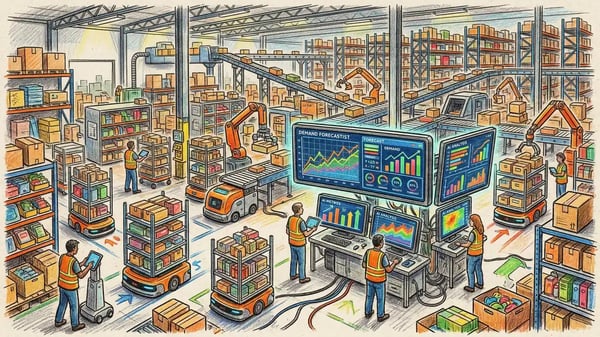
Inventory management represents a critical operational area where AI delivers measurable return on investment through dynamic demand forecasting. Traditional inventory systems rely on historical data and static forecasting models that perform poorly when consumer behaviour shifts rapidly. A UK convenience store chain deployed machine learning to analyse over three hundred factors influencing supply chain availability—including weather patterns, current events, and influencer social media activity—to improve product availability and reduce costly stockouts. The financial benefits extend beyond waste reduction: retailers achieving ninety-five percent forecast accuracy instead of eighty percent experience fewer markdowns on aged stock, more rapid inventory turnover, and improved working capital.
For grocery retailers, demand forecasting excellence becomes critical where perishable goods deteriorate rapidly and forecasting errors directly impact both waste and customer satisfaction. Tesco applies machine learning across its estate to determine optimal timing for daily replenishments of dairy and perishable products to minimise waste. National pharmacy chains utilise AI to forecast demand for specific items based on national epidemiological trends—such as vaccine demand tracked through federal government reporting—enabling them to maintain appropriate stock levels without overstocking seasonal medications. The operational implication is clear: retailers competing in thin-margin environments where efficiency improvements directly enhance profitability have prioritised demand forecasting AI investment accordingly.
35-50%
Conversion rate uplift from personalisation
80%
UK retailers forecasting AI-driven sales growth
95%
Target forecast accuracy for inventory optimisation
51%
Online share of UK card spending (2025)
How Can UK Retailers Implement AI-Powered Warehouse and Supply Chain Automation?
Warehouse automation using AI represents a frontier technology where UK retailers address critical labour shortages. Ocado, the UK's leading online-only grocer, pioneered AI-powered robotic picking systems that address the fundamental challenge in grocery logistics: product variability. Unlike standardised manufacturing items that traditional robots handle readily, groceries present extraordinary complexity. Soft fruits, glass jars, frozen goods, and ambient products each require different handling techniques, grip pressures, and movement patterns. Ocado's On-Grid Robotic Pick (OGRP) system combines computer vision, machine learning, and smart sensors to enable robots to learn from human demonstrations through behaviour cloning, then improve performance through reinforcement learning based on outcome data.
The operational results are substantial. Ocado reports that OGRP picked over thirty million items in 2024, delivering significant productivity gains with only small numbers of robotic arms deployed. As Ocado expands OGRP deployment across facilities, the system contributes learnings across its entire robot fleet, creating a collective intelligence effect where improvements identified by one robot inform operational enhancements across all units. This capability addresses a critical gap in warehouse automation: whilst manufacturing has benefited from robotics for decades, grocery and general merchandise fulfilment remained labour-intensive because of product variability. AI-powered systems now enable automation precisely in sectors where human labour shortages create the greatest operational challenges, with direct implications for delivery reliability and cost-to-serve reduction.
Strategic Consideration
Implementing warehouse robotics requires substantial capital investment and technical expertise. UK retailers should prioritise high-volume, high-variability operations where automation delivers greatest return on investment. Partnership with experienced implementation vendors and phased pilot programmes reduce deployment risk and enable validation of financial projections before full-scale investment.
Explore how Helium42 helps retail businesses implement AI—from strategy to deployment. Our education-led approach builds internal capability whilst delivering measurable efficiency gains in 6-8 weeks.
Learn About AI Implementation
What Visual Search and Computer Vision Capabilities Can Retail Unlock?
Visual search technology has emerged as a significant application area in fashion and apparel retail, where customers often seek products inspired by visual references. Visual search engines use computer vision and AI to analyse images, recognising shapes, colours, and details to identify similar products in retailer catalogues, removing the friction of translating visual inspiration into search terms. The commercial impact is quantifiable: visual search drives six point four percent of e-commerce revenue for early adopters, and platforms deploying visual search technology observe measurable improvements in conversion rates and average order values. Stuarts London, a specialist London-based retailer, observed an eight point nineteen percent increase in conversions through implementation of visually similar search technology, demonstrating concrete commercial viability.
The customer experience benefits extend beyond pure efficiency. When customers can simply photograph or upload an image of desired items, then immediately discover similar products available for purchase, the shopping experience feels more intuitive and personalised. This appeal is particularly pronounced amongst younger demographics: sixty-two percent of Generation Z and millennial consumers express interest in visual search capabilities. For fashion retailers operating at massive scale with hundreds of thousands of products, visual search integration becomes strategically important, as traditional text-based search becomes increasingly challenging for customers seeking inspiration-driven rather than specification-driven products.
How Do Chatbots and Conversational AI Enhance Customer Engagement?
Conversational AI through chatbots and virtual assistants has become ubiquitous across UK e-commerce, with implementations ranging from simple script-based customer service bots to sophisticated agentic systems capable of independent decision-making. For customer service applications, chatbots provide instant responses to routine queries, eliminating wait times and freeing human agents for complex issues requiring judgment and empathy. UK businesses typically experience three times higher lead capture rates with AI chatbots compared to static contact forms, and AI chatbots can reduce customer service wait times by up to sixty percent by collecting initial information and routing customers to appropriate human agents with context.
More sophisticated implementations move beyond customer service to encompass agentic commerce, where AI systems actively assist customers throughout the shopping journey. Instacart, operating across UK and US markets, integrates personalised AI assistants into its search interface that interpret natural language queries to suggest relevant products and recipes, then build shopping carts automatically from customer prompts. Amazon's Rufus assistant similarly supports shopping by providing comparative insights on products, helping customers navigate complex categories through conversational interfaces rather than requiring them to manually compare product pages. For UK retailers, the strategic implication is clear: customers increasingly expect to interact with brands through conversational interfaces, and those who provide sophisticated conversational shopping experiences gain competitive advantage in capturing customer attention within AI-native platforms like ChatGPT and Google Gemini.
What Are the Commercial and Regulatory Considerations for Dynamic Pricing?
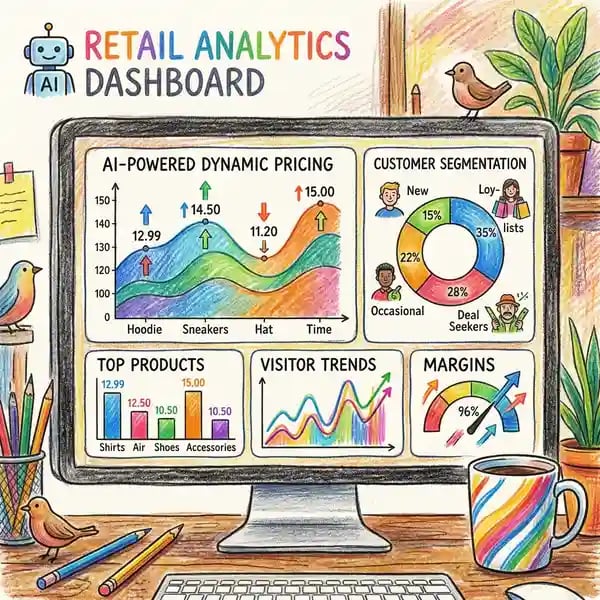
Dynamic pricing—the practice of adjusting product prices based on demand, supply, inventory levels, competitor pricing, and customer characteristics—has become increasingly prevalent in UK retail as AI systems enable real-time price optimisation at scale. However, the UK Competition and Markets Authority (CMA) has actively monitored dynamic pricing practices, publishing guidance distinguishing between legal dynamic pricing that improves efficiency and consumer outcomes, and problematic pricing that exploits vulnerable consumers or undermines informed decision-making. The CMA's framework identifies several characteristics indicating pricing likely to harm consumers: when consumers are unaware dynamic pricing is occurring, when they feel pressured to make quick decisions due to rapidly rising prices, when vulnerable consumers face disproportionate disadvantage, or when dynamic pricing enables firms to obtain or maintain market power.
This regulatory environment shapes how UK retailers deploy pricing AI. Retailers must implement transparent dynamic pricing that clearly communicates prices can change, explains what factors drive changes (for example, that prices increase closer to booking dates), and provides price ranges so customers understand whether items could become unaffordable if they wait. The CMA has signalled it will use enforcement powers under the Digital Markets, Competition and Consumers Act to challenge pricing that provides objectively false pricing information or employs aggressive tactics targeting vulnerable populations. This regulatory clarity creates opportunity for retailers who implement dynamic pricing transparently: such implementations improve efficiency whilst maintaining customer trust, potentially differentiating transparent retailers from competitors employing opaque pricing tactics. Understanding the business case for AI investment requires careful evaluation of both efficiency gains and regulatory compliance costs.
| AI Application | Primary Benefits | Implementation Considerations |
|---|---|---|
| Personalisation | 35-50% conversion uplift, improved customer lifetime value | Requires unified customer data platform, cookie compliance |
| Inventory Forecasting | Reduced waste, improved working capital, better availability | Historical data quality critical, seasonal adjustments required |
| Warehouse Automation | Labour efficiency, supply chain resilience | High capital cost, lengthy ROI, requires technical expertise |
| Visual Search | 6.4% incremental revenue, 8%+ conversion improvement | Requires extensive product image library, category-specific |
| Conversational AI | 3x lead capture, 60% wait time reduction | Hallucination risks, integration with knowledge systems |
What Investment and ROI Should UK Retailers Expect From AI Implementation?
AI software development costs in the UK vary substantially depending on project scope, technology complexity, and required capabilities. Basic AI integration involving simple machine learning algorithms and standard UI/UX design typically costs twenty-one thousand to eighty thousand pounds, whilst advanced solutions incorporating deep learning, natural language processing, computer vision, and sophisticated security features approach or exceed four hundred thousand pounds. Security features significantly impact development costs, with basic security (SSL, firewalls) adding five thousand to ten thousand pounds, whilst advanced security with encryption and secure access controls ranges from twenty thousand to sixty thousand pounds. GDPR compliance and advanced compliance audits add five thousand to fifty thousand pounds depending on data processing scope and regulatory requirements.
However, development costs alone represent only one component of total AI investment. Implementation costs, staff training, ongoing maintenance, and vendor licensing compound initial development expenses. For UK retailers, the critical metric is return on investment timing. Organisations implementing AI report substantial operational improvements within 6-8 weeks when focused on clearly defined problems with measurable success metrics. Helium42's proven approach combines education-led capability building with implementation support, enabling retailers to achieve measurable efficiency gains whilst developing internal expertise that reduces long-term dependency on external consultants. The evidence suggests that success depends not on technology selection alone, but rather on strategic alignment, clear success metrics, and organisational commitment to behaviour change alongside technology deployment.
Significantly, only thirty-one percent of UK businesses implementing AI report positive return on investment outcomes to date. This reality suggests that AI adoption without strategic alignment and clear operational focus frequently fails to deliver value. Retailers should approach AI investment with disciplined expectations: identify specific operational problems with measurable cost impact, define success metrics before implementation, and allocate resources for change management and staff training alongside technology investment. A practical implementation guide can help clarify the pathway from strategy through execution.
Strategic Implementation Roadmap for UK Retailers
Define Specific Operational Problems
Identify 2-3 high-impact operational challenges with quantifiable cost impact (e.g., inventory waste, customer service load, conversion rate limitations).
Establish Clear Success Metrics
Define measurable outcomes before implementation (e.g., 40% inventory reduction, 15% conversion uplift, 50% customer service wait time reduction).
Evaluate Technology and Vendor Options
Assess build vs. buy options, integration requirements, total cost of ownership, and vendor expertise in retail operations.
Pilot and Measure Rigorously
Run 6-8 week pilot programmes with clear success metrics, capturing baseline performance and validating ROI projections before scaling.
Invest in Capability Building
Allocate resources to staff training, change management, and internal capability development so your organisation can maintain and iterate on AI systems independently.
How Do Consumer Behaviours and Personas Influence AI Strategy Selection?
Understanding how different customer segments engage with AI shapes technology strategy. Consumer research has identified four distinct personas characterising how customer segments interact with AI in shopping contexts. AI Delegators, comprising seventeen percent of shoppers, are typically affluent, time-poor millennials who willingly permit AI systems to conduct product discovery, comparison, and even transactional decisions autonomously. This segment represents the highest-value opportunity for retailers who can optimise their product data and pricing structures for algorithmic preference.
AI Collaborators represent thirty percent of shoppers, including young, digitally sophisticated consumers who leverage AI as a trusted co-shopping tool whilst maintaining final decision-making control. AI Selectors constitute another thirty percent, typically older consumers who engage AI occasionally for information or reassurance, viewing it as a helpful secondary resource rather than a primary decision-maker. Finally, AI Skeptics comprise twenty-three percent of the market, representing cost-focused shoppers who make limited use of AI, prioritise low delivery prices over innovation, and maintain traditional shopping habits. Understanding these personas becomes critical for retailers designing customer-facing AI initiatives, as the effectiveness of any AI implementation depends substantially on alignment with target customer segments and their expectations regarding AI's appropriate role in shopping decisions. Aligning AI strategy with customer expectations requires detailed customer research and segmentation.
Book a Free AI Readiness Assessment
Helium42 works with UK retailers to assess AI readiness, identify high-impact opportunities, and create implementation roadmaps aligned with strategic objectives. Our education-led approach builds internal capability whilst delivering measurable results in 6-8 weeks. Discover where AI can drive competitive advantage in your retail operations.
Frequently Asked Questions About AI in UK Retail
What is the average ROI timeline for UK retail AI implementations?
Most retail AI implementations demonstrate measurable operational improvements within 6-8 weeks when focused on clearly defined problems. However, full return on investment timelines vary: personalisation and demand forecasting typically achieve payback within 12-18 months, whilst warehouse automation requires 2-3 years due to higher capital costs. Success depends primarily on starting with high-impact, clearly defined operational problems rather than technology adoption alone.
How can UK retailers ensure AI implementations comply with GDPR and data protection requirements?
GDPR compliance requires retailers to implement data minimisation, obtain explicit customer consent for personalisation, ensure data security, document processing activities, and enable customer data access rights. AI implementations should be designed with privacy by default, use pseudonymisation where possible, and employ data governance frameworks ensuring compliance. Working with experienced implementation partners who understand UK and EU regulatory requirements significantly reduces compliance risk and avoids costly remediation.
What data quality and integration challenges should UK retailers anticipate during AI implementation?
Most retail AI implementations face critical data quality and integration challenges. Customer data often exists in fragmented systems (ERP, CRM, POS, website analytics) with inconsistent formats and standards. Poor data quality directly undermines AI model accuracy: demand forecasting requires consistent historical sales data with proper seasonal adjustment, whilst personalisation requires unified customer profiles across touchpoints. Retailers should prioritise data quality assessment and integration before AI implementation, as data foundation represents typically 30-40% of total implementation cost.
How do UK retailers address skills gaps in AI and machine learning implementation?
Skills gaps represent a critical constraint on AI adoption across UK retail. Few retailers possess in-house expertise in machine learning, data engineering, and AI implementation. Effective strategies include partnering with experienced implementation consultants, investing in staff training programmes, recruiting specialist talent, and building internal capability gradually through mentoring and knowledge transfer. Education-led implementation approaches that prioritise capability building alongside technology deployment help retailers transition from consultant dependency to internal ownership over time.
What steps should retailers take to mitigate algorithmic bias and ensure AI fairness?
Algorithmic bias can lead to discriminatory personalisation, pricing, or hiring outcomes that violate equality law and damage brand reputation. Retailers should implement bias auditing procedures, test AI systems across diverse customer segments to identify performance disparities, document algorithmic decision-making processes, and establish governance frameworks ensuring human oversight of high-impact decisions. Regular model retraining with diverse data samples helps prevent bias drift over time as historical patterns evolve.
How can UK retailers measure and demonstrate AI's contribution to business outcomes?
Measurement requires establishing clear baseline metrics before implementation and rigorous attribution methodologies distinguishing AI impact from other factors. A/B testing allows retailers to compare AI-enabled customer experiences against control groups, directly quantifying conversion uplift and revenue impact. For demand forecasting, measuring forecast accuracy improvements against baseline models demonstrates operational value. Effective measurement frameworks track financial outcomes (revenue, margin, cost reduction) alongside operational metrics (forecast accuracy, inventory turns, service levels), enabling retailers to justify continued investment and iterate implementation strategies.
About the Author
Peter Vogel is an AI transformation strategist at Helium42, working with UK and European organisations to implement practical AI systems that deliver measurable business outcomes. With expertise in education-led implementation approaches, Peter has helped 500+ organisations build internal AI capability whilst achieving 40% average efficiency gains in 6-8 weeks. His approach balances strategic thinking with practical delivery, combining board-level guidance with hands-on implementation support.
Published: March 22, 2026
Sources:
[1] Adyen UK Retail Report 2025 — Consumer AI adoption and shopping behaviour trends across UK retail
[3] Adyen Research — UK consumer AI shopping engagement statistics
[4] Deloitte UK Retail Insights — Personalisation impact on consumer spending and conversion
[5] Office for National Statistics: AI in UK Firms — Business-level AI adoption rates and sectoral variation
[6] Adyen Retail Insights — E-commerce personalisation and conversion metrics
[7] Tidio: Conversational AI for UK E-commerce — Chatbot lead capture and customer service metrics
[8] UK Competition and Markets Authority: Dynamic Pricing Guidance — Regulatory framework for transparent dynamic pricing
[9] McKinsey & Company: Retail Technology Insights — Demand forecasting and inventory optimisation case studies
[10] Shutterstock: Visual Search in E-commerce — Visual search revenue impact and consumer engagement metrics
[13] Ocado: OGRP Robotic Picking Systems — Warehouse automation and supply chain innovation
[16] Statista: AI Software Development Costs UK — Development cost ranges for UK AI implementations
[20] British Retail Consortium: Consumer Trust in AI — UK consumer confidence in AI-assisted shopping
[24] Bank of England: Payment Trends — UK payment method evolution and consumer behaviour shift
[25] HM Treasury: Retail Payments Infrastructure Strategy — UK government payment system modernisation roadmap
[28] Ocado Technology: Machine Learning Implementation — AI deployment in grocery retail operations
[31] Office for National Statistics: AI ROI in UK Businesses — Business return on investment from AI implementations
[32] ASOS: AI-Powered Conversational Shopping — Retail application of generative AI and LLMs
[35] Instacart: AI Shopping Assistant — Agentic commerce and natural language shopping interfaces
[37] Office for National Statistics: Retail Sales Analysis — Online penetration, card spending, and sectoral variation in UK retail
Related Reading
- AI for Sales: Transforming Customer Acquisition and Pipeline Management
- AI for Marketing: Customer Personalisation and Campaign Optimisation
- AI Implementation Guide: From Strategy to Measurable Results
- Building the Business Case for AI: ROI Measurement and Financial Justification
- Best AI Tools for Business: Technology Selection and Vendor Evaluation
For strategic guidance on implementing AI across your organisation, explore Helium42's AI consultancy services. AI for supply chain