

Published by

Procurement teams across UK enterprises are drowning in manual processes. Spend classification, contract extraction, supplier risk assessment, invoice matching, and demand forecasting consume thousands of hours annually whilst delivering inconsistent results. Artificial intelligence is systematically eliminating this waste. The transformation is already underway: 94 percent of procurement executives now use generative AI weekly, yet only 4 percent have achieved large-scale deployment.
This article examines how leading organisations are deploying AI across sourcing, spend management, and supplier operations to achieve measurable outcomes. You will learn the specific use cases delivering rapid ROI, the platforms reshaping procurement operations, the regulatory landscape your organisation must navigate, and the implementation pathways that separate successful transformations from failed pilots.
Generative AI Adoption in Procurement is Accelerating Rapidly
The adoption curve for AI in procurement has shifted dramatically. Procurement executives who deployed generative AI moved from 50 percent in 2023 to 94 percent in 2024 — a 44 percentage point increase in a single year. This is not experimental adoption. These are production deployments solving real operational challenges.
Yet momentum does not equal maturity. Whilst 47 percent of organisations have piloted AI procurement solutions, only 4 percent have scaled those pilots into large-scale deployment. The gap between experimentation and enterprise adoption represents a critical challenge: most organisations lack the data quality, change management, and integration expertise required to move beyond isolated proof-of-concepts.
of procurement executives now deploy generative AI weekly, up from 50% in 2023
Strategic Use Cases Delivering Measurable ROI
Procurement AI achieves impact in six primary use cases, each addressing specific operational bottlenecks and delivering quantifiable returns. These are not theoretical applications — they are deployed across mid-market and enterprise organisations today, producing verifiable savings and efficiency gains.
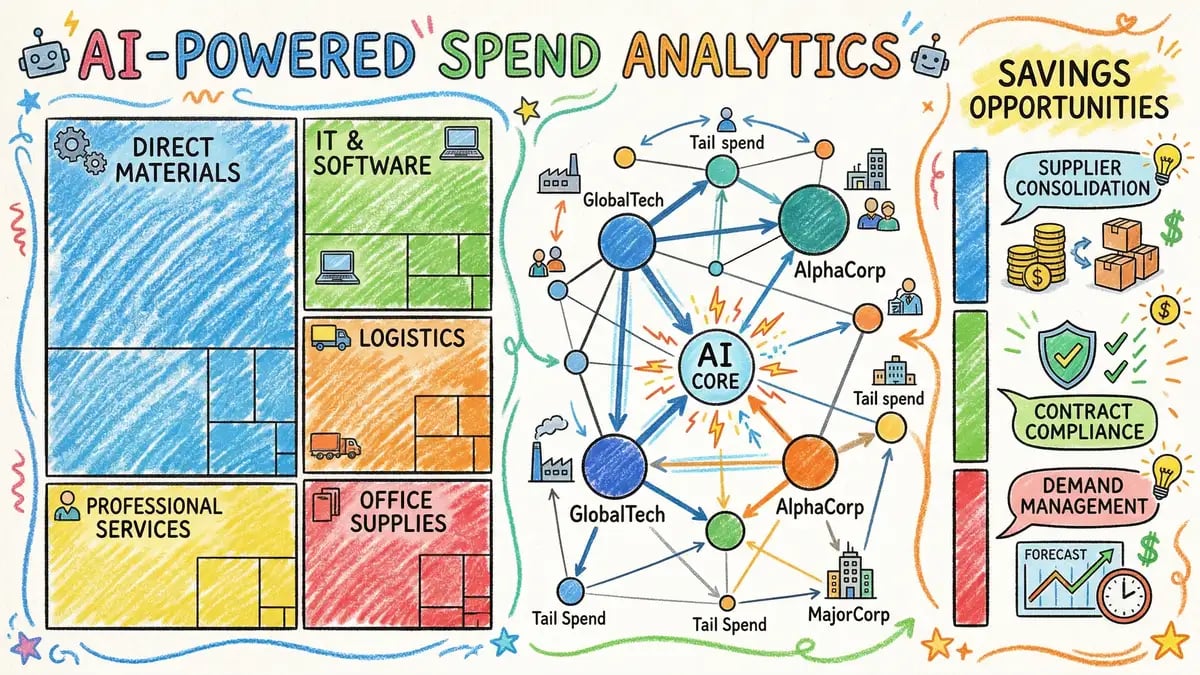
Spend Analytics and Commodity Classification
Organisations cannot optimise what they do not measure. Most enterprises maintain incomplete spend visibility, with critical transaction data scattered across multiple systems, suppliers, and cost centres. Traditional spend analytics requires months of manual classification, rule configuration, and data cleaning.
AI-driven spend analytics algorithms classify transactions in real time, uncovering spend patterns, identifying consolidation opportunities, and surfacing maverick buying. Machine learning models learn from historical categorisation patterns and adapt as new supplier relationships emerge. The outcome: procurement teams identify cost-reduction opportunities 40 percent faster than manual analysis, with category managers shifting from administrative classification to strategic negotiations.
Request for Proposal and Request for Quotation Automation
Creating and distributing RFP and RFQ documents remains a labour-intensive process. Document creation, requirement translation, supplier selection, and response management consume procurement staff time that could be deployed to strategic sourcing. Generative AI automates this workflow.
AI systems generate RFP templates tailored to commodity type, automatically identify relevant supplier pools, distribute documents through integrated procurement systems, and extract key information from supplier responses. One UK logistics company deployed AI-driven RFQ automation and reduced sourcing cycle time from 12 weeks to 4 weeks, cutting procurement costs by 18 percent. The technology learns from previous RFP outcomes, continuously improving supplier suggestions and requirement specifications.
Contract Analysis and Automated Extraction
Contract lifecycle management is a compliance and cost function that procurement teams execute sub-optimally. Organisations struggle to locate critical terms, track renewal dates, monitor compliance obligations, and identify cost escalation clauses embedded in supplier contracts.
AI-powered contract analysis tools extract key information from supplier documents, identify risks, flag renewal dates, and highlight unfavourable terms. Natural language processing algorithms identify payment terms, service level agreements, liability clauses, and termination conditions. For procurement teams managing thousands of active supplier contracts, this automation reduces administrative overhead by 60 percent and reveals cost optimisation opportunities worth 3-5 percent of total contracted spend.
Purchase Order Automation and Three-Way Matching
Invoice processing remains a manual, error-prone function. Finance and procurement teams reconcile purchase orders, receiving documentation, and supplier invoices to ensure accuracy and prevent duplicate payments. This three-way matching process consumes time and introduces errors.
AI-driven invoice processing automates extraction of invoice data, automatic matching with corresponding purchase orders and goods receipts, and exception escalation when discrepancies arise. Implementation across mid-market organisations reduces invoice processing time from 5-7 days to same-day or next-day processing, eliminates 80 percent of manual reconciliation effort, and prevents payment disputes that damage supplier relationships.
Demand Forecasting and Supply Planning
Procurement responds to demand signals generated upstream. Inaccurate demand forecasts create purchasing inefficiencies, excess inventory, stockouts, and supply chain volatility. Traditional forecasting models struggle with seasonal variation, promotional impacts, and market disruption.
Machine learning demand forecasting integrates sales pipelines, historical purchasing patterns, market signals, and external data (economic indicators, commodity prices, supplier capacity) to generate accurate, probabilistic demand forecasts. Organisations deploying these systems reduce safety stock by 15-25 percent, improve forecast accuracy by 30-40 percent, and optimise working capital by reducing excess inventory.
Supplier Risk Monitoring and Predictive Assessment
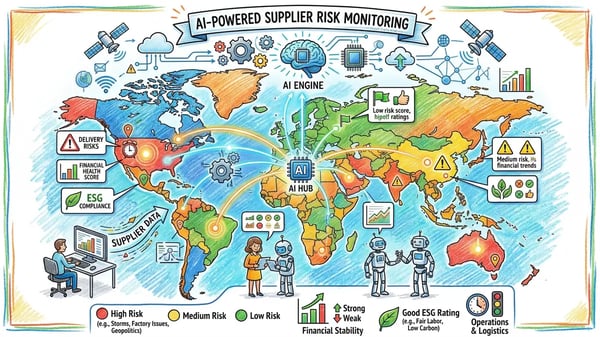
Procurement teams bear supplier risk but lack real-time visibility into supplier financial health, operational capacity, compliance status, and geopolitical exposure. Traditional supplier risk assessment is reactive — organisations discover supplier problems when orders are missed or quality fails.
AI-driven supplier monitoring continuously evaluates supplier performance across financial metrics, regulatory compliance, sustainability reporting, and operational indicators. The system flags emerging risks, identifies secondary supplier options, and alerts procurement leaders to concentration risk before supply disruption occurs. Organisations using supplier risk AI reduce unplanned supply disruptions by 35-45 percent and mitigate reputational risk from supplier compliance failures.
Major Procurement Platforms Integrating AI Capabilities
The procurement platform market is consolidating around a core set of vendors that dominate enterprise procurement technology, each integrating AI capabilities into core sourcing, contracting, and payment workflows. Understanding platform positioning, capability maturity, and roadmaps is essential for organisations planning technology investments.
Coupa Software commands the mid-market to mid-enterprise segment with its unified source-to-pay platform. Coupa's AI suite includes spend analytics, contract obligation extraction, invoice exception detection, and supplier performance prediction. The platform's machine learning models operate on transaction datasets spanning millions of transactions, providing statistical power for accurate predictions.
SAP Ariba dominates the enterprise segment and has developed Joule, an AI agent designed to reduce procurement process steps. Joule handles request processing, approval routing, and supplier communication through a conversational interface. The technology represents SAP's strategic commitment to agentic AI in procurement workflows.
JAGGAER has launched its agentic platform, JAI, positioning itself as a specialist in complex procurement environments (aerospace, defence, manufacturing). The platform handles complex sourcing scenarios where human judgment remains critical but AI agents accelerate document preparation, compliance verification, and risk assessment.
GEP (Global eProcurement) operates GEP SMART (software) and has released GEP Qi, an AI assistant providing on-demand procurement guidance. The platform specialises in category management, supplier consolidation, and spend visibility for global procurement operations.
Ivalua serves the enterprise market with integrated spend management and has developed AI-driven savings detection capabilities. The platform identifies savings opportunities across spend categories, automates compliance checks, and enables spend analytics across complex organisational structures.
Emerging agentic platforms including Levelpath (focused on healthcare procurement) and Fairmarkit (algorithmic sourcing and supplier intelligence) are gaining traction in specialist markets. These platforms demonstrate that procurement AI is not limited to incumbent vendors — new entrants can compete by solving specific procurement challenges with superior technology.
UK Regulatory Environment Shaping Procurement AI Implementation
Procurement AI does not operate in a regulatory vacuum. UK regulations increasingly mandate transparency, supplier diversity, sustainability reporting, and ethical sourcing. Your AI deployment must navigate this landscape or face compliance risk and reputational damage.
The UK Procurement Act 2023 represents the most significant reform of UK public procurement in two decades. The Act introduces value-for-money principles that extend beyond price, mandates supplier diversity and small business engagement, and requires transparency in procurement decisions. AI systems deployed to support public procurement must be auditable and explainable — particularly when algorithms make determinations affecting supplier eligibility or scoring.
NHS Slavery and Human Trafficking Regulations 2025 impose mandatory due diligence requirements on NHS suppliers. Organisations providing goods or services to the National Health Service must demonstrate supply chain transparency and prove that procurement processes identify and exclude suppliers with slavery and trafficking risk. AI systems that can extract and analyse supplier modern slavery statements accelerate this compliance process.
European Union Procurement Modernisation Directives require EU member states (relevant for UK organisations with EU operations) to prioritise circular economy principles, climate considerations, and social value in procurement decisions. AI systems must be able to evaluate suppliers on sustainability criteria, track Scope 3 emissions, and report ESG impact alongside traditional cost and quality metrics.
For organisations operating across multiple jurisdictions, compliance complexity increases substantially. Your procurement AI strategy must account for jurisdiction-specific requirements and build flexibility to meet different regulatory standards across markets.
Data Quality as Foundation and Barrier
AI systems deliver value proportional to the quality of data they ingest. Procurement data is notoriously messy: supplier names vary across systems, cost centres lack consistent structure, commodity coding is incomplete or inconsistent, and transaction histories include errors and duplicate entries.
Organisations undertaking procurement AI transformation must treat data quality as a strategic priority, not an operational afterthought. This requires investment in data governance, master data management, and historical data cleanup. The organisations achieving fastest ROI are those that address data quality before deploying AI systems, not after.
Specific data quality imperatives include standardising supplier master data across all systems, ensuring consistent commodity coding aligned to recognised taxonomies, establishing cost centre and general ledger account mapping, and validating transaction completeness. Organisations that skip this foundation consistently report disappointing AI results.
Integration Complexity and Legacy System Architecture
Most organisations operate procurement across multiple legacy systems. Enterprise resource planning systems handle transactional purchasing, contract management platforms store supplier agreements, supplier information management systems manage supplier data, accounts payable systems process invoices, and analytics platforms support reporting. This fragmented architecture creates integration challenges for AI platforms.
AI procurement solutions require access to data across multiple systems in real time. Integration complexity increases with legacy system age and the number of disconnected systems your organisation operates. Organisations should evaluate integration requirements and associated costs before selecting procurement AI platforms.
Cloud-based procurement platforms reduce integration complexity by centralising procurement data. However, migration from legacy systems introduces risk and requires rigorous change management to prevent disruption to operational procurement.
Change Management and Workforce Capability Development
Procurement AI reshapes how teams work. Buyers transition from transaction execution to strategic sourcing. Invoice processors become payment operations specialists. Data entry roles are eliminated. These shifts generate workforce anxiety and resistance if not managed proactively.
Organisations achieving successful procurement AI adoption invest in change management and upskilling. Category managers require training to interpret AI insights and make strategic decisions. Procurement leaders need governance frameworks to oversee AI systems and understand model decision-making. Frontline staff require clear communication about how their roles evolve and what new capabilities they must develop.
Best-practice organisations position procurement AI as augmentation, not replacement. AI handles routine analysis and exception identification; human procurement professionals apply strategic judgment, negotiate complex contracts, and manage stakeholder relationships. This partnership model reduces workforce resistance and achieves faster adoption.
Sustainable Procurement and ESG Integration
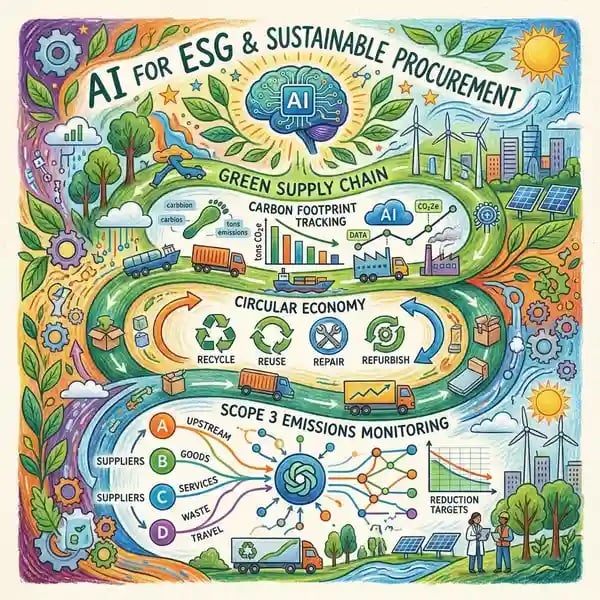
Procurement AI is increasingly applied to sustainability and ESG management. Procurement operations directly influence supply chain sustainability, Scope 3 emissions, and ethical sourcing outcomes. Regulatory mandates across the UK and European Union increasingly require procurement to report on sustainability and ESG metrics.
AI systems extract ESG data from supplier sustainability reports, assess supplier environmental performance against published metrics, calculate Scope 3 emissions embedded in purchased goods and services, and identify suppliers with above-average ESG risk. This capability helps procurement teams balance cost optimisation with sustainability objectives and meet regulatory reporting requirements.
Circular economy integration is an emerging application area. AI systems can evaluate products on lifecycle environmental impact, identify opportunities to extend product lifecycles, and support supplier relationships focused on product-as-service models rather than transactional purchase. As corporate net-zero commitments intensify, this capability becomes strategically important.
Return on Investment and Business Value
Procurement AI delivers measurable return on investment across multiple dimensions. Organisations implementing AI across their procurement function report outcomes including:
- Efficiency Gains: 30-60 percent reduction in manual process time through automation of transaction classification, invoice matching, and contract extraction.
- Cost Reduction: 3-8 percent of total addressable spend through improved negotiations driven by spend visibility and supplier consolidation opportunities.
- Cycle Time Reduction: 40-60 percent faster sourcing cycles through automated RFP generation, supplier scoring, and decision acceleration.
- Inventory Optimisation: 15-25 percent reduction in safety stock through improved demand forecasting and supply planning.
- Working Capital Improvement: Faster invoice processing and exception resolution reduces days payable outstanding and improves cash flow.
- Risk Mitigation: 35-45 percent reduction in unplanned supply disruptions through proactive supplier risk monitoring.
Return on investment typically materialises within 12-18 months of deployment, with payback periods of 18-24 months for comprehensive implementations. Organisations starting with targeted use cases (spend analytics or invoice automation) typically achieve faster payback than those attempting broad-based transformation.
Implementation Pathways and Success Factors
Procurement organisations pursuing AI transformation should follow a sequenced approach rather than attempting simultaneous implementation across all use cases. The most successful implementations follow this pathway:
Phase 1: Foundation. Establish data governance, create master data management practices, define your commodity taxonomy, and audit data quality. This foundation phase requires 2-3 months and establishes conditions for successful AI deployment. Do not skip this phase — organisations that do consistently report disappointing results.
Phase 2: Quick Wins. Deploy AI to a high-volume, low-complexity use case where quality data already exists (spend analytics or invoice automation). Demonstrate business value, build internal AI expertise, and develop change management capability. This phase typically delivers ROI within 6-9 months.
Phase 3: Strategic Scale. Expand AI to more complex use cases (demand forecasting, supplier risk monitoring) now that your organisation has capability and change management experience. Integrate multiple AI applications into cohesive procurement workflows.
Phase 4: Continuous Optimisation. Monitor AI model performance, retrain models on new data, expand to additional categories, and refine processes based on experience. This phase continues indefinitely as AI capabilities mature and new use cases emerge.
Procurement AI Requires Strategic Planning, Not Tactical Point Solutions
Organisations achieve lasting advantage through systematic implementation of AI across the procurement function. This requires executive sponsorship, cross-functional capability building, and sustained investment in data quality and change management. Helium42 works with procurement leadership to design transformation pathways aligned to your strategic objectives and operating environment.
Start Your Procurement AI TransformationStrategic Imperatives for Procurement Transformation
Procurement AI represents a critical capability inflection point. Organisations that systematically deploy AI across sourcing, spend management, and supplier operations will achieve competitive advantage through cost optimisation, faster decision-making, and superior supplier relationships. Those that delay face competitive disadvantage as AI-enabled competitors capture disproportionate value from their supply chains.
Your transformation pathway should begin with clarity on strategic procurement priorities. Are you optimising cost? Improving supplier quality and risk management? Accelerating product development through faster sourcing? Building supply chain resilience? Your AI strategy must align to these priorities, not chase technology for its own sake.
Data quality is a prerequisite, not a consequence of AI deployment. Governance structures, master data practices, and compliance frameworks must be established before AI systems go live. Integration complexity must be assessed honestly — legacy system fragmentation will delay and complicate deployment.
Change management is not optional. Workforce upskilling, stakeholder communication, and clear articulation of how roles evolve will determine adoption speed and sustained value realisation. Organisations that treat AI as augmentation rather than replacement achieve faster adoption and better outcomes.
Finally, procurement AI does not exist in regulatory isolation. Your implementation must navigate UK public procurement requirements, NHS supply chain transparency mandates, European sustainability directives, and industry-specific compliance frameworks. Forward-thinking organisations build regulatory compliance into AI design rather than attempting to retrofit it later.
The transformation of procurement through artificial intelligence is underway. The question is not whether to implement AI in procurement, but how quickly and effectively you can build the capability to compete in an AI-augmented procurement landscape.
Related Reading
Explore how AI transforms related business functions across your organisation:
- AI for Supply Chain and Procurement — Strategic overview of AI applications across the broader supply chain function.
- AI for Finance and Accounting — How finance teams deploy AI in accounts payable, financial planning, and audit.
- AI Compliance in Regulated Industries — Navigating regulatory risk when deploying AI systems in compliance-sensitive environments.
- AI Implementation Guide — Step-by-step pathway for implementing AI across business functions.
- AI Governance Framework — Establishing governance structures to oversee AI systems and manage risk.
- Building the AI Business Case — Financial frameworks for quantifying and tracking AI ROI.