Published by

Artificial intelligence is reshaping education across UK schools and universities at unprecedented pace. According to the latest research, 95 per cent of UK undergraduate students now use AI in at least one form, yet only 31 per cent of students report learning about AI from their teachers. The Department for Education, Ofsted, and university leaders are racing to develop governance frameworks that harness AI's potential to personalise learning whilst safeguarding academic integrity and protecting student data. This comprehensive guide explains how AI is transforming education, which tools are leading adoption, what the regulatory landscape requires, and how institutional leaders should implement AI responsibly.
What Is AI for Education and Why Does It Matter?
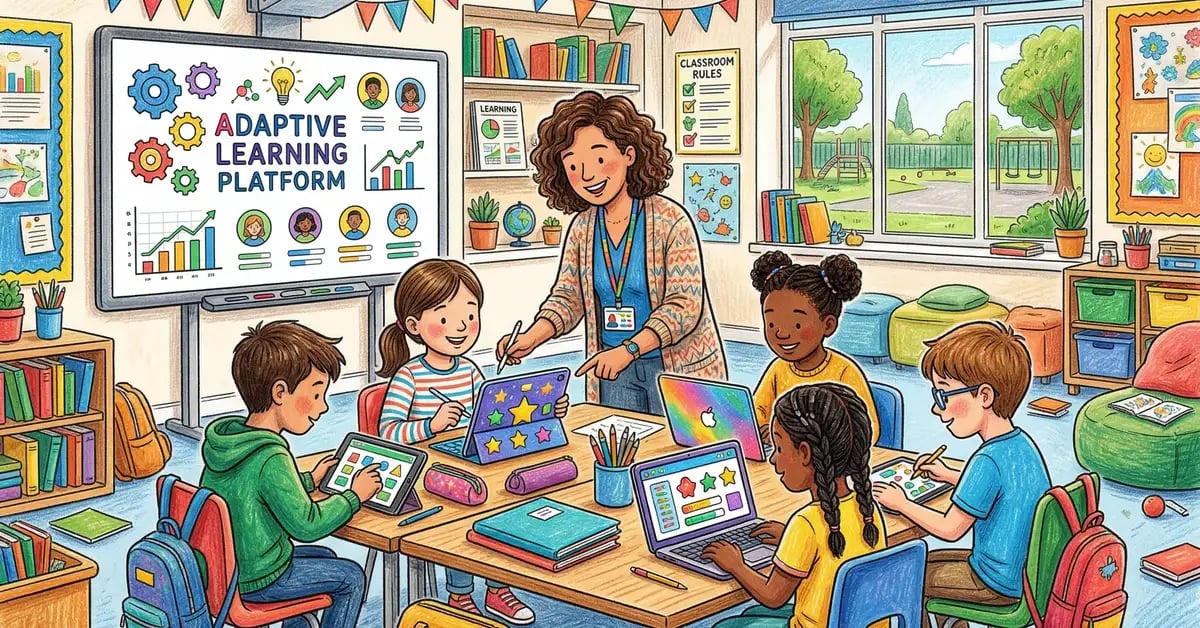
AI for education spans three distinct applications: personalised and adaptive learning systems that adjust content difficulty and pacing to individual students; automated assessment and marking tools that provide feedback at scale; and administrative automation that frees educators from routine tasks. The strategic difference from other sectors is that education involves children, learning outcomes, and academic integrity—which means implementation must balance innovation with safeguarding, data protection, and equity.
The evidence for AI's educational impact is compelling. Adaptive learning platforms such as Century Tech and Adaptemy enable students to progress at their own pace whilst receiving personalised feedback. For students with special educational needs and disabilities, AI-powered text-to-speech tools and speech recognition systems create unprecedented access to learning materials. In assessment, AI marking systems trained on hundreds of real scripts achieve consistency superior to human markers—a 2025 trial showed AI marks deviating by just 0.22 marks from the average human score, compared to 0.55 marks of variance between human markers themselves. Yet widespread student adoption of generative AI tools like ChatGPT has also created risks around academic integrity and assessor workload that educational institutions are still learning to manage.
Key Takeaway
AI for education is not about replacing teachers; it is about augmenting learning. Successful implementation personalises student pathways, provides educators with actionable data, and frees them to focus on mentoring, feedback, and high-value interactions rather than administrative overhead.
How Are UK Schools Using AI in the Classroom?
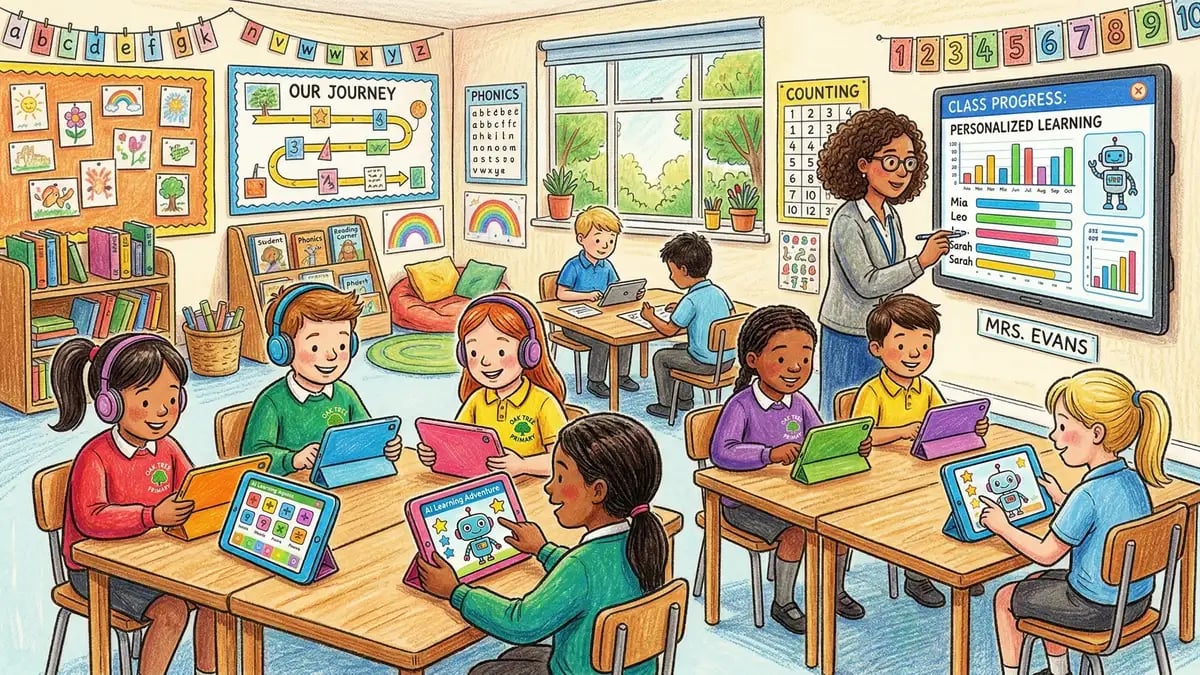
AI adoption across UK schools is accelerating but remains unevenly distributed. Approximately 30 per cent of UK students currently use AI tools within school settings, whilst 35 per cent of students report using generative AI to support their learning—suggesting more students use AI at home than are formally introduced to it in school. This mismatch creates both risk and opportunity.
In secondary schools, the most common AI implementations include:
- Adaptive learning platforms: Century Tech, deployed across many UK schools, personalises content for students from Key Stage 1 to GCSE, adjusting difficulty and pace based on performance data.
- Automated quiz and test generation: Teachers use AI to rapidly create formative assessments, quizzes, and comprehension tests—saving time on lesson preparation whilst maintaining pedagogical rigour.
- Accessibility support: Text-to-speech tools such as Speechify and NaturalReader support students with dyslexia, visual impairments, and motor disabilities, reading content aloud and creating summaries.
- Lesson planning assistance: A Riverside school district pilot showed teachers using AI lesson planning tools saved an average of 6.1 hours per week in preparation time, whilst producing 23 per cent more differentiated materials than before.
- Data analytics and early intervention: Schools are beginning to use AI to identify at-risk students based on attendance, engagement, and assessment patterns, enabling targeted intervention before performance deteriorates.
However, significant equity gaps exist. 31 per cent of private schools offer AI tutors or homework helpers compared to only 17 per cent of state schools—indicating that AI adoption is currently amplifying existing socioeconomic inequalities. The Department for Education's TechFirst Youth programme aims to address this by funding one million secondary school students to learn about technology and AI, with implementation by August 2026.
The critical issue facing secondary schools is not lack of tools but lack of coherent policy. Teachers' use of generative AI has nearly doubled from 31 per cent in 2023 to 58 per cent in 2025, yet 45 per cent of teachers express concern about their pupils using AI, and 66.5 per cent believe generative AI might decrease the perceived value of developing writing skills. This anxiety reflects legitimate uncertainty about academic integrity, the pedagogy of AI-assisted learning, and how to assess work produced with AI support. Schools need clear, evidence-based guidance—not prohibition, but thoughtful integration.
What Are the Most Effective AI Applications in Higher Education?
Higher education is experiencing a faster and more profound transformation than schools. In 2026, 95 per cent of undergraduate students report using AI in at least one form, with 94 per cent specifically using generative AI to help with assessed work. More strikingly, 12 per cent of students report directly including AI-generated text in their assessed work, up from 8 per cent in 2025 and just 3 per cent in 2024—a trajectory indicating near-exponential acceleration.
Universities are responding by reimagining assessment. Rather than ban AI, leading institutions such as University of Birmingham are redefining what academic integrity means in an AI era. Some universities now explicitly permit AI use with attribution; others require AI-free assessments; most have not yet decided. The Quality Assurance Agency is positioning AI literacy as a critical institutional priority, with Russell Group universities developing coordinated principles on academic integrity, assessment design, and student capability.
The most effective applications of AI in higher education include:
Personalised Learning Pathways
Adaptive platforms that adjust content difficulty, pacing, and learning materials based on student performance and learning preferences, enabling students to progress at their own pace whilst receiving intelligent tutoring support.
Automated Assessment and Feedback
AI marking systems trained on hundreds of real scripts provide consistent, rapid feedback to students whilst freeing academics from routine assessment overhead, allowing more time for detailed feedback and discussion.
The Data (Use and Access) Act 2025 and updated UK GDPR requirements create a critical compliance challenge for universities managing student data. The Information Commissioner's Office has introduced strict standards for children's data processing. Research from LSE and 5Rights Foundation uncovered widespread non-compliance by EdTech companies, with a single child accessing teaching resources being tracked by 92 third-party services including Google, TikTok, Facebook, and Amazon. Universities must now verify that all AI and EdTech tools comply with these new standards before deployment.
Critical Insight
Data protection must be designed into AI implementation from the start, not retrofitted after deployment. UK GDPR Article 25 requires institutions to account for children's higher data protection needs at different ages and stages of development—meaning educational AI tools must be fundamentally different from consumer tools.

Which AI Tools Lead in UK Education?
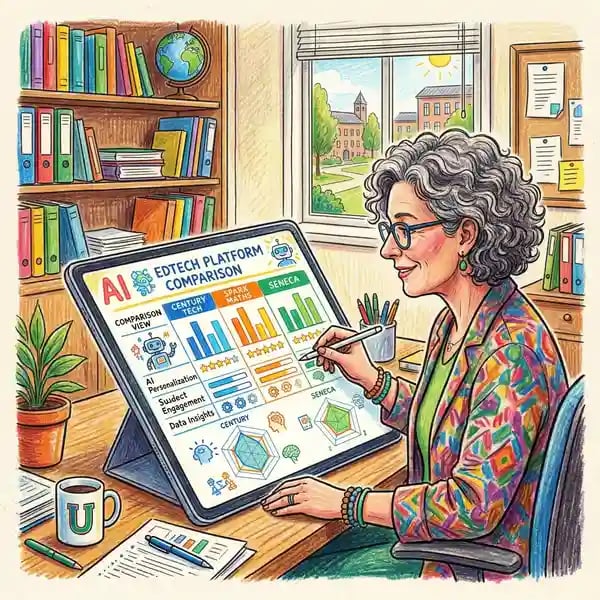
The UK education technology market includes purpose-built adaptive platforms, general-purpose LLMs, and emerging AI marking systems. Each serves different needs across school and university settings.
Century Tech
UK-based adaptive platform integrated with the National Curriculum. Personalises learning across Key Stages 1–GCSE through machine learning, with real-time analytics for teachers. Over 10,000 UK schools registered.
Adaptemy
Deployed across secondary and higher education for mathematics and sciences. Delivers AI-driven personalised learning paths with real-time adaptation, immediate feedback, and detailed teacher analytics on student progress and gaps.
RM Results
UK assessment and marking specialist conducting pilot AI marking trials. 2025 trial showed AI marks deviating only 0.22 marks from average human score, with greater consistency than human markers (0.55 mark variance).
For text-to-speech and accessibility, Speechify and NaturalReader are leading tools. Both use AI to read content aloud with natural prosody, create summaries, and generate outlines—providing critical support for students with dyslexia, visual impairments, and learning disabilities.
General-purpose LLMs such as ChatGPT, Claude, and Google Gemini are now ubiquitous in both schools and universities. Whilst not purpose-built for education, they are used for lesson planning, assignment design, student explanations, and supplementary tutoring. The key is clear institutional guidance on permitted and prohibited uses.
The most critical emerging tool category is AI-powered marking systems. Pearson, Juno Learning, and RM Results are all developing AI marking for GCSE and A-level examinations. The Department for Education gave the green light in June 2025 for teachers to use AI to automate routine marking, provided teachers remain in control. This has immediate implications for workload and assessment turnaround, but requires robust governance.
| Tool Category | Primary Use | Examples | Best For |
|---|---|---|---|
| Adaptive Learning | Personalised learning paths based on student performance and learning preferences | Century Tech, Adaptemy, Knewton Alta | Schools and universities wanting to personalise at scale |
| AI Marking | Automated marking and feedback for formative and summative assessments | RM Results, Pearson, Juno Learning | Reducing teacher assessment workload while maintaining fairness |
| Accessibility | Text-to-speech, speech recognition, content summarisation | Speechify, NaturalReader | Supporting students with disabilities and learning differences |
| General LLMs | Lesson planning, student support, brainstorming, content creation | ChatGPT, Claude, Google Gemini | Supplementary use with clear policies; not assessment |
Note: All tools require data protection due diligence and clear institutional policies before deployment.
Educational institutions need AI governance frameworks that protect data, ensure integrity, and build capability across staff and students.
View AI Implementation GuideWhat Does UK Regulation Require for AI in Education?
The regulatory framework for AI in education is complex because it spans child safeguarding, data protection, academic integrity, and curriculum governance. The Department for Education, Ofsted, the Information Commissioner's Office, and the Quality Assurance Agency have each published guidance that institutions must navigate simultaneously.
Ofsted's AI Regulation Framework: Ofsted explicitly supports the use of AI where it improves educational outcomes but will not directly inspect the quality of AI tools. Instead, it will consider the impact of AI on provision against existing inspection frameworks and child safeguarding regulations. Leaders and teachers are responsible for ensuring that AI does not have detrimental effects on safeguarding, provision quality, or educational decision-making. Ofsted itself now uses AI for risk assessment of schools judged "good", whilst exploring how AI can improve its own decision-making.
Data Protection and Privacy: The Data (Use and Access) Act 2025 introduces new codes of practice for educational technology. A critical amendment to Article 25 of the UK GDPR requires services to account for the higher standard of protection children are entitled to. This means organisations must consider children's different needs at different ages and stages of development when processing data. Schools and universities must now verify that all AI tools—particularly learning platforms and marking systems—comply with these standards and do not expose student data to third-party tracking services.
Academic Integrity and Assessment: Ofqual's regulatory position emphasises that assessment validity, transparency, fairness, and accountability must be maintained for qualification integrity and public confidence. Whilst AI as the sole mechanism for marking does not yet comply with Ofqual regulations, the Department for Education approved AI-assisted marking in June 2025, provided teachers retain control. This creates a framework for responsible automation without removing human judgment.
| Regulatory Area | Key Requirement | Institutional Responsibility |
|---|---|---|
| Safeguarding | Ofsted requires AI use to not have detrimental effects on child safeguarding or educational outcomes | Verify all tools against child safety standards; ensure staff training on safeguarding implications |
| Data Protection | UK GDPR Article 25 requires data processing to account for children's higher protection standards | Conduct Data Protection Impact Assessments; verify no student data shared with third parties for training |
| Assessment Integrity | Ofqual permits AI-assisted marking if teachers retain full control; AI cannot be sole decision-maker | Document AI use in assessment; define policies on permitted/prohibited uses; train staff on AI limitations |
| AI Literacy | DfE mandates AI literacy content in curriculum from September 2026; deepfakes included | Develop AI literacy curriculum; ensure teachers receive training to teach AI topics confidently |
| Transparency | Communities and parents must understand how AI is being used and why | Publish AI governance policies; communicate to parents/governors; address concerns transparently |
Sources: Ofsted Inspection Handbook, ICO UK GDPR Article 25 Guidance, Ofqual AI in Assessment Framework 2025
95%
Undergraduates Use AI
Survey 2026
12%
Include AI-Generated Text in Work
Higher Education 2026
6.1h
Weekly Time Saved on Lesson Prep
School District Pilot
0.22
AI Mark Variance vs Human 0.55
RM Results Trial 2025
Sources: Department for Education 2026, JISC Research 2026, UK School District Pilot 2025, RM Results Marking Trial
How Should Institutions Implement AI Responsibly?
Responsible AI implementation requires institutions to move beyond tool adoption and establish governance frameworks that integrate AI strategy with curriculum design, safeguarding, data protection, and educator capability. The following five-step framework, informed by QAA guidance and emerging institutional practice, provides a structured approach.
Establish an AI Governance Committee
Create a cross-functional committee including curriculum leaders, IT security, safeguarding officers, and a student representative. This committee should own the AI strategy, approve tool procurement, oversee implementation, and respond to emerging risks or concerns. Meeting monthly is typical; issues should be escalated to senior leadership quarterly.
Conduct Data Protection Due Diligence
Before deploying any AI tool, verify compliance with UK GDPR Article 25, Data (Use and Access) Act 2025, and children's data protection standards. Request a data processing agreement (DPA) and conduct a data protection impact assessment (DPIA). Verify that no student data is shared with third-party services or used for training other AI models. This step is non-negotiable.
Define AI Policies for Academic Integrity
Develop clear, documented policies that specify permitted and prohibited uses of generative AI across different assessment contexts. Some assessments may permit AI use with attribution; others may require AI-free work. Communicate these expectations clearly to students and staff, with training on how to use AI ethically and how to acknowledge AI contributions in academic work.
Build Educator Capability and Confidence
Educators need training on how to integrate AI tools into curriculum design, how to assess work produced with AI, and how to use AI for lesson planning and professional development. Structured AI training programmes should cover both technical skills (how the tools work) and pedagogical thinking (how to use AI to enhance learning outcomes).
Monitor Outcomes and Equity Impact
Measure the impact of AI tools on student learning outcomes, engagement, and progression—particularly for students with disabilities, lower prior attainment, and underrepresented groups. If AI adoption amplifies existing inequalities, governance committees must pause deployment and redesign implementation. Equity audits should be conducted annually.
Helium42 works with educational institutions to design and implement AI governance frameworks that balance innovation with safeguarding. We provide strategic AI consultancy, policy development, and comprehensive AI strategy guidance tailored to education sector requirements.
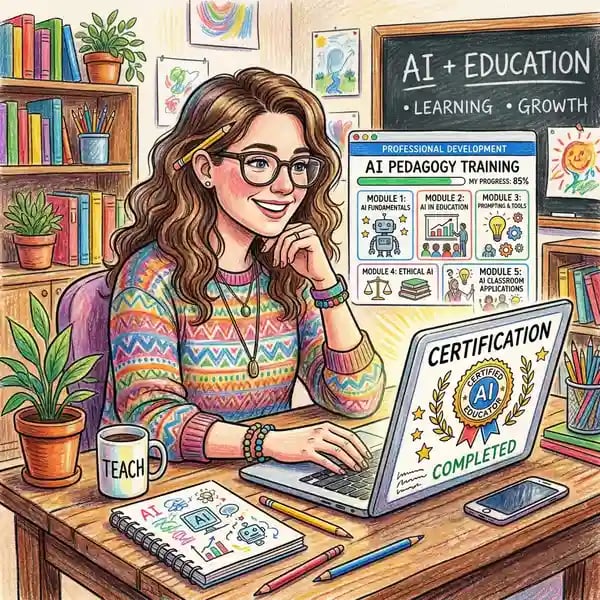
What Skills Do Educators Need to Work with AI?
The Department for Education's "A Safe, Informed Digital Nation" publication recognises that teacher preparedness is foundational to responsible AI implementation. Yet surveys show that only 31 per cent of UK students have learned about AI from their teachers, suggesting systemic capability gaps. Educators need three categories of skill: technical literacy (understanding how AI tools work and their limitations), pedagogical integration (using AI to enhance learning without diminishing critical thinking), and critical evaluation (understanding AI bias, limitations, and ethical implications).
Most educators do not need to become AI engineers, but they do need sufficient understanding to:
- Recognise AI-generated content and understand its characteristics (hallucinations, potential biases, lack of real-time knowledge)
- Design assessments that develop critical thinking even as AI tools become more capable
- Use AI tools to personalise learning pathways whilst maintaining teacher judgment and oversight
- Teach students about AI literacy, bias, and responsible use—recognising that AI literacy is now as essential as digital literacy
- Communicate AI risks and benefits to parents and school governors
The updated Relationships, Sex and Health Education guidance, effective from September 2026, now includes explicit content on AI literacy, including understanding deepfakes. This curriculum requirement signals the government's commitment to embedding AI literacy across the entire system. Schools and universities should implement structured AI training programmes for all staff—not just early adopters, but universal capability building. This investment in educator capability is as critical as any tool procurement decision.
Avoiding the Equity Trap
Common mistake: Deploying AI tools without measuring equity impact, assuming that technology benefits all students equally.
The reality: Current AI adoption is widening the gap between well-resourced private schools and under-resourced state schools. Students from disadvantaged backgrounds may have less access to AI tutors, personalised learning, and educator AI literacy. Responsible implementation requires explicit equity audits and targeted allocation to underserved communities.
Frequently Asked Questions About AI in Education
Should schools ban generative AI or permit its use?
Bans are ineffective—students already use AI at home and lack structured guidance on responsible use. Instead, schools should develop clear policies that specify permitted uses (e.g., brainstorming, editing, learning explanations) versus prohibited uses (e.g., submitting AI-generated work as original writing without attribution). This approach teaches students to use AI ethically rather than driving usage underground.
How can teachers detect AI-generated student work?
Detection tools such as Turnitin now include AI detection algorithms, though no tool is perfectly accurate. The more effective approach is assessment design: create assignments that require sustained thinking, personal reflection, or problem-solving that students are unlikely to outsource entirely to AI. Combine detection tools with professional judgment and conversations with students about their learning process.
Are adaptive learning platforms proven to improve outcomes?
Adaptive platforms like Century Tech and Adaptemy show strong evidence of improving engagement and learning velocity, particularly for students at the extremes of the ability range. However, effectiveness depends on quality implementation, teacher integration, and data quality. Platforms alone do not improve outcomes; outcomes improve when platforms are used strategically to personalise learning and free teachers to focus on high-value interactions.
What are the data privacy risks of education AI tools?
The primary risks are third-party tracking (student data shared with advertisers, data brokers), model training (student work used to train AI models without consent), and long-term data retention (profiles created from years of learning activity). Schools must conduct data protection impact assessments (DPIAs) before deployment and verify that tools comply with UK GDPR Article 25 requirements for children's data protection.
Should universities allow students to use AI in assessments?
This depends on assessment design and learning outcomes. Some assessments (essays, open-ended analysis) should require AI-free work to develop authentic writing and reasoning skills. Others (technical problem-solving, analysis of ambiguous situations) may benefit from AI as a thinking tool. Russell Group universities are implementing tiered policies: clear rules for each assessment, rather than blanket permits or bans. Universities should redesign assessment to focus on skills AI cannot yet perform well—critical evaluation, synthesis of competing ideas, original research.
How can schools ensure AI tools do not amplify existing inequalities?
Conduct equity audits before and after AI deployment. Measure learning outcomes, engagement, progression rates, and support needs disaggregated by ethnicity, gender, disability, and socioeconomic status. If adoption amplifies gaps (e.g., disabled students benefit less from adaptive platforms, or private school students access better tools), redesign implementation or pause deployment. Equity should be monitored as rigorously as academic outcomes.
For educational leaders and institutions developing AI strategy, comprehensive AI strategy guidance and governance framework resources are available to support responsible implementation.
Ready to Design Your Education AI Strategy?
Helium42 works with schools and universities to develop governance frameworks, educator training programmes, and responsible implementation strategies that harness AI's potential whilst protecting student data, academic integrity, and equity.
Peter Vogel
Senior Strategist, Helium42
Peter leads strategic AI consulting and governance advisory for educational institutions across the UK. He advises school leaders, university councils, and EdTech companies on balancing innovation with safeguarding, regulation, and equity. His work focuses on AI implementation frameworks, educator capability, and assessment design in the age of generative AI.
Sources: Department for Education—A Safe, Informed Digital Nation 2026, JISC Higher Education Student AI Adoption Survey 2026, QAA Generative AI in Higher Education Guidance, Information Commissioner's Office—Data (Use and Access) Act 2025 Codes of Practice, Ofsted Regulatory Framework on AI 2025, UK School District Adaptive Learning Pilot 2025, RM Results AI Marking Trial 2025