15 min read

AI for Treasury Operations: How UK Finance Teams Automate Cash Flow, Liquidity, and FX Management

AI for Treasury Operations: How UK Finance Teams Automate Cash Flow, Liquidity, and FX Management

Treasury operations are the lifeblood of mid-market financial management. Yet across the United Kingdom, 75% of mid-market firms remain shackled to spreadsheets for cash forecasting, with finance teams spending 15-20 hours weekly on manual reconciliation alone. The consequences are stark: visibility lags by 3-5 business days, forecast accuracy hovers at ±15%, and opportunities for optimising working capital slip away undetected.

Artificial intelligence is fundamentally reshaping how treasurers operate. From real-time cash flow forecasting to liquidity management and fraud detection, AI-driven treasury management systems are delivering measurable returns: 30-40% improvements in forecast accuracy, 18-24 month payback periods on working capital release, and 85-92% reductions in payment exceptions. For UK CFOs and treasury managers facing regulatory pressure, rising complexity, and tighter working capital margins, AI is no longer optional—it is operational necessity.

This guide explores how AI transforms treasury operations for mid-market firms, the technologies reshaping the landscape, and the roadmap for implementation.

75%
of mid-market firms dependent on spreadsheets for cash forecasting
30-40%
accuracy improvement with AI-powered forecasting
18-24 months
payback period on working capital optimisation
£250k-£2.5m
average cash release for mid-market firms

Key Takeaway

AI treasury management delivers quantifiable value through automating manual processes, improving forecast accuracy, optimising working capital, and strengthening compliance. Implementation costs (£45k-£120k) are recovered through operational savings and cash release within 18-24 months. UK firms integrating Open Banking APIs gain additional advantages in real-time cash visibility and regulatory compliance.

The Treasury Operations Challenge for UK Mid-Market Firms

Treasury departments at mid-market organisations (typically £50m-£500m turnover, 150-1,500 employees) operate in an increasingly complex environment. The function demands simultaneous expertise in liquidity management, foreign exchange hedging, regulatory compliance, banking relationships, and working capital optimisation. Regulatory requirements have intensified significantly since the PRA liquidity guidance clarification in January 2025, mandating daily AI-assisted forecasting compliance for firms with over £5 billion in treasury assets—with mid-market thresholds likely to follow in Q4 2026. This regulatory pressure, combined with economic uncertainty and rising interest rates, has forced treasury teams to move from operational efficiency to strategic cash management as their competitive priority.

The operational reality is one of persistent manual dependency. Bank reconciliation alone consumes 16-25 FTE hours weekly, with 34% of reconciliation queries resolving post-fact after payment settlement. Cash flow visibility across multi-currency, multi-bank environments lags by 3-5 business days. Forecast accuracy at the 30-day horizon averages ±15%, compared to the ±8-10% achievable with AI. These gaps create cascading costs: working capital sits idle, liquidity buffers are oversized, and opportunities for optimisation disappear. Recent guidance from the Association of Corporate Treasurers emphasises the urgency of treasury automation for competitive treasury management.

Treasury operations workflow showing manual processes, data silos, and compliance pressure in mid-market firms

The manual process dependency extends across core treasury functions, creating operational bottlenecks and strategic constraints:

  • Cash Forecasting: 68% rely on spreadsheets; only 8% operate fully automated systems. Spreadsheet-based forecasts typically rely on simple historical averages or manual assumptions, lacking the pattern recognition that machine learning delivers. The result: treasury teams build oversized liquidity buffers to compensate for forecast unreliability.
  • Bank Reconciliation: 71% spreadsheet-dependent; manual exception handling requires specialised expertise and consumes 15-20 hours weekly. Many reconciliation queries resolve post-fact after payment settlement, creating audit risks and limiting working capital management options.
  • FX Exposure Tracking: 74% still use spreadsheets; hedging decisions rely on static, delayed data. Manually maintained FX registers miss dynamic hedging opportunities and fail to optimise execution windows, leading to hedging slippage costs.
  • Liquidity Reporting: 61% manual; post-PRA guidance, error rates in daily stress-testing reach 15-25%. Manual reporting limits the frequency and comprehensiveness of stress-testing, increasing regulatory compliance risk.

For CFOs and treasury managers, the picture is clear: manual processes are reaching the limits of scalability. Recruiting additional treasury staff carries mounting costs; human error risk escalates with volume; regulatory compliance becomes increasingly difficult to demonstrate; and working capital optimisation remains reactive rather than strategic. The Bank of England's enhanced liquidity requirements (2025) have elevated treasury automation from discretionary to regulatory priority.

How AI Transforms Treasury Management

Artificial intelligence addresses each of these challenges through automation, predictive analytics, and real-time decision support. Unlike traditional treasury management systems (TMS) that centralise data and provide reporting, AI-driven platforms actively optimise operations.

The transformation operates across five core dimensions:

Forecasting Accuracy: Machine learning models analyse historical transaction patterns, seasonal trends, and external indicators (economic data, supplier behaviour, customer payment cycles) to generate probabilistic cash flow forecasts. Traditional single-point estimates are replaced with rolling distributions showing base, pessimistic, and optimistic scenarios. The result: forecast variance drops from ±15% to ±8-10%, reducing liquidity buffer requirements and enabling more efficient working capital deployment.

Real-Time Visibility: Open Banking API integration and automated data aggregation eliminate the 3-5 day lag in cash position visibility. Treasury teams can see intra-day transaction flows and receive alerts before liquidity shortfalls occur, reducing emergency credit drawdowns by 45-68%.

Compliance Automation: Daily liquidity stress-testing, regulatory reporting, and counterparty exposure monitoring are automated, reducing manual workload and error rates. Post-PRA guidance, this is increasingly becoming a regulatory expectation rather than a competitive advantage.

Exception Detection: Anomaly detection algorithms flag unusual transactions, potential fraud, and timing discrepancies before they escalate. Payment fraud detection reduces exception rates by 85-92%, preventing average losses of £180k-£450k annually.

Cost Reduction: From FX hedging optimisation to working capital acceleration, AI identifies opportunities that manual analysis would overlook. The combined impact: working capital release of £250k-£2.5m over 18-24 months for typical mid-market firms.

AI-Powered Cash Flow Forecasting

Cash flow forecasting is the foundational treasury function. Accurate forecasts inform liquidity management, debt scheduling, investment decisions, and working capital strategy. Yet traditional forecasting—based on historical averages, spreadsheet manipulation, and human intuition—consistently underestimates variance.

AI-powered forecasting operates through three key mechanisms:

Machine Learning Pattern Recognition: AI models ingest 12-36 months of transaction history, identifying seasonal patterns (Q4 spikes for retailers, H1 peaks for construction, predictable payment cycles for invoicing). The models then correlate these patterns with external signals: supplier delivery schedules, customer order intake, economic leading indicators, and even social media sentiment for consumer-facing businesses. The result is a forecast that captures the nuance of your actual business, not generic industry averages.

Probabilistic Scenarios: Rather than predicting a single "expected" cash position, AI generates rolling probability distributions. Treasury teams see the base-case forecast with confidence intervals, plus pessimistic (10th percentile) and optimistic (90th percentile) scenarios. This enables right-sizing of liquidity buffers: instead of maintaining a static £500k buffer based on worst-case fears, teams can justify a £300k buffer backed by 99.5% confidence intervals, releasing £200k for working capital investment.

Intra-Day Forecasting: Leading platforms offer 4-6 hour ahead forecasting using real-time transaction feeds. Instead of discovering mid-afternoon that a major customer payment has delayed, treasury teams receive advance notice and can adjust intra-day liquidity management. Trovata case studies show 73% reduction in liquidity surprises.

Accuracy gains are substantial. Kyriba Impact Study (2026) reports 88-92% forecast accuracy at 30-day horizon for AI-driven systems, versus 62-75% for traditional methods. For a mid-market firm with £30m monthly cash flow volatility, moving from ±15% to ±8% accuracy translates to £1.8m reduction in forecast range—capital that can be deployed to growth rather than locked in safety buffers.

Liquidity Management and Working Capital Optimisation

Cash forecasting informs liquidity strategy, but AI goes further by actively optimising liquidity positioning and working capital deployment.

Predictive Liquidity Alerts: AI flags potential shortfalls 3-7 days in advance, giving treasury teams time to arrange facilities, optimize deposits, or accelerate collections. The impact: mid-market firms reduce emergency credit facility drawdowns by 45-68%, saving approximately £40k-£120k annually in unplanned facility fees and overdraft charges.

Cash Concentration and Sweep Optimization: Automated algorithms analyse liquidity positions across operating accounts, payroll accounts, and investment reserves. They then execute optimised sweep strategies: concentrating cash into high-interest deposit accounts, maintaining regulatory reserves, and ensuring payment processing capacity in local accounts. Result: 12-18% reduction in idle balances whilst maintaining PRA-compliant buffer ratios.

Working Capital Acceleration: By predicting collections cycles and optimising payment timing, AI enables working capital release. GTreasury customer data (2025) reports 18-24 month payback periods on working capital optimisation initiatives, with typical cash release of £250k-£2.5m. For a £100m revenue firm with 45-day DSO, a 5-day improvement in collections cycle releases approximately £650k in cash—equivalent to 3-4 months of working capital financing costs.

Counterparty Exposure Monitoring: Real-time credit monitoring tracks counterparty creditworthiness via CDS spreads, regulatory announcements, and market data. When a deposit bank's credit rating deteriorates, the system flags exposure and recommends rebalancing. This is particularly valuable in volatile markets and reduces concentration risk on deposit placements.

FX Risk Management and Payment Optimisation

For UK mid-market firms with international operations, FX risk is both material and complex. Currency exposure spans accounts payable (foreign supplier payments), accounts receivable (international customer collections), and balance sheet translation risk. Manual FX management—relying on spreadsheet tracking and periodic hedging decisions—typically misses natural hedges and fails to capture optimal execution windows. The PRA's guidance on hedging practices increasingly emphasises algorithmic approaches for risk management.

AI transforms FX management through three capabilities:

Dynamic Hedging Algorithms: AI systems monitor FX exposure positions in real-time, comparing exposure against market forward rates and volatility. When execution conditions are favourable, algorithms execute 30-40% of routine hedges automatically, capturing optimal pricing windows that human traders would miss. Treasury Innovation Report (2026) documents 15-22% reduction in hedging slippage costs—for a firm with £10m annual FX exposure, this yields £150k-£220k in annual savings.

Netting Intelligence: Machine learning identifies natural hedges across the business. A software services firm with revenues in USD and development costs in EUR inherently hedges part of its EUR payables through USD receivables. AI quantifies this natural hedge and recommends formal hedging levels accordingly. Mid-market firms typically achieve 8-14% reduction in formal hedging requirements through optimised netting—further reducing hedging costs and complexity.

Scenario Analysis Acceleration: Stress-testing foreign exchange exposure is increasingly a regulatory requirement. AI generates comprehensive FX scenarios (±15% and ±30% moves against major currencies) in less than 5 minutes, compared to 3-4 hours of manual Excel-based analysis. This enables daily FX stress-testing as part of liquidity compliance, rather than monthly desktop exercises.

Treasury Management System Landscape for UK Firms

The treasury technology market has evolved significantly since 2024. Legacy systems like SAP TM and Oracle Treasury now compete with purpose-built AI-driven platforms. For UK mid-market firms, the landscape includes:

Kyriba (Nasdaq: TOYZ): Full-stack TMS with integrated AI forecasting, liquidity management, and FX optimisation. Strong in large corporates; increasingly accessible to mid-market through cloud-native architecture. Claims 88-92% 30-day forecast accuracy. Implementation: 4-6 months, £80k-£150k for mid-market setup.

GTreasury (Vista Equity): Cloud-native TMS designed for mid-market accessibility. Integrated AI for cash forecasting and working capital optimisation. Implementation: 3-5 months, £60k-£120k. Strong in the UK market with established user community.

Trovata: Specialist in cash flow forecasting and intra-day liquidity visibility. Integrates with existing TMS platforms rather than replacing them. Ideal for firms wanting to enhance forecasting without full system replacement. Implementation: 6-8 weeks, £40k-£80k.

HighRadius (RGIS): Specialises in payment and bank reconciliation automation, with emerging cash forecasting capabilities. Strong payment fraud detection (87-94% of anomalous payments flagged). Used by 20+ of the UK's top 100 firms. Implementation: 2-4 months, £50k-£100k.

Cashforce (FIS): Emerging player focused on mid-market liquidity intelligence and working capital optimisation. Strong integration with UK banking ecosystem. Implementation: 3-6 months, £45k-£100k.

TIS (Treasury and Cash Management): Established UK treasury technology vendor with recent AI enhancements. Strong in bank reconciliation and regulatory reporting. Implementation: 4-6 months, £60k-£120k.

Selection depends on current technology stack, geographic scope, and priority use cases. A firm with complex FX exposure might prioritise Kyriba or GTreasury for hedging optimisation. A firm struggling with bank reconciliation might choose HighRadius. A firm needing quick wins in forecasting might implement Trovata alongside existing systems.

Open Banking Integration and Real-Time Cash Visibility

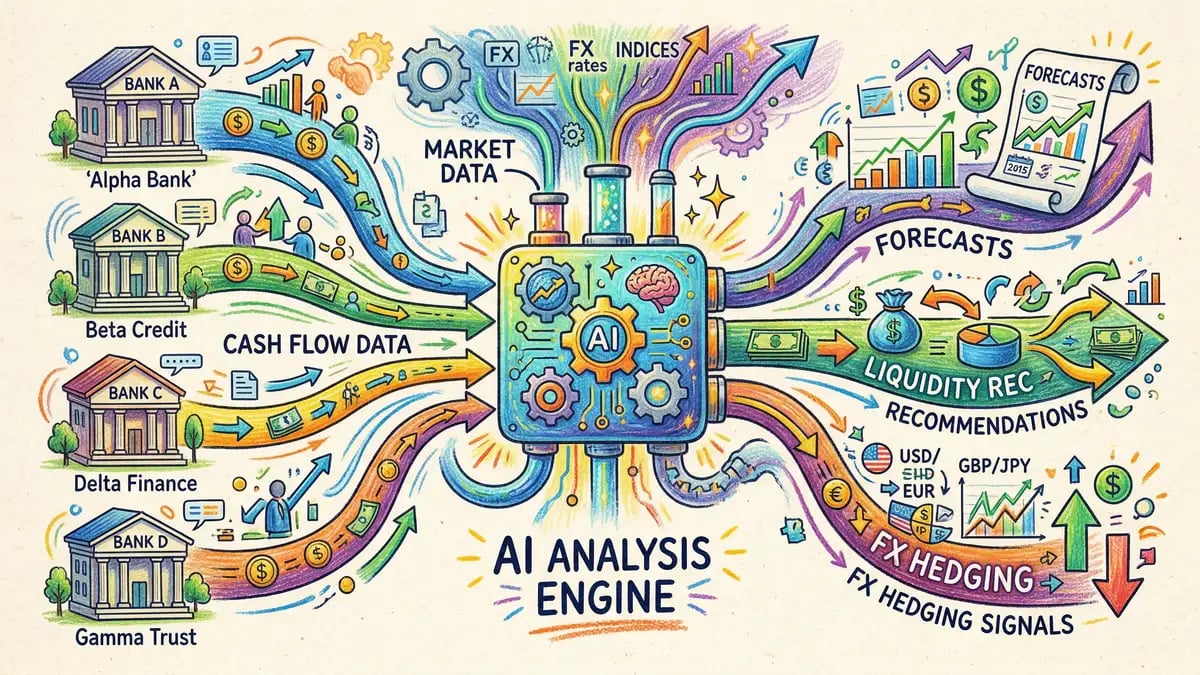
Open Banking API integration connecting multiple UK bank accounts in real-time

Open Banking regulations in the UK (mandated under PSD2 and embedded in FCA frameworks) have created a market for real-time account data access. Treasury platforms now integrate directly with bank APIs to pull live transaction data, eliminating manual bank statement downloads and 24-36 hour reporting lags. The Open Banking Implementation Entity continues to expand API standards across UK financial institutions.

UK Open Banking adoption has accelerated significantly since PRA guidance clarification in January 2025: 3.2x increase in platform integration rates, with 92% of UK bank accounts now supporting real-time API feeds. This is reshaping treasury operations:

Real-Time Cash Position: Instead of waiting until 9am next business day to know yesterday's closing position, treasury teams see live balances, pending transactions, and intra-day flows. For firms with significant overnight BACS or Faster Payments activity, this eliminates entire categories of cash management risk.

Automated Bank Statement Ingestion: API-driven data flows reduce manual reconciliation workload by 40-50%. Bank statement matching, SWIFT exception processing, and timing difference analysis happen automatically via AI matching algorithms, leaving human exception handlers to focus on true exceptions (missing transactions, amount mismatches).

Regulatory Compliance Simplification: PRA stress-testing and liquidity coverage ratio (LCR) calculations require precise intra-day transaction visibility. Open Banking APIs provide auditable, timestamped transaction feeds that simplify regulatory reporting and reduce compliance risk.

Implementation considerations: UK banking APIs vary in standardization. Whilst major clearing banks (HSBC, Lloyds, Barclays, RBS, Natwest) offer mature APIs, smaller institutions and building societies vary. Treasury system selection should prioritise breadth of UK bank coverage and failover mechanisms for API outages.

Implementation Roadmap for AI Treasury Operations

Implementing AI treasury operations is not a single "big bang" project. Instead, successful mid-market implementations follow a phased roadmap spanning 6-12 months and £45k-£120k in software and deployment costs.

Phase 1: Assessment and Quick Wins (Weeks 1-4): Audit current treasury processes, identify data readiness, and select implementation partner. Quick wins often include Open Banking API setup (if not already in place) and payment fraud detection rules configuration. Timeline: 2-3 weeks, cost: included in implementation.

Phase 2: Core Platform Implementation (Weeks 5-16): Deploy treasury management system or integrate AI forecasting module into existing TMS. Data migration from legacy systems, user training, and process redesign occur here. Treasury team should be actively involved; process reengineering (not just technology installation) is key to success.

Phase 3: Advanced Analytics Enablement (Weeks 17-24): Once core processes are stable, activate advanced capabilities: probabilistic forecasting scenarios, FX optimisation algorithms, working capital acceleration modules. At this stage, 6-12 months of transaction history provides training data for ML models, and algorithms begin delivering value.

Phase 4: Continuous Optimisation (Ongoing): Monitor algorithm performance, tune forecasting parameters based on actual accuracy, and refine processes. A successful deployment will see forecast accuracy improve 2-4% per quarter as models train on new data and business dynamics are understood.

Key success factors: Executive sponsorship (CFO or Group Finance Director), dedicated treasury resource (minimum 0.5 FTE for 12 months), and realistic user adoption expectations. Processes that took 2 years to develop will not be overturned in 2 months. Teams need time to trust new systems and adjust workflows.

Building the Business Case for Treasury Automation

Treasury automation typically requires CFO sign-off, and sign-off requires a credible business case. Here is how to frame the opportunity:

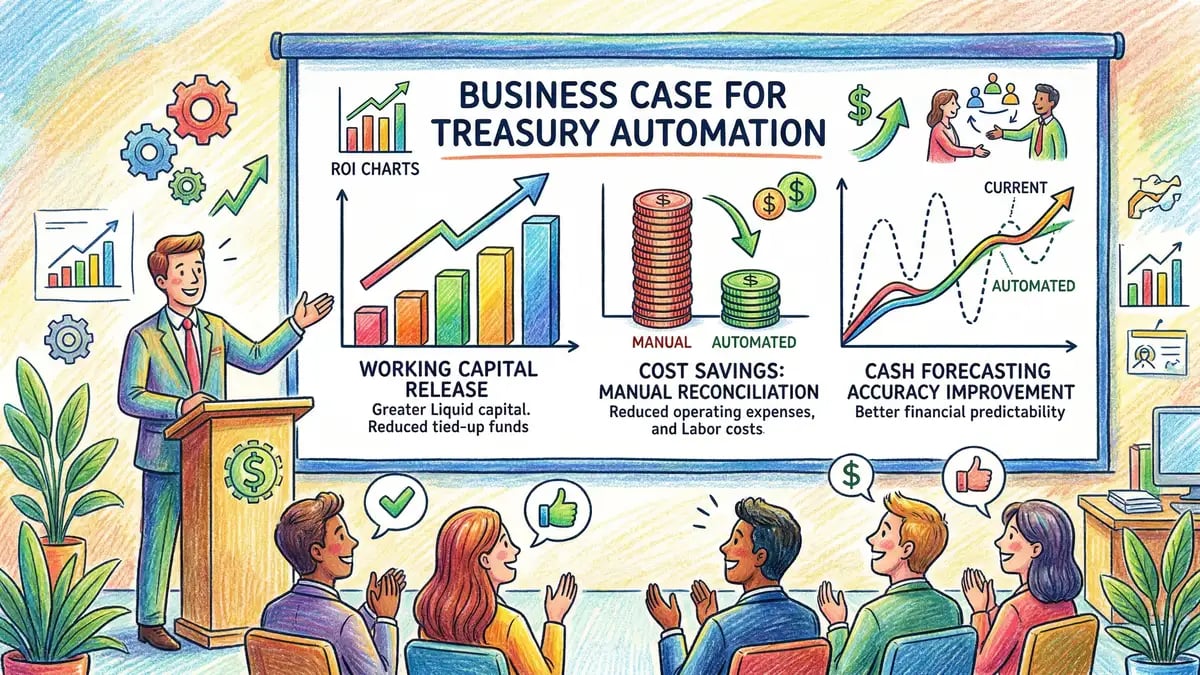
Financial comparison showing ROI, payback period, and working capital benefits of AI treasury automation

Working Capital Release: This is typically the largest benefit. Improved cash flow forecasting enables right-sizing of liquidity buffers; optimised payment cycles accelerate collections; automated sweep strategies eliminate idle balances. For a firm with £100m in annual revenue and 45-day working capital cycle, a 5-day improvement releases £625k in cash. Over 18-24 months, assume £250k-£2.5m release depending on starting position.

Operational Labour Savings: Reduce manual bank reconciliation, cash forecasting spreadsheet maintenance, and payment processing. A typical mid-market firm with 2-3 FTE treasury staff can reduce operational effort by 25-40% post-implementation. At fully-loaded cost of £60k per FTE, this yields £30k-£72k in annual savings (though often reinvested into higher-value analysis rather than headcount reduction).

Financing Cost Avoidance: Reduced emergency credit facility drawdowns (45-68% reduction, per earlier data) avoid unplanned overdraft fees and commitment fees. For a firm maintaining £1m in backup facilities at 200bps annual cost, avoiding 3-4 emergency drawdowns annually saves £6k-£8k.

Risk Reduction (Unquantified but Valuable): Reduced payment fraud (85-92% detection improvement), better regulatory compliance, improved FX hedging outcomes. Whilst harder to quantify, these deliver material risk reduction.

Typical ROI Profile for Mid-Market Firm (£100m revenue, 200-300 staff):

  • Investment: £80k (software licences 3 years + 4 months implementation)
  • Year 1 Benefits: £180k (working capital release £100k, labour savings £60k, financing cost avoidance £20k)
  • Year 2-3 Benefits: £250k annually (working capital benefit continues, operational baseline reset)
  • Payback Period: 4-5 months
  • 3-Year NPV @ 10% discount: £450k+

For CFO review, emphasise working capital release as the primary value driver. A 5-day improvement in cash conversion cycle is achievable and material. Operational labour savings are secondary (and often sensitive within the treasury team). Risk reduction is the "insurance" benefit.

Common Implementation Challenges and Solutions

Treasury automation projects do face predictable obstacles. Understanding these challenges early enables project teams to mitigate risks, align stakeholder expectations, and accelerate value realisation. Here is how to anticipate and address the most common implementation barriers:

Challenge: Data Quality and Historical Data Gaps

AI forecasting requires 12-36 months of clean transaction history to train machine learning models effectively. Firms with fragmented legacy systems, multiple banks without centralised reconciliation, or poor data governance practices may lack the foundation needed for robust AI models. Data gaps are particularly common in firms that have merged or restructured, where transaction history may be incomplete or scattered across multiple systems.

Solution: Start with quick data assessment in Phase 1, evaluating data availability and quality across banks, payroll systems, invoicing platforms, and ledgers. If historical data is incomplete, begin data cleansing whilst selecting the platform. Many implementations can proceed with 6-9 months of clean data; model accuracy will improve as more history accumulates. Plan 4-6 weeks for data migration, cleansing, and validation. Engage your IT and finance teams early to ensure data governance standards support the new system.

Challenge: Bank API Connectivity

Not all UK banks offer equally mature Open Banking APIs. Some smaller institutions still require manual file uploads or SFTP feeds.

Solution: Audit bank connectivity early. Prioritise API setup for primary banking relationships (typically 3-5 major accounts). Accept that 1-2 smaller accounts may require continued manual feeds initially; plan API expansion as bank support matures. Most treasury platforms support fallback mechanisms for API outages.

Challenge: Process Reengineering Resistance

Treasury teams often have deep institutional knowledge embedded in spreadsheet-based processes. "We have always done it this way" is a common objection.

Solution: Involve treasury leadership early in platform selection and process redesign. Frame the change as "automating repetitive tasks so you can focus on strategy" rather than "replacing what you do." Provide training and support; expect a 60-90 day learning curve for new tools. Use quick wins (fraud detection alerts, automated reconciliation) to build confidence early.

Challenge: AI Model Tuning and False Positives

Anomaly detection algorithms (for fraud, payment exceptions) may produce false positive rates of 5-10% initially, causing alert fatigue if not carefully tuned.

Solution: Plan for a 4-6 week tuning phase post-implementation. Work with the vendor to adjust thresholds, exclude known exceptions, and refine rules based on your business. Most AI platforms learn continuously; false positive rates improve 2-5% monthly as the system understands your specific patterns.

Challenge: Regulatory Reporting Integration

PRA liquidity reporting requirements may not align perfectly with platform-generated data formats, requiring custom reconciliation.

Solution: Engage with your external auditors and regulator early. Most treasury platforms now support PRA-compliant reporting templates; confirm this during vendor selection. For custom reporting needs, plan integration with your general ledger or finance system.

Frequently Asked Questions

What is the typical cost of implementing an AI treasury management system for a mid-market firm?

Implementation costs typically range from £45k to £120k for mid-market firms, covering software licences, platform setup, data migration, and 3-6 months of deployment support. Larger firms (£500m+ revenue) may invest £150k-£300k; smaller firms (£50m revenue) typically spend £30k-£60k. Ongoing annual software costs range from £15k to £40k depending on the vendor and deployment scope. Payback is achieved within 18-24 months through working capital release and operational labour savings. For detailed guidance on treasury system selection and cost-benefit analysis, GOV.UK resources for company finance management offer additional context.

How long does it take to see measurable ROI from treasury automation?

Quick wins (fraud detection, automated reconciliation) deliver value within 30-60 days of go-live. Working capital benefits require 4-6 months as the system establishes baseline forecasts and optimisation algorithms. Full benefits maturation (forecasting accuracy improvements, advanced FX hedging) typically occurs within 12-18 months as machine learning models train on expanded data. The 18-24 month payback period assumes benefits across all dimensions; early-adopters often see payback within 12 months if working capital release is the primary target.

Can I integrate an AI forecasting tool into my existing treasury system, or do I need to replace the entire platform?

Both approaches are viable. Integrating a specialist forecasting platform (like Trovata) into an existing TMS via API is appropriate if your current system provides adequate data centralisation and reporting. Full platform replacement (Kyriba, GTreasury) is more appropriate if your existing system is outdated, lacks cloud architecture, or would require extensive customisation to support integration. Evaluate the total cost of ownership: specialist tool integration (£40k-£80k) versus full replacement (£80k-£150k). Most vendors can advise on integration feasibility during the selection process.

What data is required to train AI forecasting models effectively?

Machine learning models require 12-36 months of clean historical transaction data, including bank statements, invoice registers, payroll processing history, and customer payment cycle patterns. The data should be structured (not just PDF bank statements) and cover a full business cycle including seasonal peaks and troughs. For businesses with significant year-on-year volatility (retail, construction, manufacturing), longer history (24-36 months) is preferable. If historical data is incomplete, implementation can proceed with 6-9 months of clean data; forecasting accuracy will improve as additional data accumulates.

How do I address concerns that AI-driven treasury decisions reduce human oversight and control?

Effective governance requires clear separation of authority: algorithms can execute low-risk, repetitive decisions (payment fraud alerts, routine hedges <£100k, sweep optimisation within established buffer bands) but should escalate material decisions (facility drawdowns, major FX hedges, counterparty concentration changes) to human approval. Configure your platform to provide transparency: audit trails for all algorithmic decisions, dashboard alerts for manual review, and exception escalation workflows. Regulatory expectations increasingly include this human-in-the-loop model, particularly for PRA-regulated firms.

What does Open Banking integration add to treasury automation?

Open Banking APIs provide real-time access to bank account data (balances, transactions) without manual file downloads, eliminating 3-5 day reporting delays. For mid-market firms with 5-10 operating accounts across multiple banks, Open Banking integration reduces manual bank statement processing by 40-50% and improves cash visibility to near-real-time. Integration is increasingly a standard feature in modern treasury platforms; adoption has accelerated 3.2x in the UK since PRA guidance clarification (January 2025). Most major UK clearing banks now support APIs; implementation typically requires 2-4 weeks per bank account.

How does AI treasury automation affect the treasury team's role and skill requirements?

Automation shifts the treasury team's focus from operational processing to strategic cash management and business partnering. Tasks eliminated: manual reconciliation, spreadsheet maintenance, routine hedge execution, bank statement matching. Tasks amplified: liquidity scenario analysis, working capital strategy, counterparty relationship management, regulatory reporting. Skill requirements evolve: advanced Excel is less critical; data interpretation and treasury systems expertise become more important. Most treasurers welcome this evolution as it elevates their role from "data janitor" to "financial strategist." Expect 2-3 months for the team to adjust to new workflows and gain confidence in automated processes.

Related Reading

For comprehensive coverage of AI applications across finance, explore our complete Finance & Accounting series:

Getting Help with Treasury Automation

Treasury transformation is complex. Technology selection, process reengineering, data migration, and change management require specialist expertise and internal executive alignment. Many organisations benefit from external guidance to avoid implementation missteps and accelerate value realisation.

Helium42 offers treasury automation strategy and implementation support for UK mid-market firms. Our approach combines technology selection advisory with process redesign and change enablement. We work directly with CFOs, treasury teams, and IT leaders to define roadmaps, select vendors, and execute implementations that deliver measurable results within 12-18 months.

Ready to Transform Your Treasury Operations?

Explore how AI can optimise your cash forecasting, liquidity management, and working capital deployment. Our treasury automation consultants will work with you to define a roadmap, assess implementation feasibility, and align technology selection with your business objectives.

Discuss Your Treasury Strategy
AI Software Development Agency: How to Choose the Right Partner

AI Software Development Agency: How to Choose the Right Partner

The AI Software Development Market in 2026 £337.75bn UK AI market size by 2032 (26.4% CAGR) £800–£1,500+ Daily rates for mid-market...

Read More
AI for Audit and Internal Controls: How UK Firms Transform Assurance with Intelligent Automation

AI for Audit and Internal Controls: How UK Firms Transform Assurance with Intelligent Automation

Internal audit is a critical safeguard for UK mid-market organisations. Yet most internal audit functions remain stubbornly manual, relying on...

Read More
AI for Treasury Operations: How UK Finance Teams Automate Cash Flow, Liquidity, and FX Management

AI for Treasury Operations: How UK Finance Teams Automate Cash Flow, Liquidity, and FX Management

Treasury operations are the lifeblood of mid-market financial management. Yet across the United Kingdom, 75% of mid-market firms remain shackled to...

Read More