AI Application Development for Enterprise: A Practical Guide
Application Layer Spending £14.25 Billion Global 2025 Coding AI Spend £3 Billion 55% of departmental AI UK Market Position Third Largest ...

6 min read
Peter Vogel
:
Updated on March 24, 2026
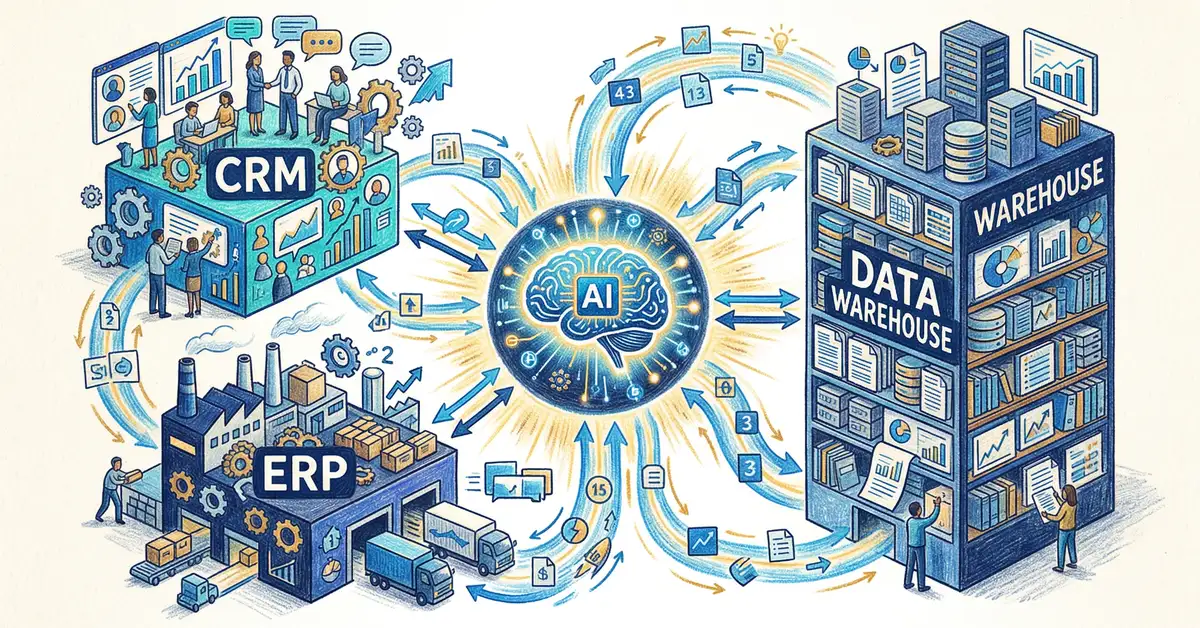
AI integration services connect artificial intelligence systems to your existing business infrastructure, enabling seamless data flow, operational efficiency, and measurable business outcomes. Rather than implementing AI in isolation, integration services ensure your AI solutions work directly with your CRM, ERP, data warehouses, and operational systems. For UK organisations operating multiple siloed systems, this integration is where AI adoption succeeds or fails. According to NCS London research, 95% of UK businesses cite integration challenges as the primary barrier to AI adoption, with 81% of IT leaders reporting that data silos hinder digital transformation. Without proper integration architecture, even sophisticated AI solutions remain disconnected from the business processes they are designed to improve.
AI integration services translate raw AI capability into business value by connecting intelligence systems to operations. The cost ranges from £50,000 to £300,000 in the UK mid-market, with payback periods of 6 to 18 months depending on deployment complexity. Success depends on data readiness, security compliance, and phased implementation—not on the sophistication of the AI itself.
Cost Range
£50k–£300k
Mid-market deployment
Payback Period
6–18 months
ROI realisation timeline
Integration Timeline
8–16 weeks
Typical deployment duration
AI integration is the architectural and operational work required to connect artificial intelligence systems to your existing business infrastructure. It is not the same as AI implementation or AI deployment. AI implementation focuses on selecting and training an AI model or tool. AI integration is about building the data pipelines, APIs, security controls, and operational workflows that allow that AI to function within your organisation.
An AI solution without integration is like a powerful engine disconnected from a car. The engine is theoretically capable, but it cannot move the vehicle. Integration wires the engine to the transmission, fuel system, electrical system, and wheels—creating a functional, operational system.
For UK organisations with complex IT estates—multiple legacy systems, cloud platforms, third-party SaaS tools, and on-premise databases—integration determines whether an AI investment succeeds or becomes a disconnected pilot that never scales.
Most UK mid-market organisations operate in a fragmented IT environment. A typical company might run:
Each of these systems holds data, each speaks a different "language" (API standards, authentication protocols, data formats), and each serves a different functional department. When an AI solution is introduced, it must connect to multiple systems simultaneously—extract data, process it, return results, and trigger actions across all of them.
This is where UK organisations fail. According to the ICG London 2025 AI Adoption Report, 81% of UK IT leaders cite data silos and systems fragmentation as the primary reason AI pilots fail to scale into production.
Successful AI integration follows one of three architectural approaches, selected based on your current IT environment and integration complexity.
In this pattern, a central integration platform (usually an ETL tool like Talend, MuleSoft, or Apache Kafka) acts as the hub. All data from source systems (CRM, ERP, data warehouse) flows into the hub, where the AI solution sits, processes data, and returns results back to each spoke (individual system).
Advantages: Scalable, centralised data governance, easier to audit, simple to add new systems later.
Disadvantages: Higher initial cost (£80k–£150k), requires data governance expertise, can introduce latency if real-time responsiveness is critical.
Best for: Organisations with 5+ systems, large data volumes, or strict regulatory requirements.
In this pattern, the AI solution connects directly to individual systems via APIs. If your AI needs data from your CRM, it queries the Salesforce API. If it needs to update your ERP, it calls the SAP API.
Advantages: Lower upfront cost (£40k–£80k), simpler for organisations with 2–3 systems, faster to deploy.
Disadvantages: Point-to-point integrations become hard to manage as you add systems, no central audit trail, data consistency issues if systems are updated independently.
Best for: Small organisations with few systems, or as a stepping stone to hub-and-spoke as you grow.
In this pattern, all data from source systems is periodically (batch) or continuously (streaming) copied to a central data lake (Snowflake, BigQuery, Redshift, or on-premise data warehouse). The AI solution reads and writes to the data lake. The data lake then syncs back to source systems (via reverse ETL).
Advantages: Excellent for analytics and AI workloads, strong historical data, good for large-scale batch processing.
Disadvantages: High latency (often 2–6 hours behind source systems), requires ongoing data quality monitoring, expensive to maintain (£60k–£200k per year).
Best for: Organisations focused on analytics and insights (not real-time operational AI), large data volumes, or those that already have a data lake in place.
Integration costs are not just technical. Data readiness often accounts for 30–50% of total integration project cost. This includes:
Many organisations underestimate this work. A project estimated at £100,000 often balloons to £150,000–£200,000 once data readiness work is properly scoped.
When integrating AI into your business systems, you are not just connecting technology—you are connecting sensitive data flows. UK regulatory requirements add complexity:
Integration architects must build compliance into the system design from the start, not bolt it on afterwards. This typically adds 2–4 weeks to the project timeline and 15–25% to the cost.
Choosing the right partner is critical. Look for these capabilities:
Your partner should have hands-on experience integrating the specific systems you use. If you run Salesforce, SAP, and Snowflake, they should have done this combination before—not just read the API documentation. Ask for case studies and customer references that match your IT environment.
Integration is a data security risk. Your partner should be able to explain how they will encrypt data in transit and at rest, manage access controls, and maintain audit logs. They should be ISO 27001 certified or show equivalent security standards.
Large integration projects often have scope creep. Your partner should use agile or phased delivery models, with clear milestones and the ability to adjust scope based on what you discover during data readiness phases. Avoid partners who want to commit to a fixed price upfront without first understanding your data landscape.
Integration is not a one-time project. Systems change, APIs are updated, new data sources need to be added, and bugs emerge in production. Your partner should offer ongoing support contracts (typically 10–15% of the initial build cost per year). Ask what their SLA is for incident response and how they handle updates without causing downtime.
A typical mid-market AI integration follows this timeline (assuming no major data quality issues):
This timeline can shrink to 8–10 weeks if your data is already clean and your systems are modern and well-documented. It can extend to 24+ weeks if you have legacy systems, poor data quality, or complex regulatory requirements.
Here is a typical cost breakdown for a mid-market AI integration project (Salesforce + SAP + Snowflake, £150,000 total budget):
| Category | Cost | % of Total |
|---|---|---|
| Discovery, scoping & data readiness assessment | £30,000 | 20% |
| Architecture design & infrastructure setup | £25,000 | 17% |
| Data mapping, cleansing & governance | £40,000 | 27% |
| API development & pipeline construction | £35,000 | 23% |
| Testing, security audit & compliance review | £15,000 | 10% |
| Go-live, training & documentation | £5,000 | 3% |
| TOTAL | £150,000 | 100% |
AI integration is the bridge between AI capability and business value. Without it, even the most sophisticated AI solution remains isolated and ineffective. For UK mid-market organisations:
AI integration transforms isolated intelligence into operational advantage. Done well, it delivers ROI in 6–18 months and scales seamlessly as your organisation grows. Done poorly, it becomes a costly stalled project. Choose your integration partner carefully and invest in data readiness upfront.
Sources and references: NCS London 2025 (UK AI adoption barriers); ICG London 2025 (AI adoption barriers and integration challenges); Forrester 2025 (data readiness and integration costs); Penny 2025 (UK AI adoption rates); ONS (UK AI implementation rates); ICO January 2026 (agentic AI guidance); Cognisys 2026 (ISO 42001 and EU AI Act alignment); EU AI Act August 2026 effective date.
generative AI development services
machine learning development services
AI proof of concept methodology
AI partner evaluation framework
Application Layer Spending £14.25 Billion Global 2025 Coding AI Spend £3 Billion 55% of departmental AI UK Market Position Third Largest ...

Key Market Metrics 54% AI Projects Fail to Reach Production £21bn UK AI Market Value £400–£1.2k Daily Rates for AI Specialists ...
Key Metrics That Matter 40-60% of AI PoCs do not progress to production 4-8 weeks standard timeline for scoped PoC execution ...