15 min read

AI for Construction Design: How Artificial Intelligence Is Reshaping Architecture and Building Design in the UK

AI for Construction Design: How Artificial Intelligence Is Reshaping Architecture and Building Design in the UK

The architecture and construction sector in the United Kingdom faces persistent pressure to deliver more sustainable buildings, faster, whilst controlling costs and managing increasingly complex regulatory frameworks. Over the past five years, artificial intelligence has moved from theoretical possibility to practical necessity in architectural and design workflows. Today, leading practices are deploying AI-powered tools to optimise building layouts, detect design conflicts, verify compliance with Building Regulations, and generate variants of design solutions in hours rather than weeks.

This shift represents far more than incremental improvement. It fundamentally changes the relationship between architects, engineers, and technology. Instead of manually iterating through design options constrained by time and budget, design teams now collaborate with intelligent systems that explore parametric optimisation at scale, identify regulatory non-compliance before construction, and simulate whole-life carbon impact before a brick is laid. For UK-based practices aiming to remain competitive whilst meeting the demands of the Building Safety Act 2022 and carbon-zero commitments, understanding and deploying these tools is becoming essential.

What is Generative Design in Architecture?

Generative design is a computationally driven approach to problem-solving that differs fundamentally from traditional parametric modelling. Whereas parametric design requires architects to define rules and constraints upfront, generative design systems explore vast solution spaces autonomously, generating hundreds or thousands of viable design options based on specified criteria.

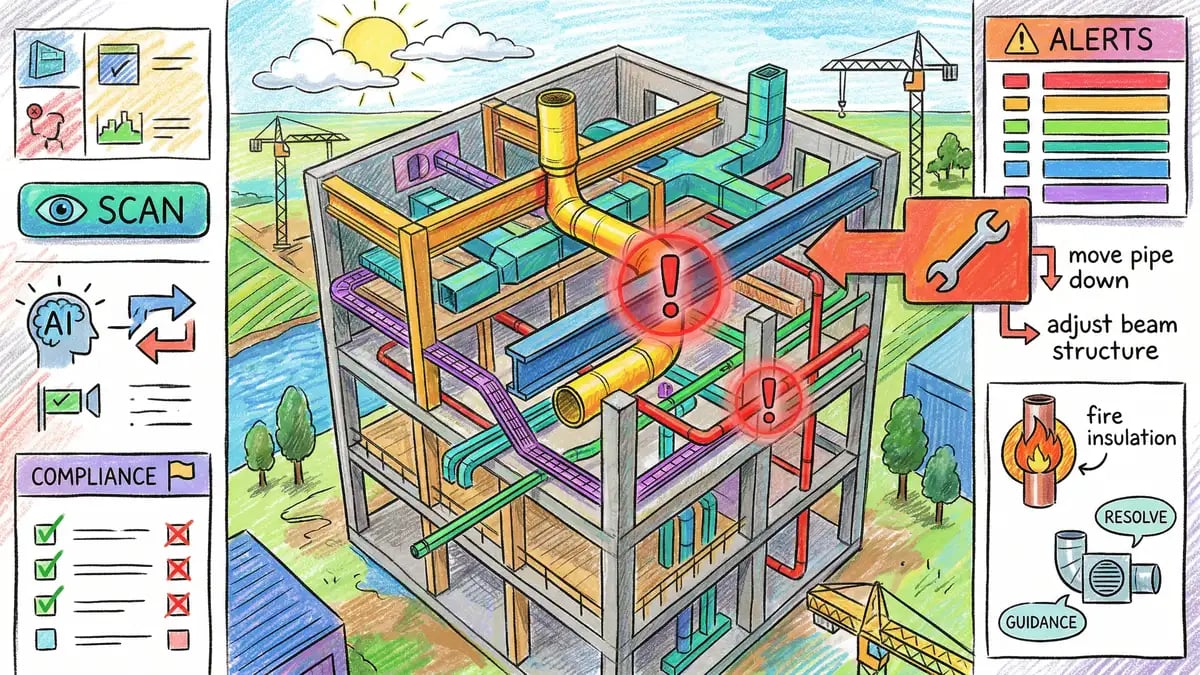
AI-powered BIM clash detection for construction design

In architectural practice, generative design typically works as follows. An architect defines a brief that includes functional requirements (floor areas, circulation routes, column grid tolerances), performance targets (daylighting, thermal mass, embodied carbon), site constraints (boundaries, neighbouring structures), and regulatory requirements (fire escape distances, accessibility standards). The AI system then explores the design space algorithmically, testing thousands of configurations against these criteria in parallel, and returns a curated set of design variants that each satisfy the brief but differ in form, massing, and internal arrangement.

Tools such as Autodesk Forma exemplify this approach. Forma allows architects to sketch a site boundary and programme mix, then generates high-performing masterplan alternatives within minutes. Hypar takes the concept further, integrating parametric functions with machine learning to optimise everything from floor plate efficiency to façade performance. Spacemaker, acquired by Autodesk, specialises in urban-scale site analysis, using AI to assess sunlight, noise, and walkability across design variants before any detailed drawings are produced.

For UK practices, the practical benefit is immediate. A conventional design development process for a medium-rise residential or mixed-use scheme might require 8–12 weeks of iteration between architect, structural engineer, and planning authority. Generative design can reduce this to 2–4 weeks, with superior optimisation across daylight, carbon, and cost simultaneously. More importantly, it shifts the architectural role from "optimiser of a single solution" to "curator of intelligent systems that explore the design space comprehensively."

AI-Powered Building Information Modelling Integration

Building Information Modelling (BIM) has been mandated on UK Government and publicly funded projects since 2016, yet many practices still use BIM primarily as a documentation tool rather than a generative or analytical system. AI integration is changing this dynamic fundamentally.

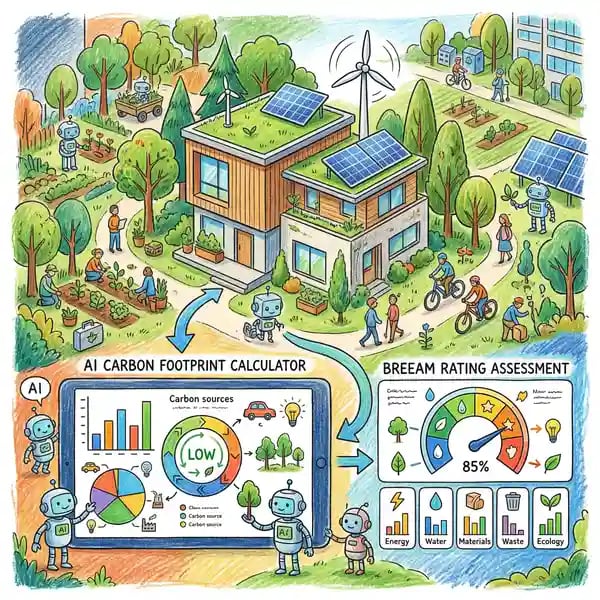
AI carbon footprint calculator and BREEAM assessment dashboard

Traditional BIM workflows require a model manager or senior architect to coordinate between specialist disciplines (structural, MEP, acoustic, fire safety). This process is labour-intensive and error-prone. AI systems can now automate much of this coordination. Tools integrated with Revit (the de facto standard BIM platform in the UK) can parse model geometry, extract constraints from the architectural model, and test design changes against structural, MEP, and regulatory requirements in real time.

One critical application is clash detection and early warning. Conventional clash detection requires explicit definition of what constitutes a clash (e.g., a structural beam cannot intersect a mechanical duct). AI systems can learn from historical project data what typical clash patterns emerge, predict where conflicts are likely to occur even before explicit modelling, and suggest geometrically feasible resolution options. This is qualitatively different from rule-based clash detection, which can only catch violations of pre-coded rules.

Another application is performance prediction from incomplete models. Using deep learning trained on completed BIM datasets, AI systems can predict daylighting, acoustic performance, thermal behaviour, and energy consumption from partial or schematic models. This allows architects to receive performance feedback during early design phases, when changes are least costly and most impactful. Revit itself is increasingly integrating these capabilities through Autodesk's AI initiatives, alongside third-party plugins developed by specialist AEC technology firms.

For UK practices working on listed building conservation or heritage projects, AI-enabled BIM integration offers particular value. Historic fabric is notoriously difficult to model accurately. AI systems can learn the characteristics of traditional construction details (lime mortar properties, stone behaviour, thermal bridging patterns in traditional masonry) and flag design interventions that might compromise heritage fabric or breach planning conditions before detailed specifications are drafted.

Automated Compliance Checking Against UK Building Regulations

The Building Regulations are complex, prescriptive, and subject to ongoing revision. For architects and engineers, ensuring compliance across all aspects of a design—fire safety, structural stability, accessibility, energy efficiency, damp resistance, noise control, and safety in use—requires detailed cross-referencing with the Building Regulations Technical Guidance and supplementary guidance from bodies such as RIBA and the Institution of Civil Engineers (ICE).

Manual compliance checking typically occurs late in the design process, after the majority of decisions have been locked in. This often results in costly redesigns in response to building control feedback. AI systems can shift this process earlier by automating initial compliance screening from BIM data. An AI system trained on Building Regulations guidance can extract relevant constraints from a BIM model—egress distances, structural loading, thermal U-values, airtightness requirements—and flag non-compliance automatically.

Platforms like NBS (National Building Specification), which works closely with UK building control bodies and Local Authority Building Control (LABC), have begun integrating AI-based compliance checking into their specification and verification workflows. The Building Safety Act 2022 strengthens this imperative by introducing mandatory golden thread documentation and enhanced building control oversight, particularly for higher-risk buildings. AI-assisted compliance verification reduces the administrative burden of maintaining this documentation and lowers the risk of oversights that could trigger regulatory action.

Practically, this means that by the time a scheme goes to planning or building control, the design team can provide a compliance matrix—generated and verified by AI—that demonstrates how every material element of the design satisfies relevant Building Regulations sections. This transparency accelerates building control review and reduces negotiation cycles.

Sustainability Analysis and Carbon Optimisation

The UK's commitment to net-zero carbon by 2050, coupled with strengthened Part L (Conservation of Fuel and Power) and Part F (Ventilation) requirements in the 2021 Building Regulations revisions, means that embodied carbon and operational carbon analysis has moved from optional sustainability aspiration to baseline design requirement. AI systems are proving invaluable in this domain.

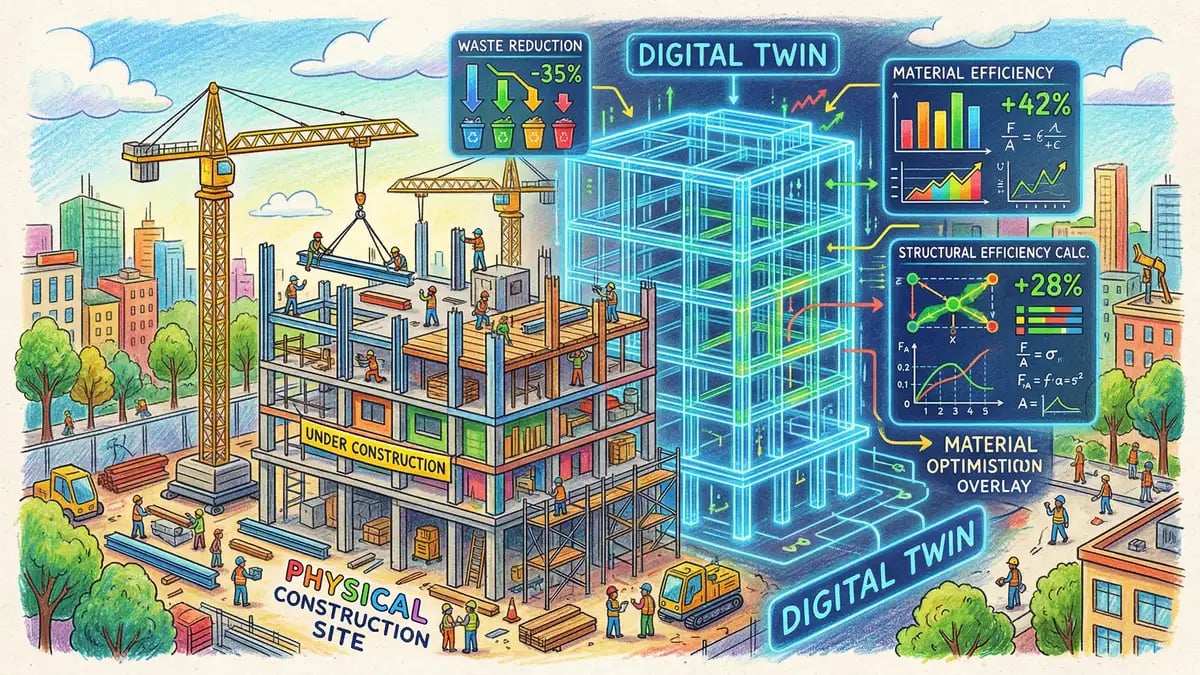
Digital twin with AI material optimisation for construction

Generative design tools can now embed whole-life carbon analysis directly into the design exploration loop. Rather than designing a building and then calculating its carbon footprint retrospectively, architects can set a carbon budget as a constraint during generative design. The AI system then explores design variants that deliver the programme and performance requirements whilst minimising or meeting the carbon target. This is fundamentally different from manual iteration, which tends to treat carbon as a secondary concern.

Tools like Spacemaker and Forma integrate embodied carbon databases (drawing from industry standards such as BREEAM and the Inventory of Carbon and Energy) and operational energy models to provide real-time carbon feedback. An architect designing a residential masterplan can see immediately how variations in building height, material selection, and orientation influence total carbon across the scheme lifetime. This enables value engineering with explicit carbon trade-offs—e.g., "increasing brick density from 5% to 8% adds 50 tonnes of embodied carbon but reduces operational heating by 150 tonnes, netting a 100-tonne saving."

For UK practices targeting BREEAM Excellent or Passivhaus certification, AI-assisted carbon analysis reduces the design-to-certification cycle significantly. Rather than achieving compliance through post-hoc design adjustments, the design itself is born from carbon-aware exploration. This often results in better performing, lower-cost buildings because fundamental decisions about form, orientation, and materiality are optimised early.

AI for Structural Engineering and Load Analysis

Structural engineering within the design process has historically been a sequential discipline—architects propose a form, structural engineers analyse whether it stands safely and efficiently, then architects adjust in response. AI is beginning to compress this cycle by allowing structural behaviour to be predicted and optimised during the generative design phase itself.

Machine learning models trained on structural analyses of millions of configurations can predict load paths, member sizes, and structural efficiency of a proposed design before explicit structural modelling. This allows architects to receive structural feedback during early design exploration, eliminating forms that are structurally inefficient or uneconomical. For complex geometries—parametric facades, non-orthogonal floor plates, space-frame roofs—this capability is transformative. An architect can explore curvature, tapering, or geometric variation with real-time feedback on its structural implications.

Beyond prediction, AI systems can optimise structural systems for multiple objectives simultaneously. A 3D topology optimisation algorithm can determine the minimum material distribution within a defined design envelope that satisfies both safety requirements and serviceability limits. This approach has been pioneered in aerospace and automotive design; it is now entering mainstream architectural practice. The result is often structures that are 20–40% lighter in material terms than conventional solutions, reducing both embodied carbon and construction cost.

For UK practices working under strict cost and carbon constraints—increasingly the norm for public sector and housing projects—AI-enabled structural optimisation is becoming a core competitive advantage. Rather than designing a structural system and hoping it is efficient, teams can now explore the optimal structural expression for a given geometry, load case, and material constraint.

Digital Twins and Design-Phase Simulation

A digital twin is a comprehensive virtual representation of a physical asset that can be updated in real time with sensor data throughout the asset's lifecycle. In the design and construction phases, digital twins can simulate building behaviour under varied conditions, allowing architects and engineers to optimise performance before ground is broken.

AI-driven digital twins integrate multiple simulation engines—thermal, lighting, air flow, acoustics, structural vibration—and allow architects to explore "what-if" scenarios rapidly. For example, an architect can ask: "If we change the facade from triple-glazing to triple-glazing with external shading, how does peak summer temperature change, and what is the carbon cost of the shading system?" The AI system executes the coupled thermal and embodied carbon simulation and returns the answer in minutes rather than days.

For UK buildings where occupant comfort and energy efficiency are mandated by Building Regulations and corporate sustainability commitments, digital twins in the design phase reduce post-handover performance gaps. Many buildings perform significantly worse operationally than modelled—a phenomenon sometimes called the "performance gap." AI-driven digital twins, informed by real-world performance data from analogous buildings, are more predictive and help close this gap before occupation.

Material Optimisation and Circular Economy Principles

The circular economy—designing buildings for disassembly and material reuse—is an increasingly important sustainability criterion, particularly for projects pursuing BREEAM circular economy credits. AI systems can analyse a BIM model and suggest how the design could be modified to enable material recovery at end-of-life.

For example, an AI system trained on circular economy principles can detect bolted connections that support disassembly versus welded connections that do not, flag material combinations that cannot be easily separated (e.g., composite cladding panels), and suggest alternative strategies. This is particularly valuable in the early design phase, when adopting circular principles is least costly.

Additionally, AI can optimise material selection to minimise waste during fabrication and construction. For bespoke cladding panels, structural components, or prefabricated units, an AI system can nest components within material sheets or structural modules to maximise yield and minimise offcuts. For projects using mass timber—an increasingly popular low-carbon structural system in the UK—this optimisation is particularly impactful, as material cost and carbon are high, and waste reduction directly affects project economics.

The UK Regulatory Landscape and Compliance Burden

The Building Safety Act 2022 introduced a new regulatory regime for "higher-risk buildings" (broadly, residential buildings with seven or more storeys or 7,000 m² of floor area). Core to this regime is the concept of the "golden thread"—comprehensive, continuously updated documentation that traces every material change to a building design from initial concept through operation and maintenance.

Maintaining the golden thread manually is extraordinarily labour-intensive. Every design change must be recorded, ratified by the building control authority, and documented alongside its implications for safety, performance, and compliance. AI systems can automate much of this administrative burden by maintaining a continuous audit log of design changes, auto-flagging implications for regulated aspects (fire safety, structural stability, accessibility), and generating updated compliance documentation automatically.

Furthermore, the Building Safety Act places responsibility on "accountable persons" (building owners and occupiers) for ensuring buildings comply with Building Regulations throughout their lifecycle. This creates incentives for better design documentation and performance prediction from the outset. AI-driven design tools that produce verifiable, auditable compliance records become not merely advantageous but operationally necessary for practices working on higher-risk buildings.

Implementation Pathways for UK Architecture Practices

For a typical UK architecture practice considering AI adoption in design workflows, implementation typically unfolds in three phases. In the discovery phase, practitioners experiment with generative design tools on one or two representative projects to understand capabilities, limitations, and integration with existing workflows. Tools like Forma or Spacemaker are accessible to architects without deep coding knowledge, allowing hands-on learning within 2–3 weeks. During this phase, practices should identify a lower-risk pilot project—ideally a new masterplan, a significant site analysis, or a facade optimisation problem. The pilot should have defined performance targets (carbon, daylight, cost) and clear success criteria. Allocate 120–160 hours of architect time (typically one mid-level architect working 2–3 days weekly for 4 weeks). Parallel track: run the same project through traditional design processes to benchmark time, cost, and outcome quality. Document everything—decision logs, data handoffs, issues encountered—as this intelligence will inform scaling decisions.

In the embedding phase, practices begin using AI tools on a higher proportion of projects. This typically requires investment in staff training, integration of AI-generated data into BIM workflows, and sometimes reconfiguration of design team roles. An architect trained in generative design increasingly acts as a curator and performance analyst rather than a detail designer, whilst junior designers transition toward task-oriented work (detailing, specification) or higher-level strategic thinking. This phase typically spans 3–6 months and should include: (1) formal training programme for 3–5 core team members (typically 40–60 hours per person, often vendor-led); (2) development of internal protocols for design briefs, AI tool deployment, output validation, and BIM integration; (3) update to professional indemnity insurance to explicitly cover AI-assisted workflows; (4) dialogue with key clients about AI methodology to manage expectations and demonstrate rigour. By the end of this phase, two or three additional projects should have deployed AI tools, with measurable tracking of time, cost, and quality outcomes relative to traditional workflows.

In the maturation phase, AI-assisted design becomes normalised. Generative design, compliance checking, and performance simulation are routine steps in the design process. Practices may invest in custom AI training using their own project data—teaching algorithms to recognise cost, quality, and planning approval patterns specific to their context and geography. This phase is ongoing and continuous. At maturity, a practice should expect: (1) AI tools deployed on 50%+ of projects across multiple project types (masterplans, refurbishment studies, new builds); (2) integration of AI-generated performance data into design management systems and handover documentation; (3) staff who can fluently brief generative systems and interpret results without external support; (4) quantified performance improvements logged systematically—time savings, cost reductions, quality metrics—that demonstrate competitive advantage; (5) occasional bespoke AI training on project-specific datasets (e.g., local planning approval patterns, client cost preferences).

From a financial perspective, the ROI calculation is straightforward for UK practices. If a typical design development phase costs GBP 80,000–150,000 in labour and takes 12 weeks, and generative design tools reduce this to 6 weeks with equivalent labour cost but superior outcomes, the time and cost savings are immediate—saving 6 weeks equates to GBP 40,000–75,000 per project. Factor in reduced post-contract variations due to earlier clash detection and compliance checking—often saving 2–5% of contract value on medium-sized projects (e.g., GBP 30,000–100,000 on a GBP 2–5 million scheme). Consider also improved planning approval likelihood: AI-optimised designs often perform better against planning policy objectives (sustainability, density, public realm), reducing negotiation cycles and resubmission costs. A typical medium-sized practice running 8–12 significant design projects annually could realise cumulative savings of GBP 300,000–600,000 within the first full year of deployment, more than offsetting tool subscriptions (typically GBP 30,000–100,000 annually) and training costs (GBP 20,000–40,000). Payback typically occurs within 4–8 months of full operational deployment.

Challenges and Current Limitations

Notwithstanding the significant potential of AI in architectural design, substantial challenges remain. First, current generative design tools are most effective for well-defined, repeatable problems—masterplans, facade optimisation, structural systems. They are less mature for the creative, contextual judgement that characterises architectural design in historic cities, conservation areas, or culturally sensitive contexts. AI systems optimise against quantified criteria; they do not readily account for subjective aesthetic or contextual qualities that planning authorities may prize.

Second, training data and model quality directly determine system reliability. AI systems trained on North American or generic development patterns may perform poorly in the UK regulatory context. Several tools have announced UK-specific datasets and model training, but this is ongoing work. Architects deploying AI tools in UK practice must remain critical, validating AI-generated compliance findings against actual Building Regulations before relying on them.

Third, liability and professional indemnity insurance present evolving questions. If an AI system recommends a design that later proves non-compliant or underperforming, who bears responsibility—the software vendor, the architect, or both? Professional indemnity insurance policies are only beginning to explicitly cover AI-assisted design. Practices should engage with their insurers and legal advisors before deploying AI tools in client-facing workflows.

Fourth, skills and training gaps are real. Architects trained in conventional design processes do not automatically understand how to brief, supervise, and validate generative design systems. Continuing professional development (CPD) investment is necessary. Some of this will be vendor-led through tool publishers like Autodesk; some will emerge from professional bodies like RIBA and the Construction Industry Training Board (CITB).

Real-World Use Cases and Outcomes

Several UK practices have begun reporting tangible outcomes from AI-assisted design. A medium-sized London residential practice used Forma to explore masterplan variants for a 2.5-hectare brownfield site. Traditional approach would have yielded 4–5 manually designed variants over 8 weeks; Forma generated 150+ high-performing variants in 2 days. The practice selected three for detailed development, ultimately achieving a scheme that was 12% more efficient (floor area per site hectare) and 18 tonnes lower in embodied carbon than the baseline estimate. The client planning application benefited from demonstrating evidence-based optimisation—the planning officer commended the rigor of the design methodology, and approval was granted with minimal negotiation cycles. The practice quantified total time savings at 6 weeks and cost savings at GBP 65,000 relative to traditional iteration.

A large engineering consultancy deployed Revit-integrated compliance checking on a 15-storey residential tower in Manchester. The system flagged 23 non-compliance issues during detailed design that would otherwise have been identified only at building control. Remediation at detailed design stage cost GBP 15,000 in additional modelling and coordination; fixing the same issues post-planning or post-contract would have cost GBP 120,000–200,000. Beyond cost, earlier detection prevented project delay and allowed the practice to include a compliance matrix in the planning application, demonstrating proactive alignment with the Building Safety Act 2022 requirements. The local authority building control office noted the thoroughness of the documentation and expedited their formal review.

In the structural domain, a UK structural engineering firm implemented topology optimisation for a complex parametric roof spanning over a public atrium. The optimised structure used 28% less steel than the initial design while meeting all safety and serviceability requirements. The combination of material saving and embodied carbon reduction aligned the project with a stringent net-zero brief and unlocked additional planning approval support from the local authority's sustainability officer. The structural cost savings totalled GBP 180,000, and the embodied carbon reduction (approximately 150 tonnes CO₂eq) proved decisive in the client's choice of the optimised design.

A mid-sized Scottish practice applied AI-assisted BIM compliance checking to a mixed-use development on a constrained urban site in Glasgow. The project involved complex interfaces between residential, retail, and public realm, with tight Building Regulations constraints on fire egress and structural tolerance to neighbouring existing structures. Traditional design coordination would have required 15–20 formal design review meetings over 10 weeks. AI-powered clash detection and constraint checking reduced this to 5 focused review meetings over 6 weeks, each supported by algorithmically generated clash reports and proposed solutions. The practice reported that 80% of typical design coordination issues were identified and resolved before formal reviews, significantly improving team productivity. The project advanced to planning 3 weeks ahead of baseline schedule, and the client attributed this acceleration partly to the clarity and rigour of the BIM coordination process.

Frequently Asked Questions

Can AI-generated designs be submitted directly to planning authorities?

Yes, but with important caveats. A design generated by AI is architecturally and legally equivalent to a design created by traditional means, provided it meets all Building Regulations, planning policy, and contractual requirements. However, planning officers often value transparency about design process. Demonstrating that a scheme has been rigorously optimised through AI analysis—with documented trade-offs between competing objectives—can actually strengthen a planning application by showing evidence-based design. It is advisable to explain the generative design process in design statements rather than hiding it.

Do I need to retrain my entire design team to use AI tools?

Not necessarily. Most modern AI tools are designed for architects without coding expertise. What does change is the conceptual framework—rather than designing one solution and iterating, teams learn to define design briefs with explicit performance targets and constraints, then curate and refine AI-generated options. This represents a skill shift more than a complete re-training requirement. Many practices see junior and mid-level architects upskilled within 4–8 weeks of hands-on tool use.

Are AI-generated designs automatically compliant with Building Regulations?

No. Whilst AI compliance checking can flag clear violations (e.g., a corridor width below minimum), Building Regulations compliance remains a professional judgement. An architect must verify that AI recommendations align with actual regulatory intent and local authority expectations. Think of AI compliance checking as an early-stage filter, not a substitute for professional review. Maintain clear documentation of compliance assumptions and any deviations from AI recommendations.

What is the typical cost of generative design tools for a small practice?

Pricing varies widely. Some tools offer per-project licensing (GBP 5,000–20,000 per project), whilst others operate on annual subscriptions (GBP 15,000–60,000 annually for a small practice). Many vendors offer introductory pricing or free trials. For a practice evaluating ROI, calculating payback against time savings from one or two projects typically justifies subscription cost. Many practices find that a single successful application of generative design to a masterplan or complex envelope design recovers the annual tool cost.

How do I ensure AI-generated data integrates properly with my existing BIM workflows?

Integration depends on your current BIM platform and data standards. Most generative design tools export to common formats (IFC, Revit native) that integrate with existing BIM authoring tools. Best practice is to run a pilot project that explicitly tests data handoff—generate a design in the AI tool, import into your BIM platform, and assess information loss or formatting issues. Plan 1–2 weeks of learning on a non-critical project before deploying on live commissions. Engage your IT team early to ensure cloud connectivity and data security requirements are met.

Next Steps for UK Architects and Engineers

The integration of artificial intelligence into architectural and construction design is not a distant prospect—it is occurring now. Leading practices across the UK are deploying generative design, AI-powered BIM analysis, and automated compliance checking on live projects. For practices aiming to remain competitive, deliver better buildings faster, and navigate the increasingly stringent regulatory landscape defined by the Building Safety Act and Part L updates, engagement with these tools is becoming essential rather than optional.

The most effective approach is to begin with low-risk exploration. Identify one representative project—a masterplan, a significant facade element, or a structural system—and run a parallel study using a generative design tool. Allocate one architect or engineer part-time for 2–3 weeks. Document the time investment, costs, and quality of outcomes relative to traditional approaches. Most practices find the results compelling enough to justify broader adoption. As AI systems mature and UK-specific training data improves, the competitive advantage of early adoption will only increase.

Related Reading

To deepen your understanding of AI applications across the construction design and engineering disciplines, we recommend exploring our series of specialist guides. Start with our comprehensive pillar article on AI for construction engineering, which covers the full spectrum of AI deployment across design, estimating, project management, and operations. For deeper dives into specific disciplines, explore AI for construction estimating to understand how AI accelerates cost planning and value engineering; AI for quantity surveying to see how AI improves measurement and cost control; AI for construction project management to learn how AI coordinates complex workflows; AI for construction safety to understand how AI reduces risk on-site; and AI for construction bidding to explore how AI enhances tender response and competitiveness. Each of these articles builds on the foundational design concepts covered here, offering practical implementation guidance for your discipline.

How Helium42 Can Support Your AI Implementation

Adopting generative design, AI-powered compliance checking, and digital twin simulation represents a material investment in skills, tools, and process change. Many organisations benefit from specialist guidance to navigate this landscape effectively. At Helium42, we work with UK architecture and engineering practices to assess readiness for AI adoption, design implementation roadmaps tailored to your team's skills and project types, and embed AI tools into your workflows with minimal disruption.

Our AI consultancy services help design and engineering firms understand which AI applications will deliver the highest ROI for your practice, navigate vendor selection and contracting, and upskill teams through structured training. We also provide specialist support for UK regulatory compliance—ensuring that AI-assisted design outputs meet Building Regulations, planning policy, and professional indemnity insurance requirements.

For organisations seeking to build in-house AI capability systematically, our AI training programmes are customised to your sector and technical level. Whether your team are architects new to generative design, engineers deploying structural optimisation, or project managers overseeing AI-enabled workflows, we deliver practical, hands-on training that translates directly into project value.

To discuss how AI can benefit your architectural or engineering practice, please contact us to arrange an initial consultation.

AI Software Development Agency: How to Choose the Right Partner

AI Software Development Agency: How to Choose the Right Partner

The AI Software Development Market in 2026 £337.75bn UK AI market size by 2032 (26.4% CAGR) £800–£1,500+ Daily rates for mid-market...

Read More
AI for Construction Bidding: How Artificial Intelligence Is Transforming Tender Management and Win Rates

AI for Construction Bidding: How Artificial Intelligence Is Transforming Tender Management and Win Rates

The construction industry generates over £110 billion annually in output across the UK, yet the bidding process remains one of the most...

Read More
AI for Construction Design: How Artificial Intelligence Is Reshaping Architecture and Building Design in the UK

AI for Construction Design: How Artificial Intelligence Is Reshaping Architecture and Building Design in the UK

The architecture and construction sector in the United Kingdom faces persistent pressure to deliver more sustainable buildings, faster, whilst...

Read More