
Published by

The construction industry generates over £110 billion annually in output across the UK, yet the bidding process remains one of the most resource-intensive and competitive facets of business development. Construction firms invest considerable time and capital preparing tender AI-powered BOQ automation responses, analysing project requirements, and evaluating risk—only to face win rates of 15–25% on average. For organisations competing on multiple fronts simultaneously, this represents both significant waste and a critical opportunity for competitive advantage.
Artificial intelligence is fundamentally reshaping how construction companies approach bidding and tender management. Rather than relying on manual document review, historical guesswork, and subjective decision-making, leading firms now deploy AI systems to automate tender analysis, optimise pricing strategies, assess risk in real time, and make data-driven bid/no-bid decisions. The results are measurable: reduced bid preparation time, improved win rates, better project profitability, and more intelligent resource allocation.
This article explores how AI is transforming construction bidding, the practical applications reshaping the sector, the UK regulatory landscape affecting deployment, and the tangible ROI organisations can expect from these technologies.
Understanding the UK Construction Bidding Challenge
Construction firms operate in one of the most competitive industries in the UK economy. Margins remain thin—typically 2–5% on fixed-price contracts—and competition for work is relentless. Public sector procurement, which accounts for a substantial portion of infrastructure and public works, has become increasingly complex following the introduction of the Procurement Act 2023.
The traditional bidding workflow is labour-intensive. Project managers and estimators must manually review tender documents, extract key requirements, cross-reference specifications with historical project data, calculate labour and material costs, assess supply chain capacity, evaluate risk, and compile comprehensive responses—often under tight deadlines. A single tender response might require 40–80 hours of skilled labour.
Decision-making around which bids to pursue (the "bid/no-bid" decision) is often subjective, based on gut feel, availability, and relationship history rather than objective analysis of profitability potential. This leads to two common problems: either firms pursue marginal opportunities that drain resources, or they walk away from profitable work because capacity appears constrained.
For construction firms seeking to scale, the bottleneck is clear: bidding capacity does not keep pace with market opportunities. AI addresses this bottleneck directly by automating document analysis, enriching decision-making with historical data, and freeing skilled staff to focus on strategy and relationship management rather than data entry.
AI-Powered Bid/No-Bid Decision Making
One of the highest-value applications of AI in construction bidding is the automated bid/no-bid decision. This is where AI systems analyse tender documents, historical project performance data, current capacity constraints, market conditions, and profitability forecasts to recommend whether a firm should pursue a particular opportunity.
Effective bid/no-bid systems integrate multiple data sources: the tender document itself (scope, timeline, location, client), historical wins and losses against similar criteria, current project pipeline and team capacity, supplier and subcontractor availability, market intelligence on competitor activity, and client payment history. Machine learning models trained on this data can predict win probability, expected margin, and resource requirements with far greater accuracy than manual review.
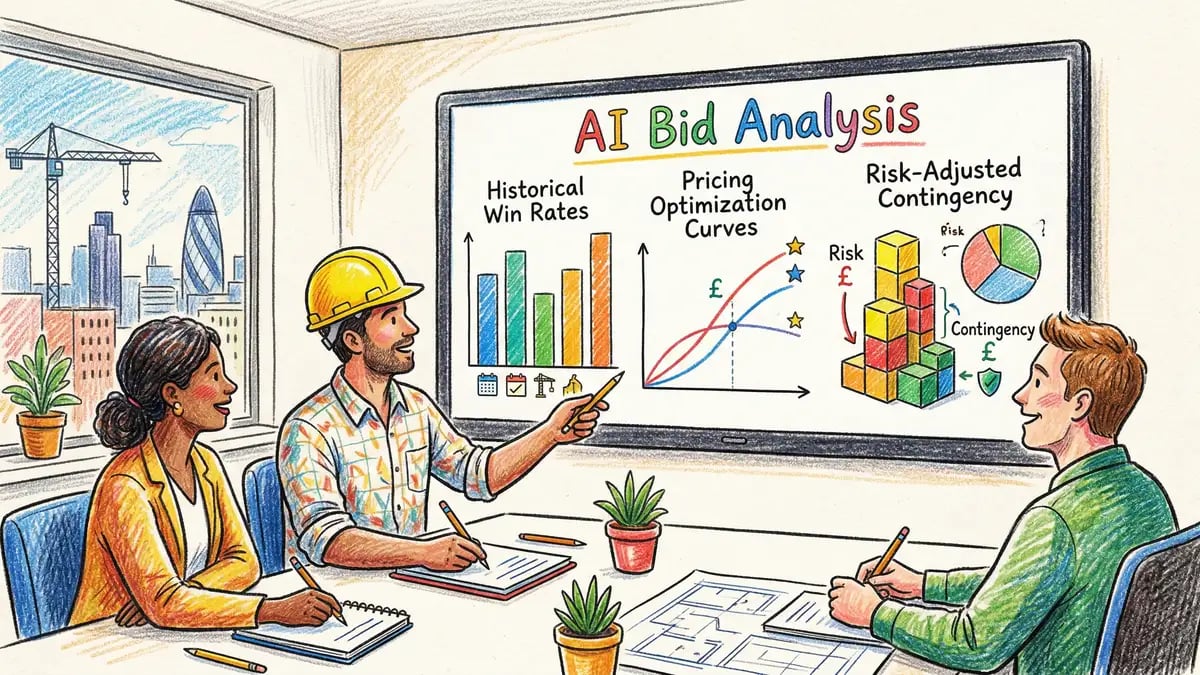
The practical outcome is significant. A mid-size contractor bidding for 15–20 opportunities per month can immediately focus effort on high-probability, high-margin opportunities whilst deprioritising marginal work. Research by Constructing Excellence suggests that organisations using data-driven bid filtering reduce proposal cost by 15–20% whilst simultaneously improving win rates.
This approach also allows construction firms to identify patterns in their loss history. If data reveals that the organisation has a 15% win rate on public sector work over £2M but a 35% win rate on private sector work under £1M, this insight should drive strategy. Rather than bid on everything, focus resources where competitive advantage exists.
Automated Tender Document Analysis and Requirement Extraction
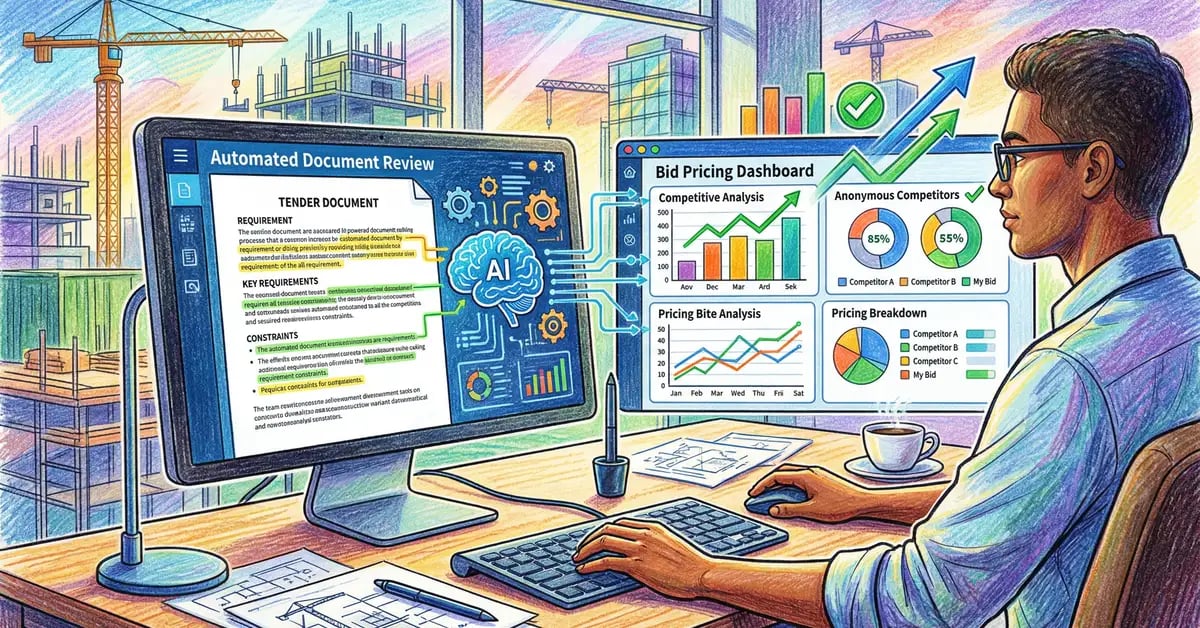
Tender documents—whether Invitations to Tender (ITT), Requests for Proposal (RFP), or Public Contracts Regulations submissions—are typically lengthy, dense, and scattered across multiple PDFs, Word documents, and spreadsheets. Extracting key requirements, constraints, and evaluation criteria manually is error-prone and time-consuming.
Natural Language Processing (NLP) systems trained on construction documentation can now automatically parse tender documents and extract structured data: project scope, timeline, budget constraints, compliance requirements, subcontractor eligibility criteria, social value weightings, insurance minimums, and evaluation scoring methodology.
Consider a practical example: An ITT document specifies that bidders must demonstrate "at least 10 years' experience in similar projects, proven safety record (RIDDOR rates below industry average), and certified B-Corp status or equivalent sustainability commitment." A traditional approach requires a tender manager to manually read and interpret each criterion, then manually verify the organisation's credentials against it.
An AI system can extract these requirements in seconds, flag which ones the organisation already meets (drawing on company records, HR systems, and certification databases), identify gaps (B-Corp certification needed), and estimate the effort required to meet them. This capability—sometimes called "requirement gap analysis"—lets a firm make an informed decision on whether to bid before investing days in proposal writing.
Beyond extraction, NLP systems can also identify hidden or implicit requirements. A tender may state "preference for local subcontractors" or "strong preference for supply chain resilience"—language that hints at weighting criteria not explicitly scored. AI can flag these nuances for management consideration.
Implementation of automated document analysis typically reduces tender review time from 8–12 hours per document to 1–2 hours, with significantly improved accuracy and completeness of requirement capture. When a construction firm is processing 10–15 tenders simultaneously, this efficiency gain is transformative.
Historical Bid Data Analysis and Pricing Optimisation
Construction companies accumulate vast archives of completed projects, won and lost bids, and cost data. These historical records are almost universally underutilised. Estimators rely on published cost indices, experience, and memory—missing the opportunity to leverage the organisation's own data as a competitive asset.
AI systems can analyse historical bid data to identify pricing patterns and profitability drivers. For instance, analysis might reveal that projects in the South East command 8% higher margins than those in the North West, or that labour-heavy projects (high percentage of labour to materials) win at a lower frequency but deliver higher margins, whilst material-heavy projects are more competitive but lower-margin.
Machine learning models can learn these patterns and provide real-time pricing recommendations during the bid process. When an estimator enters project scope parameters (size, location, contract type, timeline, complexity), the system recommends a target price based on historical performance in similar work. This is not a formula—it is a data-driven suggestion that accounts for the complexity of multiple variables simultaneously.
The benefit extends further: if historical data shows that the organisation wins 22% of bids at a £500K price point but only 8% at £550K, this sensitivity analysis allows estimators to make strategic pricing decisions. Sometimes winning at lower margin is better than losing entirely; sometimes the cost of bidding is not justified at a certain price point.
Advanced systems also integrate market intelligence. If competitor analysis data indicates that three specific rivals are likely to bid on a particular opportunity, and historical data shows these competitors typically price 5–10% below the organisation, the pricing algorithm can factor this in. The result is more sophisticated, market-aware pricing recommendations.
For large contractors managing multiple bid streams, this capability can improve margin per win by 2–4% and win rate by 8–12%, translating to substantial bottom-line impact. A contractor bidding for £20M in work annually with a 20% win rate capturing £4M in revenue can improve to £4.3M–£4.5M through smarter pricing alone.
Risk Assessment and Contingency Calculation
One of the most common sources of project failure in construction is underestimation of project risk. When estimators calculate labour and material costs, they often apply generic contingency percentages (typically 10–15%) without differentiation based on actual risk factors present in the specific project.
AI-driven risk assessment systems automatically analyse tender documents and project characteristics to identify risk factors: tight timelines relative to scope, complex interfaces with existing infrastructure, novel or untested construction methods, supply chain dependencies on single suppliers, weather-dependent tasks during winter, regulatory complexity, or first-time client relationships.
Each of these factors has a statistical correlation with cost overrun and delay. The system can assign a risk score, calculate a risk-adjusted contingency, and surface high-risk elements to project leadership. A project with compressed timeline, new client, and supply chain constraint might warrant a 22% contingency, whilst a straightforward repeat project with familiar supply chain might justify 8%.
This approach is far more rigorous than blanket percentages. It also creates an audit trail: the bid rationale explicitly states which risk factors drove contingency calculation, making it easier to justify pricing to clients and manage stakeholder expectations should risk events materialise.
Integration with NBS Construction platforms and other BIM (Building Information Modelling) systems allows AI systems to analyse project complexity at a granular level. Is the structural design novel? Is the MEP (mechanical, electrical, plumbing) coordination unusually complex? Does the project scope include heritage elements requiring specialist work? All of these feed into risk scoring.
The practical outcome is more accurate pricing, fewer loss-making projects, and better project delivery. Construction firms deploying AI-driven risk assessment typically see a 3–5% improvement in project margin through more accurate contingency allocation.
Competitor Analysis and Market Intelligence Integration
Construction firms rarely have systematic visibility into competitor bidding patterns. Winning a bid tells you little; losing a bid tells you almost nothing (unless the client graciously shares feedback). This information asymmetry disadvantages even sophisticated operators.
AI systems can aggregate publicly available intelligence on competitor activity: public procurement announcements on Find a Tender and similar platforms, company announcements, awards databases, and industry press. By combining this with internal bid win/loss records, AI can identify which competitors are active in which sectors, at what price points they tend to compete, and which customers they target.
When evaluating a new tender opportunity, this intelligence becomes actionable. If analysis shows three aggressive competitors are likely to bid, the system flags this and can recommend a strategic response: perhaps accelerate schedule to differentiate, or accept lower margin to win and build client relationship.
Some advanced platforms integrate with news feeds and social media monitoring. When a competitor announces expansion into a new geography or sector, this signals intent and allows organisations to adjust bidding strategy proactively. Conversely, if a competitor has just won several large projects, they may be capacity-constrained on the next opportunity—another input to bid/no-bid logic.
The discipline required here is continuous updating. A competitor intelligence system is only valuable if it is kept current; static data becomes stale quickly. Leading platforms automate this update cycle, continuously scanning public sources and refreshing the competitive landscape view.
Natural Language Processing for Proposal Response Generation
Once a firm decides to bid, proposal writing remains labour-intensive. PQQ (Pre-Qualification Questionnaire) responses, method statements, and management plans all follow standard structures but demand bespoke content tailored to the specific project and client.
NLP systems can now accelerate response drafting. Rather than starting from a blank page, an estimator can input key project parameters (scope, client, timeline, location, contract type), and the system generates a draft method statement, programme, and risk management plan. The draft is not final—it requires skilled review and refinement—but it provides a solid foundation that reduces writing time from 12–16 hours to 4–6 hours for a typical method statement.
More sophisticated systems integrate organisational knowledge. They have access to precedent documents (previous successful PQQ responses, method statements, safety plans) and can learn from these examples. When generating a response, the system identifies the most similar precedent project, adapts content to the new project, and produces output that maintains consistency with organisational brand and quality standards.
PQQ responses are particularly amenable to automation. Many PQQ questions follow standard formats: "Describe your experience in similar projects." An NLP system trained on the organisation's project portfolio can generate a tailored response that highlights relevant projects, team capability, and quality credentials in seconds. A human then reviews for accuracy and adds nuance.
For public sector procurement under the Procurement Act 2023, this capability is increasingly valuable. The new regime emphasises outcome-focused tendering and quality over lowest-cost competition. Crafting persuasive quality and social value responses requires skill. AI-assisted drafting accelerates this without compromising quality.
Subcontractor Selection and Supply Chain Optimisation
Large construction projects typically involve dozens of subcontractors and suppliers. Identifying the right supply chain partners, negotiating rates, and managing dependencies is complex. Many firms manage this through relationship history and informal networks—an approach that works at small scale but breaks down when bidding activity accelerates.
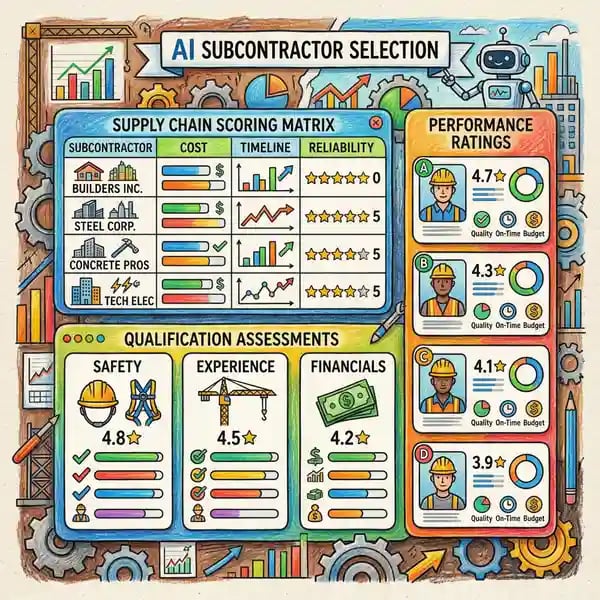
AI systems can analyse subcontractor performance data (quality ratings, schedule adherence, cost performance, safety record, insurance status, payment history) and recommend optimal combinations to meet project requirements. If a project requires specialist structural steelwork, the system identifies all pre-approved steelwork contractors, filters by availability during the project timeline, ranks by cost and quality rating, and presents options to the estimator.
More advanced systems solve what is essentially a combinatorial optimisation problem: given multiple subcontractors across multiple trades, each with varying costs, schedules, and quality ratings, what is the lowest-cost combination that meets all project requirements and interdependencies? This is computationally complex but increasingly tractable with modern AI.
The benefit is two-fold. First, faster subcontractor selection (hours instead of days). Second, more optimised supply chain decisions that balance cost, quality, and schedule. A subcontractor may be 5% cheaper but unavailable during the critical path; the AI system flags this interdependency and recommends a more expensive but schedule-compatible option.
Integration with supplier and subcontractor management systems (platforms like Buildxact or ConWize) allows real-time visibility into availability, pricing, and performance. This data feeds into optimisation algorithms, ensuring recommendations are based on current information rather than stale estimates.
Social Value and Sustainability Scoring
Public sector procurement in the UK increasingly emphasises social value and sustainability. The Public Value Framework and guidance from CIOB (Chartered Institute of Building) make clear that price is no longer the sole evaluation criterion. Social value—employment in disadvantaged communities, apprenticeships, environmental benefit—can account for 30–50% of evaluation weighting.
Quantifying and claiming social value is increasingly sophisticated. A project may deliver value through: local apprenticeships (with economic valuation), carbon reduction relative to alternative methods (with carbon cost models), use of local supply chain (with economic multiplier calculations), and training for long-term unemployed. Each of these has a quantification methodology; AI systems can help organisations calculate and substantiate claims.
NLP analysis of tender documents can extract social value criteria explicitly and implicitly stated. An ITT may specify "at least 2 apprenticeships required" or hint at preference for "carbon-neutral supply chain." AI flagging ensures no scoring opportunity is missed.
During proposal development, AI systems can recommend social value commitments that the organisation can credibly deliver and that are likely to score well given the weighting criteria. Rather than generic claims, these are specific, quantified, and aligned to tender evaluation methodology. A firm committing to training 3 long-term unemployed in construction trades (with economic value £18K per person) is more persuasive than a vague commitment to "support local communities."
The CITB (Construction Industry Training Board) publishes approved apprenticeship standards and costing. Integration with CITB data and similar sector standards allows AI systems to ensure claims are credible and verifiable.
ROI and Business Case: The Numbers Behind AI Bidding
The value proposition for AI in construction bidding is substantial and measurable. Consider a mid-size contractor with £30M annual revenue, bidding for 20 opportunities per year, with a historical 18% win rate (capturing £6M in work). Current bidding costs (staff time, proposal writing, analysis) total approximately £150K annually.
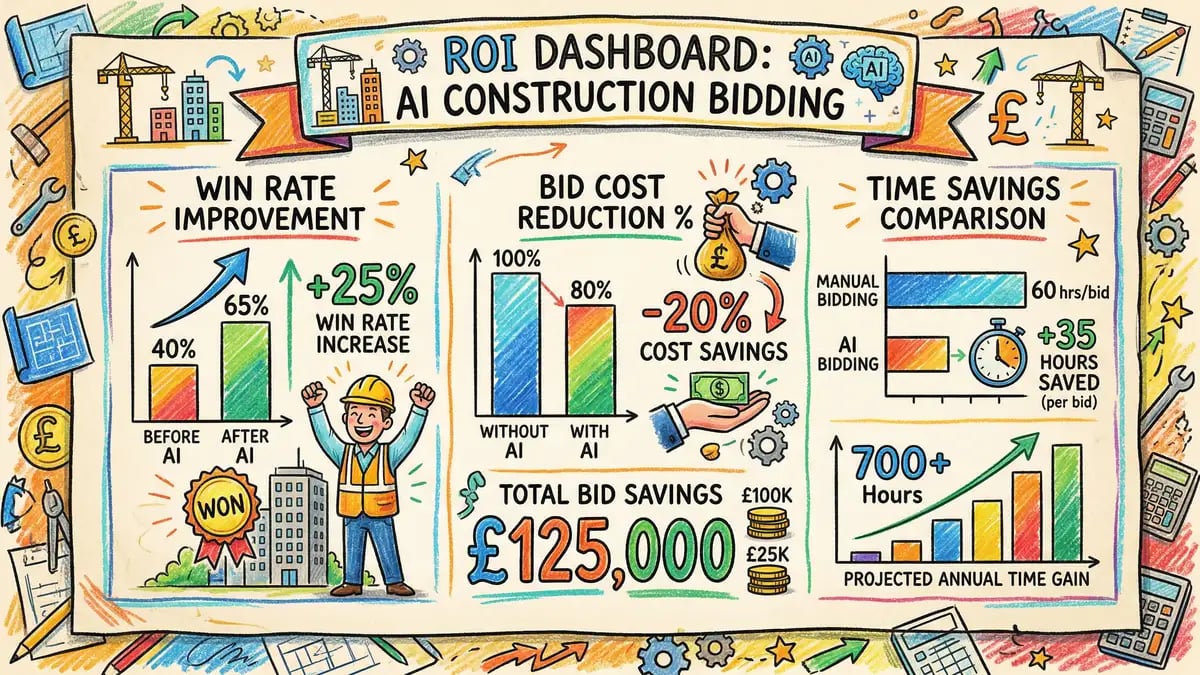
Scenario 1: Efficiency gains alone. By automating document analysis, proposal drafting, and data look-up, bidding staff reduce proposal preparation time by 30%. This frees 600 hours annually—equivalent to £30K in labour cost savings. No improvement in win rate; pure efficiency gain.
Scenario 2: Win rate improvement. By deploying bid/no-bid filtering, the firm focuses on high-probability opportunities. Win rate improves from 18% to 24% (a modest 33% improvement). On the same 20 opportunities, the firm now wins £8M in work instead of £6M—an additional £2M revenue. At 3% margin, this is an additional £60K in profit. Bidding costs remain £150K (bid volume is same, but effectiveness is higher).
Scenario 3: Combined effect. Efficiency gains (30% time reduction, £30K savings) plus win rate improvement (18% to 24%, £2M additional revenue, £60K additional profit) yields total incremental benefit of £90K per year. If AI system costs £25K annually (software license + implementation), net benefit is £65K—a 260% ROI in year one.
For larger contractors (£100M+ revenue), the benefit scales significantly. A 2% improvement in win rate on £40M bidding activity represents £800K additional revenue. The business case becomes compelling.
These scenarios are conservative. Research by leading construction technology providers (Briq and peers) document win rate improvements of 20–35% and bid cost reductions of 20–25% following AI implementation. Margin improvements from smarter pricing add an additional 2–4% bottom-line benefit.
Perhaps most valuably, AI systems free senior estimators and project managers from routine document analysis and proposal drafting, allowing them to focus on strategy, relationship management, and complex problem-solving. This is difficult to quantify but recognised as a major source of competitive advantage.
Integration with Procurement Platforms and Workflow
Most organisations do not operate AI bidding systems in isolation. They integrate with existing tools: bid management platforms (some modern platforms like Bid Manager and specialist construction tools), ERP (enterprise resource planning) systems, project accounting systems, and supplier databases.
A mature bidding workflow might look like this: A tender opportunity is posted to Find a Tender or received via client email. A webhook or API integration automatically loads the tender document into the AI system. The system extracts requirements, analyses against organisational capability, queries historical bid and project data, runs a bid/no-bid model, and delivers a recommendation to the estimating manager within 30 minutes.
If the recommendation is "bid," the system auto-generates proposal outlines, programme forecasts, risk registers, and subcontractor recommendations. The team refines these and builds the proposal. The system integrates with the ERP to pull certified cost data, ensuring proposals reflect current pricing. Once submitted, the bid is logged in the central bid management system with all associated data, supporting post-bid analysis and continuous improvement.
This workflow significantly accelerates decision-making and reduces manual handoffs. A decision that historically took 3–4 days (receive tender, review, discuss in meeting, decide) now takes 4–6 hours (automated analysis + brief management discussion).
Implementation requires investment: software selection, data migration (historical project and bid data must be cleaned and imported), staff training, and initial calibration (the bid/no-bid model must be tuned to the organisation's actual performance and risk appetite). Typically, initial implementation requires 8–12 weeks and costs £30K–£60K depending on complexity. Ongoing costs are software subscription (£15K–£35K annually) plus internal resource allocation for model maintenance.
Challenges and Mitigation
Deploying AI in construction bidding is not without challenges. Data quality is the foundational issue. Historical bid data often contains errors, inconsistencies, and missing fields. Projects may be mislabelled or outcome data (did we win or lose?) may be incomplete. Cleaning and structuring historical data for AI consumption typically requires 3–4 weeks of skilled effort.
Model calibration and validation require patience. The bid/no-bid model must be tested against historical data before it is trusted in live bidding. If the model recommends rejecting an opportunity that would have been highly profitable, or recommends pursuing one that turns unprofitable, confidence erodes quickly. Leading implementations allocate time for backtesting and refinement before full rollout.
Change management is subtle but important. Estimators and bid managers may perceive AI as threatening their autonomy or expertise. Successful implementations position AI as a support tool that enhances judgment rather than replaces it. A system recommending "bid this project at £450K" is guidance, not instruction; the estimator retains authority and rationale for override.
Regulatory and compliance considerations exist but are typically manageable. If AI recommendations are used in procurement decisions, organisations should be able to articulate the logic: "We used historical data on 47 similar projects and applied a risk-adjusted cost model to arrive at this price." This is auditable and defensible. Avoid purely black-box recommendations lacking explainability.
Finally, integration with legacy systems can be technically challenging. Many construction firms run on ageing ERP and bid management systems with poor APIs. Custom integrations may be required, adding cost and complexity. Selection of AI vendors with strong integration capabilities and pre-built connectors (to popular platforms like ProEst, Buildxact, and others) mitigates this risk.
Case Study: Application in UK Public Sector Work
Consider a 40-person contractor specialising in educational and healthcare infrastructure, working primarily with public sector clients. They receive 8–10 ITT opportunities per month from various education authorities and NHS trusts. Proposal preparation is intensive; each ITT requires 60–80 hours across multiple staff. Annual bidding cost is approximately £200K. Historical win rate is 16%.
The firm implemented an AI-based system that automatically extracts PQQ requirements, scans credentials database to confirm compliance, identifies gaps, and generates a draft PQQ response tailored to each client. For evaluation criteria analysis, the system extracts weighting, identifies scoring factors, and recommends social value commitments aligned to client priorities (e.g., if the client has published a commitment to net-zero by 2035, the system recommends carbon reduction specifics that resonate).
Within six months, bidding preparation time fell to 40–50 hours per proposal (a 30–40% reduction). The team pursued the same volume of opportunities but with higher quality, more targeted responses. Win rate improved to 22% (a 37.5% improvement). Additional revenue captured: approximately £1.2M annually. Annual bidding cost remained approximately £200K (lower due to efficiency), plus £35K software cost. Net incremental benefit: approximately £1M annually (at 3% margin).
Beyond the financial return, the team reported improved morale. Senior estimators spent less time on document review and more time on complex technical problem-solving and relationship management. Staff turnover in the bidding team fell from 35% to 10% annually, reducing recruitment costs and maintaining institutional knowledge.
Frequently Asked Questions
What is the typical implementation timeline for AI bidding systems?
Initial implementation typically requires 8–12 weeks. This includes software selection and licensing (2 weeks), data migration and cleaning of historical bid and project data (4–6 weeks), staff training and process redesign (2 weeks), and pilot testing and model calibration (2 weeks). Organisations should expect full productivity and ROI to emerge over 3–6 months as teams become proficient and models are fine-tuned.
Do we need to have excellent data to start, or can AI help us clean messy historical data?
AI can assist in data cleaning—identifying anomalies, suggesting missing values, and flagging inconsistencies—but does not eliminate the need for human review. A phased approach works well: assess current data quality, use AI tools to identify and flag issues, then allocate skilled staff to resolve critical gaps. Do not delay implementation waiting for perfect data; start with 80% clean data and refine iteratively.
Will AI reduce the number of bidding staff we need?
AI typically reduces bidding hours per proposal by 25–35%, which may allow a team to pursue more opportunities with the same headcount or reduce headcount by 20–30%. However, most organisations choose reinvestment: pursue more bids, improve proposal quality, or redeploy staff to higher-value activities (relationship management, strategic planning, delivery support). Staff reductions are rarely necessary and can actually harm organisational knowledge.
How do we ensure AI recommendations align with our business strategy?
AI models must be configured to your risk appetite and strategic priorities. If you are pursuing market share growth in a specific region, configure the bid/no-bid model to weight regional presence more heavily. If you are exiting certain sectors, configure the model to deprioritise work in those sectors. The system should reflect your strategy, not replace it. Regular review meetings between leadership and the bidding team ensure alignment.
Is there a risk that AI pricing recommendations will undercut or harm profitability?
Yes, if models are not properly calibrated and monitored. Implementation should include backtesting: run the AI pricing model against 50–100 historical bids and verify that model-recommended prices would have resulted in similar win rates and margins to actual outcomes. If the model recommends consistently lower prices, recalibrate before deploying in live bidding. Ongoing monitoring—comparing AI recommendations to actual prices submitted—should be standard practice.
What vendor should we select for AI bidding systems?
Several vendors serve the construction industry. Briq and ConWize specialise in construction bidding; Buildxact integrates estimating with AI features. Before selection, evaluate integration capability (does it connect to your current systems?), model explainability (can you understand recommendations?), implementation support, and pricing. Request case studies from similar-sized organisations in your sector.
Transforming Construction Bidding Through AI
Artificial intelligence is not a speculative future technology in construction bidding—it is already reshaping the industry. Organisations deploying these systems are demonstrating measurable competitive advantage: improved win rates, reduced bidding costs, better project profitability, and freed-up leadership capacity for strategy.
For UK construction firms operating in an increasingly competitive market with thin margins and complex public sector procurement requirements, AI bidding systems represent a significant opportunity to gain competitive edge. The technology is mature, the business case is clear, and implementation is now manageable for mid-size and larger organisations.
The construction companies that embrace this transition—treating AI not as a cost reduction tool but as a source of competitive intelligence and operational excellence—will capture disproportionate market share over the next 24–36 months. Those that delay risk being outbid by more sophisticated competitors.
Related Reading
Explore more about AI in construction and related disciplines:
- AI for Construction Engineering: Automating Design Validation and Site Coordination
- AI for Construction Estimating: Automating Cost and Resource Planning
- AI for Quantity Surveying: Transformation Through Machine Learning
- AI for Construction Project Management: Intelligent Scheduling and Risk Control
- AI for Construction Safety: Predictive Hazard Detection and Compliance
- AI for Construction Design: Automating Conceptual Development and Optimisation
Take the Next Step
Improving bidding efficiency and win rate requires a structured approach grounded in data and underpinned by the right technology. At Helium42, we help construction firms deploy AI bidding systems that align to business strategy, integrate with existing workflows, and deliver measurable ROI.
Whether you are bidding 10 opportunities annually or 100, whether your challenge is win rate, bidding cost, or both, we work with you to diagnose your current process, identify optimisation opportunities, and implement AI solutions that stick.
Our AI consultancy services provide end-to-end guidance: business case development, system selection and implementation, staff training, and ongoing optimisation. We also offer tailored AI training programmes to build internal capability in your bidding and estimating teams.
Contact us to discuss your bidding challenge and explore how AI can transform your approach. AI Readiness Checklist