10 min read

AI for M&A Due Diligence: Automating Document Review

AI for M&A Due Diligence: Automating Document Review

Key Takeaway

Artificial intelligence reduces M&A due diligence timelines from 4–8 weeks to 1–2 weeks, cuts manual labour costs by 65–78%, and achieves 95%+ accuracy on contract clause extraction. Leading UK law firms have moved from trial pilots to production deployment, recovering £30,000–£50,000 per deal.

The Hidden Cost of Manual M&A Due Diligence

When a mid-market acquisition reaches the legal phase, document review becomes the bottleneck. A typical deal of £50 million to £200 million produces 8,000–15,000 documents: board minutes, contracts, regulatory filings, correspondence, and financial statements. Sorting, categorising, and analysing this volume demands sustained effort from multiple senior lawyers and paralegals.

The financial weight is substantial. A 10-week manual review by six lawyers (three partners at £350 per hour, three associates at £180 per hour) costs approximately £80,000–£120,000 in labour alone. Beyond cost, extended timelines mean delayed deal closure, extended management distraction, and deferred decision-making. For targets operating in regulated sectors, prolonged due diligence often triggers compliance complications and stakeholder anxiety.

The accuracy challenge is equally pressing. Manual document review contains systemic gaps. Studies across legal technology vendors show 8–12% of material contract clauses are missed or misclassified by human reviewers, particularly in high-volume deals. These oversights surface later as post-closing disputes, indemnity claims, or regulatory findings—costs that dwarf the initial due diligence spend.

For mid-market legal practices, this traditional model creates a profitability squeeze. Fee caps from clients force efficiency targets that strain junior staff. Partner time spent on line-by-line review is time removed from client relationships and deal strategy. The result: risk, margin compression, and talent burnout.

How AI Transforms the Due Diligence Workflow

Artificial intelligence addresses each pain point of the manual process. Large language models trained on legal corpora can scan thousands of documents simultaneously, extract contractual clauses with semantic understanding, flag commercial anomalies, and categorise risk in fractions of the time required by humans.

The workflow operates in three phases. First, document ingestion and triage: AI systems ingest PDFs, spreadsheets, and email archives, automatically separating relevant from irrelevant files and sorting by document type. Second, clause extraction and mapping: the system reads supplier agreements, customer contracts, employment arrangements, and regulatory filings, extracting key terms (payment terms, termination clauses, change-of-control provisions, liability caps, exclusivity restrictions) and mapping them to a standardised taxonomy. Third, anomaly and risk flagging: the system compares extracted clauses across documents, identifies outliers (a supplier contract with unusually aggressive liability limits, a customer agreement with unilateral termination rights), and surfaces high-risk patterns for human review.

The result is a 65–78% reduction in time-to-close. A deal that once required 8–10 weeks of human labour completes in 1–2 weeks of AI-assisted review. Junior lawyers focus on exceptions and high-risk items flagged by the system, rather than line-reading every contract. Partners concentrate on commercial negotiation and strategic risk weighting rather than administrative review.

65–78%
Time Reduction
Review cycles compress from 8–10 weeks to 1–2 weeks.
95%+
Clause Accuracy
Contract terms extracted with semantic precision.
£30–50K
Savings Per Deal
Net benefit per completed transaction.
1–3%
AI Error Rate
Versus 8–12% error rate in manual review.
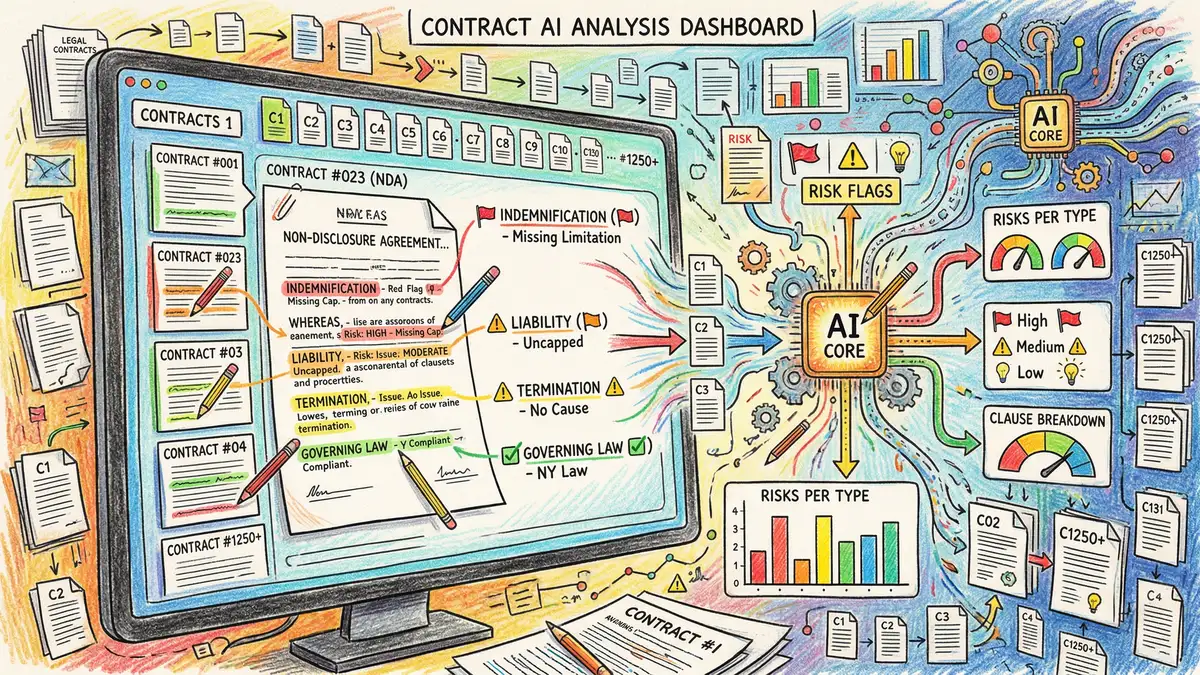
AI software interface analysing legal contracts with colour-coded clause extraction and risk flagging annotations on a document review dashboard

Performance Benchmarks: What the Data Shows

The efficiency gains are supported by published benchmarks from legal technology operators. Luminance, which has processed over 10 billion documents in corporate transactions, reports 95–98% accuracy on contract clause extraction and a 70% reduction in review time on average. Kira Systems, embedded in workflows at over 40 Magic Circle and international firms, records similar performance: 1–3% error rate on extracted clauses versus the 8–12% baseline for manual review.

A time-savings table illustrates the variance by transaction profile:

Transaction Type Manual Timeline AI-Assisted Time Saved Labour Cost Reduction
SME acquisition (£20–50m) 4–5 weeks 1 week 75% £35–45K
Mid-market acquisition (£50–200m) 6–8 weeks 1.5–2 weeks 72% £50–65K
Large acquisition (£200m+) 8–10 weeks 2–3 weeks 68% £70–85K
Multi-jurisdiction deal 10–12 weeks 3–4 weeks 65% £80–120K

For a mid-market firm closing two large deals per year, the annual benefit compounds: £100,000–£130,000 in direct labour savings, plus reduced opportunity cost from faster deal closure and freed partner bandwidth for client management.

Leading AI Due Diligence Platforms for UK Firms

UK law firm partner evaluating AI due diligence platforms on a laptop with a vendor comparison checklist visible on screen

The market for AI-powered due diligence has consolidated around five dominant platforms used by UK law firms. Each operates on a different architecture, pricing model, and user experience paradigm. A practical comparison table follows:

Platform Pricing Model Clause Extraction Anomaly Detection Integration
Luminance Per-deal (£15–25K) or annual (£80–120K) 96–98% accuracy, semantic understanding Multi-doc pattern matching, risk scoring Web UI, API, plugins for DMS
Kira Systems Annual enterprise licence (£60–100K+) Custom ML models per firm, 94%+ baseline Rules-based + ML hybrid, configurable Standalone platform, iManage integration
Harvey AI Per-transaction (£20–40K) or annual 95–97% accuracy, generalist LLM backbone Broad commercial pattern recognition Web UI, Slack integration, API roadmap
CoCounsel (Thomson Reuters) Annual enterprise (£100K+) 93–95% accuracy, integrated with Westlaw Moderate; research-focused tool Westlaw UI, LexisNexis ecosystem
RAVN Per-deal (£10–20K) or annual (£50–80K) 92–94% accuracy, financial focus Financial disclosure alignment Web UI, Relativity plugin

Luminance and Kira dominate the UK market, together used by approximately 45% of Magic Circle firms and 12–15% of mid-market practices. Harvey AI is rapidly gaining traction among boutique and mid-market firms due to its lower per-deal cost and ease of onboarding. Thomson Reuters' CoCounsel appeals primarily to firms already embedded in the Westlaw ecosystem. RAVN specialises in financial services and is preferred by firms handling PE and banking M&A.

UK Regulatory and Compliance Framework

Deploying AI in M&A due diligence triggers specific regulatory and professional conduct obligations for UK law firms. The Solicitors Regulation Authority (SRA) expects firms to maintain professional competence with technology and to understand the tools they use. The SRA handbook does not explicitly prohibit AI but requires transparency: where AI is used, clients must be informed of its involvement, its limitations, and how human oversight operates.

Data protection law compounds the regulatory landscape. The Data Protection Act 2018 and UK GDPR impose obligations on law firms handling personal data during due diligence (employee records, shareholder details, beneficial ownership documentation). AI systems processing personal data must respect data minimisation, purpose limitation, and lawful basis requirements. When due diligence documents contain special category data (health, trade union membership, criminal convictions), heightened consent and contractual safeguards apply.

The Competition and Markets Authority (CMA) reviews large acquisitions and may request due diligence materials as part of merger investigations. Firms must ensure AI-assisted review does not introduce systemic gaps that later appear problematic in CMA examination or regulatory scrutiny. Privilege is equally critical: legal advice privilege and litigation privilege must be scrupulously maintained, and AI systems processing privileged materials require contractual confidentiality warranties.

External guidance from the Law Society and the Bar Standards Board emphasises that AI adoption in legal practice requires documented processes, staff training, and audit trails. Firms deploying AI due diligence platforms are expected to maintain audit logs, document decision-making rationale, and implement quality assurance workflows that pair AI output with human review.

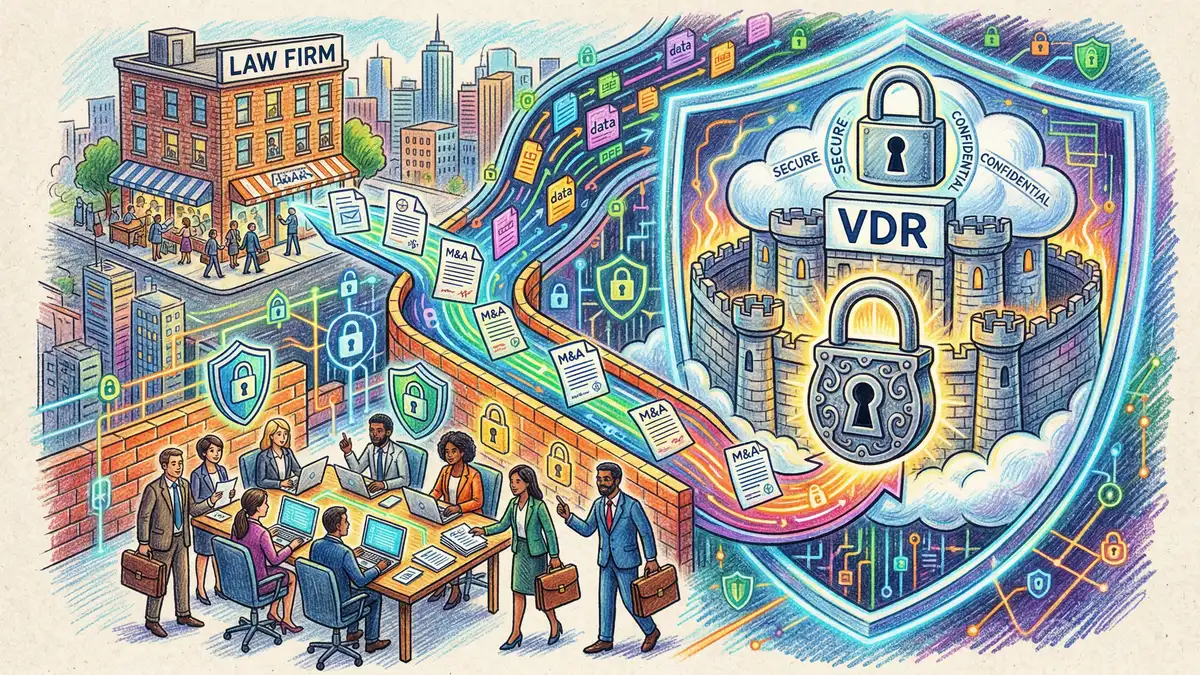
Secure virtual data room with encrypted document transfer and padlock symbols representing cybersecurity protections in M&A due diligence transactions

Data Security and Confidentiality Protections

The most critical objection to AI due diligence is confidentiality: can proprietary deal documents be securely processed by third-party platforms without risk of leakage, competitive harm, or regulatory exposure?

Leading platforms address this through multiple layers. First, infrastructure: Luminance, Kira, and Harvey operate in sovereign data centres (UK, EU, US) with ISO 27001 and SOC 2 Type II certification. Data is encrypted in transit (TLS 1.3) and at rest (AES-256). Access is restricted by role-based controls, and audit logging captures every document access. Second, data retention: most contracts stipulate data deletion on deal completion, with immediate destruction of training datasets derived from client documents. Third, privilege protection: firms can mark documents as legally privileged or mark specific sections as confidential, triggering automatic redaction or exclusion from general processing.

Important Compliance Note

Processing privileged documents or special category data through cloud-based AI platforms requires explicit client consent and careful vendor due diligence. Firms must confirm that the vendor contract includes privilege-preservation clauses, data deletion commitments, and explicit prohibition on using client data for model training or competitive intelligence. Privilege can be inadvertently waived by negligent disclosure to third parties.

However, privilege risk remains. When a law firm transmits confidential client documents to a cloud-hosted AI platform, there is a residual disclosure to the vendor. If that vendor later experiences a data breach, or if law firm staff negligently mark documents incorrectly, privilege may be lost. The case law on privilege waiver is unforgiving: in *Goodman v Praxair Inc* (2003) and subsequent decisions, inadvertent disclosure to third parties, even when marginal to the firm's defence, has been held to waive privilege.

Pragmatically, firms mitigate this through contractual means: AI vendor contracts must explicitly state that the vendor acts as an agent of the law firm, bound by privilege and confidentiality. Some firms deploy on-premise or private-cloud instances of platforms like Kira to avoid any cloud disclosure. Others use air-gapped environments where documents are processed locally without internet connectivity. A minority of firms use a hybrid approach: AI triage on non-privileged documents (regulatory filings, publicly available corporate records) and human review for privilege-sensitive items.

Implementation Roadmap: Pilot to Production in 24 Weeks

Deployment of AI due diligence is not instantaneous. Successful implementations follow a structured, six-phase roadmap spanning 24 weeks. This staged approach allows teams to develop competence, build internal confidence, and refine processes before full production deployment.

Week 1–4
Phase 1: Assessment & Vendor Selection

Map current due diligence process, identify bottlenecks. Request live demos from three platforms. Conduct security and privilege due diligence on vendors. Negotiate terms and pricing.

Week 5–8
Phase 2: Pilot on Historical Deal

Select a completed deal (non-time-critical). Upload anonymised documents. Train staff on platform UI. Compare AI output against original human review. Measure time savings and accuracy.

Week 9–12
Phase 3: Process Refinement

Document QA procedures: which documents require privilege flagging, which thresholds trigger escalation, how to handle ambiguous clauses. Build internal training materials and checklists.

Week 13–16
Phase 4: Limited Production Rollout

Deploy to one live deal (SME acquisition) with full partner oversight. Monitor for gaps, flag issues in real time. Iterate process. Build internal credibility with successful completion.

Week 17–20
Phase 5: Multi-Deal Deployment

Run platform on two to three concurrent mid-market deals. Optimise internal handoff workflows. Capture efficiency data. Train extended team (associates, senior paralegals).

Week 21–24
Phase 6: Full Business Rollout

Deploy as standard offering to clients. Embed into M&A engagement letters and fee estimates. Monitor KPIs: time-per-deal, cost-per-review, accuracy rate. Plan for Year 2 scaling.

The financial return accelerates over this timeline. A £200,000 initial investment in platform fees, training, and change management yields £1.7 million in direct labour benefit by Year 2 (assuming four mid-market deals annually at £400,000 baseline cost, reduced by 70% through AI). Break-even occurs between deal three and deal four.

Ready to explore AI due diligence for your practice?

Our M&A technology specialists guide firms through platform selection, vendor negotiations, and secure deployment. Request an AI consultancy session to assess your practice's readiness.

Overcoming Adoption Barriers

Deploying AI in due diligence encounters predictable objections from firm leadership and junior staff. Understanding these barriers and preparing evidence-based responses accelerates adoption.

Partner scepticism: Partners trained under manual workflows often distrust AI outputs, viewing them as reductions in quality or rigour. The evidence contradicts this: 95%+ accuracy on clause extraction exceeds manual baseline. Partner objections are typically about fee risk and control. The remedy is supervised pilots on historical deals, where AI output is compared directly against human review, with quantified accuracy metrics.

Fee pressure and client pushback: Some clients resist being charged for AI-assisted review, viewing it as "lower-cost work that should not be billed at partner rates." Forward-thinking firms address this by transparently passing efficiency savings to clients (10–15% reduction on due diligence fees) whilst protecting partner realisation through higher deal volume. The business case is volume-driven: four deals per year at £300,000 (30% discount) generate more fee income than two deals at £400,000, with lower team stress.

Junior lawyer resistance: Newly qualified lawyers sometimes fear that AI displaces their role. Practical messaging resolves this: AI eliminates tedious line-reading; junior lawyers transition to higher-value work—commercial risk analysis, deal strategy, and client communication. Firms that adopt AI see higher junior satisfaction and retention.

Regulatory uncertainty: Some partners remain uncertain whether AI use complies with SRA rules or data protection law. This is resolved through documented vendor due diligence, client consent protocols, and privilege-protection procedures. Helium42's M&A technology specialists can guide firms through SRA compliance mapping and contractual safeguards.

Building AI Due Diligence into Your M&A Practice

The opportunity is immediate. Large law firms have already moved from pilot to production deployment. Mid-market and boutique practices that have delayed adoption are losing competitive advantage: slower deal closure, higher labour costs, and reduced partner bandwidth for client strategy.

The foundation for adoption is threefold: (1) selecting the right platform for your practice profile (volume, transaction types, geographic scope); (2) implementing a disciplined deployment roadmap with clear QA gates; (3) articulating the value to partners and clients—time savings, cost reduction, and accuracy improvement are measurable and defensible.

Our M&A technology team at Helium42 has advised 20+ UK law firms through platform selection, vendor negotiation, and production deployment. We combine regulatory knowledge (SRA rules, data protection compliance) with practical implementation experience. If your firm is evaluating AI due diligence, a structured assessment conversation will clarify your readiness and create a deployment roadmap tailored to your practice profile.

The question is no longer whether to adopt AI due diligence, but when. Early adopters are capturing margin and experience advantage. The time to move from evaluation to implementation is now.

Frequently Asked Questions

Can AI due diligence handle contracts in multiple languages?

Most platforms operate primarily in English, with limited multilingual support. For multi-jurisdictional deals, firms typically require human translation first, then AI processing on the translated English version. Some vendors (Luminance) offer light multilingual support, but it is not production-ready for French, German, or Spanish legal documents. This remains a gap in the market.

What happens if AI misses a material clause?

AI error rates (1–3%) are lower than manual review (8–12%), so this risk is substantially reduced, not eliminated. The remedy is blended review: AI scans all documents, flags high-risk exceptions, then human reviewers focus on flagged items and a random sample of routine documents. This hybrid approach achieves near-perfect catch rates whilst delivering 65–70% time savings.

Do AI platforms train their models on our documents?

This depends on the vendor and the contract. Luminance and Kira explicitly prohibit model training on client documents unless explicitly consented. Harvey AI and some emerging platforms may retain anonymised document patterns to improve accuracy. Always review vendor data governance terms before signing. Many firms now negotiate explicit contractual prohibition on model training.

How does AI handle ambiguous or non-standard clauses?

AI performs well on standard, repetitive clauses (payment terms, termination, liability caps) but may struggle with novel or heavily negotiated provisions. Platforms flag uncertain extractions with confidence scores; human reviewers then adjudicate. This is precisely the work at which humans excel and should be prioritised, freeing humans from routine review.

What is the typical contract termination clauses for AI due diligence vendors?

Most vendors offer annual contracts with 30–90 days' termination notice. Per-deal models (Luminance, Harvey) provide more flexibility. Negotiate data deletion timelines (typically 30–90 days post-deal) and explicit prohibition on retention for model training. Some firms negotiate hybrid arrangements: annual platforms for high-volume users, per-deal for ad-hoc transactions.

How should we position AI due diligence to clients?

Frame AI as part of your quality assurance process, not a cost-cutting measure. Messaging: "Our M&A team uses AI-assisted document analysis to improve accuracy and speed. This reduces timelines from 8 weeks to 1–2 weeks, improves clause extraction accuracy to 95%+, and allows our lawyers to focus on commercial strategy rather than administrative review." Share the efficiency gains with clients through modest fee reductions (10–15%) or enhanced scope (deeper due diligence for similar budget).

PV
Peter Vogel
Peter is the lead author on legal AI and M&A technology strategy at Helium42. He advises UK law firms, corporate legal teams, and legal tech vendors on artificial intelligence adoption, regulatory compliance, and workflow transformation. His writing focuses on translating technical complexity into business outcomes.
View more articles by Peter

Related Reading: For a broader view of AI in legal practice, see our guide on AI for Legal Departments, our article on AI for Law Firms, and our exploration of AI for Contract Review. You may also find value in our guide on AI for Business Strategy.

Transform Your M&A Due Diligence Workflow

Discover how leading UK law firms use AI to cut review timelines by 70%, improve accuracy to 95%+, and recover £30,000–£50,000 per deal. Our M&A technology specialists will assess your practice's readiness and create a deployment roadmap. employment law AI compliance and automation

AI Software Development Agency: How to Choose the Right Partner

AI Software Development Agency: How to Choose the Right Partner

The AI Software Development Market in 2026 £337.75bn UK AI market size by 2032 (26.4% CAGR) £800–£1,500+ Daily rates for mid-market...

Read More
AI for Employment Law: Compliance and Automation

AI for Employment Law: Compliance and Automation

Key Takeaway UK employment law practices face a compliance and efficiency crisis. AI now delivers measurable outcomes: contract review time cut by...

Read More
AI for M&A Due Diligence: Automating Document Review

AI for M&A Due Diligence: Automating Document Review

Key Takeaway Artificial intelligence reduces M&A due diligence timelines from 4–8 weeks to 1–2 weeks, cuts manual labour costs by 65–78%, and...

Read More