AI Sales Pipeline Optimisation: How UK Sales Teams Are Using AI to Close More Deals
Artificial intelligence is fundamentally reshaping how UK sales teams manage their pipelines. For decades, pipeline management relied on...

11 min read
Peter Vogel
:
Updated on April 1, 2026
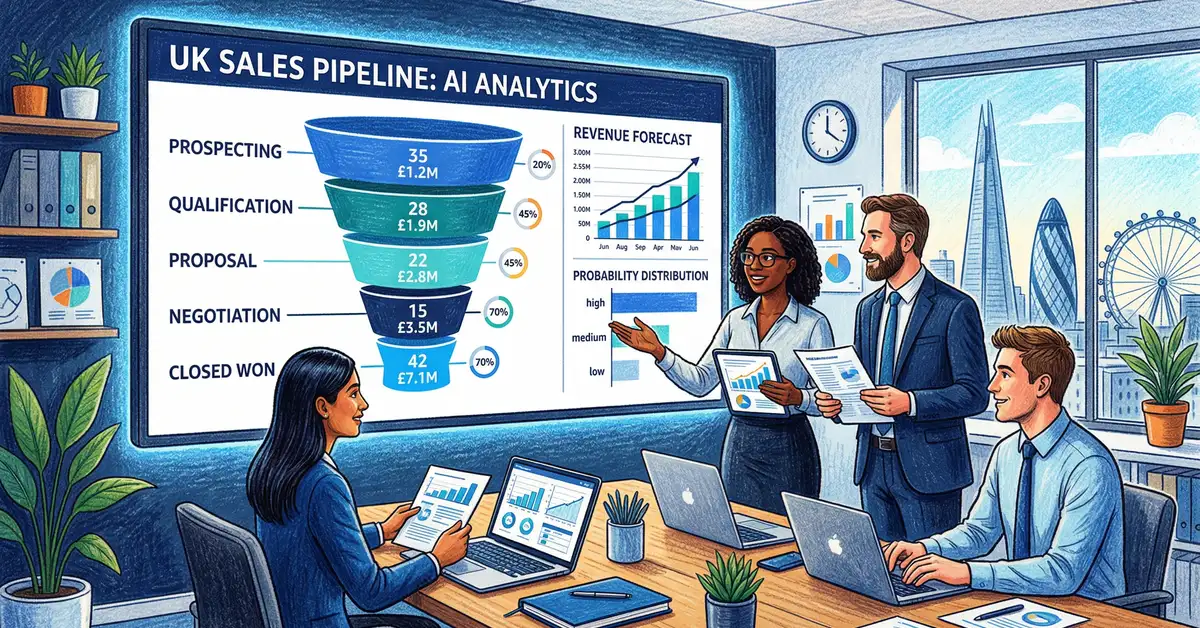
Artificial intelligence is fundamentally reshaping how UK sales teams manage their pipelines. For decades, pipeline management relied on spreadsheets, gut feeling, and manual processes that consumed countless hours whilst generating unreliable forecasts. Today, AI for sales is enabling teams to qualify leads faster, predict deal closure with greater accuracy, and identify pipeline risks weeks before they become problems.
This guide explores how leading UK sales organisations are using AI to optimise their pipelines, the tools available to implement these capabilities, and the practical roadmap for deploying AI-driven pipeline management in your organisation.
Key Takeaway
AI-driven pipeline management delivers measurable results: organisations using AI achieve 83% higher revenue growth, 34% shorter sales cycles, and 30% better conversion rates than those relying on traditional methods. However, implementation requires more than technology—it demands data quality, team alignment, and a structured change management approach.
The adoption of AI in sales pipeline management remains uneven across UK organisations. According to recent research, 31–35% of UK businesses are actively using AI to enhance their sales operations, whilst 81% of global sales teams are experimenting with AI-powered tools in some form. Among organisations that have successfully implemented AI, the results are compelling: revenue growth for AI adopters averages 83% compared to 66% for those without AI capabilities.
Yet adoption remains constrained by barriers that have little to do with cost. A significant skills gap affects 60% of organisations attempting to deploy AI in sales, whilst only 11% cite cost as their primary obstacle. This distinction is critical: the challenge is not affording AI tools, but rather developing the expertise to configure, manage, and extract value from them. This is where AI for sales services and structured AI training become essential investments.

83%
Revenue growth with AI
85%+
ML forecast accuracy
34%
Shorter sales cycles
30%
Conversion improvement
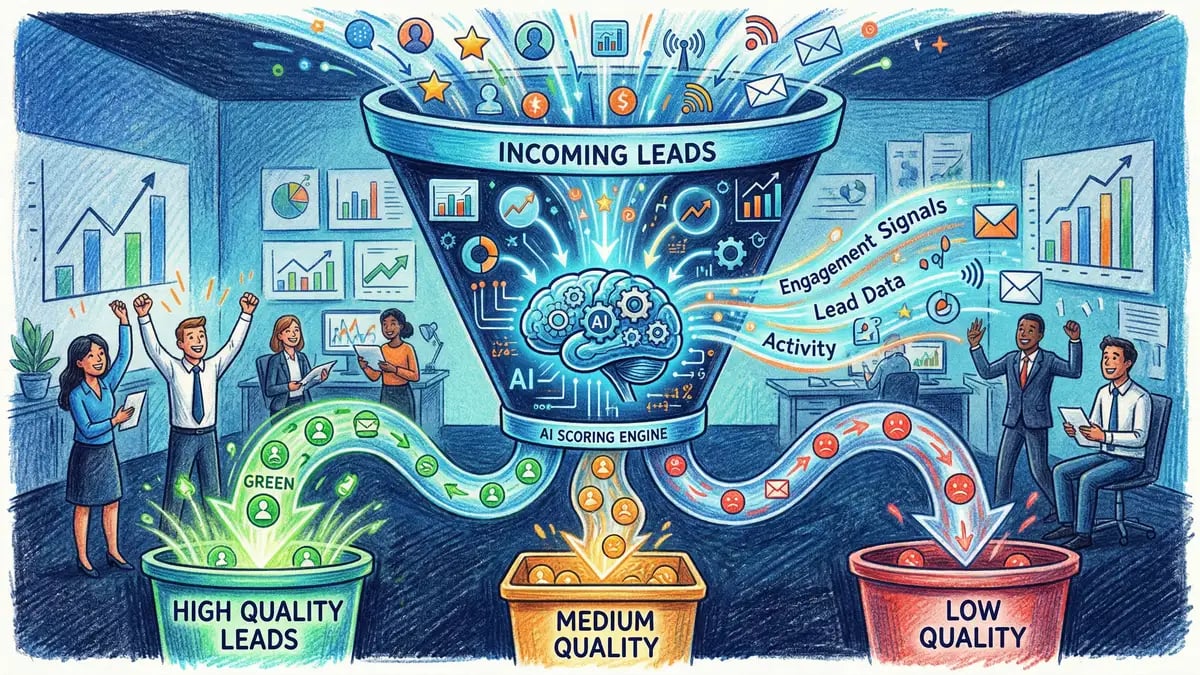
Lead scoring remains one of the highest-impact applications of AI in pipeline management. Traditional rule-based scoring methods assign points based on fixed criteria—company size, industry, job title—yielding inconsistent results and wasted sales effort on low-quality leads. AI-powered lead scoring, by contrast, learns from historical conversion data to identify which lead characteristics actually drive deals.
The performance differential is substantial. Organisations using AI lead scoring report 75% higher conversion rates and 138% better return on investment compared to those using traditional rule-based approaches. Additionally, AI scoring enables faster response cycles—Harvard Business Research has documented that teams responding to leads within five minutes are 100 times more likely to engage the decision-maker. AI qualification systems auto-route inbound leads to the appropriate sales representative and flag hot opportunities immediately, eliminating delays caused by manual review.
The business impact is equally clear: organisations implementing AI lead scoring typically see 50% more qualified leads entering the pipeline whilst reducing customer acquisition cost by 60%. This combination—more leads with lower cost—creates a powerful efficiency gain that accelerates revenue scaling.
Sales forecasting has long been the weakest link in pipeline management. Traditional forecasts, typically produced monthly or quarterly based on sales representative estimates, carry accuracy rates of only 70–79%. These estimates are vulnerable to optimism bias, compressed timelines, and inconsistent deal assessment across the sales team. The result: forecast misses that damage credibility with finance and executives.

Machine learning models, trained on historical deal data, achieve accuracy rates exceeding 85% and do so by continuously recalibrating. These systems analyse deal progression patterns, engagement velocity, buyer behaviour signals, and competitive context to generate probabilistic forecasts that update daily. More critically, AI forecasting systems identify at-risk deals 3–4 weeks earlier than traditional methods, giving teams time to intervene with additional resources, executive engagement, or scope adjustments.
The most mature organisations employ a human-in-the-loop approach: AI surfaces predictions and risk indicators, but account executives retain authority over deal closures and timelines. This preserves human judgment for nuanced client situations whilst leveraging AI's analytical power to flag patterns that individuals might miss. This approach, combined with AI implementation roadmap frameworks, ensures forecasts improve month-on-month.
Conversation intelligence platforms record, transcribe, and analyse every sales call and meeting. These systems use natural language processing to extract deal sentiment, identify customer pain points, track objection handling, and benchmark individual performance against top performers. The capability has proven transformational: organisations using conversation intelligence close deals 19% faster and improve win rates by 41%.
Real-time coaching is the engine behind this improvement. As a sales representative speaks with a prospect, the system identifies opportunities—questions to ask, objections to address, competitor threats to acknowledge—and surfaces them to the representative or a manager in real-time. Post-call, the system generates a structured analysis highlighting what went well, where coaching is needed, and which techniques the representative should replicate. Over time, this builds institutional knowledge about what messaging, questions, and approaches drive conversions.
Beyond sales effectiveness, conversation intelligence delivers compliance and risk management benefits. Automatic transcription and analysis ensure consistent documentation of customer commitments, pricing agreements, and scope discussions—reducing disputes and post-deal complications. This capability becomes increasingly valuable as organisations scale and the risk of miscommunication grows.
Traditional pipeline management relies on monthly or quarterly reviews. Sales managers analyse historical deal data, spot-check key accounts, and make adjustments. This cadence is too slow. Deal dynamics change weekly, competitive threats emerge unexpectedly, and stakeholder changes can derail deals before a manager notices.
AI-driven pipeline health monitoring runs continuously. Systems track engagement velocity (how quickly buyers are progressing through your sales process), monitor stakeholder changes at target accounts, flag competitive threats detected through market intelligence, and identify deals slipping backward in the pipeline. When anomalies emerge—a deal stalling for two weeks, a key contact leaving, a competitor entering the account—the system alerts the account executive and manager immediately.
The business outcomes are striking: organisations using continuous pipeline monitoring report 40% reduction in deals slipping beyond their target close date and 25% improvement in forecast accuracy. Combined with rapid intervention protocols, these gains create predictability that translates directly to reliable revenue.
Want to accelerate your sales pipeline with AI?
Helium42 helps UK sales teams implement AI that delivers measurable pipeline improvements in 6 to 8 weeks.
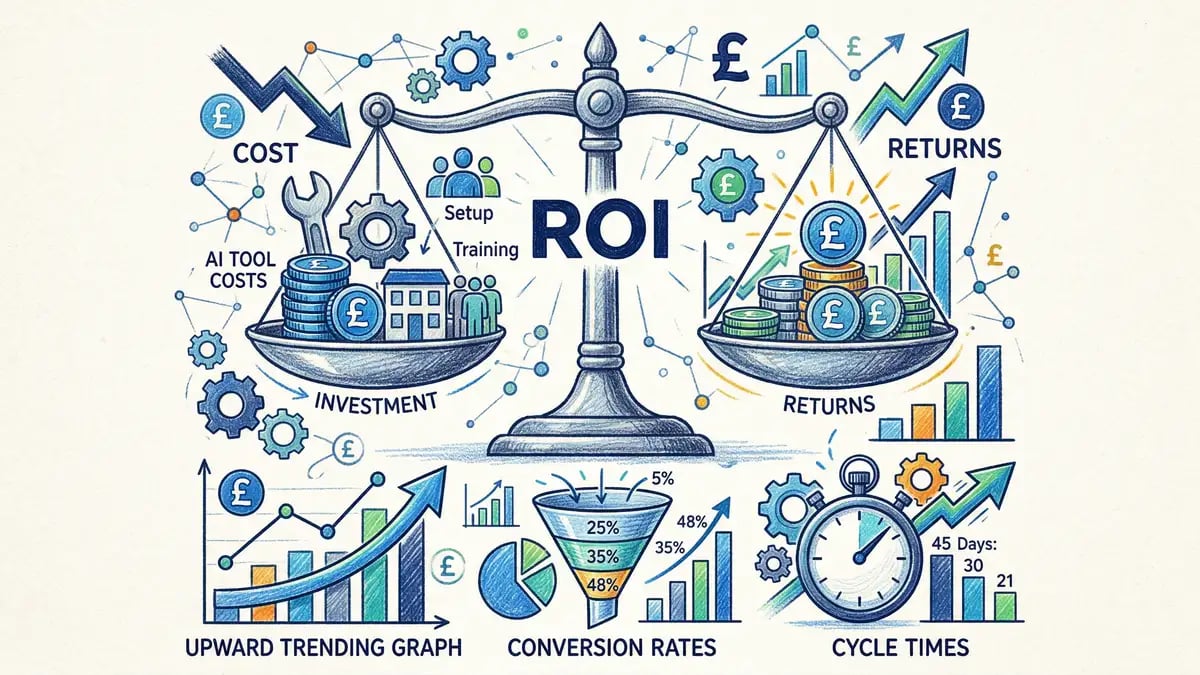
Explore AI for SalesReturn on investment from AI pipeline management varies by component and maturity. According to Boston Consulting Group research on AI adoption, only 5% of organisations achieve scale value from their AI investments. However, organisations that do achieve scale value realise 1.7x revenue growth relative to their pre-AI baseline. Understanding the ROI timeline for each component is essential for realistic planning and stakeholder management.

| Component | ROI Timeline | Expected Payback |
|---|---|---|
| Lead Scoring & Qualification | 6–12 months | Immediate; revenue impact within 6 months |
| Sales Forecasting | 3–6 months | Operational; reduces forecast variance month 2 |
| Deal Velocity Tracking | 6–12 months | Measurable deal acceleration in months 3–6 |
| Churn & Risk Detection | 12–18 months | Longer payback; protects high-value deals |
Lead scoring delivers the fastest ROI, often within 6–12 months as organisations immediately qualify more leads and reduce wasted effort through sales automation. Forecasting improves forecast accuracy within 3–6 months—a measurable outcome that builds buy-in. Deal velocity improvements—shorter sales cycles and higher win rates—take 6–12 months to mature. Churn and risk detection require the longest payback period, typically 12–18 months, but protect high-value deals and reduce revenue volatility once mature.
In practical terms, a mid-market organisation deploying AI pipeline management should expect short-term wins within 6–18 months (lead scoring, forecast accuracy), medium-term benefits within 18–36 months (deal velocity, sales rep productivity), and strategic improvements in 36+ months (risk mitigation, revenue predictability). This timeline informs both budget allocation and stakeholder expectations.
Selecting the right AI platform for pipeline management requires balancing capability, ease of use, implementation cost, and ongoing support requirements. The UK market offers three primary categories: integrated CRM platforms with embedded AI, specialist conversation intelligence and forecasting tools, and AI sales development representative (SDR) platforms.
| Platform | Cost per User/Month | Ease of Use (G2) | Admin Requirement | Implementation Time |
|---|---|---|---|---|
| HubSpot CRM | £85 | 8.7/10 | Low (86% no dedicated admin) | 4–8 weeks |
| Salesforce | £140+ | 6.8/10 | High (£55–80k admin per year) | 12–20 weeks |
| Gong/Clari | £150–250 | 7.9/10 | Medium (specialist team) | 6–10 weeks |
For UK SMEs (20–200 employees), HubSpot CRM offers the optimal balance of capability, cost, and operational simplicity. At £85 per user per month with a 8.7/10 G2 ease score, HubSpot's AI features for lead scoring, pipeline tracking, and basic forecasting integrate seamlessly into the platform without requiring a dedicated CRM administrator. Indeed, 86% of HubSpot users operate without dedicated admin support, handling configuration and customisation internally.
Mid-market organisations (200–2,000 employees) often choose between HubSpot and Salesforce depending on their existing ecosystem. Salesforce offers deeper customisation but demands a dedicated CRM administrator (typically costing £55–80k annually) and longer implementation timelines (12–20 weeks). Specialist tools like Gong or Clari (£150–250 per user) excel at conversation intelligence and forecasting but typically supplement rather than replace a core CRM.
The emerging AI SDR market, projected to exceed £15 billion by 2030, offers an alternative: outsourced lead generation and qualification powered by AI agents. These solutions work alongside existing CRMs and accelerate pipeline fill, though they do not replace in-house pipeline management tools. For AI consultancy pricing UK guidance, see our dedicated pricing analysis.
AI pipeline management systems process sensitive customer and prospect data—email addresses, phone numbers, firmographic details, and engagement history. UK organisations must ensure these systems comply with General Data Protection Regulation (GDPR) requirements and emerging EU AI Act obligations. Non-compliance exposes organisations to regulatory fines (up to €20 million or 4% of global turnover), reputational damage, and customer distrust.
Compliance Requirement
Privacy-by-design: Build privacy into AI system architecture. Collect only data necessary for pipeline management; implement data minimisation principles.
Lawful basis: Establish a lawful basis for processing (typically legitimate interest for B2B sales, consent for outbound marketing). Document this basis.
Retention policies: Define and enforce data retention limits. Remove prospect records after a defined period (typically 3 years) if no ongoing business relationship exists.
Data subject rights: Ensure individuals can request access to, correction of, and deletion of their data. Build these workflows into your CRM configuration.
Third-party processors: Verify that AI vendors (Salesforce, HubSpot, Gong) have adequate Data Processing Agreements (DPAs) in place. Check where data is stored and processed.
Human-in-the-loop: For high-risk decisions (e.g., excluding prospects from outreach based on predicted non-conversion), maintain human oversight to ensure fairness and compliance with the emerging EU AI Act.
Records of Processing Activities (RoPA): Maintain documentation of what data is processed, how, why, and for how long. This Article 30 requirement supports regulatory audits.
Data Protection Impact Assessments (DPIAs): Conduct DPIAs (Article 35) before deploying new AI capabilities, particularly those involving automated decision-making or large-scale data processing.
Practical compliance begins with understanding your data flows. Map what data flows into your AI system (lead sources, engagement data, firmographic details), where it is stored, how it is processed, and how long it is retained. Document your lawful basis for each data type. For UK organisations, guidance from the Information Commissioner's Office (ICO) provides the authoritative framework.
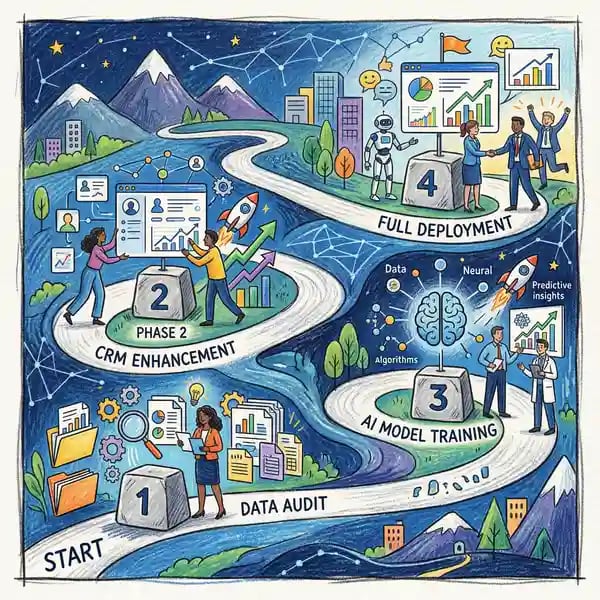
AI pipeline management is not a single-step deployment—it is a phased programme that builds capability progressively. The roadmap differs by organisation size, but the underlying principles remain consistent: start with data quality, pilot with a subset of the team, measure outcomes, and scale based on evidence.

Data quality is the binding constraint. Organisations with poor data—incomplete contact information, inconsistent deal stage terminology, missing engagement records—struggle to train effective AI models. Before implementing AI, allocate 15–25% of the total programme budget to data audits and hygiene. This upfront investment prevents wasted effort downstream and accelerates ROI.
Change management is equally critical. Sales representatives are sceptical of systems that appear to second-guess their judgment or add administrative burden. Engage the sales team early in the design process, involve top performers in pilot testing, and communicate clearly how AI will help them (e.g., freeing time for strategic deals, providing coaching, flagging at-risk accounts). This collaborative approach accelerates adoption and uncovers configuration issues before full rollout.
Phase 1: Data Audit & CRM Hygiene
Assess data quality, fix duplicate records, standardise deal stages, consolidate contact information. Duration: 4–6 weeks. Deliverable: clean data foundation.
Phase 2: Platform Selection & Configuration
Evaluate tools, select platform, configure lead scoring rules, set up forecasting models. Duration: 2–4 weeks. Deliverable: production-ready system.
Phase 3: Pilot Programme & Adoption
Deploy to one sales team or region, measure adoption metrics, gather feedback, refine workflows. Duration: 4–8 weeks. Deliverable: validated playbook.
Phase 4: Scale & Continuous Improvement
Roll out to full sales organisation, implement feedback loops, enhance AI models, monitor outcomes. Duration: ongoing. Deliverable: continuous uplift.
Implementation timelines and budgets vary by organisation size. For SMEs (20–200 employees), expect 12–16 weeks to full deployment with a total budget of £25–40k (including platform costs, configuration, data cleanup, and training). For mid-market organisations (200–2,000 employees), allow 6–9 months and budget £100–250k. For enterprise organisations, plan 12–18 months and budget £500k–£2M, accounting for integration complexity, multiple geographies, and legacy system constraints.
SME (20–200)
Timeline: 12–16 weeks
Budget: £25–40k
Team: 1 part-time CRM admin
Platform: HubSpot CRM
Focus: Lead scoring, basic forecasting
Mid-Market (200–2K)
Timeline: 6–9 months
Budget: £100–250k
Team: 1 full-time CRM admin + consultant
Platform: HubSpot or Salesforce
Focus: Full pipeline intelligence
Enterprise (2K+)
Timeline: 12–18 months
Budget: £500k–£2M
Team: Dedicated centre of excellence
Platform: Salesforce + specialists
Focus: Integrated ecosystem
A practical starting point: begin with lead scoring on HubSpot or your existing CRM. This is the fastest path to ROI, requires minimal configuration, and generates early wins that build organisational confidence. Once lead scoring is working, add sales forecasting and deal tracking. Finally, layer in more advanced capabilities like conversation intelligence and risk detection. This sequential approach—which aligns with the AI transformation playbook framework—reduces risk and ensures sustained adoption. For detailed guidance on selecting and implementing the right platform, consult our AI consultancy guide.
The sales technology landscape is shifting rapidly. Gartner forecasts that by 2027, 95% of seller research and lead generation will be augmented or automated through AI. More provocatively, Gartner projects that by 2028, AI agents will outnumber human sellers by 10 times. These are not dystopian scenarios—they reflect the scale at which AI augmentation will operate. Human sellers will remain essential for relationship building, complex negotiation, and strategic account management. But the volume and quality of work generated by AI agents will be transformative.
This shift from "AI-augmented sales teams" to "AI-first sales operations" is what we term the Agentic AI transition. Rather than AI tools serving sales representatives, AI agents work autonomously (with human oversight) to generate, qualify, and sometimes close routine opportunities. This model fundamentally changes how sales organisations structure themselves, how they recruit, and what skills they value.
However, the Cowan Paradox—a principle from innovation economics—warns that organisations attempting to transition too quickly face severe disruption. Overinvestment in automation before the organisational infrastructure is ready can backfire: reduced headcount without corresponding revenue growth, demoralised teams, and loss of institutional knowledge. The safer approach: invest in AI strategy capability now, pilot agentic approaches with small teams, measure outcomes carefully, and scale thoughtfully.
For UK sales organisations, the binding constraint through 2026–2027 will remain the skills gap. More UK businesses are attempting to adopt AI than have the internal expertise to implement and operate it. This is why AI consultancy support and structured AI for business frameworks—not just tools—will drive competitive advantage. Organisations that invest in capability-building and structured change management will pull ahead of those treating AI as a point solution.
The future of sales operations, in short, is not binary. It is not "humans versus AI"—it is "organisations that orchestrate human and AI capabilities effectively versus those that do not." This shift is happening now. The time to begin your journey is today.
How does AI improve sales pipeline management?
AI enhances pipeline management across four dimensions: qualification (identifying high-value leads faster), prediction (forecasting deal closure with 85%+ accuracy vs 70–79% for traditional methods), coaching (analysing calls to improve sales technique), and monitoring (identifying at-risk deals in real-time). Collectively, these capabilities deliver 83% higher revenue growth and 34% shorter sales cycles for organisations that adopt them.
What is the typical ROI timeline for AI sales tools?
ROI varies by component. Lead scoring delivers the fastest payback (6–12 months) because it immediately improves conversion efficiency. Sales forecasting improves forecast accuracy within 3–6 months. Deal velocity acceleration takes 6–12 months. Risk detection requires the longest timeline (12–18 months). In aggregate, organisations typically recover their investment within 12–24 months, depending on starting point and execution quality.
Which AI sales platform is best for UK SMEs?
HubSpot CRM is the optimal choice for UK SMEs. At £85 per user per month with a 8.7/10 G2 ease score, it offers integrated lead scoring, forecasting, and pipeline tracking without requiring a dedicated CRM administrator. Salesforce is more powerful but demands significantly higher investment (£55–80k per year for admin support) and longer implementation timelines. For more options and pricing analysis, see our AI consultancy pricing guide.
How do UK organisations ensure GDPR compliance with AI sales tools?
GDPR compliance requires four steps: (1) establish a lawful basis for data processing (typically legitimate interest for B2B sales); (2) implement data minimisation—collect only what is necessary; (3) define retention policies—remove prospects after 3 years if no ongoing relationship; (4) ensure third-party vendors (HubSpot, Salesforce, Gong) have adequate Data Processing Agreements (DPAs) in place. For detailed guidance, consult the ICO website.
What data quality is needed before implementing AI pipeline management?
Data quality is the foundation. Before implementing AI, ensure: complete contact information (email, phone, company); standardised deal stage terminology (not a mix of custom labels); engagement records (call dates, meeting notes, email interactions); and firmographic data (company size, industry, region). Poor data makes AI models unreliable. Allocate 15–25% of the total implementation budget to data audits and cleanup before deploying AI. This upfront investment prevents downstream failures and accelerates ROI. For more on workflows and integration, see AI workflow integration best practices.
Helium42 delivers education-led AI implementation that helps UK sales teams achieve 40% average efficiency gains. From pipeline audit to full deployment in 6 to 8 weeks.
Book a Sales AI ConsultationPeter Vogel
AI Strategy & Implementation, Helium42
Peter leads AI education and implementation programmes at Helium42, helping UK and European organisations transform their sales operations through practical, education-led AI adoption. With experience across 500+ organisations, he specialises in bridging the gap between AI capability and measurable business outcomes. He regularly contributes to industry publications and advises the TechUK and British Chambers of Commerce on AI skills and adoption policy.
Sources: Salesforce State of Sales Report 2025 · BCG AI Adoption Research 2025 · British Chambers of Commerce AI Adoption Survey 2026 · HubSpot vs Salesforce Comparison 2025 · Gartner Future of Sales Technology Predictions 2026–2028 · Office for National Statistics (ONS) Business Insights Survey · Information Commissioner's Office (ICO) GDPR Guidance · ONS Data Protection Research
Artificial intelligence is fundamentally reshaping how UK sales teams manage their pipelines. For decades, pipeline management relied on...

Key Takeaway UK AI consultancy pricing spans £500-£2,500+ per day depending on consultant type, with typical SME projects costing £25,000-£150,000....
AI document parsing tools extract, classify, and match line items from construction documents including bills of quantities and subcontractor quotes,...