
Published by

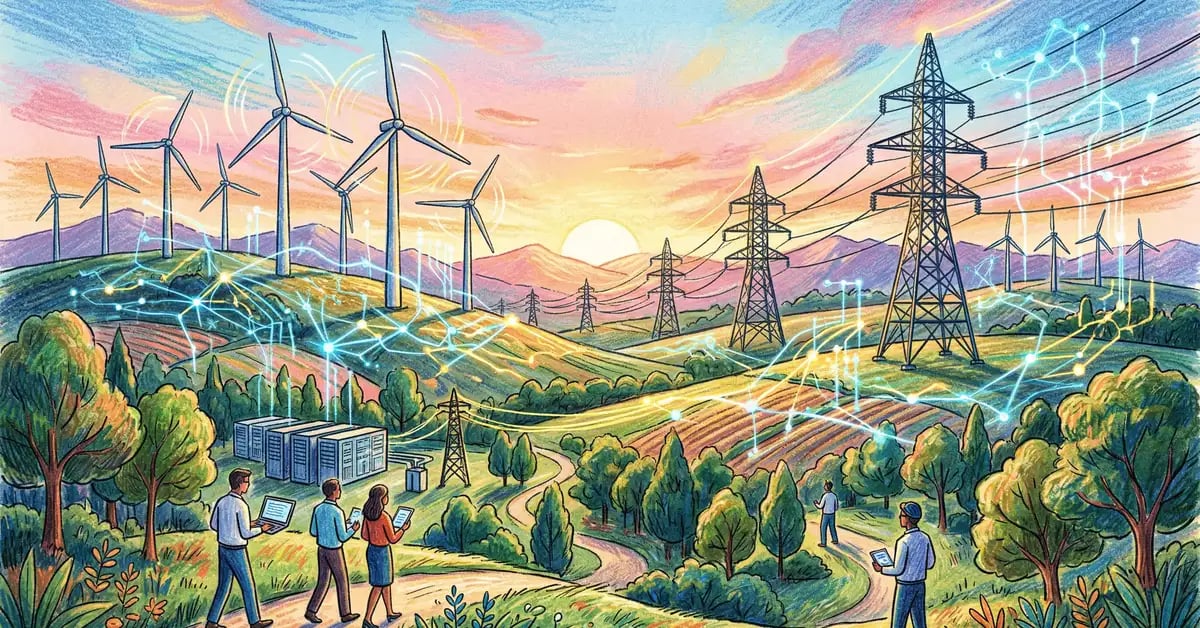
The energy sector stands at a critical inflection point. By 2035, artificial intelligence data centre power demand in the United States alone could exceed 123 gigawatts—a more than thirtyfold increase from current levels. Globally, AI data centre investments reached USD 580 billion in 2025, with power demand expected to surpass 500 terawatt-hours annually by 2026, representing approximately 2% of all global electricity consumption. For energy utilities, this presents both an unprecedented challenge and a transformative opportunity.
The question for utility executives, operations leaders, and innovation directors is no longer whether to adopt artificial intelligence, but how to deploy it strategically to manage demand, optimise grid efficiency, reduce operational costs, and meet regulatory requirements. This article examines how intelligent systems are reshaping energy generation, distribution, and consumption across the UK, Europe, and beyond—and how your organisation can build the capability to compete in this transformed landscape.
The Reshaping of Energy Markets by AI Data Centre Demand
Energy markets are being reshaped by data centre demand at an unprecedented scale. The sheer computational requirements of artificial intelligence systems have created a new category of power consumer that rivals entire nations. A single large-scale AI data centre can consume between 10-20 megawatts of continuous power, equivalent to the energy requirements of 8,000-16,000 homes. At global scale, this concentration of demand is forcing utilities to rethink capacity planning, infrastructure investment, and grid resilience strategies.
In the UK, this shift is already visible. National Grid, the operator of the country's electricity transmission system, has identified data centre growth as a material factor in future demand forecasting. Similarly, energy providers including Octopus Energy and EDF are restructuring investment portfolios to accommodate both traditional demand growth and the hyperconcentration of power consumption in specific geographic regions where data centres cluster.
The commercial implications extend beyond generation capacity. Energy providers face margin compression from hyperscale data centre customers who negotiate fixed-rate contracts based on wholesale power costs. This dynamic forces utilities to differentiate through service innovation and operational efficiency—domains where artificial intelligence is proving transformative.
AI-Powered Grid Optimisation and Predictive Maintenance
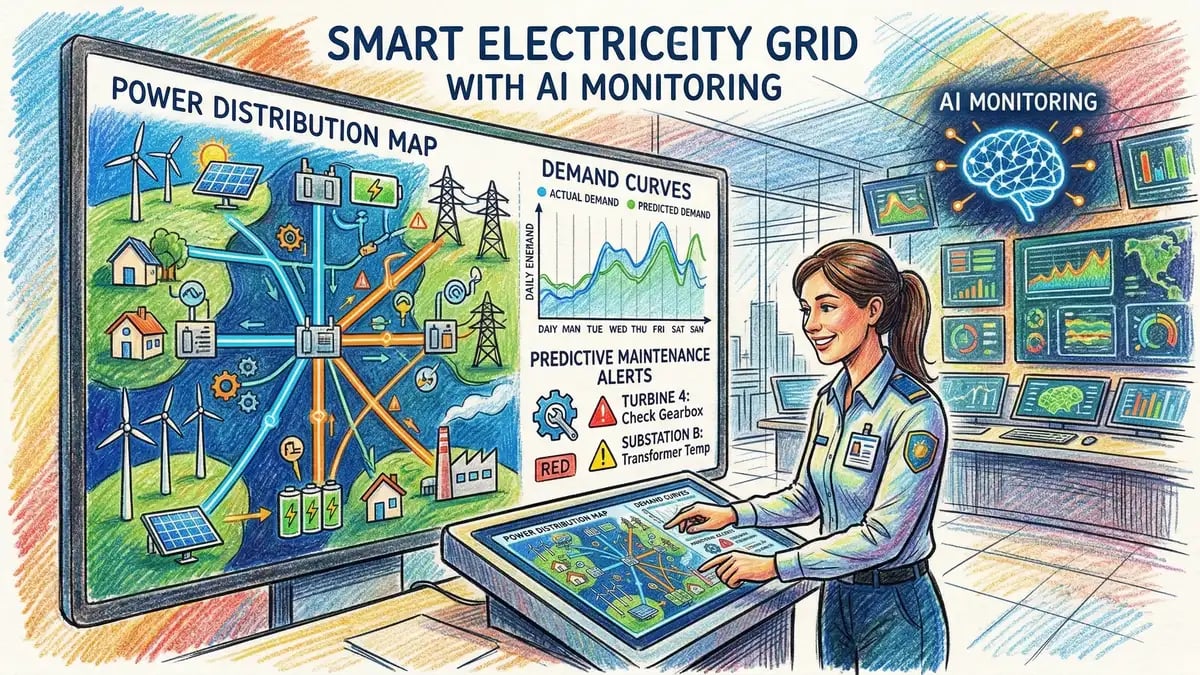
Grid optimisation and predictive maintenance represent the immediate, highest-ROI applications of artificial intelligence within energy infrastructure. Modern electrical grids are extraordinarily complex systems: thousands of generation assets, transmission lines, substations, and distribution networks must operate in real-time synchronisation to prevent outages, maintain voltage stability, and balance supply and demand across regions. Artificial intelligence excels at this class of problem.
Kraken Technologies, serving over 70 million customer accounts globally through partnerships with EDF, E.ON, National Grid USA, and Tokyo Gas, processes 15 billion data points daily through AI-driven platforms. These systems detect anomalies in equipment performance weeks before conventional maintenance schedules would flag them, reducing unplanned downtime by 20-35%. Predictive maintenance alone can extend asset life by 5-10 years and reduce maintenance costs by 25-40% for organisations implementing comprehensive AI monitoring programmes.
Demand forecasting—predicting how much electricity consumers will need in the next 24 hours, 7 days, or 3 months ahead—has traditionally been a source of significant operational waste. Utilities maintain spinning reserves, fast-start generation capacity that runs inefficiently to ensure adequate supply during demand spikes. Artificial intelligence models, trained on weather data, historical consumption patterns, customer behaviour, and economic indicators, reduce forecast error by 12-18%, enabling utilities to reduce expensive reserve capacity while maintaining reliability.
National Grid and Vattenfall are actively deploying AI-driven grid balancing systems that manage real-time supply-demand matching with microsecond precision. These platforms integrate distributed renewable generation, battery storage systems, demand-response programmes, and traditional generation assets into a unified control fabric. The operational gains are substantial: reduced curtailment of renewable energy (waste caused by generation exceeding demand), improved asset utilisation across the fleet, and enhanced grid stability during periods of high renewable penetration.
Reduction in unplanned equipment downtime through AI-powered predictive maintenance
Customer Engagement and Demand-Side Management
Artificial intelligence is fundamentally reshaping how utilities interact with customers and manage consumption. Rather than passive consumers receiving monthly bills, customers increasingly expect dynamic pricing, real-time consumption visibility, and recommendations to reduce energy costs and environmental impact. AI-powered demand-side management systems are enabling this transformation at scale.
Octopus Energy, Britain's fastest-growing energy supplier, has integrated AI into its customer engagement platform to deliver personalised consumption insights and dynamic pricing recommendations. Machine learning models analyse household consumption patterns, local weather forecasts, wholesale electricity price movements, and upcoming renewable energy generation (from wind and solar) to recommend optimal times for customers to use flexible loads such as electric vehicle charging, heat pump operation, and washing machine scheduling. Early data indicates customers adopting these AI-driven recommendations reduce consumption by 8-12% whilst improving overall comfort and lifestyle flexibility.
This demand-side flexibility is critical to grid stability in an era of high renewable penetration. When wind generation exceeds demand, utilities can employ AI-driven signals to automatically shift consumption towards flexible loads—essentially using thousands of distributed devices as a virtual power plant. This eliminates the need to curtail renewable energy, increases renewable utilisation rates, and reduces overall system costs.
Building this capability requires energy companies to move beyond traditional utility business models. Customer data integration—aggregating consumption data, tariff history, device information, and customer preferences—becomes a strategic asset. Privacy and security governance become board-level concerns. Skills in data science, software engineering, and customer experience design become as critical as traditional utility engineering expertise.
Renewable Energy Integration and Storage Optimisation
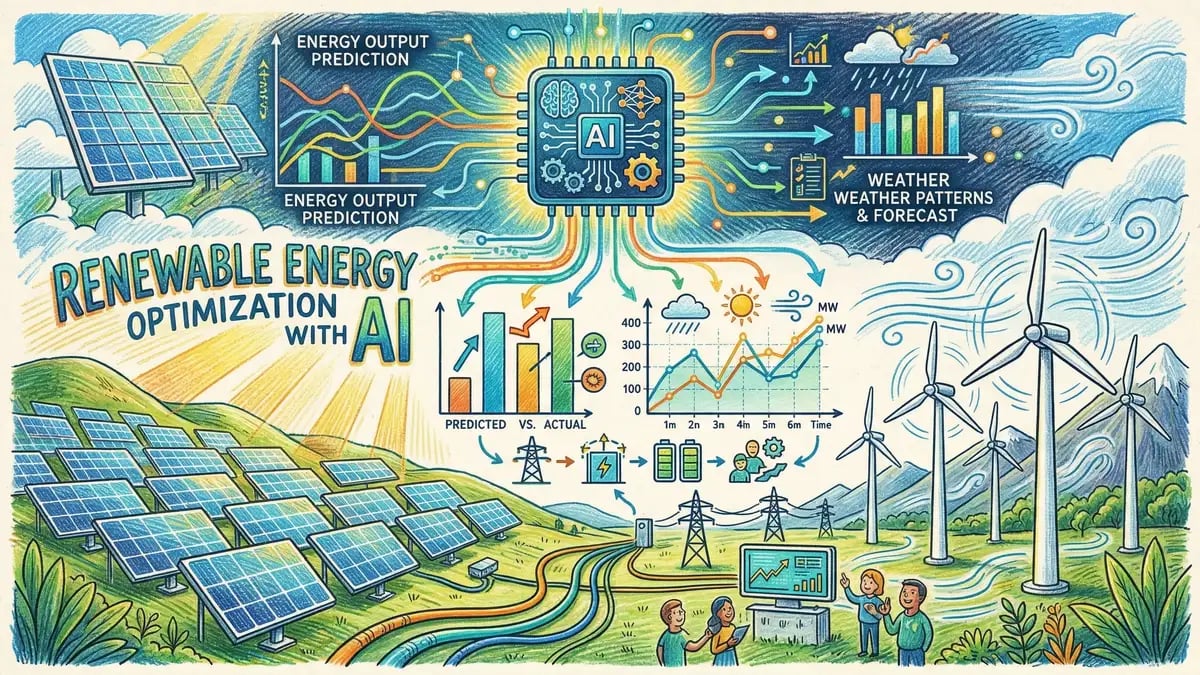
Renewable energy integration—managing the variability and geographic distribution of wind and solar generation—has emerged as one of the most computationally intensive challenges in modern energy systems. Traditional forecasting techniques rely on statistical models; artificial intelligence systems leverage satellite imagery, real-time weather data, asset-level telemetry, and grid state information to forecast renewable generation with unprecedented accuracy.
Vattenfall, Europe's largest nuclear energy producer, is deploying AI-driven systems to optimise the integration of 12+ gigawatts of renewable generation assets across Nordic markets. These systems forecast wind generation at 15-minute and hourly intervals with accuracy improvements of 15-22% compared to conventional weather forecasting models. This improved visibility enables more efficient commitment of thermal generation assets, reduces reserve requirements, and increases the economic value of renewable investments.
Battery storage optimisation—deciding when to charge and discharge energy storage systems to maximise revenue whilst supporting grid stability—represents another critical application. Storage systems that cost £150-300 per kilowatt-hour are only economically viable if they achieve high utilisation and revenue stacking (participating simultaneously in energy markets, ancillary services markets, and grid support programmes). Artificial intelligence systems optimise these decisions in real-time, increasing storage revenue by 25-40% compared to rule-based or manual dispatch approaches.
| Technology / Capability | Typical ROI Timeframe | Operational Impact |
|---|---|---|
| Predictive Maintenance | 12-18 months | 25-40% reduction in maintenance costs; 20-35% reduction in unplanned downtime |
| Demand Forecasting | 6-12 months | 12-18% improvement in forecast accuracy; 8-15% reduction in reserve capacity requirements |
| Customer Engagement / Demand Response | 9-15 months | 8-12% customer consumption reduction; improved customer satisfaction and retention |
| Renewable Forecasting | 12-24 months | 15-22% improvement in wind/solar generation forecasting accuracy |
| Storage Optimisation | 6-12 months | 25-40% improvement in storage revenue; enhanced grid support contribution |
Regulatory Compliance and Governance Frameworks
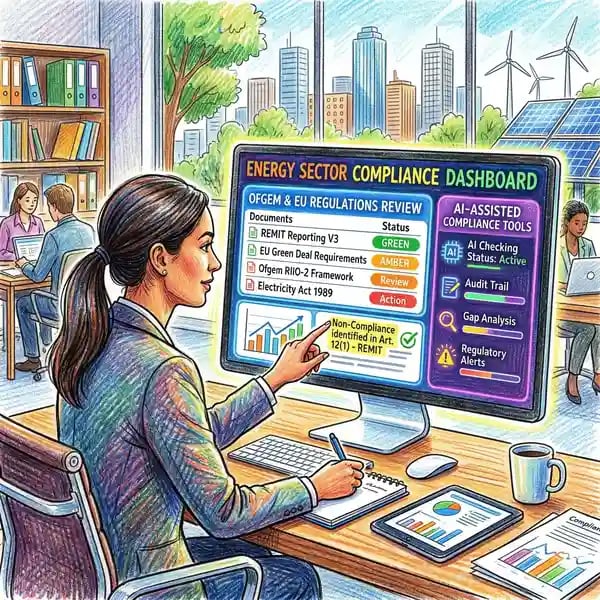
Regulatory bodies across the UK and Europe have recognised the strategic importance of AI governance in energy systems. Ofgem, the UK's energy regulator, released comprehensive guidance on ethical AI deployment in May 2025, establishing standards for algorithmic transparency, bias testing, and stakeholder accountability. Simultaneously, Ofgem is developing an AI technical sandbox to enable utilities to test novel AI systems in controlled environments before full deployment—reducing regulatory risk while fostering innovation.
The European Union AI Act has introduced energy-specific compliance requirements, mandating that providers document energy consumption for large-scale AI models. Organisations deploying models launched before August 2, 2025, must demonstrate compliance by August 2, 2027. This creates immediate pressure for utilities to audit existing AI systems, document their power requirements, and establish governance processes to track model performance, accuracy, and energy consumption.
From a competitive perspective, regulatory compliance should not be viewed solely as a cost. Organisations that demonstrate robust AI governance, transparent decision-making processes, and proactive regulatory engagement build trust with regulators, customers, and investors. This trust translates into faster regulatory approval for innovation pilots, reduced compliance penalties, and stronger stakeholder relationships.
Building effective AI governance requires cross-functional teams spanning technical, legal, compliance, and business functions. Many energy organisations are establishing dedicated AI governance committees with representation from operations, customer service, data privacy, and executive leadership. This governance structure ensures that AI deployment decisions are made with full awareness of regulatory, operational, financial, and reputational implications.
Workforce Transformation and Capability Building
Artificial intelligence adoption within energy utilities fundamentally changes workforce composition, skill requirements, and organisational structures. Traditional utility engineering—focused on asset design, network planning, and maintenance execution—remains essential. However, it now operates alongside new specialisations: data engineers building data platforms and real-time data pipelines; machine learning engineers developing and deploying forecasting and optimisation models; data analysts extracting insights from operational and customer data; and software engineers building the systems that integrate AI into operational workflows.
This skills transition creates significant organisational challenges. Many large energy utilities employ engineering workforces with deep expertise in physics, electrical systems, and traditional asset management—but limited exposure to software development, data science, and machine learning. Upskilling existing staff whilst hiring new technical talent requires simultaneous investment in training programmes, recruitment infrastructure, and cultural change initiatives.
Helium42's approach to workforce transformation mirrors the broader energy sector challenge. Rather than treating AI as a technology problem solved through tool procurement, we support energy organisations in building durable internal capability. This means developing training programmes that translate AI concepts into energy-specific contexts, establishing data governance frameworks that clarify ownership and accountability, and designing implementation projects that build technical confidence and operational credibility within existing teams.
Early success is critical. Initial AI projects should be selected based on a combination of business impact (measurable cost reduction, revenue increase, or risk mitigation) and implementation feasibility (clear data availability, defined success metrics, and stakeholder alignment). Quick wins build internal momentum, demonstrate tangible value, and create advocates within the organisation who champion further AI investment.
Industry-Specific Use Cases: Finance, Legal, and HR Applications
Beyond core energy operations, artificial intelligence is transforming support functions across energy organisations. Finance teams use AI-driven systems to automate invoice processing, forecast cash flow with greater accuracy, and optimise working capital management. These applications yield 30-50% reduction in manual processing time and 15-25% improvement in cash forecasting accuracy.
Legal and compliance functions increasingly deploy AI to review contracts, identify regulatory risks, and manage compliance workflows. Energy sector contracts are typically complex—power purchase agreements, grid connection agreements, construction contracts—involving multiple parties and spanning 10-20 years. AI systems trained on historical contracts and regulatory requirements can rapidly identify material terms, flag non-standard provisions, and highlight potential regulatory misalignments, reducing legal review time by 35-50%.
Human resources and recruitment functions face acute talent challenges in the energy sector. Attracting software engineers, data scientists, and cloud infrastructure specialists to traditional energy companies remains difficult. AI-driven recruitment systems analyse job descriptions, identify skill overlaps with existing staff, and recommend internal candidates for upskilling. Additionally, these systems optimise job postings, identify underutilised talent pools, and personalise candidate engagement to improve hire quality and reduce time-to-hire.
These cross-functional applications often deliver faster ROI than core operational projects—particularly when organisations lack mature data infrastructure or experienced data teams. Many energy leaders treat finance and HR applications as "capability building" projects, using them to establish data governance, build team expertise, and demonstrate proof-of-concept for more complex operational deployments.
Building an AI Implementation Roadmap for Energy Organisations
The energy sector's AI transformation is not a single initiative or pilot project. Rather, it represents a multi-year strategic programme requiring disciplined planning, phased execution, and continuous learning. An effective AI roadmap typically spans 24-36 months and includes four distinct phases:
Phase 1: Foundation (Months 1-6). Establish AI governance, build core data infrastructure, complete skills assessment, and deliver 1-2 quick-win projects (typically in finance, HR, or customer service). These foundation activities establish the processes, governance, and cultural foundations that enable subsequent scaling. Success requires executive sponsorship, dedicated programme leadership, and investment in foundational data and cloud infrastructure.
Phase 2: Core Operations (Months 7-15). Deploy AI across core operational domains: demand forecasting, predictive maintenance, renewable integration, and customer engagement. These projects deliver the highest strategic impact and operational ROI but also require more sophisticated data infrastructure and team expertise. Successful Phase 2 execution typically requires a dedicated data science team (3-5 engineers), modern cloud infrastructure, and cross-functional collaboration with operations leadership.
Phase 3: Advanced Optimisation (Months 16-24). Develop advanced optimisation models for grid balancing, storage dispatch, and real-time operational decision-making. These applications require real-time data pipelines, low-latency compute infrastructure, and deep integration with operational technology (SCADA, EMS, and generation control systems). Phase 3 projects are highest-impact but also highest-complexity.
Phase 4: Continuous Improvement (Months 25+). Transition to continuous model monitoring, retraining, and optimisation. Establish performance metrics, dashboards, and alert systems that track model accuracy, operational impact, and cost-benefit realisation. Create feedback loops that enable rapid iteration and improvement as operational conditions change and new data becomes available.
This phased approach balances ambition with realism. Early wins build internal momentum and demonstrate tangible value, reducing organisational resistance to subsequent, more complex initiatives. Phased deployment also spreads investment across multiple budget cycles, improving financial planning and reducing execution risk.
Accelerate Your Energy AI Transformation
Energy organisations that move decisively on AI-driven optimisation today will establish competitive advantages that compound over the next decade. Helium42 partners with energy utilities, generators, and service providers to build proven AI capabilities, establish governance frameworks, and deliver measurable operational gains. Let us guide your transformation journey.
Book a Strategic ConsultationKey Decisions for Energy Leaders
Energy leaders considering AI investment should focus on three critical decisions:
1. Build versus Partner. Should your organisation develop AI expertise internally or partner with external providers? The answer depends on scale, timeline, and strategic importance. Large utilities (£1B+ annual revenue) typically justify internal teams; smaller utilities benefit from partnerships that provide expertise without fixed cost. However, even utilities with internal teams benefit from external guidance on governance, regulatory strategy, and implementation methodology.
2. Pace of Transformation. How aggressively should you pursue AI adoption? Conservative approaches (2-3 projects per year over 5 years) minimise disruption but risk competitive disadvantage. Aggressive approaches (8-10 projects per year over 3 years) capture value faster but risk execution failures and change fatigue. Most successful utilities pursue balanced approaches: 4-6 significant projects per year, with continuous progress on foundational capabilities.
3. Governance and Risk Management. How do you establish governance that enables innovation whilst managing regulatory, operational, and reputational risk? This requires explicit decisions on model transparency, bias testing, data privacy, and stakeholder engagement. Early investment in governance creates foundations for rapid, sustainable scaling.
These decisions should be made explicitly, with full awareness of their strategic implications. Many utilities have succeeded by establishing cross-functional strategy teams—including CTO, CFO, Chief Data Officer, Chief Compliance Officer, and operational leadership—to debate these decisions and build alignment on direction and pace.
Frequently Asked Questions
Conclusion: The Strategic Imperative for Energy Transformation
The energy sector's transformation through artificial intelligence is neither optional nor distant. Data centre demand growth, regulatory evolution, and customer expectations are reshaping energy markets in real time. Energy organisations that move decisively on AI-driven optimisation today will establish competitive advantages in operational efficiency, customer engagement, risk management, and regulatory relationships that will compound over the next decade.
The specific pathway to AI adoption differs for each organisation based on scale, geography, asset mix, and strategic priorities. However, all successful programmes share common characteristics: executive commitment to transformation, investment in foundational data infrastructure and governance, recruitment or partnership to access necessary expertise, and disciplined prioritisation of projects based on business impact and implementation feasibility.
The time to begin is now. Energy leaders who delay face increasing competitive pressure from more agile competitors, rising regulatory expectations around AI governance, and deteriorating talent acquisition as competing industries attract technical talent. Conversely, organisations that establish AI capability today build internal confidence, create advocates for further transformation, and create foundations for rapid scaling in subsequent years.
Whether you lead a large multinational utility, a regional generation company, or a specialist energy services firm, artificial intelligence is reshaping your competitive landscape. The question is not whether to pursue AI, but how rapidly and comprehensively to build the capability that will define your competitive position for the next decade.
Helium42 has spent the last five years partnering with energy organisations across the UK and Europe to build AI capability that creates measurable competitive advantage. If your organisation is considering this transformation journey, we would welcome the opportunity to discuss your strategy, challenges, and potential pathway forward.
Read our comprehensive AI implementation guide for additional framework and methodology resources, or explore our AI governance framework to understand the governance structures that enable sustainable, risk-managed AI adoption. For energy-specific context, consider reviewing our coverage of AI compliance in regulated industries.