

Published by

Large language models are the technology behind ChatGPT, Claude, and Gemini — and they are reshaping how UK businesses operate. Seventy-one percent of UK organisations reported active AI or machine learning initiatives in 2024, yet only 22% achieved production-ready LLM deployments. The gap between experimentation and measurable business value is where most organisations stall. Understanding what LLMs actually are, how they work, and where they deliver genuine returns is the first step toward closing that gap.
This guide explains large language models in practical business terms. It covers how LLMs differ from traditional automation, where they deliver proven ROI for UK organisations, what they genuinely cost, and how to evaluate whether an LLM initiative is right for your business — written for managing directors, operations leaders, and technology decision-makers who need clarity without the jargon.
Key Takeaway
Large language models predict text by recognising patterns learned from billions of examples. They do not "understand" language — they perform sophisticated pattern matching at scale. For UK businesses, the practical value lies in content generation, customer service automation, document processing, and sales enablement, with typical ROI of 150–400% within 12 months when deployed against well-defined use cases. Helium42 helps organisations identify which use cases will deliver returns before committing investment.
71%
UK Organisations
Active AI/ML initiatives in 2024
22%
Production-Ready
LLM deployments achieving live status
300–400%
Documented ROI
Within 12–18 months for proven use cases
Sources: Deloitte UK Tech Trends 2024, McKinsey State of AI 2024
What Are Large Language Models and How Do They Work?
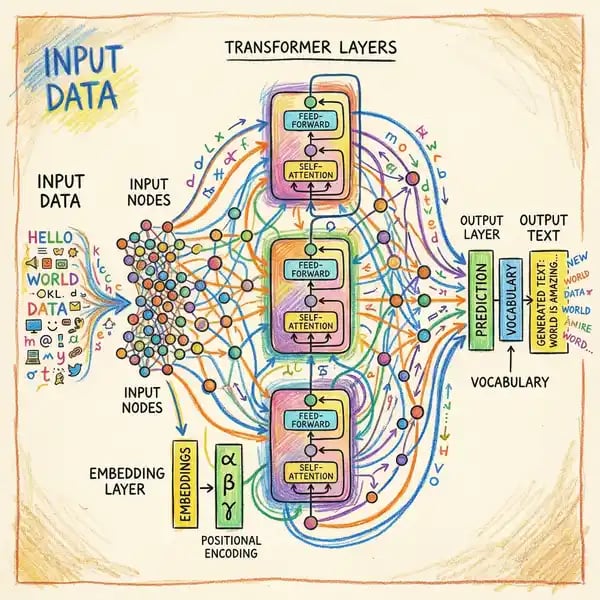
A large language model is software that predicts the next word — or more precisely, the next token — based on patterns learned from vast quantities of text data. LLMs do not understand language in the human sense. They perform statistical pattern matching at extraordinary scale, recognising which words, phrases, and structures typically follow one another across billions of training examples.
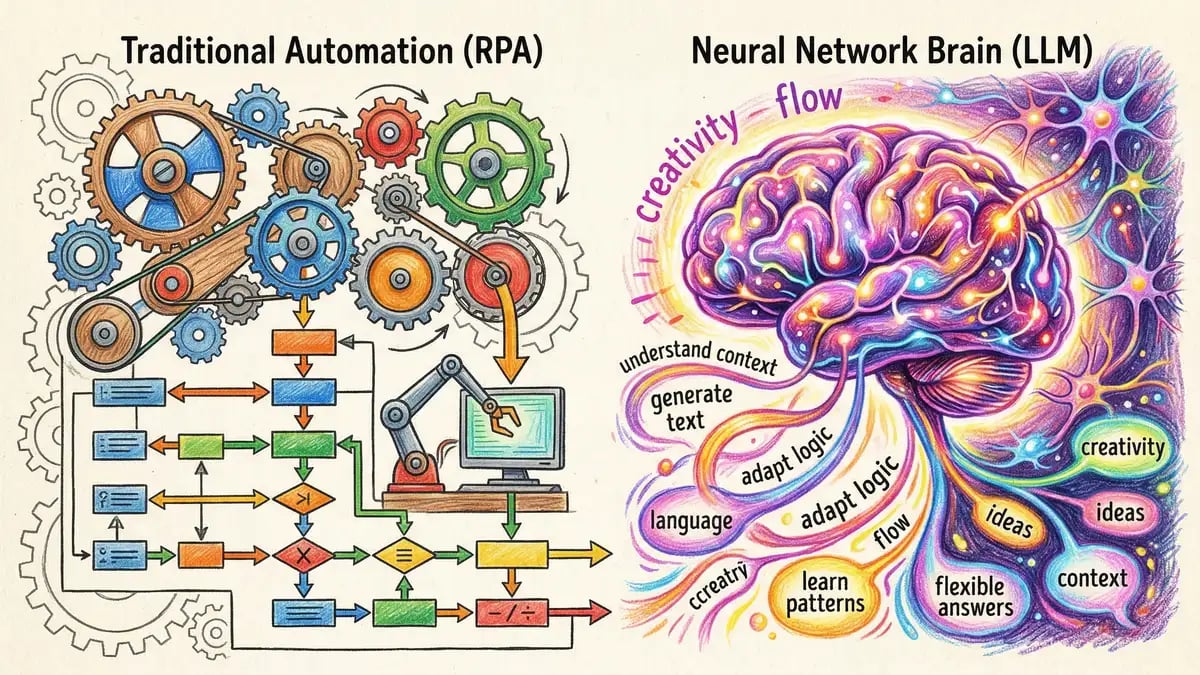
The practical analogy for business leaders is straightforward. Traditional software operates like a filing cabinet: it retrieves exact documents based on rigid rules. An LLM operates like an exceptionally well-read expert employee who can synthesise information, draft proposals, and handle nuance — but who can occasionally misremember facts or fabricate plausible-sounding details. This distinction matters because it defines both the opportunity and the risk.
The architecture powering modern LLMs is called a transformer, introduced in 2017 by researchers at Google. Transformers use an "attention mechanism" that allows the model to evaluate relationships between all words in a passage simultaneously. When reading the sentence "the bank executive approved the loan application," the model learns to pay attention to "executive" and "loan" rather than interpreting "bank" as a riverbank. This parallel processing capability is what makes LLMs remarkably adaptable — the same model that drafts marketing copy can analyse financial statements and generate code, because it has learned language patterns across thousands of domains.
For UK business leaders, the critical implication is that LLMs are general-purpose tools that can be applied to multiple business functions without building separate AI systems for each use case. This flexibility drives the cost-efficiency argument for adoption.
How Do LLMs Differ from Traditional Business Automation?
Large language models represent a fundamentally different category of technology from the rules-based automation and robotic process automation (RPA) that UK businesses have deployed over the past decade. Understanding these differences is essential for evaluating where LLMs add value and where existing automation remains the better choice.
| Capability | Rules-Based / RPA | Traditional ML | LLMs |
|---|---|---|---|
| Handles unstructured data | Poor | Limited | Excellent |
| Generates new content | No | No | Yes |
| Training data per use case | Explicit programming | Weeks to months | Minimal (zero-shot or few-shot) |
| Adapts to new domains | No | No | Yes (prompt engineering) |
| Typical deployment time | 2–6 weeks | 3–6 months | 1–4 weeks |
| Cost model | Licence + implementation | Infrastructure + data science | Per-token API or subscription |
Source: Deloitte AI in Practice Guide 2024
The decisive advantage of LLMs over previous automation technologies is their ability to handle unstructured data — emails, contracts, customer conversations, reports, and free-text queries that comprise an estimated 80% of enterprise data. Rules-based systems require structured inputs and predefined logic. LLMs can process a customer complaint written in natural language, extract the key issue, determine sentiment, and draft an appropriate response without explicit programming for each scenario.
However, LLMs are not a wholesale replacement for existing automation. For highly structured, repetitive tasks with clear rules — such as invoice data entry or payroll calculations — traditional RPA remains more reliable, cheaper, and less prone to error. The practical recommendation for UK organisations is to deploy LLMs alongside existing automation, not instead of it.
Which LLM Platforms Are Available to UK Businesses?
UK organisations have access to both proprietary and open-source large language models, each with distinct cost, capability, and data residency characteristics. The choice of platform shapes not only performance but also GDPR compliance obligations and long-term vendor dependency.
OpenAI GPT-4 / GPT-4o
Strongest general-purpose reasoning. Multimodal (text + image). US-based, raising GDPR data residency concerns. Cost: approximately £0.01–0.03 per 1,000 tokens.
Anthropic Claude
Ranked equal to GPT-4 on benchmarks. Emphasis on constitutional AI and reduced hallucination rates (8–12%). EU data region available. Cost: approximately £0.008–0.024 per 1,000 tokens.
Meta Llama / Mistral (Open Source)
Commercially permissive licensing. Self-hosted for full data sovereignty. 34% of UK enterprises now experiment with open-source models. Cost: £0.0005–0.002 per 1,000 tokens via API.
Sources: Gartner AI Hype Cycle 2024, OpenAI Pricing 2024, Anthropic Pricing 2024
The most significant trend for UK businesses is the narrowing capability gap between proprietary and open-source models. Open-source alternatives like Meta's Llama and France-based Mistral now approach GPT-4 performance on many business tasks whilst offering cost savings of 80–95% and full data residency control. For organisations processing sensitive data under GDPR, self-hosted open-source models eliminate the complexity of cross-border data transfer agreements entirely.
The recommended approach for most mid-market UK organisations is a hybrid strategy: use proprietary APIs (GPT-4 or Claude) for prototyping and complex reasoning tasks, then migrate high-volume, cost-sensitive workloads to self-hosted open-source models once the use case is validated.
Where Do LLMs Deliver Proven Business Value?
LLMs deliver measurable returns across four primary business functions, with documented ROI ranging from 150% to 500% within 12 months depending on use case and implementation quality. The key distinction is between use cases where LLMs augment human work and use cases where they attempt to replace human judgment — the former consistently outperforms the latter.
Customer Service Automation
LLM-powered chatbots deflect 30–50% of inbound support tickets. UK organisations report 12–18% reduction in escalation time and breakeven within 4–6 months. Monthly cost: £2,000–£5,000 for mid-market volumes. CSAT improvement of 5–15% when the chatbot handles intent correctly.
Content Generation and Marketing
LLMs reduce content production time by 40–60% for first drafts. A 10-piece weekly content programme costs £100–£300 per month in API tokens. The critical constraint is quality validation — a 15–20% error rate without human oversight means editorial review remains essential. ROI: 150–300% within 12 months.
Document Processing and Summarisation
LLMs extract key terms, obligations, and risk flags from contracts in 1–3 minutes versus 2–4 hours manually. Accuracy reaches 90–95% for key term identification. Cost per document: £0.50–£2.00 in API tokens. Ideal for board meeting preparation, competitor analysis, and regulatory filing review.
Sales Enablement
Automated lead scoring, proposal generation, and CRM enrichment accelerate sales cycles by 15–25% and improve conversion rates by 5–15%. Implementation cost: £20,000–£60,000. Monthly ongoing: £800–£2,000. Breakeven within 2–4 months for high-volume sales organisations.
Sources: McKinsey State of AI 2024, PwC UK AI Barometer 2024, Gartner 2024
Helium42 helps UK organisations identify which AI use cases will deliver measurable returns. Explore our AI consultancy services.
View AI Consultancy ServicesWhat Do LLMs Actually Cost for UK Organisations?
LLM costs for UK businesses range from £1,500 to £50,000 per month depending on usage volume, model choice, and deployment approach. The most common mistake organisations make is budgeting only for API token costs whilst overlooking the operational overhead that typically adds 40–60% to the stated price.
| Deployment Approach | Monthly Cost | Annual Cost | Best For |
|---|---|---|---|
| API-first (GPT-4 / Claude) | £5,000–£8,000 | £60,000–£96,000 | 100–500 person organisations, 3–4 use cases |
| Hybrid (API + self-hosted) | £3,000–£6,000 | £36,000–£72,000 | Cost-conscious firms with technical capacity |
| Cost-optimised (Llama / Mistral) | £1,500–£3,000 | £18,000–£36,000 | Aggressive cost control, requires prompt expertise |
| Platform-based (SaaS tools) | £2,000–£5,000 | £24,000–£60,000 | Simplified operations, no-code teams |
Sources: AWS Pricing 2024, Azure OpenAI Pricing 2024, Hugging Face Inference Cost Calculators
The Hidden Cost Trap
Common mistake: Budgeting only for API token costs and assuming the stated price is the total cost of ownership.
The reality: Actual total cost of ownership is typically 2–3× published API costs. Organisations routinely underestimate prompt engineering iteration (50–100% of development time), validation and error correction (10–20% of token spend), fine-tuning experimentation (£1,000–£10,000 setup), and compliance logging infrastructure (£500–£2,000 per month). Build the 40–60% overhead into every business case from the outset.

What Are the Key Risks and Limitations?
LLMs carry three categories of risk that UK organisations must address before deployment: hallucination and factual inaccuracy, data privacy and GDPR compliance, and bias amplification. None of these risks are insurmountable, but each requires specific mitigation strategies built into the implementation plan rather than addressed after deployment.
Hallucination — the generation of plausible but false information — remains the primary barrier to enterprise LLM adoption. According to PwC's UK AI Barometer 2024, 64% of UK enterprises cite accuracy and hallucination risk as their top concern. Current hallucination rates vary by model: GPT-4 at 10–15%, Claude at 8–12%, and open-source alternatives at 15–25%. The most effective mitigation is Retrieval-Augmented Generation (RAG), which restricts the model to referencing specific company documents rather than generating from its training data. RAG implementations reduce hallucination by 60–80%.
GDPR compliance creates implementation complexity that is specific to UK and European organisations. Seventy-eight percent of UK organisations struggle with data residency and processing consent frameworks when using US-based LLM APIs. The ICO's guidance on AI and data protection permits US-based APIs if adequate safeguards are in place — including executed Data Processing Agreements, Standard Contractual Clauses, and documented Data Protection Impact Assessments. For organisations in regulated sectors (financial services under FCA oversight, healthcare under MHRA), additional audit trail and explainability requirements apply.
Bias amplification is a legal liability under the Equality Act 2010. LLMs trained on historical data can reproduce discriminatory patterns in hiring, credit decisions, and customer service. Pre-deployment bias audits (£5,000–£15,000) and continuous monitoring frameworks are not optional for UK organisations — they are a legal compliance requirement.
How Should UK Organisations Get Started with LLMs?
The most successful LLM implementations in UK organisations follow a structured pilot approach rather than enterprise-wide deployment. Starting with a single, well-defined use case reduces risk, generates measurable data for building the internal business case, and creates organisational learning that improves subsequent deployments.
Start Small and Measurable
Choose one use case with clear success metrics: ticket deflection rate, content production speed, or document processing time. Set a 90-day pilot with specific KPIs. Budget £5,000–£15,000 for initial implementation including validation frameworks.
Build the Human Layer First
Every LLM deployment requires human validation workflows, especially in the first 90 days. Define who reviews outputs, what the escalation path is for errors, and how feedback loops improve prompt quality over time. The human layer is what separates successful deployments from expensive experiments.
The minimum team for a single-use-case pilot in a 100–300 person organisation is 1.5 FTE: a part-time LLM product manager, a part-time prompt engineer, and a part-time technical integration lead. The annual cost of this team is approximately £80,000–£100,000. For mid-market organisations running 3–5 use cases with RAG infrastructure, budget for 5–6 FTE at £370,000–£450,000 annually.
Demand for LLM-specialised talent in the UK exceeds supply by 4:1. Average salaries for LLM product specialists range from £75,000 to £95,000 in London, with a 3–6 month hiring lead time. Upskilling existing software engineers and data analysts is increasingly the pragmatic path — most LLM expertise is learnable within 3–6 months of focused training.
Frequently Asked Questions About LLMs for Business
What is a large language model in simple terms?
A large language model is software that predicts text by recognising patterns learned from billions of examples. It does not understand language the way humans do — it performs sophisticated statistical pattern matching to generate coherent, relevant responses. For businesses, LLMs function as highly capable assistants for drafting content, analysing documents, answering queries, and automating routine text-based tasks.
How much does it cost to implement an LLM for a UK business?
Implementation costs range from £5,000 for a targeted pilot to £250,000 or more for enterprise-scale deployment across multiple use cases. Monthly ongoing costs for a mid-sized UK organisation (100–500 employees) typically range from £3,000 to £8,000 for API access, platform licensing, and infrastructure. The total cost of ownership is usually 2–3 times the published API price once validation, compliance, and personnel costs are included.
Are LLMs safe to use with sensitive business data under GDPR?
LLMs can be used with sensitive data under GDPR if appropriate safeguards are in place. This requires executed Data Processing Agreements with the API provider, Standard Contractual Clauses for cross-border transfers, and a documented Data Protection Impact Assessment. For highly sensitive data, self-hosted open-source models (Llama, Mistral) eliminate cross-border transfer concerns entirely. The ICO has published specific guidance on LLM data protection compliance.
What is the biggest risk of using LLMs in business?
Hallucination — the generation of plausible but factually incorrect information — is the primary risk. Current models hallucinate on 8–25% of factual queries depending on the model and use case. The most effective mitigation is Retrieval-Augmented Generation (RAG), which restricts the model to referencing verified company documents rather than generating from general training data, reducing hallucination rates by 60–80%.
How long does it take to see ROI from an LLM implementation?
Breakeven timelines vary by use case. Sales enablement and customer service chatbots typically reach positive ROI within 4–6 months. Content generation and document processing achieve breakeven in 3–8 months. Strategic capability-building programmes with multiple integrated use cases require 18–24 months. The fastest returns come from automating high-volume, repetitive tasks where the time saving per unit is small but the cumulative impact is substantial.
Ready to Evaluate LLMs for Your Organisation?
Helium42 helps UK businesses identify which AI use cases will deliver measurable returns, build robust business cases, and implement LLM solutions with the governance frameworks that regulated industries require.
Related Reading
For further guidance on implementing AI in your organisation, explore Helium42's related guides: The Business Case for AI: ROI, Timeline and Budget Planning provides the financial framework for building board-ready investment cases. The AI Transformation Playbook covers the organisational change management required for successful adoption. AI Governance and Ethics Framework addresses the compliance and risk management structures that UK organisations need. AI Compliance for Regulated Industries covers sector-specific requirements for financial services, healthcare, and legal.
Sources: Deloitte UK Tech Trends 2024, McKinsey State of AI 2024, PwC UK AI Barometer 2024, ICO AI and Data Protection Guidance 2024, Gartner AI Hype Cycle 2024, FCA AI Guidance 2023
Peter Vogel
Founder and CEO, Helium42
Peter Vogel leads Helium42's AI consultancy practice, helping UK organisations implement large language models and AI solutions with measurable business outcomes. With deep expertise in enterprise AI strategy, data governance, and operational transformation, Peter advises managing directors and technology leaders on building AI capabilities that deliver sustainable competitive advantage.