AI Software Development Agency: How to Choose the Right Partner
The AI Software Development Market in 2026 £337.75bn UK AI market size by 2032 (26.4% CAGR) £800–£1,500+ Daily rates for mid-market...

11 min read
Peter Vogel
:
Updated on March 26, 2026
Key Takeaway
AI is reshaping conveyancing from a 123-day, labour-intensive process into a streamlined, predictable service. With 30% of UK transactions falling through and conveyancer numbers declining 15%, firms implementing AI see faster completions, fewer drop-outs, and sustainable competitive advantage. The regulatory framework is clear: the SRA and CLC welcome technology that meets their principles and standards.
The UK conveyancing market is under unprecedented pressure. With 1,176,850 property transactions forecast for 2025-26 (down 3.8% year-on-year), firms are operating in a lower-volume, higher-scrutiny environment. The completion process still averages 123 days from instruction—a timeframe unchanged for decades despite technology advances. Meanwhile, conveyancer numbers have fallen 15% over the past three years: from 13,000 professionals in September 2021 to just 11,140 by January 2025.
The human cost is substantial. Individual conveyancers spend approximately 3 hours each working day on non-billable tasks: manual data entry, document retrieval, compliance checks, and administrative coordination. Across a 15-person firm, that represents almost six full-time roles lost to drudgery. Simultaneously, the collapse rate remains stubbornly high: 30% of agreed sales fall through, with 214,000+ fall-throughs recorded by mid-2025. Most occur around the eight-week mark, when interdependencies across the transaction chain become apparent and vendors lose confidence.
AI adoption in legal practice has doubled among conveyancers in 12 months—from 39% to 78%—signalling that leaders in the sector are no longer debating whether to invest in automation, but how to do it sustainably. The regulatory environment supports this shift. Both the SRA and CLC have published clear, principle-based guidance that permits any technology provided it meets their established standards and principles. This is not a compliance barrier; it is explicit permission to innovate.
For managing partners and conveyancing directors, the strategic imperative is clear: AI is the only viable way to maintain completion times and staff productivity in a market with fewer people, lower transaction volume, and higher regulatory complexity. Firms that have already adopted AI across their legal practice report measurable gains in both throughput and client satisfaction.
123
Days Average Completion
30%
Transaction Fall-Through Rate
78%
Conveyancers Using AI (12m growth)
-15%
Conveyancer Workforce Decline
Title searches and due diligence are information-intensive tasks that require cross-referencing Land Registry records, environmental databases, local authority searches, planning history, and flood risk assessments. Traditionally, this is a manual process: a conveyancer or paralegal spends hours extracting data, cross-checking entries, and producing a narrative report. AI transforms this into an automated intelligence layer.
Modern AI systems now integrate directly with HM Land Registry data feeds and third-party search providers. When a transaction is created, the system automatically retrieves the title register, parses the proprietorship, charges, restrictions, and any noted entries, and flags potential issues in real time. Environmental search results—contaminated land data, flooding risk, radon levels—are analysed against a knowledge base of historical incidents and regulatory thresholds. Planning searches are cross-referenced with local authority enforcement records. The entire intelligence package is compiled, risk-scored, and presented to the conveyancer with actionable summaries and exception alerts.
The practical benefit is speed and consistency. Where manual title analysis took 2-3 hours and was prone to oversight, AI delivers a structured report in minutes. More critically, AI does not miss entries. It systematically flags entries that statistically correlate with subsequent disputes, environmental liability, or financing obstacles. Conveyancers can then make informed decisions about whether to raise with the seller, apply for indemnity insurance, or escalate to a fee earner. This shift from reactive triage to proactive risk scoring measurably reduces post-completion disputes and lender clawbacks.

Integrated with contract review automation, title analysis also becomes part of a continuous verification loop. Leasehold properties trigger automatic lease review, with AI extracting ground rents, service charge provisions, residual terms, and any onerous covenants. Freehold purchases with historic restrictions are flagged for restriction removal or indemnity assessment. The result is a due diligence package that is both faster to produce and more thorough than human analysis alone.
Conveyancing is fundamentally a contract-review discipline. Standard-form contracts (Law Society Contract); supplementary documents (searches, survey reports, insurance certificates); and transaction-specific variations all require careful analysis. Traditionally, this work is distributed across fee earners and paralegals, with review time often accounting for 15-20% of billable hours on a transaction.
AI contract review platforms—such as Luminance and others tailored for legal services—now analyse property contracts in real time. The system extracts key commercial terms (price, completion date, deposit terms, risk allocation); identifies deviations from Law Society standard conditions; flags missing provisions (title insurance, searches, surveys); and highlights clauses that statistically precede disputes. For leasehold purchases, AI extracts and analyses lease terms: ground rent escalation, service charge provisions, leaseholder responsibilities, and any restrictions on assignment or use.
The accuracy of AI clause extraction now approaches 95-99%, significantly reducing the risk of missed terms. Firms exploring AI-powered legal drafting tools find that the same technology accelerates both contract creation and review. More importantly, AI learns from your firm's historical playbook: if your conveyancing team has amended specific clauses in past transactions, the AI notes that pattern and flags the same provisions in new contracts, reducing re-work and ensuring consistency. Settlement agreement review—particularly critical in residential disputes and employment law contexts—is similarly automated, with AI alerting to potential unwind triggers or trigger-dependent conditions.
For mid-market conveyancing firms, this capability eliminates the need for a dedicated senior paralegal reviewing every contract, redirecting that time to fee-earner supervision and client liaison instead.
Anti-money laundering (AML) and Know Your Customer (KYC) compliance is now inseparable from conveyancing practice. The Financial Action Task Force, UK regulations, and lender requirements all mandate source-of-funds verification, beneficial ownership assessment, and sanctions screening for all parties to a transaction. For cash buyers and offshore purchasers, this process has historically required days of manual enquiry, document collection, and manual screening.
Specialist platforms like Thirdfort now automate the entire AML workflow. When a buyer is onboarded, the system automatically initiates identity verification (using biometric matching against official databases), conducts beneficial ownership drilling (using corporate registry data and AI-assisted questioning), performs source-of-wealth assessment (analysing declared funds against statistical norms and employment records), and runs real-time sanctions screening against OFAC, HM Treasury, and other watchlists. The entire process—which historically took 3-5 days—now completes in hours or minutes, with AI flagging high-risk indicators for manual review and escalating only genuinely suspicious patterns. The same due diligence discipline applies in M&A due diligence processes, where AI accelerates beneficial ownership verification at scale.
The operational impact is substantial: AML onboarding shifts from a bottleneck to a non-event, and your firm maintains a clean audit trail of all checks performed. For property law practices, AML automation is no longer a luxury; it is a minimum-competency requirement.
A property transaction is not an isolated event but a link in a chain of dependent sales. The buyer in your transaction is the seller in another; the seller's lender imposes conditions; the buyer's lender imposes conditions; searches take time; survey issues emerge; survey work must complete before exchange; the seller's onward purchase may collapse, triggering a cascade of linked failures. Traditional chain management relies on email, telephone calls, and manual spreadsheets tracking dozens of parallel dependencies.
Modern transaction management platforms (such as Coadjute and ViewMyChain) now integrate AI-driven chain visibility and predictive analytics. Every stakeholder—solicitors, conveyancers, estate agents, lenders, building control, and landlords—is connected to a single source of truth. The system automatically tracks transaction progress, flags bottlenecks in real time, and generates predictive risk scores for each property transaction. If a survey issue emerges in a chain member's transaction, the system immediately alerts downstream parties and suggests mitigation strategies. If a transaction is statistically likely to collapse (based on historical patterns, lender conditions, and vendor commitment), the system flags this early, allowing your team to intervene.
The result is dramatically improved chain completion rates. Firms using AI-driven chain management report collapse rates in the 12-15% range, compared to the market average of 30%. This is not marginal improvement; it is transformational.
The 30% fall-through rate represents not just lost revenue but reputational damage and client frustration. Most collapses occur around the 8-week mark—when searches return issues, surveys reveal problems, or a chain member withdraws—leaving all parties financially exposed and emotionally exhausted. Predictive AI changes this dynamic by identifying risk factors early and enabling proactive intervention.
Modern conveyancing AI systems build risk models from your historical transaction data combined with market-level patterns. The model ingests variables: transaction type (freehold vs leasehold); property value and location; buyer type (investor, owner-occupier, overseas); financing method (cash vs mortgage); mortgage lender (some lenders are statistically more cautious); survey findings; search anomalies; and chain complexity. For each transaction, the system produces a numeric risk score (0-100) indicating the probability of completion or collapse.
Transactions scoring above the risk threshold trigger automated alerts and workflow changes. Your fee earner receives early escalation. The conveyancing team initiates more frequent contact with all stakeholders. If a search returns an environmental flag, your team proactively investigates and sources indemnity insurance before the lender raises concerns. If a chain member is statistically at risk, your team contacts them to discuss mitigation and expedite completion. This shift from reactive to proactive management directly translates to completion rate improvements of 15-20 percentage points.
For your business model, this means predictable completion dates, fewer distressed clients, and measurable fee recovery. A firm handling 200 transactions annually at 70% baseline completion rate (140 completed deals) can expect 170-180 completions with AI-driven risk management—a 30-40 additional transactions per year.
Ready to Modernise Your Conveyancing Practice?
Helium42 helps property law firms implement AI that reduces completion times and eliminates manual bottlenecks. Discover how leading conveyancing practices are achieving 80%+ completion rates with strategic AI deployment.
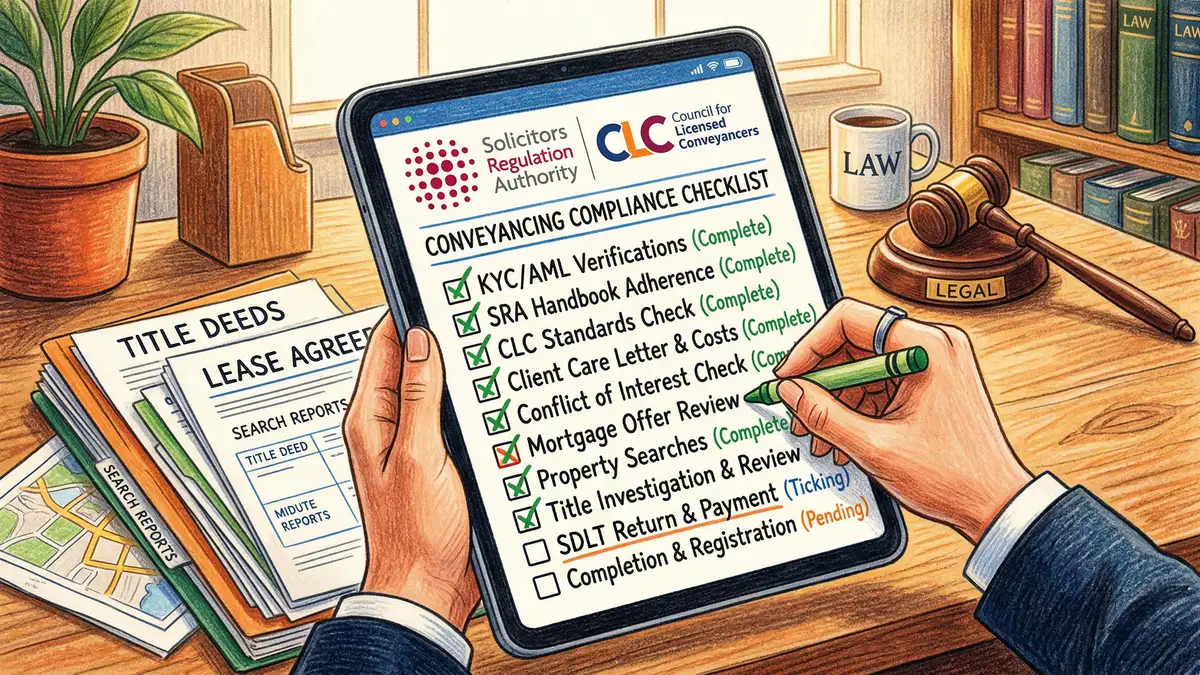
Explore AI Consultancy ServicesA natural concern for conveyancing practices is regulatory risk: will using AI expose my firm to SRA sanctions or licensing consequences? The answer is unambiguous: no. Both the SRA and the Council of Licensed Conveyancers (CLC) have published explicit guidance welcoming technology and AI, provided the firm meets their established principles and standards.

The SRA's position (set out in their guidance on using AI tools) is principle-based. Firms must ensure that any technology used maintains client confidentiality, ensures data security, preserves audit trails, avoids conflicts, and produces reliable outputs. In practice, this means: (1) no training of public-domain AI models on client data without explicit consent; (2) no use of AI to make sole decisions on legal strategy without fee-earner review; (3) documented validation that the AI tool works reliably for its intended purpose; and (4) staff training and competency checks. These are not onerous requirements—they are standard practice for any technology adoption.
The CLC's 11 AI and Technology Principles are similarly enabling. They require that licensed conveyancers understand their tools, maintain human oversight, safeguard client information, and comply with professional standards. Nothing in these principles prohibits AI; instead, they set a floor for responsible use.
Conveyancing Quality Standard (CQS) requirements and the Law Society's Conveyancing Protocol similarly support AI use provided the technology enhances rather than diminishes quality or client outcomes. The Building Safety Act 2022 adds additional verification requirements for higher-risk residential buildings, but AI-assisted due diligence reduces rather than increases your compliance burden.
Finally, HM Land Registry's digital services roadmap is actively partnering with conveyancing software providers to streamline integration. This is not a market where regulators are hostile to innovation; they are explicit advocates.
The conveyancing technology market offers a range of AI-augmented solutions. Below is a summary of leading platforms, intended to guide your evaluation:
| Platform | Primary Strength | AI Capabilities | Integration | Pricing Model |
|---|---|---|---|---|
| Thirdfort | AML/KYC automation | Identity verification, beneficial ownership drilling, source-of-funds analysis, sanctions screening | Standalone or embedded | Per-transaction fee (£50-150) |
| Coadjute | Chain management + AI tracking | Transaction risk scoring, chain visibility, predictive completion analytics | Case management integration (Smokeball, LEAP) | Subscription (£100-300/month) |
| InfoTrack | Integrated search delivery | Automated search analysis, title risk flags, due diligence summary | Direct (searches) or case management | Per-search + risk analysis add-on |
| Luminance | Contract review (universal) | Clause extraction, lease analysis, commercial term flagging, deviation detection | Standalone document upload | Subscription (variable by firm size) |
| Dye & Durham (Conveyancing Suite) | End-to-end conveyancing platform | Integrated AML, search analysis, contract tools, case management | Full-stack (case management + searches + AML) | Subscription (depends on module selection) |
| Smokeball (LEAP) | Practice management | Workflow automation, integrates with third-party AI tools (Luminance, Coadjute) | Case management hub (API-based integrations) | Monthly seats (£80-150 per user) |
For most conveyancing practices, a phased approach is recommended: (1) start with AML automation (Thirdfort) to eliminate the most time-consuming compliance bottleneck; (2) layer in contract review (Luminance) to accelerate document analysis; (3) add chain management (Coadjute) to improve completion rates; and (4) consider a full-stack platform (Dye & Durham) if your practice is large enough to justify platform migration. Firms using Smokeball or LEAP as their case management backbone can adopt point solutions via API integration, minimising switching costs. For a broader overview of how AI is transforming legal workflows beyond conveyancing, see our guide to AI-powered legal research platforms.
Implementing AI is not a single event but a structured change programme. Here is a phased approach used by leading conveyancing firms:
Audit your current process: measure time spent on each task (AML checks, contract review, title analysis, chain communication). Identify bottlenecks and calculate the cost of manual effort. Select your first AI tool based on highest-impact opportunity (typically AML automation). Cost: internal time only.
Deploy your first AI platform (e.g., Thirdfort for AML) to a single fee earner and 10-15 parallel transactions. Establish baseline metrics: time per check, error rate, user acceptance. Conduct weekly review calls with the pilot user. Cost: tool subscription + staff training (8-12 hours).
Train all conveyancing staff on the new tool. Integrate into your case management system (e.g., Smokeball, LEAP). Update client-facing communication (search and due diligence reports) to reflect AI-enhanced analysis. Measure adoption rates and address user resistance. Cost: training materials, technical integration, change management.
Once your first tool is embedded and producing measurable ROI, deploy a second platform (contract review, chain management, or title analysis). Apply lessons learned from Phase 1-3 to accelerate adoption. Estimate cumulative time savings by now: 8-12 hours per week across the team.
Establish a quarterly review cycle to assess completion rates, staff utilisation, client satisfaction, and ROI. Train new staff on AI tools as part of onboarding. Consider platform migration (to full-stack solutions) if your practice reaches scale that justifies it. Budget: ongoing training and licence management.
The most common failure mode in AI implementation is staff resistance. Conveyancers who have practised their craft manually for 10-20 years may perceive AI as a threat to their expertise or job security. Successful firms reframe AI adoption as a tool that amplifies expertise, not replaces it.
Best practice: (1) involve staff early in platform selection, so they have agency in the decision; (2) frame AI as eliminating drudgery, not replacing people (your conveyancers will spend less time on data entry and more on client liaison and complex problem-solving); (3) provide structured training and ongoing support; and (4) tie firm incentives to adoption (e.g., performance bonuses for adoption milestones or completion rate targets). Firms that successfully embed this narrative see 90%+ adoption within 6 months.
Not necessarily. While AI reduces internal cost and time, most practices use the productivity gain to increase throughput (completing more transactions with the same team) rather than cutting fees. Market-leading conveyancing practices report stable or rising fees alongside 15-20% improvement in completion times and lower fall-through rates. Higher throughput, not lower margins, drives ROI.
Yes, provided your implementation meets their principle-based standards: maintain confidentiality, ensure data security, preserve audit trails, avoid conflicts, and validate reliability. Both the SRA and CLC explicitly welcome AI and technology innovation. No additional licensing or regulatory approval is required—only documented compliance with their published principles.
Yes. Most modern AI platforms (Luminance, Coadjute, Thirdfort) offer API integrations with leading case management systems (Smokeball, LEAP, Dye & Durham). Some firms use point solutions (e.g., Thirdfort for AML, Luminance for contracts) and integrate via API. Others migrate to full-stack platforms. Your existing system should not be a barrier to adoption.
For a 15-person conveyancing team, typical ROI is 8-14 months. Savings accrue from: (1) reduced time on AML checks (£30,000-50,000 annually for a mid-market firm); (2) faster contract review (10-15 hours per week); (3) improved completion rates (30+ additional completions per year = £30,000-60,000 in fees); and (4) reduced post-completion disputes and lender clawbacks. Annual platform costs are typically £15,000-40,000. Most firms report breakeven or positive ROI within 12 months.
Point solutions (Thirdfort for AML, Luminance for contracts, Coadjute for chain management) offer flexibility and allow phased adoption. Full-stack platforms (Dye & Durham, Smokeball + integrations) offer deeper integration and unified workflows. For firms with 8-20 fee earners, point solutions are often sufficient. For larger practices (20+ people), full-stack migration typically offers better ROI and reduced integration overhead.
Yes. Clients care about outcomes: faster completion, fewer surprises, clear communication. AI-generated reports (e.g., title analysis, due diligence summaries, risk flags) are typically more thorough and better structured than human-produced reports. Your conveyancing team remains the expert who interprets AI findings and advises the client. Clients perceive this as enhanced service, not diminished.
The conveyancing market is moving faster than ever. Practices that deploy AI now—to automate compliance, streamline due diligence, and reduce fall-throughs—will capture market share and talent. Your competitors are already moving. Helium42 works with leading property law firms to design and implement AI strategies that fit your practice size, regulatory environment, and client base.
Peter Vogel
Peter is a strategist and consultant focused on AI adoption in professional services. He works with law firms, conveyancing practices, and accounting businesses to design implementation roadmaps that deliver measurable ROI. His articles on AI and regulatory compliance are published regularly in industry titles.
Sources: HM Land Registry Digital Services Roadmap; SRA guidance on using AI tools; CLC AI and Technology Principles; UK government home buying and selling reform consultation; Conveyancing Association UK market data 2024-25.
The AI Software Development Market in 2026 £337.75bn UK AI market size by 2032 (26.4% CAGR) £800–£1,500+ Daily rates for mid-market...

Key Takeaway UK employment law practices face a compliance and efficiency crisis. AI now delivers measurable outcomes: contract review time cut by...
Key Takeaway Artificial intelligence reduces M&A due diligence timelines from 4–8 weeks to 1–2 weeks, cuts manual labour costs by 65–78%, and...