9 min read

AI for IP Management and Patent Analysis: Transforming Intellectual Property Strategy

AI for IP Management and Patent Analysis: Transforming Intellectual Property Strategy

Key Takeaway

Artificial Intelligence is transforming intellectual property management by automating prior-art searches (60–80% faster), enabling semantic patent discovery, and providing continuous portfolio monitoring. UK organisations now deploy AI to reduce patent search costs, accelerate filing timelines, and maintain competitive intelligence at scale. Modern IP platforms leverage agentic AI for natural-language queries, citation analysis, and trend forecasting — unlocking significant ROI across legal, product, and commercial teams.

Why IP Management Demands AI

Intellectual property protection has become inseparable from competitive advantage in the modern economy. Organisations file hundreds of patents annually, monitor thousands of competitor trademarks, and must navigate increasingly complex patent landscapes to defend their innovations. Manual IP management processes — keyword searches, citation analysis, infringement detection, portfolio renewal tracking — are labour-intensive, error-prone, and slow.

The global IP management software market reached USD 11.83 billion in 2025 and is projected to expand to USD 31.89 billion by 2033, growing at a compound annual growth rate of 13.2%. This explosive growth reflects a fundamental shift: organisations recognise that artificial intelligence can transform IP workflows from reactive compliance exercises into strategic competitive tools. In the United Kingdom specifically, AI-powered IP management is reshaping how tech companies, life sciences firms, and creative organisations protect and commercialise their innovations.

Traditional approaches to patent searching, prior-art analysis, and trademark monitoring create bottlenecks. A patent attorney must conduct semantic searches across millions of documents, cross-reference terminology that varies across jurisdictions, and synthesise findings into strategic recommendations. AI eliminates these constraints by automating discovery, standardising terminology, and surfacing insights that human researchers might miss.

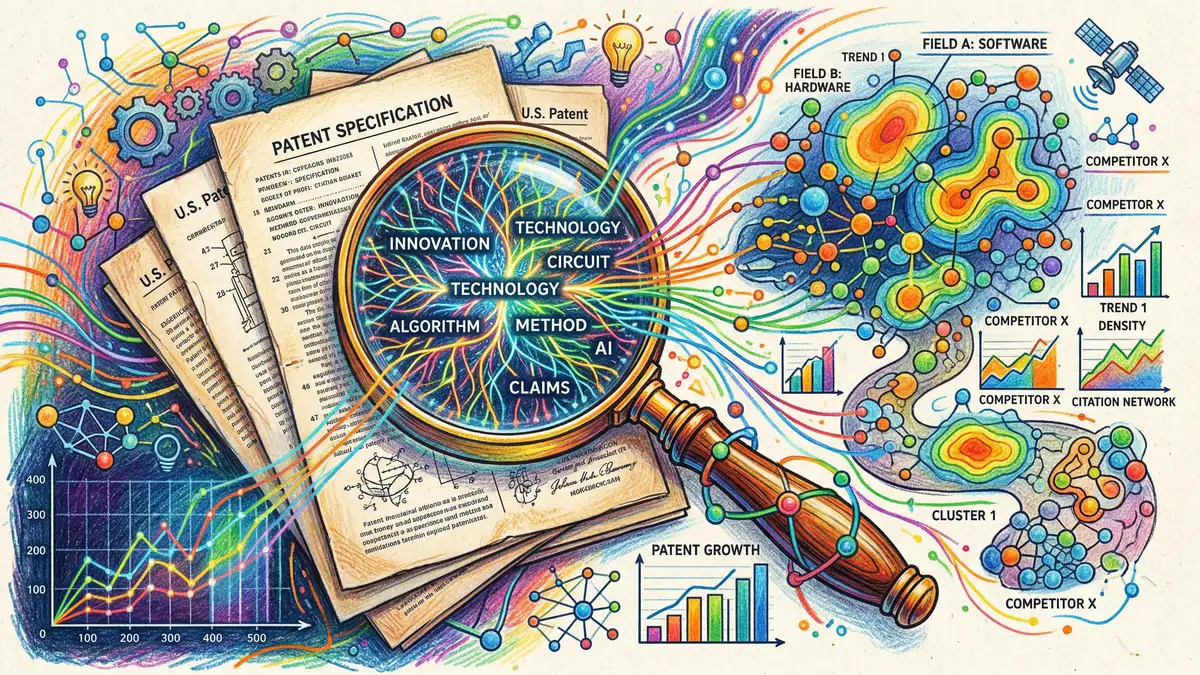
AI-powered patent analysis with neural network connections highlighting key terms and citations across patent documents

How AI Accelerates Prior-Art Searches

Prior-art search is the foundation of patent prosecution. Before filing a patent application, organisations must demonstrate that their invention represents a genuine advance over existing knowledge. This requires searching patent databases, scientific literature, and prior filings across multiple jurisdictions. The conventional process consumes 8–16 hours per search and relies heavily on manual keyword refinement.

Artificial intelligence reshapes this workflow through two core capabilities: semantic search and conceptual similarity matching. Rather than relying on exact keyword matches, AI-powered systems understand patent content at a conceptual level. A search for "machine learning patent authentication" automatically discovers patents using entirely different terminology—"neural network identity verification," "deep learning access control," "artificial intelligence security protocols"—because the underlying concepts align.

PatSnap research demonstrates that AI reduces prior-art search time by 60–80%, whilst simultaneously improving result quality. Patent examiners and in-house counsel report discovering more relevant prior art in significantly less time, leading to stronger prosecution strategies and higher first-action allowance rates. For organisations filing 50+ patents annually, this acceleration translates directly to reduced legal costs and faster time-to-grant.

Trademark monitoring dashboard showing brand tracking across multiple markets with infringement alerts

Agentic AI represents the next frontier. These systems accept natural-language queries — "find all patents related to quantum encryption in financial services" — and autonomously navigate multiple search paths, reconcile results across databases, and deliver reasoned conclusions with citations. Unlike traditional search interfaces that require users to understand Boolean operators and patent classification codes, agentic systems work in the language patent professionals already use.

Semantic search also uncovers emerging trends. AI systems can identify clusters of patents around a theme — say, "edge computing for medical devices" — and surface breakthrough patents that established databases might categorise differently. This capability is particularly valuable for competitive intelligence teams monitoring technology landscapes in fast-moving sectors like life sciences and fintech.

Automated Patent Classification and Portfolio Analysis

Patent portfolios grow organically. A mid-sized tech company might hold 200–500 patents, each filed across multiple jurisdictions with varying classification schemes. Maintaining accurate metadata — International Patent Classification codes, Cooperative Patent Classification, technology domains, market segments — becomes challenging as the portfolio expands.

AI-driven classification systems automatically assign IPC and CPC codes, identify technology domains, assess patent quality, and flag maintenance gaps. Rather than relying on historical data entry or manual review, these systems apply machine learning models trained on millions of patents to categorise new filings consistently. Quality assessment algorithms also quantify patent strength by analysing claim breadth, citation patterns, and prosecution history.

For organisations managing IP across subsidiaries or acquired companies, this standardisation is essential. AI consolidates disparate portfolio data, applies uniform quality metrics, and enables true cross-company visibility. Patent managers can then prioritise renewal investments — identifying high-value patents worthy of maintenance across additional jurisdictions, and candidates for abandonment or licensing.

Citation analysis, another AI-powered capability, reveals patent influence and technology dependencies. By mapping forward citations (patents that cite your invention) and backward citations (prior art that your patent references), AI systems quantify your patent's impact on subsequent innovation. Patent families with high forward citation rates typically represent foundational technologies — often suitable candidates for licensing revenue or defensive publication strategies.

Continuous Trademark Monitoring and Infringement Detection

Trademark infringement requires vigilance. Competitors file similar marks, counterfeiters adopt confusingly similar brands, and unauthorised sellers leverage your registered names. Traditional monitoring relies on quarterly manual reviews of patent and trademark filings, supported by occasional web searches. By then, damage may already be done.

AI-powered trademark monitoring operates continuously. Systems scan global patent and trademark databases, monitor e-commerce platforms, analyse social media, and flag potential infringements in real time. Natural language processing identifies marks phonetically similar to your registered trademarks, even across different scripts and languages. Image recognition detects visual similarity in logos and packaging designs, surfacing counterfeits that human reviewers might overlook.

Infringement analysis algorithms also evaluate likelihood of confusion — a legal standard central to trademark enforcement. By comparing your mark against potential conflicting filings across industry codes, geographic regions, and similarity metrics, AI systems quantify infringement risk and recommend enforcement priorities. This intelligence supports legal teams in deciding which infringements to challenge, which to monitor, and which pose negligible competitive threat.

For UK organisations with registered Community Trade Marks or UK Intellectual Property Office marks, AI monitoring extends across the European Union and domestically, enabling streamlined enforcement strategies. National Westminister's high-growth IP loans increasingly leverage AI valuation tools to assess trademark portfolios, making this capability commercially relevant for IP-backed financing.

Market Insights: IP Software Growth

31.89B
IP Management Software Market by 2033
13.2%
Compound Annual Growth Rate (CAGR)
60–80%
Time Reduction in Prior-Art Searches
70%
Search Quality Improvement with Semantic AI

Leading AI Patent Platforms: Feature Comparison

The IP software landscape includes platforms ranging from specialised patent search tools to enterprise-scale portfolio management suites. The following platforms represent market leaders in AI-powered IP management:

Platform Core Strength AI Capability Best For
PatSeer Complete suite, 172M+ records Amplified AI for conceptual similarity Patent prosecution, landscape analysis
IPRally Graph-based AI search NLP for product features Prior-art discovery, technical analysis
PatSnap Semantic search, classification Similarity detection, trend forecasting Patent intelligence, competitive analysis
Anaqua IP portfolio management Automated filings, renewals, maintenance Enterprise portfolio, cross-jurisdictional
Clarivate Analytics and patent intelligence Citation analysis, quality metrics Portfolio valuation, licensing strategy
Questel Integrated analytics platform AI-powered analytics across IP types Multi-IP management (patents, trademarks, designs)

Regulatory Framework and UK-Specific Considerations

AI-powered IP management exists within a regulatory landscape shaped by the UK Intellectual Property Office, the European Patent Office, and emerging AI governance frameworks. Understanding this environment is critical for organisations deploying AI across IP workflows.

The UK Intellectual Property Office (UKIPO) published updated guidelines in February 2026 addressing the patentability of AI-generated inventions. These guidelines clarify that patent applications disclosing AI involvement must demonstrate genuine technical effect — that is, the AI system must solve a concrete technical problem rather than automate routine business processes. This distinction is crucial: a patent claiming "AI optimises supply chain logistics" requires demonstrating measurable technical improvements (reduced latency, lower computational cost, novel algorithm architecture) rather than operational convenience.

For organisations implementing AI in IP management workflows, these guidelines carry indirect implications. If your IP team uses AI to analyse patents and this analysis contributes to filing a patent application, you must be transparent about AI involvement in the prosecution narrative. The UKIPO respects AI-assisted invention, provided the underlying technical contribution remains patent-eligible.

The European Patent Office (EPO) maintains the Full Text Patent Database, which now supports AI and non-AI patent classifications, enabling applicants and examiners to filter searches accordingly. Cloud-based IP management solutions dominate the market (62.2% of software share in 2025), reflecting organisations' preference for scalable, vendor-managed systems.

Confidentiality and data security remain organisational priorities. As IPKat analysis highlights, virtually every modern patent software tool now incorporates some form of AI. Leading IP platforms incorporate encryption, audit trails, and role-based access controls to protect sensitive patent data. However, organisations must conduct due diligence before selecting platforms — particularly regarding data residency (EU-hosted vs. international cloud infrastructure) and compliance with UK General Data Protection Regulation requirements.

Strengthen Your IP Strategy Today

Schedule a consultation with our IP strategy team to evaluate AI solutions tailored to your organisation's patent portfolio and competitive landscape.

Implementation Roadmap: Phased Deployment Strategy

Deploying AI in IP management is not a "big bang" transition. Successful organisations follow a phased approach, building internal expertise and demonstrating ROI incrementally. The following roadmap reflects best practices observed across leading IP practices and in-house legal teams:

Phase 1: Assessment and Pilot (Weeks 1–8)

Audit existing IP workflows, identify highest-friction processes (prior-art search, portfolio classification), select a pilot platform, and run a 50-patent proof-of-concept. Measure baseline search time and quality metrics. Success criteria: 40%+ time reduction, consistent classification accuracy.

Phase 2: Workflow Integration (Weeks 9–20)

Integrate AI platform into existing tools (patent management systems, prosecution databases). Train patent attorneys and portfolio managers on new workflows. Expand pilot to full prior-art searches and portfolio audits. Document process changes and capture lessons learned.

Phase 3: Scale and Optimisation (Weeks 21–40)

Expand to trademark monitoring, infringement detection, and portfolio analysis. Implement automation for routine tasks (renewal scheduling, quality assessments). Conduct first ROI measurement — cost savings, time reduction, improved filing quality. Refine workflows based on feedback.

Phase 4: Advanced Capabilities (Weeks 41+)

Deploy agentic AI for complex strategic queries (landscape analysis, technology trend forecasting, licensing opportunities). Implement continuous trademark monitoring. Establish governance policies for AI use in IP decision-making. Integrate AI insights into patent filing strategy and commercial licensing negotiations.

ROI and Cost Justification

Investment in AI-powered IP management delivers measurable financial returns across multiple vectors. Organisations report the following ROI drivers:

Prior-art search acceleration: At 60–80% time reduction, a mid-sized IP team conducting 200 prior-art searches annually saves 320–640 attorney hours. At average billing rates of GBP 250–350 per hour (in-house or external counsel), this represents GBP 80,000–224,000 in annual savings. For organisations filing 100+ patents annually, savings scale accordingly.

Improved first-action allowance rates: Superior prior-art discovery supports stronger prosecution strategies and higher first-action allowance rates. Each additional allowance reduces office action cycles, attorney hours, and overall prosecution cost per patent. A 10-percentage-point improvement in allowance rates yields significant savings across large portfolios.

Portfolio optimisation and maintenance cost reduction: Automated quality assessment and technology clustering enable data-driven renewal decisions. Abandoning low-value patents and renewing only high-impact assets reduces annual maintenance costs by 15–30%, whilst concentrating protection on commercially relevant inventions.

Infringement detection and enforcement: Continuous trademark and patent monitoring detects infringements within days rather than quarters, enabling faster enforcement and reduced brand damage. Early detection also prevents reputation erosion and customer confusion.

Competitive intelligence and licensing: AI-powered landscape analysis identifies technology gaps, emerging competitor innovation areas, and potential licensing opportunities. These insights inform product roadmaps, R&D investment prioritisation, and new revenue streams through licensing.

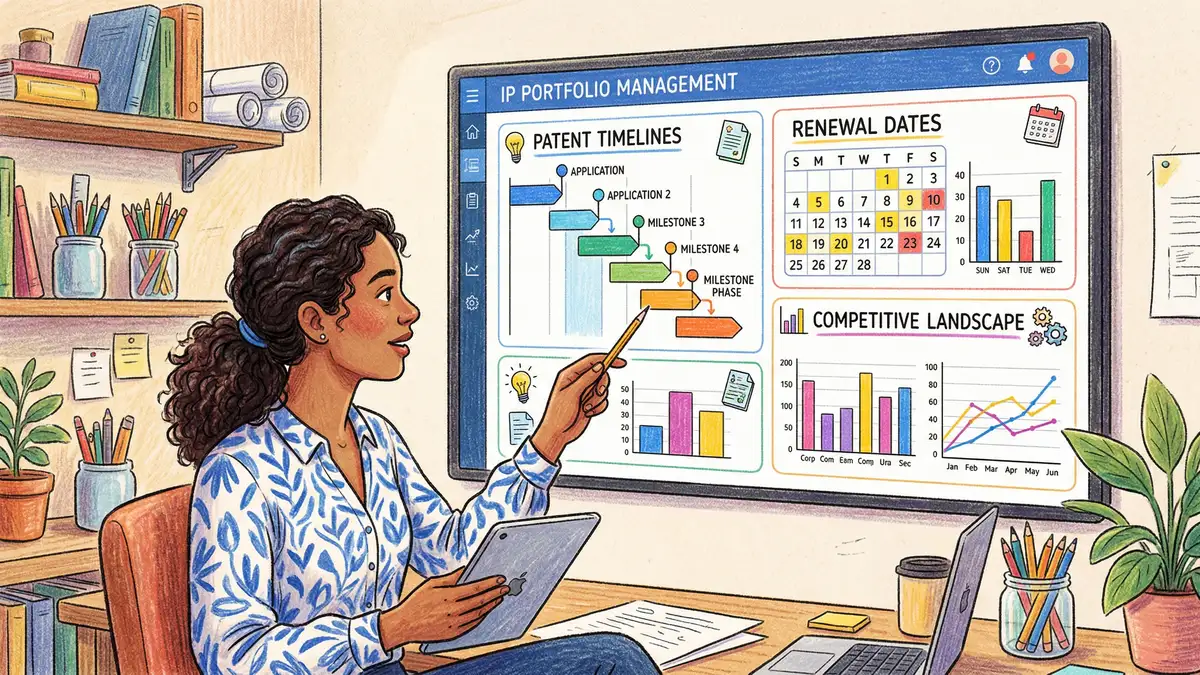
IP portfolio management interface showing patent filing timelines and competitive landscape analysis

Frequently Asked Questions

Is AI patent search accurate enough to rely on for prosecution decisions?

Yes, provided it is used as an analyst tool, not a replacement for human expert judgment. AI-powered systems excel at discovering relevant prior art and identifying conceptually similar patents. However, final prosecution strategy — claim scope, antecedent basis, enablement — remains the responsibility of qualified patent counsel. AI accelerates the research phase; human expertise drives legal strategy.

What are the main security and confidentiality risks when using cloud-based AI IP platforms?

The primary risks are data residency, access control, and vendor stability. Before deployment, confirm that the platform complies with UK GDPR, that data remains within EU or UK infrastructure (or confirm your organisation accepts international transfer), and that audit trails and encryption are in place. Review vendor security certifications (ISO 27001) and conduct penetration testing before storing sensitive portfolio data.

Can AI systems handle the nuances of UK patent law and UKIPO examination practice?

Modern AI systems are trained on UKIPO and EPO examination records, so they reflect UK examination practice. However, nuanced legal arguments — such as how specific claims navigate UKIPO objections around obviousness or lack of inventive step — require human expertise. Use AI for prior-art discovery and landscape analysis; rely on experienced UK patent counsel for prosecution strategy and claim drafting.

How do I measure ROI for AI IP management deployment?

Establish baseline metrics before deployment: number of searches conducted monthly, average search time, annual prosecution costs, first-action allowance rate, and portfolio maintenance costs. After three months, measure the same metrics and calculate improvements. ROI typically appears within six months through time savings and prosecution cost reduction. Advanced metrics (first-action allowance rate, maintenance cost reduction) often take 12+ months to mature.

Are there regulatory restrictions on using AI for trademark or design monitoring?

No. The UKIPO and EPO do not restrict AI use in IP monitoring. However, final enforcement decisions (which infringements to pursue, which to abandon) must involve qualified counsel. AI surfaces candidates; human judgment prioritises enforcement strategy.

Can AI handle patents in multiple languages and jurisdictions?

Leading platforms support multilingual search and cross-jurisdictional analysis. Patent documents in English, German, French, Japanese, and Chinese are indexed and searchable through single queries. This capability is essential for organisations with global patent families and simplifies comparative analysis across major patent offices (USPTO, EPO, WIPO, CNIPA).

Related Expertise and Internal Resources

Artificial intelligence is reshaping not only patent management but the entire legal function. For broader context on AI's application across legal workflows, explore our related resources:

  • AI for Legal Departments — Organisational strategies for deploying AI across general counsel teams, including contract management, compliance monitoring, and legal research.
  • AI for Law Firms — How legal practices are leveraging AI to enhance client service delivery, improve profitability, and differentiate practice areas.
  • AI for Contract Review — Deep dive into semantic contract analysis, risk flagging, and automated redlining powered by large language models.
  • AI for M&A Due Diligence — How AI accelerates document review in acquisitions, uncovering material risks and regulatory concerns at scale.
  • AI for Employment Law — Automation and intelligence applied to employment contracts, policy compliance, and litigation support.
  • AI for Conveyancing — Streamlining property transactions through automated due diligence and title analysis.
  • Best AI for Legal Research — Comprehensive guide to AI-powered legal research platforms transforming how counsel discover case law and statutory authority.

AI is fundamentally changing how IP professionals work — from prior-art discovery to portfolio management to competitive intelligence. The organisations embracing these tools today are building competitive advantages that will compound over years. Patent protection remains a cornerstone of innovation strategy; AI makes that protection smarter, faster, and more strategically aligned with business objectives.

About the Author

PV

Peter Vogel

Senior AI Strategy Consultant, Helium42

Peter works with organisations across legal, IP, and professional services to design and implement AI solutions that drive measurable business outcomes. With expertise in patent law, competitive intelligence, and enterprise AI deployment, he guides clients through the full spectrum of IP transformation — from strategy through execution and ROI realisation.

Sources: PatSnap (2025), Fortune Business Insights (IP Software Market 2025–2034), Straits Research (IP Management Software 2025–2033), UK Intellectual Property Office Guidelines for AI Inventions (February 2026), IPWatchdog (Agentic AI in Patent Search, October 2025), Octimine Patent Analytics, European Patent Office Full Text Database.

Transform Your IP Management with AI

From prior-art discovery to portfolio analytics to competitive intelligence — AI reshapes how organisations protect and commercialise their innovations. Let us show you how to build an intelligent IP strategy aligned with your business objectives.

legal billing automation

AI Software Development Agency: How to Choose the Right Partner

AI Software Development Agency: How to Choose the Right Partner

The AI Software Development Market in 2026 £337.75bn UK AI market size by 2032 (26.4% CAGR) £800–£1,500+ Daily rates for mid-market...


Read More
AI for Employment Law: Compliance and Automation

AI for Employment Law: Compliance and Automation

Key Takeaway UK employment law practices face a compliance and efficiency crisis. AI now delivers measurable outcomes: contract review time cut by...

Read More
AI for M&A Due Diligence: Automating Document Review

AI for M&A Due Diligence: Automating Document Review

Key Takeaway Artificial intelligence reduces M&A due diligence timelines from 4–8 weeks to 1–2 weeks, cuts manual labour costs by 65–78%, and...

Read More