Published by

AI Governance Consulting from Helium42
Helium42 works with mid-market organisations on AI governance as part of a wider implementation programme, rather than as a standalone compliance exercise. We do not begin with a fixed framework. We begin with a discovery workshop across the departments already using AI, because the governance you need depends on what that workshop finds.
How an engagement works. The workshop establishes where AI is already in use, who is accountable for it, and where the exposure sits. Where it surfaces governance gaps, we set out recommendations for the structure to put in place and support you through implementing it. Where it surfaces something else — a legal review, a process change, or a system to build — we address that instead. The sequence is deliberate: establish the facts, then prescribe.
What that looks like in practice. In one engagement, a day and a half with senior management produced the recommendations and strategy the client needed, and the work was complete at that point. In another, an initial workshop led to a monthly retainer and then to several development projects. Both began the same way. The difference emerged from what discovery found, which is why we do not quote a fixed governance package before running one.
Who we are. Helium42 was founded by Clwyd Probert, previously of the HubSpot Diamond partner agency Whitehat, and Peter Vogel, who has led digital marketing transformation programmes for over 500 organisations across the UK and Europe. Between them they have delivered more than 200 workshops and trained over 2,000 professionals. We work from London and Hamminkeln, across the UK and DACH markets. AI governance is a young discipline and we are candid about that: nobody in this market holds a decade of precedent, which is precisely why we start by establishing the facts of your situation rather than applying a template built for somebody else.
Where to start. Most organisations begin with our free 30-minute AI webinar for business leaders, which sets out the governance decisions you face before any budget is committed. The AI readiness assessment gives you a structured view of where your own gaps sit.
The guidance below covers the wider market — provider types, pricing models, regulatory drivers, and the selection criteria to apply — whether or not you engage us.
Artificial intelligence deployment is no longer optional for mid-market organisations. Yet as AI systems grow more central to business operations—from customer service automation to financial forecasting—the regulatory and reputational risks escalate correspondingly. Organisations operating in the UK and EU face a complex governance landscape: the EU AI Act mandates compliance by April 2025 for high-risk systems; GDPR intersects with AI in ways that remain partially unsettled; sector-specific regulators (FCA, ICO, CMA) are issuing new guidance quarterly. In this environment, choosing the right AI governance consulting partner is not a luxury—it is essential to avoid fines (estimated at £7.5–30 million for non-compliance), deployment delays, and reputational damage. This guide walks you through how to evaluate and select a governance consulting partner that aligns with your organisation's maturity, budget, and regulatory obligations.
Key Statistics: 62–68% of mid-market organisations lack a dedicated AI governance role (Gartner, 2024). The global AI governance consulting market is projected to grow at 28–35% CAGR through 2029, driven by regulatory pressure and talent scarcity (McKinsey & Company, 2024). Organisations with formal AI governance frameworks deploy models 30% faster than those without, as compliance pre-gates are resolved earlier (Gartner, 2024). Consulting engagements for AI governance range from £20,000–£150,000+ depending on scope, with fractional Chief AI Officer arrangements emerging as cost-effective alternatives to full-time hires (Gartner, 2024). For organisations in the EU, the AI Act is driving immediate compliance urgency, whilst UK organisations should review guidance from the ICO on data protection and AI intersections.
Understanding What AI Governance Consulting Actually Covers
AI governance consulting differs fundamentally from traditional IT or management consulting. Rather than focusing solely on infrastructure deployment or operational efficiency, AI governance addresses the regulatory, ethical, and risk dimensions of AI systems across the organisation. This distinction matters because it shapes the expertise you will need, the timeline required, and the success metrics that matter.
Governance consulting typically encompasses four core dimensions. First, regulatory alignment and compliance maps your current AI systems against the EU AI Act (risk classification, conformity assessment, documentation), GDPR (lawful basis for training data, data subject rights, third-party liability), and sector-specific rules (MiFID II for financial services, HIPAA analogs for healthcare, DSA for platform services). Second, governance framework design establishes internal policies for model risk management, transparency standards, vendor assessment protocols, and ethical decision-making. Third, operational implementation support encompasses change management, internal team training, tool selection, and metrics definition to embed governance into actual development workflows. Fourth, assurance and advisory includes third-party model audits, board-level reporting, emerging risk scanning, and peer benchmarking.
This differs markedly from IT governance consulting, which focuses on infrastructure, systems integration, and deployment speed. A practical example illustrates this: an IT consultant on an AI implementation project ensures the model pipeline architecture is sound and MLOps tooling is integrated. An AI governance consultant on the same project asks: Who is accountable when the model produces a harmful decision? What bias testing is required before deployment? How do we document informed consent for data subjects? What remediation processes exist if the model fails? How do we communicate AI use to regulators and customers? These questions reshape the entire engagement timeline and cost structure.
Organisations confusing governance with implementation consulting often encounter resistance from their teams. Data science teams may view governance as bureaucratic overhead; business units may object to deployment delays imposed by new compliance gates. This friction accelerates post-engagement adoption failure (seen in roughly 40% of engagements where governance is treated as a checkbox rather than embedded into workflows).
The Market Landscape: Provider Types and Pricing Models
The AI governance consulting market segments into four distinct tiers, each with different strengths, weaknesses, and cost profiles. Understanding these tiers helps you match your needs to the appropriate partner.
Tier 1: Big 4 and Major Consulting Firms include Deloitte, PwC, EY, and KPMG. These firms bring regulatory depth (particularly on EU AI Act compliance and GDPR intersections), global scale, and sector expertise. Day rates range from £1,400–£2,600 GBP depending on the firm and engagement complexity. Strengths include access to deep regulatory networks, robust methodologies, and large internal benchmarking datasets. Constraints include slower decision-making, generalist approaches (unless you engage a dedicated AI ethics or governance practice), and often-high engagement minimums (£75,000–£150,000+). These firms excel when organisations need credibility with boards and regulators, or when managing cross-border compliance (UK + EU simultaneously).
Tier 2: Specialist Boutiques and Mid-Market Firms (Wavestone, Capgemini Invent, CGI, Accenture's Responsible AI track) are typically faster and more agile than Big 4, with deeper embedded AI/ML expertise. Day rates range from £900–£1,600 GBP. These firms capture 35–45% of mid-market governance engagements (PwC, 2024) because they combine speed with technical credibility. They are well-suited for organisations needing rapid framework design or implementation support, and they excel at building internal capability (rather than creating consultant dependency).
Tier 3: Specialist Micro-Boutiques (e.g., independent AI ethics consultants, Alan Turing Institute partnerships, niche algorithmic auditing firms) offer deep vertical expertise—for example, specialising in fairness testing for financial services or algorithmic transparency for government AI. Day rates range from £500–£1,200 GBP, making them cost-effective for targeted engagements. They are typically better suited for specific, high-risk areas (LLM governance, bias testing) than for broad governance programme design.
Tier 4: Fractional Chief AI Officer / Governance Leadership Services (provided by firms such as Kearney, BCG, and specialist platforms like Plato and Execon) provide part-time governance leadership at £4,000–£15,000 monthly. This model is growing rapidly; currently only 15–20% of mid-market organisations use fractional executives, but adoption is projected to reach 40–50% by 2026 (Gartner, 2024). These arrangements are ideal for organisations lacking internal governance leadership but not requiring a full-time permanent hire.
Pricing Structures and Engagement Models
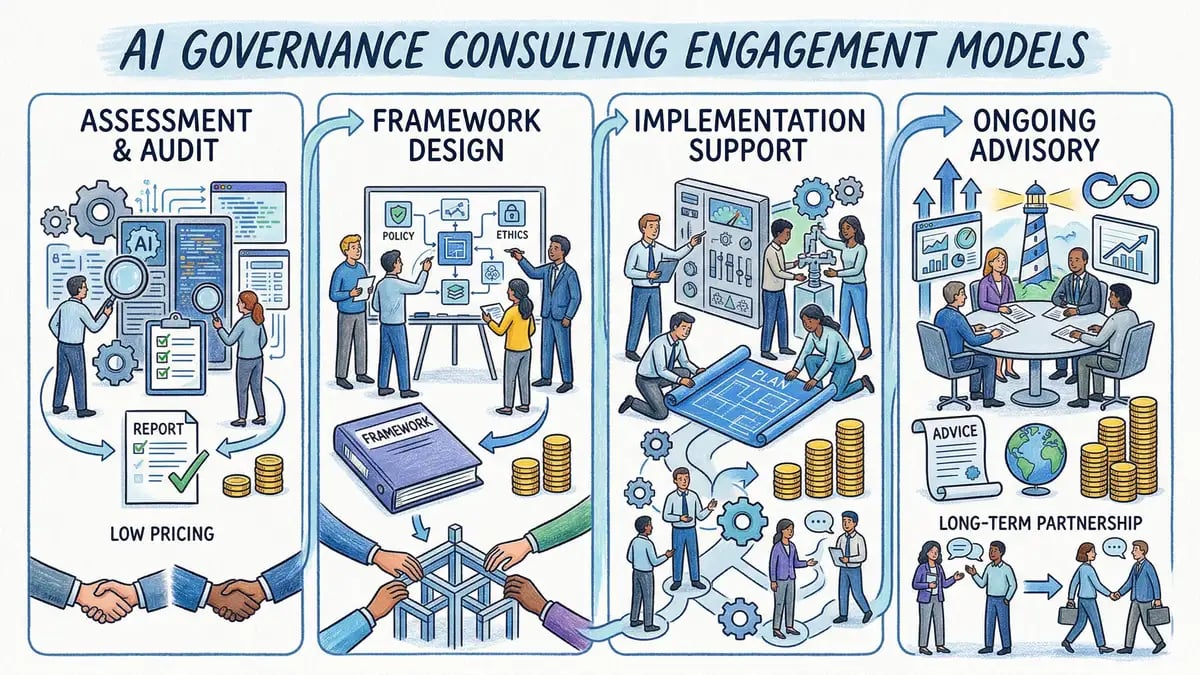
AI governance consulting is priced using five primary models. Time and materials (day rate) charges £1,000–£2,500 per day and suits exploratory audits or smaller scopes (2–8 weeks). Fixed-price project engagements range from £25,000–£150,000 and work well for specific deliverables like framework design or gap analysis (2–6 months). Retainer advisory (£3,000–£8,000 monthly) provides ongoing compliance monitoring and emerging risk scanning over 12+ months. Outcome-based pricing (£30,000–£250,000+) ties fees to risk reduction or adoption metrics; this model is still emerging but growing. Fractional executive arrangements (£4,000–£15,000 monthly) bundle governance leadership with hands-on framework development.
Most effective governance programmes combine two or more models. For example: start with a fixed-price assessment (£25,000–£40,000 over 6–8 weeks), move to a fixed-price framework design (£60,000–£100,000 over 12–16 weeks), then transition to a 12-month retainer for ongoing advisory (£4,000–£6,000 monthly). Total programme cost over 12 months is typically £130,000–£250,000 for a small-to-mid governance initiative. This phased approach allows you to validate consultant competence and cultural fit at each stage before committing to longer engagements.
Regulatory Drivers: Why You Need External Expertise Now
The urgency for AI governance consulting is driven by four converging regulatory and business forces. First, EU AI Act implementation is phasing in over 2024–2026. High-risk AI systems faced initial compliance by April 2024; the compliance phase for high-risk systems begins April 2025, with full implementation extending through 2026 (European Commission, 2024). This is not a future concern—organisations should already be conducting risk classification audits. Second, GDPR and AI intersection complexity remains high. 73% of organisations report uncertainty on how GDPR requirements map to AI model training and deployment (Gartner, 2024). Regulatory interpretation continues to evolve; external advisors provide early-warning scanning and reduce the risk of costly post-facto remediation.
Third, talent scarcity creates capability gaps. 71% of mid-market organisations report insufficient risk management expertise for AI; 65% lack algorithmic bias testing capability (Forrester, 2023; McKinsey & Company, 2024). AI governance professionals command 40–60% salary premiums over comparable roles, and hiring typically requires 6–9 month search cycles (LinkedIn, 2024). External consulting bridges this gap during permanent hiring. Fourth, business acceleration results from governance done correctly. Organisations with formal governance frameworks deploy AI models 30% faster because compliance pre-gates are resolved earlier, and stakeholder confidence (board, legal, risk) accelerates business case approval (Gartner, 2024).
The financial case is compelling: estimated fines for GDPR violations involving AI reach £10–20 million; EU AI Act high-risk non-compliance can trigger fines of £7.5–30 million (1.5–6% of revenue). A governance consulting engagement at £80,000–£150,000 delivers an ROI of 200–2,000%+ within 12 months in avoided regulatory risk alone (Deloitte, 2024).
Typical Engagement Models and Outcomes
AI governance consulting follows three primary engagement patterns. Model 1: Assessment and Audit conducts a 4–8 week baseline maturity assessment, identifying compliance gaps and drafting a remediation roadmap. Deliverables include a governance maturity assessment (often using a CMMI-style framework), regulatory compliance gap analysis (EU AI Act, GDPR, sector-specific), a prioritised risk register, and a 12–36 month remediation roadmap. Cost is typically £20,000–£60,000. This model suits organisations seeking initial clarity on risk profile or those undergoing acquisition due diligence. An illustrative case: a mid-market financial services firm (250 employees) completed an audit identifying 18 critical compliance gaps and 31 medium-priority improvements, with an estimated 14-month remediation roadmap, for £35,000 (Deloitte, 2024).
Model 2: Framework Design and Build (8–16 weeks, £60,000–£120,000) takes assessment findings and designs custom governance policies, processes, and controls. This model includes stakeholder workshops, policy documentation, tool selection guidance, and initial internal team training. It is best suited for organisations with executive commitment and a clear vision of what governance should achieve. Success depends heavily on cross-functional buy-in from data science, IT, legal, and business units—frameworks designed without this engagement typically fail post-launch.
Model 3: Implementation Support and Capability Building (24 weeks, £40,000–£80,000) embeds the consultant within your team to ensure governance is operationalised, not shelved. This includes change management, pilot AI projects under the new governance process, internal team upskilling, metrics and dashboard definition, and adoption readiness assessment. This is the most expensive model per week but yields the highest post-engagement adoption rates (70–85% vs. 40–60% for assessment-only engagements). Leading consultants increasingly market this as a "graduation-focused" model: they explicitly work to develop internal capability so the organisation no longer needs ongoing external support.
Selecting the Right Partner: Critical Evaluation Criteria
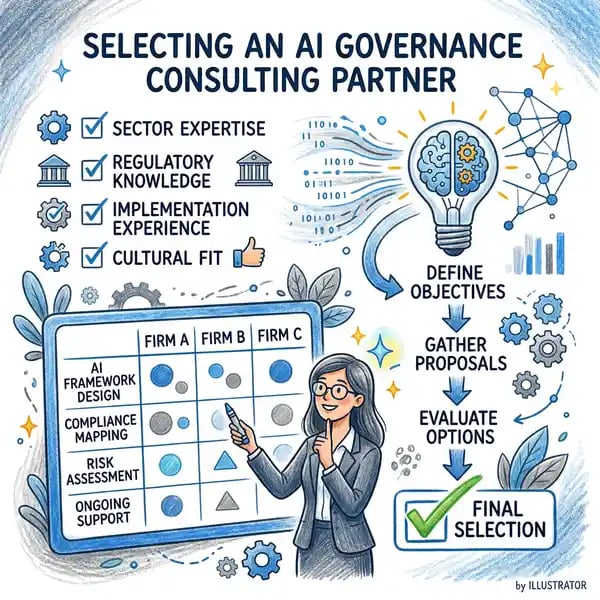
Choosing an AI governance consultant requires evaluating regulatory expertise, implementation track record, team quality, sector knowledge, and cost-effectiveness. On regulatory knowledge, ask specific questions: "Walk me through how you've advised clients on EU AI Act high-risk classification. What recent guidance or enforcement actions are influencing your approach?" Listen for references to specific GDPR+AI cases (e.g., ECJ rulings on data subject rights in AI contexts), recent ICO guidance, FCA algorithmic accountability expectations, and emerging CMA rulings on AI and fair competition. Generic "we follow all applicable regulations" responses should raise a red flag.
On implementation experience, request case studies and contact information for at least three clients in your sector. Ask: "What percentage of your governance recommendations were actually implemented by clients 12 months post-engagement?" High-maturity firms will openly discuss adoption rates (often 70–85% for implementation-support engagements, 40–60% for assessment-only) and will explain why some recommendations are deferred or rejected. They should have a documented methodology for embedding governance into actual business workflows, not just producing a glossy framework document.
On team quality and continuity, demand a named engagement lead with multi-year governance experience and secure a commitment that they will remain your primary contact throughout the engagement. Consultant turnover mid-project is a major cause of engagement failure. Ask about the supporting team: Will you have direct access to regulatory specialists, data scientists who can assess model risk, and change management experts? Or are these backstop resources who will not attend steering committee meetings?
On sector expertise, evaluate depth in your industry. A financial services firm should work with a consultant who has advised at least 3–5 other financial services firms on AI governance, understands FCA algorithmic accountability expectations, and can discuss MiFID II and market abuse regulation intersections with AI. Healthcare, legal services, and regulated manufacturing each have distinct compliance profiles; generic consultants often miss sector-specific nuances.
On internal capability building, ask: "What does graduation from your engagement look like? How do you measure success in terms of internal team readiness?" Consultants focused purely on billable hours may create dependency; forward-thinking firms design their engagement with the explicit goal of developing internal governance capacity so the client no longer needs external support after 12–18 months.
See how Helium42 compares to boutique and Big 4 governance consultants.
Explore AI Governance Consulting at Helium42Red Flags and Common Engagement Failures
Three patterns indicate a high-risk governance consulting engagement. First, framework-first design without stakeholder alignment typically leads to post-launch failure. If a consultant proposes to design governance frameworks in isolation from data science, IT, and business unit leadership, adoption will be low. Best-practice engagements conduct broad stakeholder interviews during the assessment phase and include business unit, data science, and IT leadership in design workshops. Second, underestimating change management complexity is common. Governance constrains AI development velocity in the short term (more approval gates, more documentation). If the engagement does not explicitly plan change management, secure CEO/board commitment, and test governance processes on pilot projects, post-engagement adoption drops below 40% (Deloitte, 2024).
Third, misalignment between governance maturity and intervention scope creates friction. An immature organisation (no governance structures, no dedicated roles) should not jump directly to implementing a sophisticated governance platform and formal review board. A phased approach—starting with a simple risk assessment process, then adding model monitoring, then building formal governance infrastructure—succeeds far better. Consultants who propose comprehensive, enterprise-grade governance frameworks to organisations at maturity Level 1 often trigger internal resistance and abandonment post-engagement.
UK and EU Regulatory Context: Dual Compliance Complexity
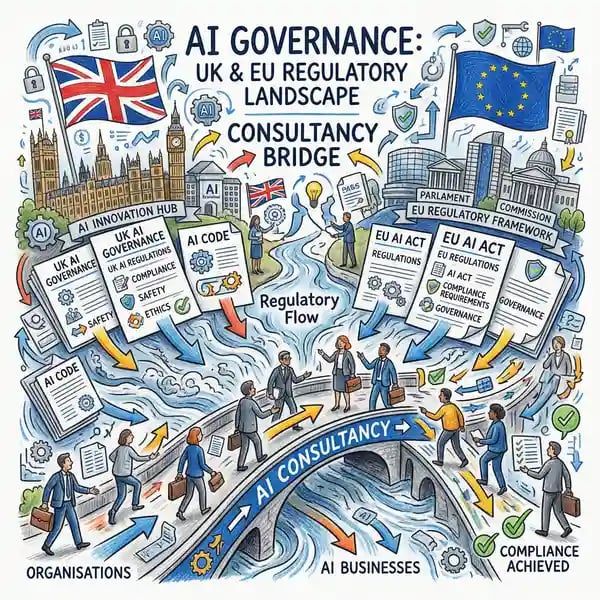
Organisations operating across the UK and EU face a particularly complex regulatory landscape. The EU AI Act is prescriptive and rules-based. High-risk AI systems (defined broadly to include many AI systems affecting fundamental rights, safety, or critical infrastructure) must undergo formal conformity assessment, maintain detailed documentation, implement pre-deployment risk analysis and mitigation, conduct model monitoring, and maintain an audit trail. The phased compliance timeline runs from April 2024 (prohibited AI systems banned) through April 2025 (high-risk phase-in) through 2026 (full implementation).
The UK AI Framework is lighter-touch and principles-based. Rather than a standalone AI Act, the UK relies on sector-specific regulators (ICO for data protection, FCA for financial services, CMA for competition, DSIT for emerging guidance). This approach provides flexibility but also creates interpretation uncertainty. A financial services firm cannot look to a single rulebook and determine compliance; instead, it must track guidance from the FCA, ICO, and general UK government announcements, each of which may interpret "responsible AI" differently.
For organisations operating in both jurisdictions, this creates a 30% cost premium for governance consulting (Gartner, 2024). A single governance framework must satisfy both EU prescriptive rules and UK principles-based expectations. Leading consultants provide separate workstreams for EU compliance (checklist-driven conformity assessment) and UK compliance (principles-based risk management), then integrate the two. This requires both deep EU AI Act expertise and UK regulatory network access.
Budget Planning and Procurement Strategy
A typical 12-month AI governance programme allocates budget across four phases. Assessment and audit (10–15% of total budget, weeks 1–8) establishes baseline maturity and compliance gaps. Framework design (25–35% of budget, weeks 9–20) develops custom governance policies and controls. Implementation support (35–45% of budget, weeks 21–52) embeds governance into business workflows and builds internal capability. Ongoing advisory (15–25% of budget, continuing months 13+) provides retainer support for emerging risks and regulatory changes.
For a mid-market organisation, a realistic 12-month budget is £130,000–£250,000. Within this budget, you have three procurement options. Option 1 (Strategic partnership) engages a single consulting firm for the full 12-month programme. This approach offers continuity, builds a single team's understanding of your organisation, and typically delivers higher adoption rates. Cost premium: 10–15% vs. modular approaches, but offset by lower integration risk. Option 2 (Cost-optimised mix) engages a Big 4 firm for assessment and framework design, a boutique firm for implementation support, and a fractional CRO for ongoing advisory. This approach reduces cost by 15–25% but requires careful hand-off management and may introduce methodology inconsistencies. Option 3 (Hybrid) engages a fractional CRO as the primary governance leader and supplements with specialist consulting on high-risk areas (e.g., LLM governance, bias testing). This approach is emerging as the preferred model for cost-conscious organisations with executive bandwidth constraints.
Strong governance is realised in delivery, not in documentation. At Helium42, we prepare organisations through the Education-to-Implementation Pathway, the method Helium42's founders developed across more than 200 workshops with over 2,000 professionals, from principle to practice. Before you brief any partner, it helps to understand how a structured pathway connects governance frameworks to operational change, so the engagement you commission produces controls that work rather than policies that sit unread.
Preparing for a Governance Consulting Engagement
Before engaging a consultant, invest time in internal preparation. Secure executive sponsorship from your CEO or COO. This is non-negotiable; governance consulting will impose constraints and costs on business units, and those costs are only justified if senior leadership visibly and consistently communicates the importance of governance. Second, assemble a cross-functional steering committee including your CIO, CFO, General Counsel, Chief Data Officer, and business unit leaders (marketing, sales, operations). This committee should meet monthly throughout the engagement; their participation signals to the consultant and your broader organisation that governance is a priority.
Third, document your current AI landscape. Consultants will ask for this anyway, but gathering it yourself accelerates the assessment phase. Inventory your active AI systems (including their business purpose, data sources, deployment environment, and regulatory relevance). Fourth, identify an internal governance lead (0.5–1 FTE during the engagement) who will work alongside the consultant and eventually own governance post-engagement. This role is critical; without internal ownership, governance decays within 12 months of consultant departure. Fifth, define success metrics jointly with the consultant. Success might be measured as: "60% of AI projects completed within governance gates on first submission" or "Risk register reviewed and approved by audit committee quarterly" or "Zero material regulatory findings on our AI systems." Quantified success metrics make adoption tracking and post-engagement impact evaluation possible.
Internal Linking and Related Reading
This article is part of a series on AI governance and compliance. For deeper exploration, consult our comprehensive AI governance guide, which covers frameworks, tools, and best practices in detail. Learn about what AI governance actually is and why it differs from data governance. For practical policy templates, see our AI policy template, which you can adapt for your organisation. On regulatory requirements, explore our guide to EU AI Act compliance in the UK and our resource on AI governance best practices. For risk and compliance frameworks, review our article on AI governance, risk, and compliance integration. Additional reading on data governance in AI systems, governance for agentic AI, and AI compliance in regulated industries will round out your understanding.
How Helium42 Delivers AI Governance Consulting
At Helium42, we bring two decades of combined experience in AI strategy, regulatory compliance, and enterprise implementation. We work with mid-market organisations across financial services, healthcare, legal, and manufacturing to build governance frameworks that satisfy regulators, accelerate AI deployment, and embed accountability into your organisation. Our approach differs from traditional consultancies in three ways.
First, we combine external expertise with internal capability transfer. We do not create consultant dependency; instead, we explicitly develop your internal governance capacity so that by month 12, you own and operate your governance framework independently. Our engagements include documented training, workshop facilitation, and a transition plan that clearly defines what you will manage internally vs. where you might retain external advisory support.
Second, we embed governance into business workflows, not into separate compliance committees. Rather than designing governance that exists in isolation, we work with your data science, IT, and business unit teams to integrate governance checks into your existing AI development lifecycle. This approach dramatically improves adoption rates (70–85% vs. 40–50% for traditional approaches).
Third, we lead with business outcomes, not compliance checklists. While regulatory compliance is essential, it is not sufficient. We help you articulate how governance enables faster AI deployment, builds stakeholder confidence, reduces model failure risk, and creates competitive advantage. This framing transforms governance from a "necessary cost" into a "business enabler."
If your organisation is evaluating AI governance consulting partners, we would welcome a conversation. We offer a free 30-minute discovery call to assess your current governance maturity, clarify your regulatory obligations, and outline a tailored engagement approach.
Evaluating AI Governance Consulting Partners?
Book a free 30-minute discovery call to assess your governance maturity and clarify your regulatory obligations.
Frequently Asked Questions
- How long does an AI governance consulting engagement typically take?
- Assessment and audit engagements typically run 4–8 weeks. Framework design and implementation support extend to 6–12 months for a complete programme. Many organisations then transition to ongoing retainer advisory (3–6 months minimum). The specific timeline depends on your current maturity, organisational complexity, and ambition for governance depth.
- What is the difference between an assessment and a full governance programme?
- An assessment (£20K–60K, 4–8 weeks) identifies compliance gaps and recommends a remediation roadmap but does not implement governance. A full programme (£130K–250K, 12 months) includes assessment, framework design, implementation support, and change management. Most organisations start with assessment, then decide whether to proceed with implementation based on findings and internal capacity.
- Do we need a Big 4 consultant or will a boutique firm suffice?
- This depends on your regulatory complexity and internal credibility needs. If you operate solely in the UK and have relatively simple AI systems, a boutique firm is typically sufficient and more cost-effective. If you operate across EU jurisdictions, manage high-risk AI systems affecting fundamental rights, or need board/regulator credibility, a Big 4 firm (or a boutique with deep EU AI Act experience) is justified. Most mid-market organisations benefit from boutique consulting for implementation and a fractional CRO for ongoing governance leadership.
- What should we budget for AI governance consulting?
- A typical 12-month governance programme costs £130K–£250K, depending on your current maturity and the scope of your AI systems. Smaller organisations with simple compliance needs may achieve governance maturity with £50K–£100K investment. Large enterprises with complex multi-jurisdiction requirements may require £300K–£500K+. As a rule of thumb, governance investment is typically 1–3% of your total AI transformation budget.
- Can we do governance consulting in-house or do we need external help?
- Governance frameworks can be designed in-house if you have internal expertise in regulatory compliance, AI/ML risk management, and change management. However, 62–68% of mid-market organisations lack this expertise (Gartner, 2024). External consultants provide regulatory knowledge, best-practice methodologies, benchmarking data, and objectivity that internal teams struggle to source. Most organisations benefit from at least an initial external assessment to benchmark their baseline maturity and identify critical gaps.
- How do we measure whether a governance consulting engagement was successful?
- Success metrics should be defined at engagement start and tracked throughout. Typical metrics include: governance maturity assessment score improvement (e.g., from Level 1 to Level 2); regulatory compliance gap closure rate; adoption rate of new governance processes (target: 70%+ by month 12); reduction in model failure incidents; speed of AI project approvals (models approved within governance gates on first submission); and stakeholder confidence scores. Post-engagement, track whether governance is sustained (does it decay over 12+ months post-consultant departure?). If adoption and sustainability are strong, the engagement succeeded.