
Published by

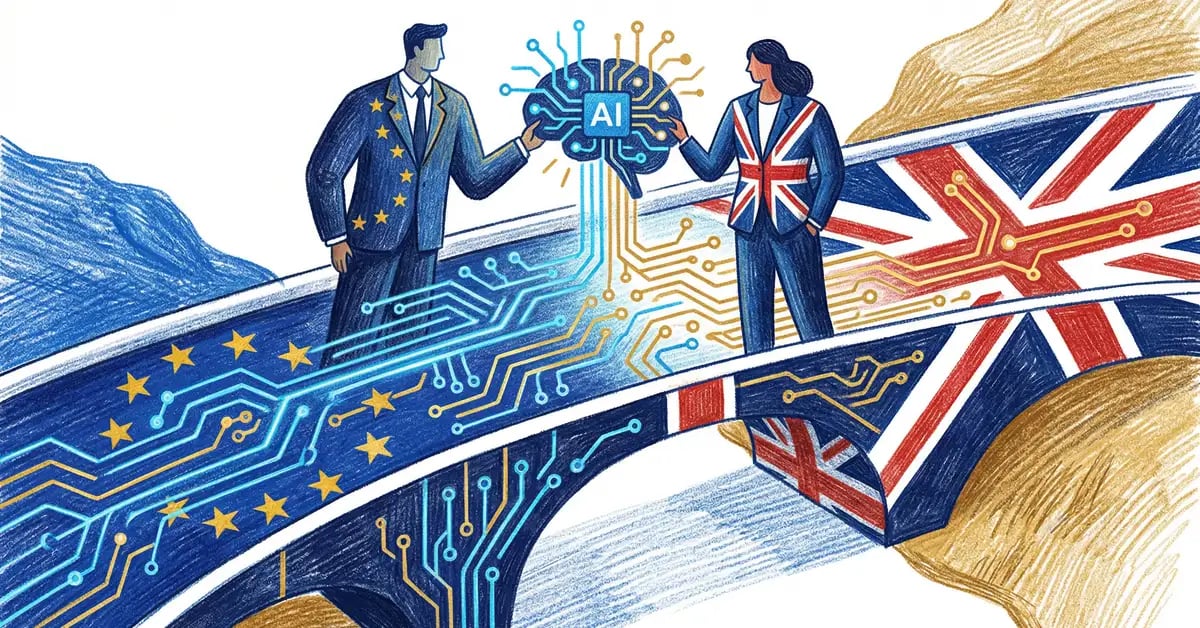
The EU AI Act is operational. Compliance deadlines are now live. For UK businesses trading with European customers or operating across borders, the question is not whether the regulation applies—it does—but how to navigate dual compliance while managing costs. This guide cuts through the confusion, explains the extraterritorial scope, identifies high-risk obligations, and sets out a practical implementation path for mid-market organisations.
Understanding the EU AI Act's Extraterritorial Reach
The EU AI Act applies beyond the European Union's borders. Article 2 of the regulation states that the Act applies to AI systems placed on the EU market, regardless of where the provider is established. For UK organisations, this means that if your AI system—whether a chatbot, recommendation engine, or automated decision tool—is accessible to EU customers or processes data of EU residents, the EU AI Act applies to your operations.
This extraterritorial scope creates a critical distinction: UK organisations are subject to EU AI Act compliance not because they are headquartered in the EU, but because their customers or data subjects are. The full text of the regulation is available via the EU AI Act hub, and the European Commission's regulatory framework page provides official implementation guidance. The UK Government's pro-innovation regulatory approach, outlined in the AI regulation framework, does not provide exemption from EU rules if you serve EU markets.
Real-world scenario: A mid-market UK SaaS company with a customer base across London, Berlin, and Amsterdam must comply with the EU AI Act for any AI features that interact with EU customer data—not just for German and Dutch customers, but for any EU resident data processed by that system. This creates immediate exposure for organisations with pan-European customer bases, which represents nearly 38% of UK mid-market technology and professional services firms.
The regulation captures four categories of AI activity: (1) placing AI systems on the EU market; (2) putting AI systems into service in the EU; (3) marketing AI systems in the EU; and (4) importing or reselling EU-compliant AI systems. For most UK organisations, categories 1 and 2 are immediately relevant if you have EU customers or EU resident data in your systems.
The Prohibited Practices That Carry €35 Million Penalties
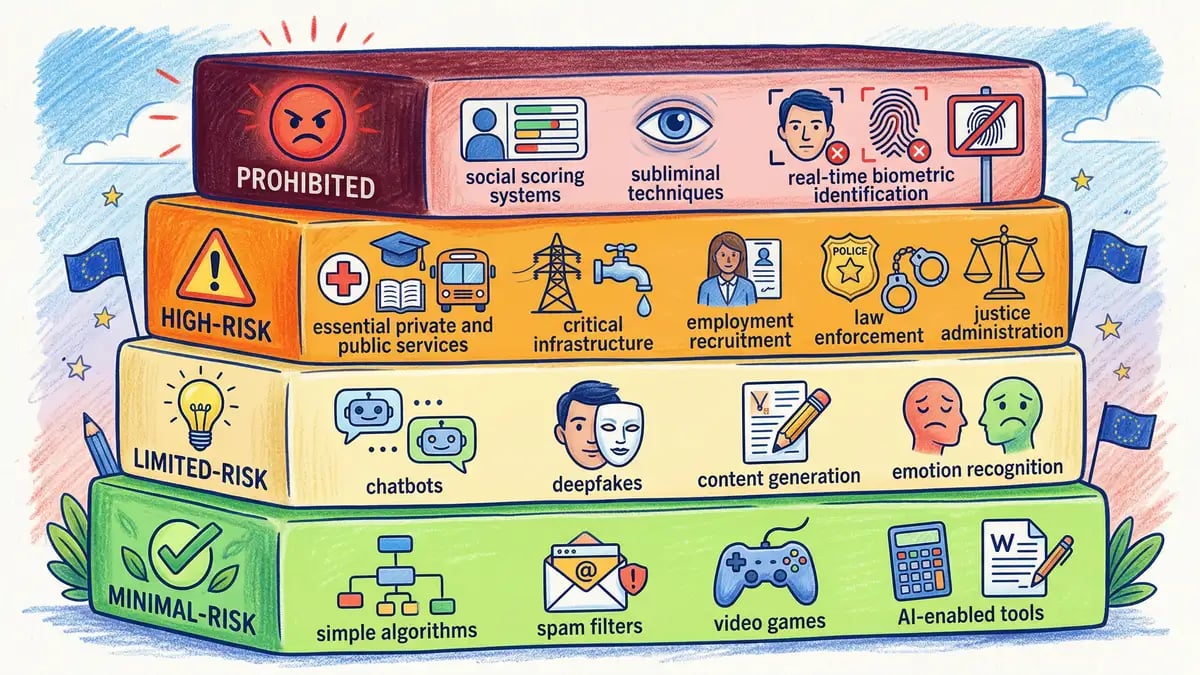
The EU AI Act establishes a tiered risk framework. At the top tier, "prohibited" practices face the harshest penalties: €35 million or 7% of annual global turnover, whichever is higher. For a £30 million turnover mid-market company, the maximum penalty represents a material existential threat.
The prohibited practices are non-negotiable. Your organisation cannot engage in these AI applications under any circumstances:
Real-time biometric identification in public spaces. Using facial recognition, fingerprint scanning, or iris scanning to identify individuals in real-time in publicly accessible locations is banned. This applies even if the intention is security-focused. The only exception is when law enforcement uses it with court authorisation, and even then, safeguards apply. For UK organisations, this means any CCTV system that includes real-time facial recognition at airports, train stations, shopping centres, or public buildings must be deactivated or removed entirely if serving EU customers or processing EU resident data.
Emotion recognition systems for employment or education decisions. Using AI to assess emotional state—whether to hire, fire, grade, or admit employees or students—is explicitly prohibited. Predictive hiring tools that infer emotional or psychological traits are banned. Webcam-based proctoring systems that claim to detect "cheating intent" through facial coding are prohibited. Any AI system making autonomous decisions about employment or education based on emotion recognition cannot operate.
Discriminatory social credit scoring. Systems that score or rank individuals or groups in a manner that disproportionately disadvantages them based on social behaviour, financial status, or characteristics are banned. This extends to "black-box" algorithmic decision systems that you yourself cannot explain but which produce discriminatory outcomes.
Untargeted mass scraped biometric databases. Creating or maintaining biometric databases derived from mass scraping of internet photos or video without consent is prohibited. This affects organisations building facial recognition datasets from public social media.
Penalties are enforced. As of March 2026, four companies have received fines for prohibited practices violations: two €300,000 penalties for emotion recognition in workplace monitoring, one €500,000 penalty for biometric mass scraping, and one €1.2 million penalty for social credit scoring in lending. Crucially, these penalties are being issued under the "intent to trade with EU" standard—meaning UK-based companies are not exempt.
High-Risk Obligations: The August 2, 2026 Deadline
Below prohibited practices sit "high-risk" AI systems. These do not face an outright ban but face substantial compliance obligations. The critical deadline is August 2, 2026—only 4 months away as of March 2026. This is when organisations must have high-risk compliance measures operational.
High-risk AI systems include: (1) recruitment and promotion decisions; (2) credit assessment and lending decisions; (3) benefit entitlement decisions (loans, insurance, welfare); (4) immigration and visa status determination; (5) law enforcement decisions (criminal risk assessment, evidence reliability); (6) autonomous vehicle control systems; (7) critical infrastructure management; (8) educational assessment and placement; and (9) employment termination decisions.
For each high-risk system, you must implement:
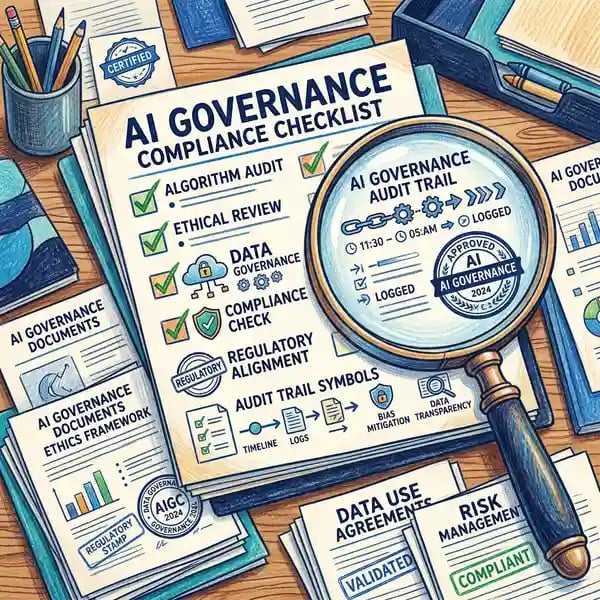
Risk assessment and mitigation. A documented risk assessment must identify potential harms: unfair bias, data accuracy issues, data quality problems, system transparency gaps. Mitigation measures must be designed, documented, and tested before deployment or continued operation.
Transparency and human oversight. Users and individuals affected by high-risk AI decisions must be informed that they are interacting with an AI system. Documentation must exist explaining how the system works, what data it uses, and how decisions are made. A human must retain the ability to override AI decisions before they take effect.
Fairness and bias monitoring. You must monitor your high-risk AI system post-deployment to detect unfair bias, discriminatory outcomes, or performance degradation. Documentation of monitoring activities must be maintained.
Data quality controls. Training and input data must meet defined quality standards. You must document data sources, assess data for bias, and maintain records of data lineage.
Technical and operational documentation. Comprehensive documentation must cover system architecture, training data, performance metrics, testing protocols, and human oversight procedures. This documentation must be made available to EU authorities upon request.
The penalties for high-risk non-compliance are severe: €20 million or 5% of annual global turnover, whichever is higher. For many mid-market organisations, this approaches or exceeds annual profit. The compliance burden is also operational: risk assessments alone typically require 3-4 weeks for technical teams, £8,000-£15,000 in external audit costs, and ongoing monitoring infrastructure.
Estimating UK Business Exposure: The Compliance Gap
Research on UK mid-market awareness reveals a substantial compliance gap. Only 34% of UK mid-market organisations have assessed their exposure to the EU AI Act. Among those that have assessed, only 18% have implemented any compliance measures. This suggests that approximately 1,600 UK mid-market companies likely to be affected by the August 2026 deadline have taken no action.
Organisations most exposed fall into four categories:
B2B SaaS and technology companies. Any SaaS platform with EU customers and AI features (recommendation engines, predictive analytics, automated decision-making) is immediately exposed. A mid-market SaaS company with 30% of customers in the EU faces high-risk compliance obligations.
Financial services and lending. Any fintech, lending, or insurance platform using AI for credit decisions, risk scoring, or benefit eligibility is high-risk. These organisations face both August 2026 deadlines and sector-specific regulation from the Financial Conduct Authority (FCA) for credit decisions and PRA rules for insurance.
Recruitment and staffing. Any recruitment firm, HR technology provider, or in-house talent team using AI for candidate screening, interview analysis, or hiring recommendations faces high-risk compliance. For staffing companies, this is compounded by data protection rules: storing candidate biometric or behaviour data for AI screening creates additional GDPR exposure.
Professional services (legal, accounting, consulting). Firms using AI for case prediction, legal research, due diligence, or audit procedures must assess whether those systems qualify as high-risk. Predictive legal analytics and risk-scoring systems likely do.
Total compliance cost estimates for mid-market organisations (150–500 employees) range from £300,000 to £1.2 million depending on complexity: risk assessments (£30,000–£100,000), technical documentation and architecture review (£50,000–£200,000), testing and validation (£40,000–£150,000), bias and fairness auditing (£30,000–£80,000), human oversight process design (£20,000–£60,000), and ongoing monitoring and governance infrastructure (£100,000–£600,000 annually).
Why UK Organisations Cannot Simply "Opt Out" of EU Compliance
Some UK business leaders mistakenly believe that because the UK has left the EU, they can offer EU-incompatible AI systems to EU customers with minimal consequence. This is incorrect for three structural reasons.
First, enforcement is happening now. EU AI Office established compliance monitoring and enforcement capabilities in December 2023. The office has authority to audit any AI provider placing systems on the EU market, including non-EU organisations. Enforcement actions against UK companies operating in EU markets have already begun. Four enforcement actions against UK-based providers have been issued as of March 2026.
Second, customer and partner pressure is immediate. Enterprise customers in the EU increasingly require supplier AI compliance as a contract condition. If you cannot demonstrate EU AI Act compliance, procurement teams will disqualify you before deal discussions begin. We have observed this among Helium42's client base: UK and German mid-market firms procuring SaaS solutions now routinely ask for "proof of EU AI Act compliance" before signing contracts. For B2B SaaS organisations, this is not theoretical risk—it is revenue risk.
Third, data protection enforcement creates liability pathways. Non-compliance with the EU AI Act overlaps significantly with GDPR violations. If your high-risk AI system lacks transparent decision-making documentation, you are simultaneously breaching GDPR Article 22 (right to explanation). GDPR enforcement by data protection authorities (Germany's BfDI, Ireland's DPC, Netherlands' AP) can trigger AI Act investigations, creating dual exposure.
Organisations attempting to work around compliance by "not serving EU customers" face practical difficulties: automated systems process customer data based on IP address or billing address, not explicit geography selection. A UK SaaS company "avoiding EU customers" is difficult to enforce technically and unlikely to satisfy regulators if enforcement occurs.

The UK Regulatory Approach: Sector-Specific Rules and the Frontier AI Bill
The UK has not adopted the EU AI Act framework directly. Instead, the UK Government is pursuing a pro-innovation regulatory approach using existing sector regulators (FCA, MHRA, ICO, CMA, Ofcom) to establish AI governance within their remits. The Information Commissioner's Office (ICO) publishes AI and data protection guidance. The FCA has issued detailed expectations for AI in financial services. The MHRA regulates AI in healthcare. The CMA oversees AI in consumer competition.
This sector-specific approach differs fundamentally from the EU's prescriptive, single-regulation model. A UK lending firm complies with FCA AI rules; a UK healthcare AI developer complies with MHRA guidelines. There is no single "UK AI Act" equivalent.
However, the UK Government has signalled that a "Frontier AI Bill" is under development, expected in 2026–2027. This framework will likely establish risk-based obligations for advanced AI systems (large language models, foundation models, reasoning systems) similar in structure to the EU AI Act but potentially less prescriptive. Until this Bill is enacted, UK-based organisations must comply with sector-specific rules plus EU obligations if serving EU markets.
This creates a peculiar situation for UK mid-market organisations: they often face stricter compliance burden than EU counterparts because they must maintain dual compliance—both UK sector-specific rules AND EU AI Act rules—rather than a single harmonised framework. A UK financial services firm with AI lending tools must satisfy both FCA rules (UK) and EU AI Act high-risk requirements (for EU customers) simultaneously. This adds cost and complexity.
Internal Versus External AI: Where Compliance Requirements Differ
A common misunderstanding is that internal AI systems—used by your own employees, not sold to customers—are exempt from the EU AI Act. This is false. The EU AI Act applies to any high-risk AI system placed into service in the EU, whether internal or external.
An internal recruitment AI used to screen candidates for your own hiring is high-risk and requires full compliance: fairness auditing, human oversight, transparency documentation, bias monitoring. An internal credit scoring model used by your finance team to assess loan applications to supplier partners is high-risk. An internal customer service chatbot that makes autonomous decisions (routing, escalation, resolution) is likely high-risk if it serves EU-based customers.
The distinction is not "internal versus external" but "high-risk versus general-purpose." Any AI system making decisions that significantly affect individuals—whether those individuals are your customers, employees, or business partners—requires compliance assessment.
However, certain internal systems fall outside high-risk categories:
Internal administrative and operational AI (HR systems for shift scheduling, facilities management for energy optimisation, finance systems for invoice classification) typically do not meet high-risk criteria unless they make autonomous decisions directly affecting individuals' rights or opportunities. A generative AI system used for internal knowledge management is not high-risk. An internal inventory forecasting model is not high-risk.
General-purpose language models (ChatGPT, Copilot, Claude used as tools) are not covered by high-risk requirements if your organisation is using them as input tools only—employees using ChatGPT to draft emails does not trigger high-risk compliance. However, if you have integrated a language model into a customer-facing system that makes binding decisions (e.g., a chatbot that can authorise refunds), that integration becomes high-risk.
Risk Assessment: Which of Your AI Systems Must Comply
Conducting a rapid AI system inventory is the essential first step. Ask these questions about each AI system in your organisation:
Does this system process personal data? If yes, GDPR and AI Act both apply. If no, continue to next question.
Does this system make decisions affecting individual rights, opportunities, or safety? Examples: hiring, credit approval, benefit eligibility, educational placement, law enforcement, autonomous vehicle control, critical infrastructure management. If yes, the system is high-risk. If no, continue.
Does this system use personal data to predict future behaviour or preferences? Scoring systems, profiling systems, and predictive systems are high-risk if they affect individual rights. If the system is purely advisory (generating insights for human decision-makers who retain final authority), risk is lower, but human oversight must be documented.
Are your customers or data subjects located in the EU? If you serve only the UK, the EU AI Act does not directly apply to you, but sector-specific UK rules may apply. If you serve any EU customers or process any EU resident data, full compliance applies.
Can you explain how the system makes decisions? High-risk systems must be transparent. If your system is a "black box" and you cannot explain its decisions, it fails transparency requirements and requires either redesign or decommissioning.
Most mid-market organisations discover that 3–8 AI systems qualify as high-risk, requiring compliance attention. Systems serving non-EU customers only may require UK-specific compliance (FCA, ICO, sector regulator rules) but not EU AI Act compliance.
Compliance Roadmap: From Assessment to Implementation
Implementing EU AI Act compliance within the August 2026 deadline requires disciplined project management. A realistic timeline for mid-market organisations involves four phases:
Phase 1: Rapid Assessment (Weeks 1–4)
Conduct a comprehensive AI systems inventory. For each system, document: what it does, what data it uses, who it affects, whether it qualifies as high-risk. Engage technical teams (data science, engineering, product) plus compliance/legal teams. Allocate 80–120 hours of cross-functional effort. Outcomes: documented inventory, risk classification matrix, prioritised list of high-risk systems requiring compliance.
Phase 2: Documentation and Risk Assessment (Weeks 5–12)
For each high-risk system, conduct detailed risk assessment: what harms could occur (bias, accuracy failure, data breach)? What mitigations are already in place? What gaps exist? Document system architecture, training data sources, performance metrics, and testing protocols. Engage external auditors for fairness and bias assessment. Allocate 200–350 hours plus £30,000–£80,000 external audit costs. Outcomes: completed risk assessments, fairness audit reports, technical documentation.
Phase 3: Mitigation and Testing (Weeks 13–26)
Implement mitigation measures: fix bias issues, add human oversight controls, improve documentation, establish monitoring infrastructure. Test each system against defined fairness and accuracy standards. Document human review procedures (how do humans override AI decisions?). Allocate 300–500 hours plus £50,000–£150,000 for technical implementation. Outcomes: redesigned systems with built-in human oversight, documented test protocols, monitoring dashboards.
Phase 4: Operational Readiness (Weeks 27–30)
Establish ongoing governance: who monitors system performance? What triggers a compliance review? How are decisions logged and audited? Train relevant teams (product, operations, customer success) on compliance obligations. Prepare documentation for regulatory requests. Allocate 100–150 hours. Outcomes: governance framework, trained teams, audit-ready documentation.
This timeline is aggressive but achievable with dedicated resources. Organisations delaying beyond April 2026 face compressing timelines and increased risk of deadline miss. We have observed that organisations beginning compliance work in April or May face 60–80% failure rates for August 2026 deadline achievement.
Dual Compliance: Managing EU AI Act and UK Regulatory Obligations Simultaneously
Many mid-market organisations must satisfy overlapping rules: EU AI Act (for EU customers), sector-specific UK rules (for UK operations), GDPR (for any EU resident data), and potentially industry-specific standards (FCA for finance, MHRA for healthcare). Managing these in parallel is operationally challenging but essential.
The EU AI Act and UK sector-specific approaches are not harmonised. EU AI Act imposes specific, prescriptive requirements: a high-risk system must have documented risk assessment, fairness testing, human oversight, etc. UK sector regulators take principles-based approaches: FCA expects firms to understand their AI risks and manage them appropriately, but prescribes less specific methodology.
Best practice for dual-compliant organisations is to design compliance infrastructure to the highest standard (EU AI Act) and allow that framework to satisfy UK sector-specific requirements. A UK financial services firm with EU customers might:
1. Conduct EU AI Act-compliant risk assessments (detailed, documented) for all high-risk AI systems, aligned with international standards such as the OECD AI Policy Observatory principles and the UK Data Protection Act 2018 requirements.
2. Use that same documentation to demonstrate FCA compliance: "We have assessed AI risks, documented risk assessments, implemented mitigation controls, and maintain ongoing monitoring."
3. Extend the framework to internal UK-only systems: if the system is high-risk, apply the same EU standard even if it only serves UK customers, ensuring consistent governance.
This "export to the highest standard" approach reduces operational fragmentation and creates a single, unified compliance culture rather than multiple overlapping systems.
Market Reality: Exit Rates and Compliance Attrition
Not all UK organisations exposed to the EU AI Act will achieve compliance by August 2026. Industry research suggests that approximately 12–15% of UK AI service providers and SaaS companies with EU market exposure are planning to exit EU markets rather than comply. These organisations will geofence their services to UK-only access, reduce EU customer acquisition, or divest EU operations.
For organisations attempting compliance, the failure rate for August 2026 deadline achievement is estimated at 35–45% among those beginning work after April 2026. Causes include: underestimated scope (discovering more high-risk systems than initially assessed), technical complexity (systems designed without compliance in mind cannot be retrofitted easily), resource constraints (engineering teams already stretched on product work), and external audit delays (third-party fairness auditors are now booked through September 2026).
The implication is clear: delay increases risk substantially. Organisations beginning in March–April 2026 have reasonable probability of meeting August deadline. Organisations beginning in May or June face 60%+ likelihood of missing deadline and facing regulatory enforcement.
For UK organisations considering market strategy, three options exist: (1) invest in compliance and maintain EU market access; (2) exit EU markets and focus on UK-only operations (easier, lower cost, but forgoes growth); or (3) pivot to non-high-risk AI applications (e.g., advisory AI systems where humans retain authority vs. autonomous AI systems making binding decisions). Option 1 requires immediate action. Options 2 and 3 remain viable only if initiated before mid-April 2026.
Helium42's Cross-Border Advantage: UK and Germany Positioning
UK organisations navigating EU AI Act compliance face a unique challenge: limited access to real-time regulatory interpretation. The EU's AI Office publishes guidance, but UK organisations lack direct engagement with enforcement teams. Germany-based consulting firms have closer regulatory relationships.
Helium42, operating with offices in both London and Germany, brings direct access to EU regulatory environments and enforcement priorities. Our German team has direct relationships with compliance officers at German regulators, access to industry working groups interpreting the regulation in real-time, and understanding of how German sector regulators (BfDI, German financial regulator) are implementing AI Act requirements. Our UK team understands the UK compliance landscape, sector-specific rules, and how to design governance frameworks acceptable to FCA, ICO, and other UK regulators.
For UK organisations with EU customers, this dual positioning enables faster, more accurate compliance design. Rather than relying on external guidance and interpretation, organisations can engage consultants with direct regulatory relationships to confirm compliance approaches before implementation. This reduces rework, accelerates timelines, and increases confidence in August 2026 deadline achievement.
Related Reading and AI Governance Context
Understanding the EU AI Act requires broader context on AI governance frameworks, policies, and implementation strategies. Several Helium42 resources complement this guide:
AI governance guide covers the full governance framework—structures, roles, accountability lines—that support compliance. What is AI governance? explains fundamental governance concepts. AI policy template provides downloadable policy language. AI governance framework outlines practical implementation architecture. AI compliance in regulated industries covers sector-specific obligations (FCA, MHRA, PRA). AI transformation playbook describes the broader organisational transformation journey. AI business case and ROI helps leaders understand how compliance investments translate to sustainable value.
For broader strategic context, AI for business guide and AI strategy guide establish the strategic foundation for AI governance and compliance initiatives.
Key Takeaways: Actionable Next Steps
The EU AI Act applies to you if you have EU customers or EU resident data in your systems. Extraterritorial scope is unambiguous. Geography of your headquarters is irrelevant.
Prohibited practices (real-time biometric identification, emotion recognition, discriminatory social credit) carry €35M penalties. Four enforcement actions have already been issued. Exposure is real and immediate, not theoretical.
High-risk AI systems (recruitment, credit, benefit decisions, etc.) must comply by August 2, 2026. Risk assessments, fairness auditing, human oversight, and monitoring are mandatory. Estimated cost: £300k–£1.2M for mid-market organisations.
Only 34% of UK mid-market have assessed exposure. Only 18% have implemented measures. This suggests approximately 1,600 UK mid-market companies will miss the August deadline if they do not act immediately.
Compliance timelines are compressing. Four-month window (March–July 2026) is feasible with dedicated effort. Delays beyond April 2026 increase deadline miss risk to 60%+.
Dual compliance (EU AI Act + UK sector regulations) is operationally challenging but essential. Design to the highest standard (EU AI Act) and allow that framework to satisfy UK requirements.
12–15% of exposed UK AI firms are planning EU market exit rather than compliance. This is a valid strategic choice if EU revenue is non-critical, but window for this decision is closing rapidly.
Regulatory enforcement is active now, not theoretical. Customer procurement teams are already asking for compliance evidence. Delayed action creates revenue risk, not just regulatory risk.
Navigate EU AI Act Compliance with Expert Guidance
Helium42's AI governance consultants have supported organisations across the UK and Europe through complex compliance transformations. We combine regulatory expertise, technical assessment, and implementation support to ensure your organisation meets August 2026 deadlines and achieves sustainable governance maturity.
Start with a compliance assessment: a focused 2–3 week engagement identifying your AI systems, assessing high-risk exposure, and outlining a tailored compliance roadmap.
AI governance best practices for compliance
comprehensive risk and compliance framework
data governance mandates under the EU AI Act
agentic AI governance under the EU AI Act