
Published by

Understanding AI Governance Risk and Compliance Requirements
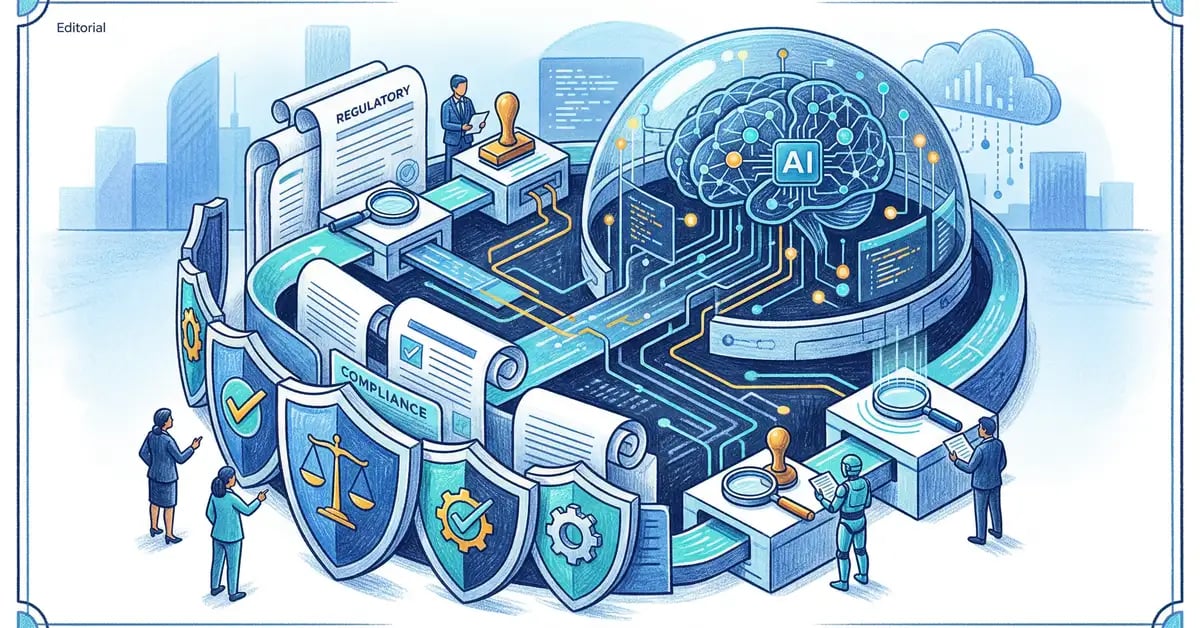
The regulatory environment surrounding artificial intelligence has transformed dramatically over the past two years. Organisations across the United Kingdom and European Union now face increasingly stringent requirements to govern, document, and manage AI systems throughout their lifecycle. For compliance officers, risk managers, and board-level executives, the convergence of the EU AI Act with existing data protection frameworks creates both significant exposure and opportunity for competitive advantage through early adoption.
The cost of non-compliance has become material. Under Article 99 of the EU AI Act, the most serious infringements can attract fines of up to €35 million or 7% of worldwide annual turnover, whichever is higher. Building governance early is far easier than retrofitting it after a problem surfaces. This article provides a practical framework for building AI governance and risk management systems aligned with current regulatory expectations.
This is not a legal advisory. Organisations must validate recommendations against current guidance from the Information Commissioner's Office, UK Government, and relevant sector regulators. However, the frameworks presented reflect current best practice adopted across mid-market organisations and align with formal guidance from the NIST AI Risk Management Framework and ISO 31000 risk management standards.
This guide focuses on a common gap: many mid-market organisations deploying AI systems do not yet maintain a formal AI risk register, which is one of the foundational governance structures required to demonstrate compliance and manage regulatory exposure.
The Regulatory Landscape: EU AI Act and UK Framework Convergence
The EU AI Act (Regulation (EU) 2024/1689) entered into force on 1 August 2024 and applies in phases through to August 2028, with most rules applying from 2 August 2026 (see the European Commission timeline). For organisations operating across the EU, this regulatory requirement is now operational. Even for UK-only businesses, understanding the Act matters: it establishes de facto standards that are increasingly adopted globally and represents the direction UK regulators are likely to move.
The EU AI Act takes a risk-based approach, with four risk levels (unacceptable, high, transparency and minimal risk) and separate rules for general-purpose AI models. The categories that create obligations are:
Prohibited Practices (banned from 2 February 2025). Organisations must eliminate prohibited practices, including real-time remote biometric identification in publicly accessible spaces for law enforcement (subject to narrow exceptions), AI systems that manipulate people or exploit the vulnerabilities of specific groups, and social scoring. Non-compliance is not a violation you can remediate—the system must be removed. Fines reach €35 million or 7% of worldwide annual turnover, whichever is higher.
High-Risk Systems (conformity assessment required). AI systems used in recruitment, credit assessment, law enforcement decisions, critical infrastructure, or legal proceedings require formal conformity assessments, detailed documentation, performance monitoring systems, and human oversight protocols. Documentation requirements are extensive. Obligations for Annex III high-risk systems apply from 2 December 2027, and for Annex I product-related systems from 2 August 2028.
General-Purpose AI and Foundation Models (transparency obligations). Since 2 August 2025, providers of general-purpose AI models must maintain technical documentation, put a copyright policy in place and publish a summary of training content; providers of models with systemic risk must also manage those risks and report serious incidents. These duties fall mainly on model providers, not on organisations that deploy a commercial LLM.
Limited-Risk Systems (transparency only). Under Article 50, chatbots must tell users that they are interacting with AI, and deepfakes and certain AI-generated content must be disclosed or labelled as such.
The UK has adopted a different regulatory approach. Rather than a horizontal AI Act, the UK operates under a "pro-innovation" framework where existing sectoral regulations (data protection, financial services, competition law, human rights) apply to AI. However, the ICO (Information Commissioner's Office) has published Guidance on AI and data protection, and the Financial Conduct Authority has stated in its AI Update that it regulates AI through its existing rules, such as the Consumer Duty and the Senior Managers and Certification Regime. The UK Government has not introduced AI-specific legislation, and none was announced in the May 2026 King's Speech. The most significant recent change is the Data (Use and Access) Act 2025, which replaced the UK GDPR rules on automated decision-making with new Articles 22A–22D from 5 February 2026 (SI 2026/82).
For practical compliance, organisations should treat the EU AI Act risk classifications as a global standard, apply them consistently across all markets, and ensure their compliance frameworks meet the higher standard. This approach future-proofs your governance and avoids managing multiple compliance postures.
GDPR and Data Protection: The Foundation of AI Compliance
A critical compliance error that continues to expose organisations: treating GDPR and AI Act as separate regulatory silos. GDPR (2018) already applies directly to all AI systems that process personal data. The vast majority of enterprise AI deployments involve personal data. GDPR fines can reach €20 million or 4% of worldwide annual turnover under the EU GDPR (£17.5 million or 4% under the UK GDPR), and regulators have already used them against AI systems: the Dutch Data Protection Authority fined Clearview AI €30.5 million in 2024 over its facial recognition database.
Four GDPR articles create the highest risk exposure for AI deployments:
Article 6: Lawful Basis. Before training, fine-tuning, or deploying an AI system on personal data, organisations must establish a lawful basis (consent, contract, legal obligation, vital interests, public task, or legitimate interests). This is often overlooked in LLM deployments. Training a large language model on personal data without a documented lawful basis exposes organisations to fines of up to €20 million or 4% of worldwide annual turnover, whichever is higher. The practical implication: document why you are processing personal data through AI and maintain records of the lawful basis assessment.
Article 22: Automated Decision-Making. GDPR prohibits solely automated decisions with legal or significant effect unless the individual consents or the decision is necessary for contract performance or legal obligation. This applies directly to recruitment AI, credit assessment systems, and performance management algorithms. [UK update: since 5 February 2026, the UK GDPR applies Articles 22A–22D, which permit significant solely automated decisions with safeguards and tighter limits for special category data.]
Articles 13-14: Right to Information. Data subjects must be informed when their personal data will be processed through automated decision-making. This includes disclosure of the logic, significance, and consequences of automated decisions. Many organisations have discovered, during regulatory audits, that user-facing interfaces did not disclose that algorithmic decision-making was occurring. Rectifying this retroactively is expensive and creates reputational damage.
Article 35: Data Protection Impact Assessment (DPIA). High-risk AI processing (defined as processing likely to result in high risk to rights and freedoms, such as algorithmic profiling or sensitive category data processing) requires a DPIA. The assessment must evaluate the necessity of processing, alternative approaches, and mitigation measures. Completing a DPIA for an AI system frequently surfaces gaps in governance or technical controls that would otherwise have remained undetected.
The practical implication: GDPR compliance is not a data protection team responsibility in isolation. It is foundational to your overall AI compliance strategy. Every new AI system deployment must trigger a DPIA, lawful basis assessment, and review of transparency obligations before deployment. This should be built into your AI development lifecycle, not handled retroactively.
Building an Effective AI Risk Management Framework
The NIST AI Risk Management Framework (v1.0, published January 2023) provides a widely used practical methodology. The framework is grounded in ISO 31000 risk management principles and integrates with existing enterprise risk management (ERM) systems. It consists of four core functions: Govern, Map, Measure, and Manage.
Govern: Establish AI Risk Governance Structures. This is the foundation. Assign ownership of AI risk management to a specific function—typically a Chief AI Officer, Chief Risk Officer, or Chief Information Security Officer. Establish an AI Governance Board with representation from technology, compliance, risk, business units, and the board. Define AI risk appetite (the level of AI risk the organisation is willing to tolerate). Document AI policies that address acquisition, development, deployment, monitoring, and retirement of AI systems. Align AI governance with enterprise risk management rather than treating it as an isolated technology function.
Map: Characterise AI Systems and Identify Impacts. Create an AI inventory of all systems deployed across the organisation. For each system, document: intended use and business justification, data inputs and sources, decision outputs and thresholds, intended users and decision-makers, and known limitations or performance constraints. Then map the system against the NIST risk categories and EU AI Act risk tiers. This sounds administrative but is exceptionally powerful. Organisations that complete system mapping often discover AI systems that were never formally approved, have unknown data sources, or lack documented business justification.
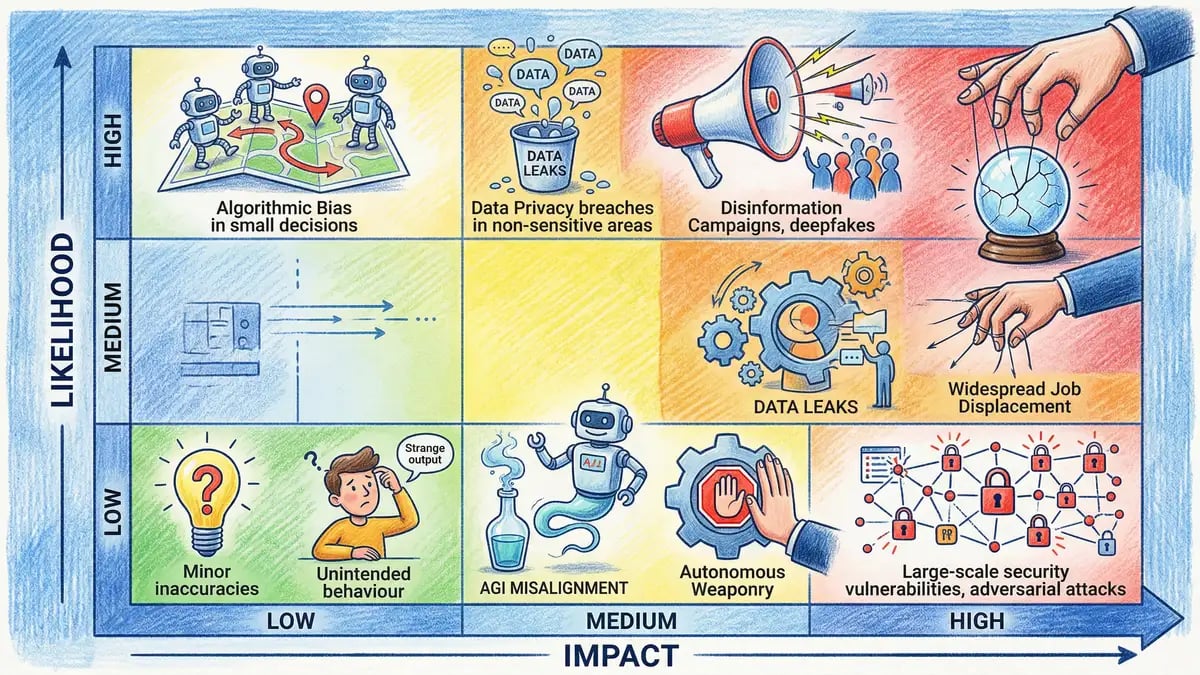
Measure: Assess Risk Likelihood and Impact. For each identified risk, estimate probability (how likely is the risk to materialise?) and impact (if it does materialise, what are the consequences?). Use a standardised scale: likelihood from 1 (rare) to 5 (certain), impact from 1 (minimal) to 5 (severe). Multiply likelihood and impact to produce a risk score. A score of 15 or higher indicates critical risk requiring immediate escalation and mitigation. Scores between 10-14 require substantial mitigation and monthly monitoring. Scores 6-9 require mitigation and quarterly review. Scores below 6 can typically be accepted with documentation. This quantification forces discipline and prevents risk appetite creep, where subjective assessments gradually normalise unacceptable risk levels.
Manage: Implement Mitigation Controls and Monitor. For each identified risk scoring 6 or above, define specific mitigation controls. Examples: continuous performance monitoring (reduces model risk), access controls and encryption (reduce security risk), bias testing during development and in production (reduce fairness risk), human review escalation thresholds (reduce automation risk), and incident response playbooks (reduce operational risk). Assign ownership of each mitigation control. Establish monitoring cadences. Document residual risk—the risk remaining after mitigations are implemented—and formally accept it. This documentation is critical for demonstrating due diligence in regulatory audits and litigation.
The entire cycle should be reassessed quarterly. Annual review is insufficient. AI system performance degrades over time (known as model drift), regulatory requirements evolve, and business contexts change. Quarterly risk reviews catch degradation early.
Creating and Maintaining an AI Risk Register
An AI risk register is the single source of truth for all identified AI risks across your organisation. It enables prioritisation, ensures consistent monitoring, facilitates board reporting, and demonstrates compliance due diligence. Without a documented risk register, an organisation will struggle to evidence its AI risk management to a regulator or auditor.
The essential elements of an AI risk register are straightforward: risk ID (unique identifier), system name, department ownership, risk category (model/data/integration/supply chain/regulatory/reputational/operational/liability), risk description, probability and impact ratings, risk score, risk owner (specific named individual), mitigation controls, control owner, implementation status, residual risk, and escalation status. Use a simple spreadsheet if you lack dedicated risk management software; the discipline of maintaining the register matters more than the tool.
A critical practical element: assign individual ownership of each risk. "The team owns this risk" is unenforceable. Assign a named individual (e.g., "Sarah Chen, ML Engineering Manager") and their contact information. This creates accountability and ensures someone is responsible for monitoring and escalation.
Escalation criteria should be pre-defined. Risks scoring 10 or above automatically escalate to the Risk Management function and the AI Governance Board. Scores 15 or higher escalate to the board-level audit or risk committee. If a mitigation control is overdue or a key control fails, the risk automatically escalates one level. This prevents subjective decisions about escalation and ensures governance operates consistently.
Sample risk entry: AI recruitment system used for initial CV screening. Risk: algorithmic bias resulting in disparate impact by protected characteristic (gender, race, age). Probability: 3 (possible—recruitment systems are known to encode historical bias in training data). Impact: 5 (severe—potential discrimination claims, regulatory enforcement, reputational harm, remediation costs). Risk score: 15 (critical). Mitigation: fairness testing across all protected characteristics, quarterly bias audit using external testing, policy requiring human review of all rejections in first 6 months post-deployment. Owner: Chief People Officer. Status: In progress (testing framework selected, awaiting deployment). Residual risk after mitigation: Score 7 (quarterly monitoring, documented acceptance of fairness testing limitations).
Compliance with Third-Party AI Tools and Vendor Management
A significant and growing compliance exposure: third-party AI tool risk. Many organisations have not extended their vendor due diligence to cover AI tools. This applies not just to formal AI tools, but to commercial APIs, foundation models accessed via cloud providers, and open-source models integrated into applications.
The exposure manifests in multiple ways. First: data residency and processing location. Using a US-based LLM API to process personal data of UK residents may violate data protection frameworks, particularly if the vendor's data processing agreements (DPAs) are inadequate or have not been reviewed. Second: model provenance. Using open-source AI models requires verification that the underlying training data was obtained legitimately (no copyright violations, proper licensing, representativeness). Third: vendor financial stability and continuity. If your AI vendor discontinues service, is there a migration path? What happens to your historical data? Fourth: vendor security and access controls. Has the vendor implemented adequate security controls for your proprietary data used to fine-tune models?
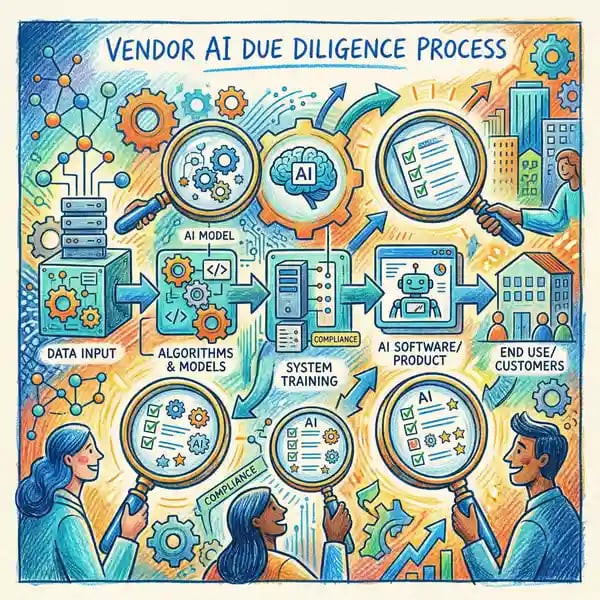
Build a vendor AI assessment process. Before adopting any third-party AI tool, require the vendor to complete a questionnaire addressing: data processing locations and jurisdictions, data protection and DPA terms, security controls and certifications, model training data sources and licensing, performance monitoring and incident notification procedures, and business continuity/exit plans. For high-risk systems (recruitment, credit assessment, regulated sectors), conduct formal security assessments and require independent third-party certifications. This assessment process should be owned by procurement and approved by the Chief Information Security Officer and legal/compliance functions—not left to individual business units.
Additionally, require all AI vendors to commit to prompt incident notification (and, for personal data breaches, notification without undue delay, as UK GDPR Article 33(2) requires of processors) if they discover that your data has been used inappropriately, models have been compromised, or performance has degraded materially. This is increasingly a contractual requirement in regulated sectors and is moving quickly to becoming a baseline expectation across all sectors.
Model Monitoring, Performance Degradation, and Incident Response
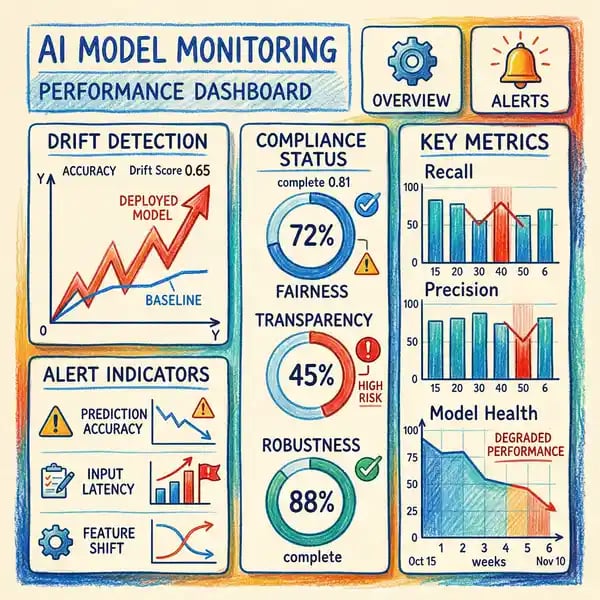
A critical governance gap: many organisations deploy AI models but lack systematic performance monitoring after deployment. This creates hidden risk. Models degrade over time as the real-world data distribution diverges from the training data distribution. This phenomenon—known as model drift—is one of the leading causes of unreliable AI decisions and undetected failures.
Establish performance thresholds before deployment. For a recruitment model, specify: accuracy must remain ≥85%; fairness metrics (demographic parity, equalised odds) must show no more than 5% difference across protected groups; coverage (percentage of applications successfully scored) must remain ≥95%. Monitor these metrics continuously in production. When actual performance falls below thresholds, trigger an investigation within 48 hours and escalate to the risk owner within 5 business days. This is not optional for high-risk systems. The EU AI Act explicitly requires post-market monitoring for high-risk AI, and UK regulators such as the ICO expect organisations to monitor the statistical accuracy of AI systems in use.
Maintain an incident response playbook specific to AI systems. A playbook should specify: detection procedures (who monitors, what metrics, how frequently); triage criteria (is this an incident or expected variation?); escalation procedure (who must be notified, within what timeframe); immediate containment actions (should we pause the system?); investigation procedure (root cause analysis, scope of impact); remediation (technical fix, policy change, or system retirement); user/regulator notification (if a serious incident, incident reporting obligations apply—for EU AI Act high-risk systems, Article 73 requires providers to report serious incidents within 15 days, or sooner in the most severe cases); and learning (process improvements to prevent recurrence). A documented playbook allows a rapid, orderly response instead of a slow discovery process.
Demonstrating AI Governance Maturity to Regulators and Auditors
Regulators are paying closer attention to AI governance. ICO audits, FCA supervision, and sector-specific regulator reviews can all include AI governance questions. The difference between a "pass" and a "fail" rating is not technological sophistication—it is documentation and governance discipline.
Regulators expect to see: a documented AI governance policy and framework aligned with NIST AI RMF or ISO 31000; an AI risk register with all deployed systems and identified risks; evidence of Data Protection Impact Assessments for high-risk processing; performance monitoring data demonstrating systems are performing as expected; incident response documentation and a recent incident log (even zero incidents can raise suspicion of inadequate monitoring); vendor assessment records for third-party AI tools; evidence of board-level oversight of AI risks; and documented evidence of bias testing and fairness assessment for systems making decisions about individuals.
Organisations that can present these materials are in a far stronger position during a regulatory inspection. In contrast, organisations that discover during inspection that governance structures do not exist or are inadequate risk enforcement action, and remediation after enforcement is typically more disruptive than proactive compliance investment.
AI Governance and Board-Level Accountability
Many boards have yet to build the AI literacy needed to oversee AI risk effectively. This represents a material governance gap and can create director liability exposure.
The board's role in AI governance is not to understand AI technology in detail. It is to ensure that governance structures, risk management processes, and oversight mechanisms are in place. This means: establishing an AI governance committee at board level or delegating oversight to the audit/risk committee with clear accountability; requiring quarterly risk reporting on AI systems; understanding which AI systems are deployed and their risk classification; reviewing incident history and management's response; understanding vendor management procedures for third-party AI tools; ensuring insurance and liability frameworks cover AI-specific exposures; and assessing the organisation's preparedness for regulatory inspection.
Practical Implementation Roadmap and Timeline
For organisations beginning AI governance implementation, a phased approach reduces disruption and distributes resource demands. Phase 1 (Month 0-2) focuses on foundation-building: assess current state (inventory all AI systems, document current governance), establish an AI governance policy and risk appetite, assign governance roles and ownership, and begin planning the risk register. Phase 2 (Month 2-4) focuses on risk identification: complete Data Protection Impact Assessments for high-risk systems, populate the AI risk register with all identified systems and risks, complete vendor assessments for third-party tools, and establish a baseline for performance monitoring. Phase 3 (Month 4-6) focuses on control implementation: implement technical monitoring and alerting, establish vendor management contracts with incident notification requirements, conduct fairness and bias testing for systems making decisions about individuals, and document incident response procedures. Phase 4 (Month 6+) is continuous improvement: conduct quarterly risk reviews, monitor system performance metrics, validate that mitigations are effective, update board reporting, and address emerging regulatory changes.
This timeline assumes mid-market organisation with existing risk management infrastructure. Smaller organisations may move faster due to fewer systems; larger organisations with extensive AI deployments may require longer implementation cycles. However, the phases remain consistent.
Resource requirements are typically modest compared to the compliance exposure being managed. A single dedicated resource (FTE) can manage governance coordination and risk register maintenance. DPIA assessments, bias testing, and vendor assessments can leverage existing internal resources (data protection officers, data science teams, procurement, IT security) with external support for specialist areas if needed, for example from an AI governance consulting partner.
Related Reading and Governance Resources
Organisations implementing AI governance frameworks should also review the related AI Governance Guide, which provides strategic context for governance evolution. The What is AI Governance article explains the foundational concepts in non-technical language suitable for board-level audiences. For those building policy frameworks, the AI Policy Template provides a starting structure. Organisations operating in regulated sectors should review EU AI Act and UK Regulatory Framework for specific compliance obligations. The AI Governance Framework article details the NIST and ISO standards referenced in this guide. For practical implementation strategies, see AI Governance Best Practices and AI Compliance in Regulated Industries. Finally, the AI Transformation Playbook contextualises governance as part of end-to-end AI implementation.
For external reference sources, the Information Commissioner's Office (ICO) Guidance on AI and data protection provides UK-specific principles-based guidance. The NIST AI Risk Management Framework (v1.0) is publicly available and provides the reference implementation used across government and regulated sectors. The ISO 31000:2018 Risk Management standard and ISO/IEC 42001:2023 AI management system standard provide the foundational frameworks referenced in this guide. EU organisations should review the EU AI Act regulatory guidance directly from the European Commission. Finally, the OECD.AI Policy Observatory provides international governance benchmarks and cross-jurisdictional analysis.
Ready to Build Your AI Governance Framework?
Governance maturity directly determines your compliance resilience and regulatory standing. A formal governance framework is far easier to defend than controls retrofitted after a problem.
Helium42 partners with organisations across the UK and Europe to build practical AI governance frameworks aligned with NIST and ISO standards. We support risk register implementation, DPIA assessments, vendor management processes, and board-level reporting structures.
AI data governance and quality management
agentic AI governance and risk controls
ethical risk management for AI systems