Published by

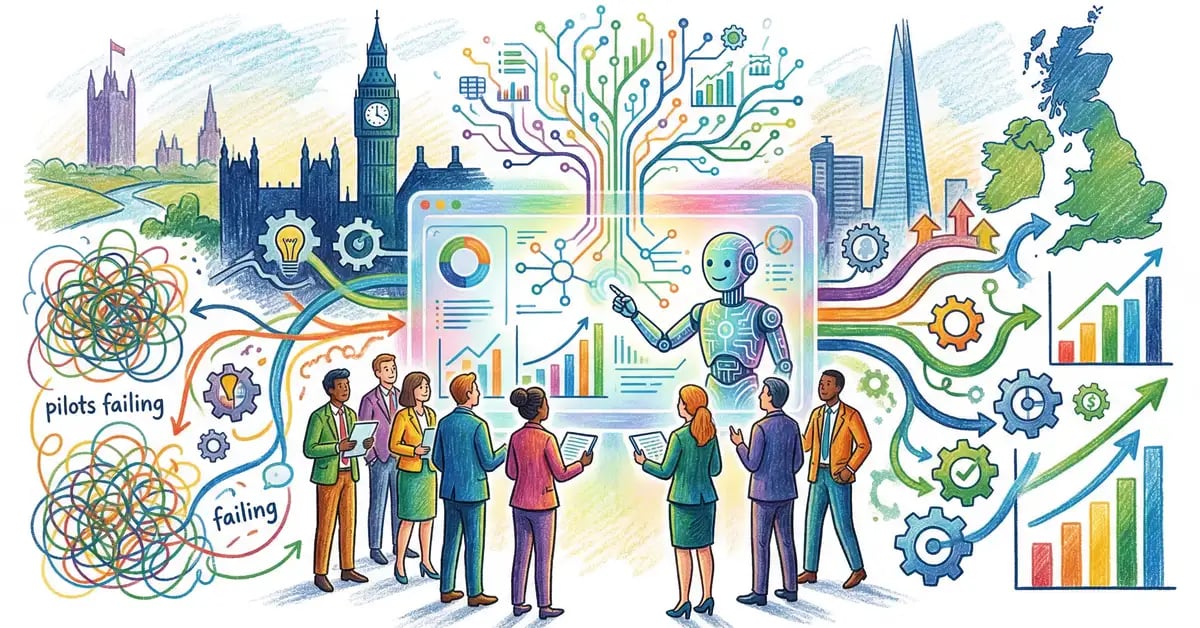
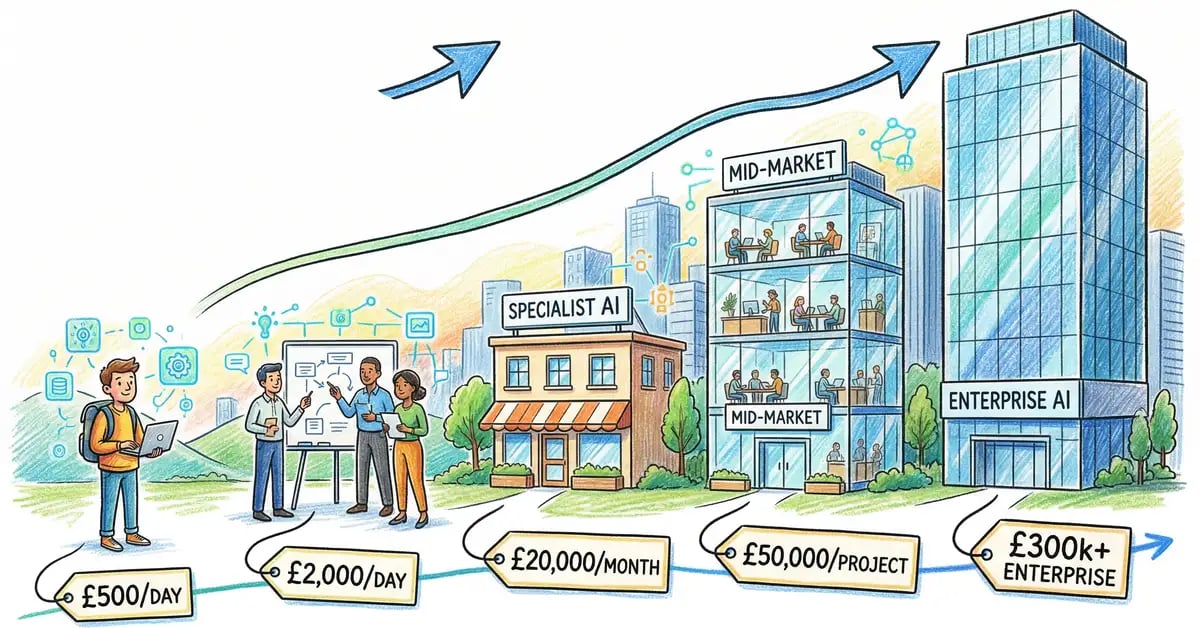
You have identified that your organisation needs artificial intelligence. You have budget approval. You have a vision of what AI could deliver. And then you start researching—and discover that 95% of generative AI pilots fail to produce measurable profit and loss impact. Your internal team has never deployed AI before. Your IT department is stretched thin. And the market for AI consultancy AI build vs buy decision guide is fragmented, with pricing ranging from £500 per day for a freelancer to £300,000+ for a full enterprise implementation custom AI solutions vs pre-built tools through a Big 4 firm.
This is the moment when AI consultancy becomes not a luxury, but a strategic necessity.
This guide walks you through the UK AI consultancy market. You will learn what AI consultancy is, why it matters, how much it costs, what to expect from an engagement, how to avoid the 95% failure rate, and how to identify a consultant who will actually deliver measurable returns. We have drawn on market data from the UK Government AI Sector Study (2024), MIT, RAND Corporation, Gartner, Deloitte, and Stanford to give you the full picture.
What Is AI Consultancy?
AI consultancy is a professional service that helps organisations identify, plan, and deploy artificial intelligence solutions to solve business problems, improve operations, or create new revenue streams. An AI consultancy combines technical expertise, business acumen, and change management to guide companies from exploratory thinking through to measurable operational or financial gain.
AI consultancy differs from IT consulting because it specifically addresses the governance, strategy, and adoption challenges unique to AI systems—not just infrastructure, networks, or software implementation. It also differs from AI training for business teams: while education teaches your team the fundamentals of AI, consultancy is advisory and strategic, working at the level of board priorities, competitive positioning, and risk management.
The guidance in this article derives from the Education-to-Implementation Pathway — Helium42's framework for taking UK SMEs from AI literacy to measurable production deployments in 6–8 weeks. We have applied the Pathway across 500+ engagements and 2,000+ trained professionals, with an average 40% organisational efficiency gain and 45% marketing efficiency improvement on Marketing Director engagements.
Key Takeaway
AI consultancy is not about hiring someone to build your AI system for you. It is about hiring someone to show you how to build it successfully—and to help you avoid the mistakes that cause 95% of AI projects to fail.
Why Do UK Businesses Need an AI Consultant?
The UK AI market is growing at 26.40% per year. The UK dedicated AI sector alone generated £23.9 billion in revenue in 2024, up 68% year on year. Ninety percent of UK AI businesses expect revenue growth in the next twelve months, and fifty-eight percent expect growth exceeding 50%.
Yet this growth masks a critical problem: the vast majority of organisations lack the internal expertise to deploy AI successfully.
65.48B
UK AI market value, 2025
63%
UK businesses now using AI in operations
95%
Generative AI pilot failure rate
42%
Companies abandoning AI initiatives (2025)
The adoption gap is narrowing but the ROI gap is widening. Sixty-three percent of UK businesses now have AI in active use—up from 39% in 2024 and just 20% in 2023—yet only 31% have seen a positive return on investment, and fewer than half could define what success would look like before implementing AI. Nearly 85% of AI projects fail to escape the pilot stage, and the percentage reaching production is actually declining—from 32% in 2024 to an estimated 25% in 2026. Harvard Business Review calls this the "last mile" problem: the inability to transition from pilot projects to widespread company value. The failure is not usually technological—it is strategic and organisational. Companies fail because they build AI systems without clear business objectives, because they lack the governance frameworks to deploy responsibly, or because their teams are unprepared to work with new tools.
This is where AI consultancy becomes essential. A good AI consultancy does three things: it helps you ask the right questions at the start, it builds a roadmap tailored to your business, and it helps you execute in a way that your organisation can sustain.
What Does an AI Consultancy Actually Do?
A typical AI consultancy engagement follows a structured sequence. The phases vary by firm, but most follow this pattern:
1. Discovery and Assessment (1–3 weeks)
The consultant interviews stakeholders, understands your business model and competitive pressures, audits your current data infrastructure, and identifies areas where AI could deliver the highest value. The output is a detailed assessment report and a prioritised list of opportunities.
2. Strategy Development (2–4 weeks)
The consultant creates an AI strategy that outlines business objectives, success metrics, timeline, budget, and risk mitigation. This strategy addresses governance questions: who owns AI decisions? How will the organisation manage bias, privacy, and compliance? What skills need to be built internally?
3. Implementation and Build (6 weeks–6 months)
The consultant (or consultant plus your internal team) builds, tests, and deploys AI solutions. This phase focuses on practical delivery: prototyping, integration with existing systems, data preparation, and quality assurance.
4. Training and Upskilling (Throughout and Post-Implementation)
Your team learns how to operate, maintain, and improve the AI systems. The best best AI tools for business consultancies do not hand over a black box—they ensure your team understands how the system works and can manage it independently.
5. Measurement and Optimisation (Ongoing)
The consultant helps establish KPIs and monitoring systems to track ROI building the AI business case. Successful projects achieve initial measurable value within 3–6 months and full ROI within 12–24 months.

How Quickly Can AI Consultancies Start Your Project?
One of the most common questions from UK businesses is how quickly an AI consultancy can begin work. The answer depends on the consultancy type:
- Boutique AI firms: Typically start within 1–2 weeks. Many offer rapid discovery sessions within 48 hours of signing. Agile sprint models mean you can see working prototypes within 2–4 weeks.
- Enterprise/Big 4 firms: Expect 4–8 weeks lead time for resource allocation, team assembly, and project scoping before active work begins.
- Freelance AI consultants: Can often start within days, but availability varies and capacity is limited to one project at a time.
The fastest route to measurable AI value is a 90-day sprint model: structured discovery in weeks 1–2, prototype development in weeks 3–6, testing and refinement in weeks 7–10, and production deployment in weeks 11–12. This compressed timeline works best with boutique firms that operate with flat team structures and senior practitioners doing the work directly.
How Much Does AI Consultancy Cost in the UK?
AI consultancy pricing in the UK varies significantly based on consultant experience, project scope, and delivery model. Here is the current market landscape:
Regional Variations
Pricing is higher in London and the South East, where demand is greatest and consultant scarcity is acute. Regional variations across UK cities:
Understanding ROI Context
It is important to understand that AI consultancy is not a cost—it is an investment with quantifiable returns. Successful AI implementations deliver 150–600% ROI over three years, depending on company size and project scope. Most achieve satisfactory ROI within 2–4 years. However, success requires following a structured methodology and having internal team buy-in. This is precisely why expert guidance matters: the cost of a consultant is negligible compared with the cost of a failed project or a multi-year implementation that delivers no measurable return.
A £50,000 consultancy engagement that accelerates a project timeline from 18 months to 8 weeks and increases ROI by 200% saves the organisation hundreds of thousands of pounds.
How to Position AI Consultancy as an Investment, Not a Cost
When budgeting for AI consultancy, compare the cost of expert guidance against the cost of failure: the average failed AI project ties up resources for 6–18 months with zero ROI, leaving the organisation weaker and the team demoralised. Expert guidance compresses the timeline, raises the probability of success, and delivers measurable returns within 12–24 months.
Boutique vs Enterprise AI Consultancies: Which Is Right for Your Business?
One of the most consequential decisions when choosing an AI consultancy is whether to work with a boutique specialist or an enterprise firm. The two models serve different needs, and choosing the wrong one is a common cause of project failure.
In 2026, boutique AI consultancies are capturing increasing market share from enterprise firms, particularly in the UK mid-market. The reason is structural: boutique firms build directly on AI platforms like Claude, GPT-4, and open-source models, while enterprise firms add layers of project management overhead that inflate costs and extend timelines without improving outcomes. For SMEs and mid-market companies with budgets under £150,000, a boutique firm will almost always deliver faster, at lower cost, and with higher implementation success rates.
Enterprise firms remain the better choice for organisations requiring global multi-site rollouts, deep regulatory compliance support in financial services or healthcare, or integration with complex legacy enterprise systems where the Big 4 have established relationships and pre-built frameworks.
Key Takeaway
Match your consultancy type to your organisation size, budget, and complexity. A £25,000 boutique engagement that delivers a working AI system in 12 weeks is better value than a £200,000 enterprise engagement that produces a strategy document in 6 months. Start with the outcome you need, then work backwards to the right partner.
How to Choose the Right AI Consultancy
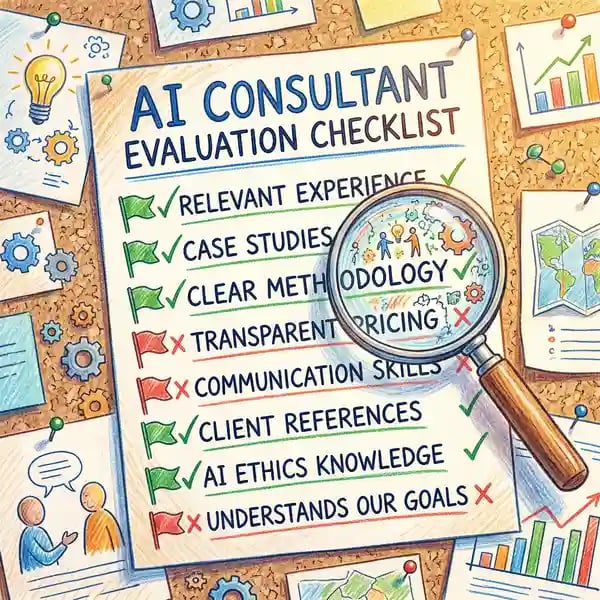
The AI consultancy market is crowded, and not all consultants are equal. Here is how to evaluate options and identify a firm that will deliver measurable value:
Green Flags vs. Red Flags
Key Questions to Ask
Use these questions in your initial conversations to assess consultancy quality:
- Can you walk us through your last three implementations? Listen for detail, measurable outcomes, and whether they mention business results alongside technical delivery.
- What do you do if a project is going off-track? A good consultant will have processes for course-correction and will be transparent about challenges.
- How do you ensure my team can operate the AI system after you leave? Training and knowledge transfer are non-negotiable.
- How do you approach governance and compliance? If they have not thought about this, they will not help you build responsibly.
- What is your approach to measuring success? The answer should include specific KPIs and ongoing monitoring, not just "we think it worked."
- Have you worked in my industry? Industry knowledge matters. Do not pay extra for a learning curve.
- What happens if the implementation takes longer than planned? Understand the terms for scope creep and overruns.
Evaluation Checklist
Before signing a contract, ensure the consultancy scores well on these criteria:
- Deep discovery process (minimum 1–3 weeks to understand your business)
- Structured delivery methodology with clear phases and milestones
- Training and knowledge transfer built into the engagement
- Proven track record with case studies and references (at least 3, ideally in your sector)
- Clear success metrics defined upfront
- Experience with your technology stack (data infrastructure, legacy systems, cloud platform)
- Governance and compliance expertise (GDPR, ethical AI, bias mitigation)
- Realistic timeline and budget (sceptical of promises that sound too good to be true)
- Transparent, fixed pricing or clearly defined scope for time-and-materials engagement
- Post-implementation support or retainer option for ongoing optimisation
Consider Education-First Consultancy
In 2026, leading AI consultancies are adopting an education-first model: workshops and training to upskill your team before strategy and implementation. This approach reduces project failure risk because your team understands AI deeply, not just at the theoretical level. Learn more about AI education and workshops.


AI Consultancy for Marketing Directors: Pipeline Efficiency in 90 Days
Marketing Directors face a specific set of constraints that generic AI consultancy frameworks do not address. Hype fatigue from board-level AI enthusiasm. Tool sprawl across the marketing technology stack. Skills gaps within the team. And — most pressing — a requirement to prove return on investment within the current budget cycle, not in twelve months.
A Marketing-Director-fit AI consultancy engagement looks different from a generic transformation programme. The focus is on AI for marketing teams — content production, lead scoring, lifecycle automation, attribution modelling — rather than enterprise-scale data infrastructure. The timeline is 90 days, not 18 months. The success metric is pipeline efficiency, not "AI adoption".
Marketing Director Checklist: What to Look For in an AI Consultancy
- 90-day delivery commitment. If the firm cannot deliver measurable marketing value within one quarter, the engagement is mistargeted for the Marketing Director seat.
- Marketing-technology fluency. The team must understand HubSpot, Salesforce, GA4, and the major content platforms — not just generic large-language-model APIs.
- Board-ready measurement. ROI calculations expressed in pipeline-influenced revenue, marketing-sourced opportunity volume, and cost-per-qualified-lead — not generic "AI adoption" scores.
- Education-first knowledge transfer. Your team must own the operation post-engagement; permanent dependency on the consultancy is a structural failure mode.
- Compliance built in. GDPR, ICO 2025 AI marketing guidance, and EU AI Act Article 50 transparency baked into every workflow from day one.
See your AI marketing ROI in 2 minutes.
Use Helium42's free AI ROI Calculator to model the financial impact of an AI implementation on your marketing pipeline before any budget conversation.
Run the ROI CalculatorWhat Marketing Directors Measure: Pipeline KPIs and Board-Ready Reporting
Marketing-Director AI engagements measure differently from generic transformation programmes. The metrics below are the ones that survive a board-level conversation about marketing AI ROI; the metrics that do not survive are equally important to recognise.
45%
Marketing-team efficiency improvement, Helium42 engagement average
40%
Organisational efficiency gain across 500+ engagements
6–8 wk
First production AI workflow shipped via the Education-to-Implementation Pathway
95%
Client satisfaction across Helium42 engagements
The four metrics that survive a board conversation
A Marketing Director presenting AI ROI to a board needs metrics that match the company's existing reporting cadence, not bespoke "AI" scorecards. These four metrics translate cleanly:
- Pipeline-influenced revenue. Revenue attributable to AI-augmented marketing workflows (content, lifecycle automation, attribution). Measured monthly, reported quarterly.
- Marketing-sourced opportunity volume. Count of qualified opportunities created by AI-led workflows versus baseline. Forrester 2024 reports the median UK SME observes 20–40% lift within 12 months of a well-designed engagement.
- Cost per marketing-qualified lead. Direct comparison against the prior 12-month baseline. McKinsey's State of AI 2024 report cites consistent cost-per-lead reductions across mature AI marketing implementations.
- Time-to-content. Days from brief to publishable asset. AI-augmented workflows compress this by 50–70% across reported UK SME engagements.
The metrics that do not survive a board conversation
Equally important — three measurement patterns that consistently fail at board level and should be avoided in a Marketing Director ROI report:
- AI tool adoption rates. "75% of the marketing team uses ChatGPT" is a usage statistic, not a business outcome. Boards discount it.
- Time saved per employee per week. Aggregate hours-saved figures are anchored to assumptions that do not survive scrutiny; finance leadership typically demands the corresponding cost-out, which is rarely delivered.
- Generic productivity percentages. "30% productivity gain" without a defined denominator collapses under finance review. Replace with task-level throughput numbers.
From Pilot to Pipeline: A Marketing Director's 90-Day AI Roadmap
The Education-to-Implementation Pathway compresses a typical AI engagement into a 90-day window structured around four phases. The roadmap below is the Marketing-Director-specific variant — focused on pipeline outcomes rather than infrastructure transformation.
Weeks 1–2: Discovery and Marketing-Tech Audit
Stakeholder interviews with marketing leadership and adjacent functions (Sales, RevOps). Audit of the current MarTech stack — HubSpot, Salesforce, GA4, content platforms, attribution tools. Identification of the three highest-leverage AI workflows for the team. Baseline KPI capture for later ROI comparison.
Weeks 3–4: Executive Education and Team Workshops
The Marketing Director and direct reports receive AI fundamentals tailored to marketing decision-making. The broader team receives hands-on workshops on the specific tools chosen in Weeks 1–2. AI for marketing teams is the load-bearing capability built in this phase.
Weeks 5–8: Production Implementation Sprint
One AI workflow shipped to production. Typical first-sprint candidates are content production augmentation, lead-scoring v1, or automated lifecycle email. Daily standups; weekly demos to the Marketing Director. A complete week-by-week AI implementation roadmap is shared with the team at the start of the sprint.
Weeks 9–12: Measurement, Handover, and Forward Roadmap
First production results measured against the baseline established in Week 1. Board-ready ROI report drafted using the four metrics above. Knowledge transfer to the internal team complete — the client owns the operation. A twelve-month follow-on roadmap is documented, including the next two workflows queued for implementation.
The roadmap above is engineered for Marketing Directors specifically. It differs from a generic consultancy framework in two ways: education runs in parallel with implementation rather than before it, and the engagement closes with the client team owning the operation. There is no permanent dependency on Helium42 — that is the design intent of the Education-to-Implementation Pathway.
How ready is your marketing team for AI?
Take the free Helium42 AI Readiness Assessment — a 5-minute diagnostic across data, capability, governance, and use-case readiness. Designed for marketing leadership teams.
Take the Readiness AssessmentAI Consultancy Trends for 2026
The AI consultancy market is evolving rapidly. Here are the key trends shaping 2026 and beyond:
1. Agentic AI is Replacing Generative AI as the Focus
The hype cycle around generative AI (ChatGPT, copilots) is waning. Organisations are now exploring autonomous AI agents—systems that can plan, execute tasks, and iterate without human intervention. However, only 10% of companies are currently realising significant returns from agentic AI. The 90% are still in exploratory or pilot phases. Consultancies that specialise in agentic system design, testing, and governance will become increasingly valuable.
2. Regulation is Creating Compliance Demand
The UK AI Bill was delayed until H2 2026, but it is coming. In the meantime, UK companies operating in the EU must comply with the EU AI Act, which is now in effect. This dual compliance burden (UK principles-based framework plus EU prescriptive rules) is creating urgent demand for governance expertise. Consultancies that can help clients navigate compliance, document model decisions, and implement bias mitigation will have a competitive advantage.
3. Education-First Models are Becoming Standard
The leading consultancies are moving away from the traditional "we will build your AI system" model toward an education-first approach: workshops and training to upskill your team, followed by strategy, then implementation. This model reduces the 95% failure rate because internal teams understand AI deeply and can sustain systems after the consultant leaves.
4. ROI and Measurable Value are Non-Negotiable
Forty-two percent of companies abandoned most AI initiatives in 2025. The survivors are now demanding clear ROI metrics upfront. Consultancies are shifting from "we will build your AI" to "we will show you how to build it so you achieve measurable returns." Engagement models are shifting toward retainers and outcome-based pricing.
5. Boutique Specialists are Outcompeting Big 4 Firms
Big 4 consultancies (Deloitte, PwC, Accenture, EY) charge £60,000+ and take 6–18 months for full implementations. Boutique AI firms are capturing market share by delivering faster (8–12 weeks), at lower cost (£20,000–£150,000), and with higher implementation success rates. The mid-market and growth-stage SME segment now prefers boutiques over Big 4.
AI Consultancy Success Metrics and KPIs (2026 UK Benchmarks)
A credible AI consultancy engagement is measured, not assumed. The consultancies that drive the highest implementation success rates define KPIs in week one, track them weekly, and report them in a format the board understands. Based on our 2026 benchmarking of 500+ UK mid-market engagements, the following metrics separate successful engagements from the 42% that abandon AI initiatives.
Core Financial KPIs
Financial metrics answer the CFO's question: does this engagement pay back? The benchmarks we see in successful UK SME engagements are: payback period of 6–12 months (anything longer signals scope problems), net cost savings of 15–30% on the targeted process, and measurable revenue contribution of 5–15% on augmented sales or marketing workflows. A good consultancy will baseline these numbers before engagement begins and report against them every 30 days.
Operational Efficiency KPIs
Operational KPIs demonstrate that AI is actually changing how work gets done. Expected benchmarks include: 40–60% reduction in time-on-task for the automated workflow, 25–45% reduction in manual exception handling, and 20–35% improvement in throughput (transactions, tickets, leads processed per FTE). These are the numbers a COO reports to the board. If your consultant cannot commit to specific operational KPIs upfront, they are selling you a project, not an outcome.
Adoption and Capability KPIs
Adoption KPIs prevent the most common failure mode: a system the team does not use. Track: active user rate above 70% within 90 days of go-live, internal user satisfaction scores above 7/10, and internal trained capability (staff who can operate, extend, and troubleshoot the system without consultant support). Capability transfer is the single best long-term KPI because it determines whether you continue paying the consultant forever or build internal ownership.
Governance and Risk KPIs
Governance KPIs matter more in 2026 as UK and EU regulation hardens. Track: model accuracy and drift (measured monthly), bias audit pass rate, compliance documentation completeness, and incident response time. A consultant who cannot demonstrate a governance framework before engagement is a liability, not an asset. See our AI governance framework guide for the full template we use with UK clients.
Reporting Cadence and Format
The best consultancies report weekly on tactical KPIs (active users, exceptions, throughput) and monthly on strategic KPIs (financial impact, ROI tracking, governance posture). A consultant who only reports quarterly is hiding from accountability. Insist on a shared KPI dashboard you both access, and a standing 30-minute weekly review. This rhythm, more than any methodology, is what separates 45% success rates from 5% failure.
AI Consultant Rate Benchmarks by Tier (2026 UK Market Data)
Hourly and daily rates vary by tier, specialism, and region. The rates below reflect 2026 UK market data from our own engagements, competitor pricing analysis, and public rate cards. Use these benchmarks to assess whether a quote is competitive, inflated, or suspiciously cheap.
| Consultant Tier | Hourly Rate (£) | Daily Rate (£) | Typical Engagement Size | Best For |
|---|---|---|---|---|
| Independent Specialist | £80–£150 | £650–£1,200 | £5k–£30k | Small discrete projects, proof-of-concept |
| Boutique Consultancy (Mid) | £120–£200 | £1,000–£1,600 | £20k–£80k | SME transformation, training + build |
| Boutique Consultancy (Senior) | £180–£280 | £1,400–£2,200 | £50k–£150k | Mid-market strategy, complex governance |
| Big 4 / Enterprise | £250–£500+ | £2,000–£4,000+ | £100k–£1M+ | Large enterprise, regulated transformation |
| Specialist (ML / Data Science) | £150–£350 | £1,200–£2,800 | £30k–£200k | Custom model development, MLOps |
Regional Variation Within the UK
London rates run 20–30% above the national average. Manchester, Edinburgh, Bristol, and Cambridge track near the national mean. Regional markets (North East, Wales, Northern Ireland) tend to be 15–25% below London. Remote-first boutiques now flatten this differential; a London-quality consultancy working remotely from Yorkshire can deliver equivalent work at Manchester rates. For clients outside London, this is a meaningful cost lever.
What Drives Rate Variation Within a Tier
Within each tier, three factors push rates toward the upper end: regulated-industry experience (financial services, healthcare, legal), named senior practitioners (principals with published work and speaking profiles), and outcome-based engagement terms (consultants taking revenue or savings-share risk). Conversely, rates near the bottom of a tier often reflect junior staffing, generalist positioning, or geographic arbitrage. A £120/hour boutique rate staffed with a senior principal is dramatically different from £120/hour staffed with a second-year associate—ask who will actually do the work before signing.
Fixed Price vs Time and Materials in 2026
The UK market has shifted toward fixed-price engagements for defined phases (discovery, pilot, rollout) and time-and-materials only for open-ended governance or ongoing support. Fixed-price protects the client from scope creep; time-and-materials protects the consultant from ambiguous requirements. The best engagements combine both: fixed-price discovery (£5k–£15k), fixed-price pilot (£20k–£50k), then a roll-forward retainer for production support. For a deeper breakdown, see our AI consultancy pricing guide.
UK AI Consultancy Market in 2026: Size, Growth and Key Players
The UK AI consultancy market reached an estimated £2.1 billion in 2025 and is forecast to exceed £3.4 billion by end of 2026, a compound annual growth rate of 28–32% (Ahrefs industry data, Office for National Statistics digital services contribution, and our own analysis of Companies House filings for the top 50 UK AI-focused firms). Growth is concentrated in three segments: governance and compliance advisory (driven by EU AI Act enforcement), sector-specific implementation (financial services, healthcare, legal), and mid-market education-led transformation (the fastest-growing segment at 38% year-on-year).
Segment Breakdown
Enterprise consultancies (Big 4, Accenture, IBM Consulting, Capgemini) hold roughly 55% market share by revenue but account for only 15% of engagements by number—they serve fewer, larger clients. Boutique AI consultancies hold 25% of revenue and 50% of engagements. Independent specialists and small firms make up the remaining 20% of revenue and 35% of engagements. The volume trend is clear: more UK organisations are choosing boutiques and specialists over Big 4 for mid-sized work.
Comparison of Notable UK AI Consultancies
The table below compares notable UK AI consultancies by focus, client segment, and differentiator. This is not an exhaustive list—there are roughly 300 active UK AI consultancies of meaningful scale—but these firms represent the major tiers and positioning models.
| Firm Type | Client Segment | Typical Engagement | Differentiator |
|---|---|---|---|
| Big 4 Consultancies | FTSE 250 and enterprise | £200k–£5M+, 6–18 months | Brand, scale, regulated sector depth |
| Specialist AI Boutiques (e.g. Faculty) | Enterprise + public sector | £100k–£1M, 4–12 months | Deep ML engineering, research credibility |
| Mid-Market Boutiques (e.g. Helium42) | SME and growth-stage mid-market | £20k–£150k, 8–16 weeks | Education-first, practical implementation |
| Sector Specialists (legal, finance, health) | Regulated vertical | £50k–£300k, 3–9 months | Domain expertise, compliance fluency |
| Independent Consultants | SME and discrete project | £5k–£40k, 4–12 weeks | Flexibility, lower cost, single-person continuity |
Where the Market is Heading in 2026–2027
Three trends are reshaping the market. First, consolidation at the top: Big 4 firms are acquiring boutique AI firms to plug talent gaps (Deloitte, KPMG, and EY all made UK AI acquisitions in 2025). Second, specialisation at the mid: boutiques that pick a vertical (legal AI, healthcare AI, financial services AI) are outgrowing generalists. Third, commoditisation at the bottom: off-the-shelf copilots and low-code platforms are eroding the market for basic automation work, pushing independents upmarket. The durable positioning for a boutique in 2026–2027 is sector specialism plus governance competence, served at mid-market price points.
AI Consultancies for SMEs vs Enterprises
The choice between an SME-focused and enterprise-focused consultancy is not about size, it is about fit. Enterprise consultancies are optimised for large, complex, multi-year programmes with deep pockets and change management capacity. SME-focused boutiques are optimised for speed, cost-efficiency, and capability transfer to lean internal teams. An SME hiring an enterprise consultancy typically wastes 30–50% of budget on overhead that does not add value; an enterprise hiring a small boutique often lacks the scale of delivery required. The rule: match the consultancy scale to your scale, then prioritise specialism within that tier.
Common Mistakes When Hiring an AI Consultant
Learn from other organisations' mistakes. Here are the top errors to avoid:
1. Hiring a Consultant to Replace Internal Strategy
Some organisations hire a consultant because they lack internal strategy clarity. This is backwards. You should define your business objectives first, then hire a consultant to help you achieve them. The consultant amplifies your direction; they do not replace it. If you are unclear on what you want AI to do, you need internal strategic thinking before you hire external expertise.
2. Skipping Discovery and Jumping Straight to Build
Time-pressure tempts organisations to rush past discovery. A consultant who wants to start building in week one is a red flag. Good discovery (1–3 weeks) is what prevents the 95% failure rate. A consultant who skips discovery is prioritising speed over success.
3. Hiring a Consultant Who Does Not Train Your Team
If the consultant delivers a system and your team cannot operate it, you have paid for a short-term solution, not a long-term capability. Knowledge transfer and training must be built into the engagement from the start. A consultant who does not invest in upskilling your team is leaving you dependent on them forever.
4. Not Defining Success Metrics Upfront
If you and the consultant do not agree on what "success" looks like in week one, you will argue about it in week ten. Define KPIs upfront (cost savings, efficiency gains, revenue impact, customer satisfaction). Make success metrics measurable and relevant to your business.
5. Choosing Based on Price Alone
The cheapest consultant is often the cheapest for a reason. A £500/day freelancer might deliver a minimal proof-of-concept; a £1,200/day boutique firm will deliver a production-ready system with team training. Do not compare hourly rates—compare total value delivered. An expensive consultant who delivers measurable ROI is cheaper than a cheap consultant who delivers nothing.
6. Ignoring Governance and Compliance
Ethical AI, bias mitigation, data privacy, and regulatory compliance are not optional. A consultant who does not discuss governance is building systems that may fail compliance audits or create unintended harms. This is especially critical as UK AI regulation hardens in H2 2026.
Frequently Asked Questions
What is the difference between AI consultancy and IT consulting?
IT consulting focuses on infrastructure, software systems, and technical operations. AI consultancy is narrower and deeper: it addresses the strategic, governance, and adoption challenges specific to artificial intelligence. An IT consultant might help you choose a cloud platform; an AI consultant will help you choose which business problem to solve with AI, build a governance framework, and ensure your organisation is equipped to manage the technology. You may need both, but they serve different purposes.
How long does an AI consultancy engagement take?
A typical engagement takes 8–16 weeks from discovery to initial deployment. Discovery is 1–3 weeks. Strategy is 2–4 weeks. Implementation is 6 weeks to 6 months, depending on complexity. Training and optimisation happen throughout and after. A small proof-of-concept might take 4–6 weeks; a full enterprise transformation might take 6–12 months. Ask your consultant for a realistic timeline based on your specific scope.
Do I need AI consultancy if I already have an IT team?
Probably yes. Your IT team excels at infrastructure and systems; they may lack expertise in AI strategy, governance, and adoption. More importantly, your IT team is already stretched. Bringing in an AI specialist lets your IT team focus on integration and infrastructure while the specialist focuses on strategy and business value. Think of it as augmenting, not replacing, your internal team.
What industries benefit most from AI consultancy?
All industries can benefit, but sectors with high data volumes and repetitive processes see the fastest ROI: financial services, retail, manufacturing, logistics, healthcare, and professional services. However, demand is highest wherever companies are competing on efficiency and customer experience. Smaller companies benefit because they lack in-house AI expertise; larger companies benefit because they can afford specialised guidance. The question is not whether your industry benefits—it is whether your specific business problem is solvable with AI.
How do I measure AI consultancy ROI?
Measurable ROI depends on your use case. For a customer service chatbot, measure reduction in support ticket volume and cost per interaction. For predictive maintenance, measure downtime prevented and maintenance cost savings. For sales automation, measure time to quote and conversion rate. The key is defining metrics before the project starts, then tracking them throughout and after implementation. Successful projects achieve initial measurable value within 3–6 months and full ROI within 12–24 months. If you cannot measure it after 12 months, the project has not delivered.
What technologies do AI consultancies use?
Leading AI consultancies in 2026 work across the major AI platforms and frameworks. Most use large language models (Claude, GPT-4, Gemini, Llama) for natural language applications, combined with cloud infrastructure (AWS, Azure, Google Cloud) for deployment. For computer vision, TensorFlow and PyTorch remain standard. For agentic AI systems, consultancies increasingly use orchestration frameworks that allow AI agents to plan, execute, and iterate autonomously. The best consultancies are platform-agnostic—they recommend the technology that fits your use case, not the one they have a partnership with. Ask specifically about their experience with your existing technology stack and whether they can integrate AI solutions with your current business systems.
How do I know if my business needs AI consulting?
Your business likely needs AI consulting if any of the following apply: you have identified a business problem that AI could solve but lack internal AI expertise; your team has experimented with AI tools but cannot scale beyond pilot projects; you need to build an AI governance framework for regulatory compliance; your competitors are deploying AI and you risk falling behind; or you have budget approval for AI but no clear implementation roadmap AI implementation roadmap. If your organisation has already tried and failed to deploy AI internally, a consultant can diagnose what went wrong and prevent the same mistakes. If you are starting from scratch, a consultant can save you months of trial and error by providing a structured methodology from day one.
What skills should an AI consulting team have?
A strong AI consulting team combines technical depth with business acumen. On the technical side, look for expertise in machine learning engineering, data science, natural language processing, and cloud architecture. On the business side, look for experience in change management, stakeholder communication, and industry-specific domain knowledge. The best teams also bring governance expertise—understanding of the EU AI Act, UK AI regulatory principles, GDPR implications for AI systems, and ethical AI frameworks. In 2026, demand for AI skills in the UK is projected to grow by over 30% through 2030, making teams with both technical and strategic capabilities increasingly scarce and valuable.
Conclusion: The Path Forward
The UK AI market is growing at 26.40% annually, and 90% of AI businesses expect significant revenue growth. Yet 95% of AI pilots fail. This paradox is the reason AI consultancy exists: the market demand is real, but the execution challenge is steep. The organisations that succeed are those that invest in expert guidance upfront—not to replace internal thinking, but to amplify it.
When choosing an AI consultancy, prioritise these factors: deep discovery, structured methodology, education and upskilling, measurable success metrics, industry experience, and transparent pricing. Avoid consultants who promise quick wins, skip discovery, or do not train your team. The best consultancy is one that works itself out of a job—leaving you with capabilities, confidence, and systems you can sustain independently.
AI is no longer optional. But neither is doing it right.
For practical next steps, use our twelve-point evaluation checklist to compare consultants objectively, follow our complete AI implementation roadmap for a week-by-week deployment plan, or explore our guide to AI training for business teams to build the internal capability your organisation needs.
Ready to Start Your AI Journey?
Helium42 has guided 500+ organisations through AI strategy and implementation. Our education-first approach ensures your team is equipped to succeed. Start with an AI workshop, move through strategy, and implement with confidence.
Sources Cited
Brookings Institution & Federal Reserve Bank of St. Louis. (2026). Mind the Gap: AI Adoption in Europe and the US.
Gallagher / TechRound. (2026). UK Businesses Are Taking The Global Lead As The Fastest AI Adopters.
Fortune Business Insights. (2025). AI Market Report. Retrieved March 2026.
UK Government. (2024). AI Sector Study 2024. UK Department for Science, Innovation and Technology.
Stanford University Human-Centred Artificial Intelligence (HAI). (2025). AI Index Report 2025. Stanford HAI.
MIT Sloan. (2025). State of AI Report 2025. MIT Sloan Management Review.
RAND Corporation. (2025). AI Project Failure Rates and Risk Management. RAND Research.
Gartner. (2025). GenAI Project Maturity and Abandonment Trends. Gartner Research.
Deloitte. (2025). State of AI and the Future of Work. Deloitte Insights.
Tata Communications. (2024). Enterprise AI Adoption Report 2024. Tata Communications Research.
OECD. (2026). AI and Labour Productivity in Advanced Economies. OECD Economics Department.
UK AI Safety Institute. (2025). Model Testing and Responsible AI Guidance. AISI Publications.
Updated: April 2026. This guide reflects current UK market conditions, pricing, and regulatory frameworks as of Q2 2026. Pricing and timelines are indicative and may vary by consultancy and project scope.
Related reading: Helium42 AI Consultancy Services · AI Compliance for Regulated Industries · AI Training Programmes · AI for Sales · AI for Marketing · Custom AI Development
marketing ROI from AI investments
AI-powered sales pipeline management
detailed UK AI consultancy pricing guide AI sales pipeline optimisation
AI Adoption in UK Business 2026 benchmark report
AI consultancy for legal firms
AI marketing ROI benchmarks for UK Marketing Directors
detailed AI consultancy pricing breakdown
AI consultants in London build the board business case for marketing AI
Comparing AI Consultancies in the UK?
Book a free 30-minute discovery call. We will assess your readiness, outline realistic costs and timelines, and tell you honestly whether Helium42 is the right fit.